zenpundit.com » poetry

Archive for the ‘poetry’ Category

Some poems, Madhu

Saturday, September 28th, 2013

[ by Charles Cameron — some of my own poems, some of my own theology, and a damn fine French police procedural on Netflix ]
.

Engrenages / Sprial, season 4 episode 9

**

Madhu, a wonderful friend of this blog, encouraged me some while back to post some of my poems here. I don’t do it often, and I hope you will at least tolerate it when I do.

This one, for instance:

The rolling dice
.

That there is a murder to be committed, this the god knows, that the car
travelling through the woods contains victim and victor paired like dice strung
on a rear-view mirror, this the god knows, but it is the tops of trees
the god attends to, oblivious of the car which moves on its inerrant way
between them, the topmost branches it she or he observes, the upper
and as the car is first heard approaching, middle, and as it rolls into view
in left field, lower branches, the car now drawing his attention, riddle
of the two men still obscured by deflecting windows, roof doors tyres and

the leaves, the fallen, as though the two men from their high estate had fallen
to this, to the ground, among leaves which become mulch, the one sooner
and the other later, man become mulch as the god had become man, a
seasoning, of the ground, fall, a leavening of the earth, spring, in that primal
and primordial turning of planets and years on which between tree top
and mulch, between before and when with no after, two men’s dice are rolled.

**

As you know, I’m interested in the workings of the imagination, and find much of its power concentrated in the specific theologies and rituals of the world’s religions. My poems, accordingly, allow me to explore themes at the intersection of human behavior in all its light and shade, with the divine, in all its brilliant clarity, depth of heart, and, well, ineffableness, inscrutablemness, indescribability.

Indescribable? The word the Athanasian Creed uses is Incomprehensible:

As also there are not Three Uncreated, nor Three Incomprehensibles, but One Uncreated, and One Uncomprehensible.

You see, for my purposes the word god refers precisely to a greater unknown that nevertheless permeates and can inspire us — and simply saying that indescribable is omnipresent, omniscient and omnipotent gives us very little understanding. Inspiration and revelation are, for me, poetic openings on what cannot in any definitional sense be known, but from which our lives can glean radiance, love, clarity, courage.

**

In my attempt to glean some of that harvest for myself, and to spread some of what I glean around in words, I have found myself writing a long, continuing series of poems that take their central motif from films. If god, or whatever name you might use to point to that Incomprehensible — that medium “in which we live and move and have our being” — if that is indeed conscious of all that is, I’m inclined to wonder how it (he, she, other, all or none of the above) perceives, in a way that makes sense to me.

And the “seeing” that most extends my own outward perception of the world is the seeing done by cameras and brought to me by movies. So I give “god” in this series of poems all the zooms, overhead shots, close-ups, jump cuts, helicopter rides, narrative thrust, slomo, freezeframe and other tricks that film is capable of… to get a human glimpse of an omni-director who might even, like Hitchcock and Renoir, choose to make a cameo appearance in his (her its or other) own film.

And what films do I use? The one’s I’m watching between fatigue and sleep, for late-night entertainment — usually thrillers, and on Netflix. The poem above and the two which follow were written this last week, triggered by an episode of Engrenages, a French policier [trailer here] which shows in the UK under the title Spiral, and which has been called “France’s answer to The Wire” in this Guardian write-up from an early season: Meet Spiral’s feminist anti-hero.

I like it very much — but have to put it on pause from time to time, when a poem comes on through.

**

Okay, here are the other two poems from the set of three, drawn from my viewing of Engrenages, season 4 episode 9:

Still rolling
.

The spade wasn’t used, wasn’t needed, wasn’t necessary, the dice rolled,
no murder was committed, did the god know this, no, that the car
traveling through these trees would roll back the two men out of the woods
and into some new relation, clearer for being less fearful, though
he wild with hope and he sweating with regret might yet change course
as the god already knew or might know or might not if there be such
a they it she or he know, passionate impassive or nonexistent, or might
mightily decide — but the dice had rolled, the car parts the trees, departs

the woods, burial and the eventual arising of young two leafed tree sprouts
will continue though the car has left to right of view, and still, moved,
the god sees, observes, reflects, and builds, in his own extended image,
narratives of birth and eventful or eventless lives and meaningless or
on some perhaps many occasions meaningful deaths, and — who knows,
perhaps the god if any, rebirths after eventful nonevents, and thus onwards.

and this one:

Stopt
.

And then again the car, in the woods, its doors wide open like wings,
surely the god would lift the car above treetops, clouds, into some other,
some blue, some empyrean, yonder, where murder would no longer
be needed, necessary, where no dice would roll but puffballs,
tossed clouds. hither and yon without pattern or purpose, repeating
yet that eternal pattern, that this car so still might forever roll,
this breath so quiet might breathe, life under the trees and under these
stars continue, continue, one death less than the god expected, the

car wings watching to carry the spirit windward, deprived of the death,
the murder uncommitted is no murder but if it be committed, even
here late in the day in the woods, in this word, committed, then
there is murder under the high trees a few paces from the sad car, the
corpse carrier, the fortuneless car carriage, and a man who stood
upright yet walked crooked perhaps is fallen, flat, dead and truly buried.

**

Caroline Proust as police captain Laure Berthaud, in Engrenages

.

Please feel free to comment on any or all of this: the ideas about a greater-than-human perception, poetry, cinema, Engrenages, these particular poems…

Teju Cole on Nairobi: death and birdsong, death and poetry

Thursday, September 26th, 2013

[ by Charles Cameron — on the topic of Nairobi there’s the news — and then there’s Teju Cole ]
.

Teju Cole, left, Kofi Awoonor, right -- photo credits Teju Cole & Peace FM Online respectively

**

We’re interested in creativity as well as natsec issues here at Zenpundit, so i thought it might be appropriate to see what a fine writer had to say about the hideous attack and siege of the Westgate mall in Nairobi — and perhaps more importantly, how he chooses to say it.

Teju Cole is a writer (“award winning” and rightly so) whose insightful and skilfully deployed tweets caught my attention some while back, and have only increased my admiration for him over time. I followed his twitterstream along with others while the events in Nairobi were playing out, and today read his New Yorker blog post covering much the same ground in greater detail.

What is striking to me about Cole’s approach — the approach of a fine writer, in Nairobi at the time, a friend and admirer of the Ghanaian poet Kofi Awoonor who died at the mall — is the care he takes to balance death with birdsong, death with poetry. In treating matters this way — and we can be sure he is every bit as deliberate in his use of 140 characters as he is in longer-form writings — he both gives a world of context to the small world of the mall event itself, and offers us hope to balance our despair and disgust.

Cole is reading from his novel Open City at the National Museum at the time the attack on the mall begins:

During the reading, as word of the attack filtered in, people answered their phones and checked their messages, but, onstage and oblivious, I continued taking questions from the audience

**

Here, then, I have pulled together most of the tweets Cole posted in recent days for your consideration, in the order in which he posted them… Together, they offer us a very different way to encounter tragic events from those presented by journalists or analysts.

.
Nature has entered the picture: next up will be death — the death of his poet colleague and friend, described first obliquely in the poet’s own words:

.
Then comes the first of two tweets in which Cole judiciously balances the tragically human and blithely natural worlds, including in his tweet a short soundscape in which those voices are woven together in counterpoint:

.

This one is grim — suitable, or a bit overstated, with its echo of the Holocaust? — a question best left to individual taste, perhaps:

.
And then his second polyphonic melding of sounds natural and human-made, joyous and terrifying:

.
He returns to his friend’s death…

.
And then again to birdsong, to the natural world, to the world in which the events of the past days are framed…

**

There is something powerfully moving about Cole’s tweeted reflections, and I believe they take their impact from the precision with which Cole himself frames and balances the horror with beauty.

Just today, my friend Jessie Daniels posted a tweet that caught my eye:

Teju Cole has gone from a tweet to a blog post on the New Yorker site in a matter of days. Here’s just a brief taster:

The massacre did not end neatly. It became a siege. In my hotel room, about half a mile from the mall, I was woken in the mornings that followed by the sounds of gunfire, heavy artillery, attack helicopters, and military planes. In counterpoint to these frightening sounds were others: incessant birdsong outside my window, the laughter of children from the daycare next door. I read Awoonor’s poems, and watched a column of black smoke rise from the mall in the distance. The poems’ uncanny prophetic force became inescapable. A section of “Hymn to My Dumb Earth” reads:

What has not happened before?
An animal has caught me,
it has me in its claws
Someone, someone, save
Save me, someone,
for I die.

.
But you should really read the whole thing: Letter from Nairobi: “I will say it before death comes”.

Nairobi tweets 2: Sun Tzu and more

Sunday, September 22nd, 2013

[ by Charles Cameron — further hints from the HSM Press twitter stream, following on from part 1 on bullet-proofing ]

Update:


As of Monday morning 11am California time:

I now think it’s clear that the twitter stream I was commenting on in this post and the first in the series was not an official Shabaab feed, and thus untrustworthy as to its statements — although it’s exact status (fan, mimic, troll, loosely connected?) is undetermined.

I am leaving the post up (a) for the record, and (b) for whatever minor interest it may still have.

Original post:


.

Okay, let’s pick up the thread from my earlier post in this series with this sheer poetry — sheer Anglo-Chinese poetry in fact, the poetry of Sun Tzu from The Art of War — Chapter 7, “Maneuvering”, # 19 in the Lionel Giles translation.

I won’t be presenting the rest of these tweets in graphical form, since that would be labor intensive and I’m trying to be conservative about my labor, but there’s one more Sun Tzu quote I noticed in their stream, and we’ll come to it.

In the meantime, HSM Press tweeted on a variety of topics, all of which seem relevant to them:

**

Let’s note first the importance given to prayer in these tweets:

  • our mujahideen just prayed salat dhuhr! #westgate #alshabaab #Nairobi
  • our mujahideen are preparing to pray salat maghrib! #westgate #AlShabaab #Nairobi
  • The Qur’an is cited:

  • and kill them wherever you find them! ring a bell? #westgate #AlShabaab
  • Their Islam is a religion of peace —

  • yes islam is a religion of peace! thats undebatable. the debate here is who hit first? #westgate #AlShabaab
  • dont blame islam! islam never told you wage war on another country! #westgate
  • — but peace comes arms-in-arms with justice.

    There are matters of logistics:

  • we tweeted arrival of 2 squads and they are replacing our first two now. hooo-ah! #Westgate
  • update: our third mujahideen squad just crossed the border, enroute to #garisa and other undisclosed locations. #Westgate #AlShabaab
  • update: 4th mujahideen squad rendezvous to undisclosed location! brace yourselves #kenya #westgate #AlShabaab
  • Here’s that other Sun Tzu quote, along with a mention of training camps:

  • the first thing they taught us in training camps: know your enemy! #AlShabaab #Westgate
  • and there, making a fine DoubleQuote, is Margaret Atwood‘s nifty variant on Clausewitz:

  • “War is what happens when language fails.” #westgate @nairobi
  • Now, about those “training camps”?

  • have we mentioned we trained in this same building months ago! our mujahideen know every corner of this building! #alshabaab #westgate
  • But also:

  • our mujahideen are all under 25 years old. 7 of them having completed training in black water facility in north california! #Westgate
  • So they train with Blackwater / Academi and in situ, eh? And they’re all under 25 — when they started naming namesa bit later, they identified at least one 27 year old, but you get the drift — and at least one is a young woman:

  • our female combatant took out 15 kenyan soldier! what an amazing woman! #Westgate
  • They count the cost — though unlike AQC in the case of 9/11, they don’t do so to show what a huge ROI they have, just to be glad it wasn’t a flop:

  • the vast amount of time, money and dedication we contributed to this operation were glad it was carried successfully! #westgate #AlShabaab
  • They call it an op here, but their view of its size and importance is pretty flexible as to scale…

    It’s a game — the “war as game meme” once again!:

  • lets see how yall enjoy this game! #westgate #alshabaab #Nairobi
  • They also call it a war:

  • this is a war and its not going to end well. #westgate #AlShabaab
  • It’s not a Jihad, though:

  • #JIHAD is a big word to use for this drill. #kneyans you will know when jihad is happening its unevitable! #westgate #AlShabaab
  • It’s gonna get worse:

  • you call few hundred death a deadly attack. well see what a deadly attack is. brace yourselves #lenya #westgate #AlShabaab
  • — and hey, it looks as though they have their eye on S Africa as a target further down the road:

  • #southafrica gere we come!!! #Westgate
  • **

    Those are the tweets I found interesting on a first read. HSM followed up with the names and home cities of three American participants, and then their feed was suspended and I was invited to return to my home timeline…

    Credit goes to JM Berger for getting Twitter to be a whole lot quicker in disabling their feeds, but it’s all a bit whack-a-mole, and I suspect they’re probably back up by now, under some variant name or other.

    Pope Francis and the artists who move him

    Thursday, September 19th, 2013

    [ by Charles Cameron — Dostoevsky, Hopkins, Caravaggio, Mozart, Bach, Fellini, Cervantes — that’s who! ]
    .

    For context and contrast, first read this:

    Pope Francis decided at the last minute not to attend a Beethoven concert last evening, Fox News and others reported. Fox News comments, “Unlike his predecessor Benedict, who was well-known as a music lover, Francis has shown scant interest in music, liturgical or otherwise.” The concert, an event long planned for the Year of Faith, included Beethoven’s 9th symphony with choir and orchestra.

    Pope Francis supposedly said “I am not a Renaissance prince who listens to music instead of working,” Vatican Insider first reported, later softening its report to preserve the general sense without quoting the pope directly.

    — then this, from the first extended interview of Pope Francis, which has just been released.

    While I’m sure plenty of others will mull over other aspects of what he has to say for himself, I’m taking my own insights into his character from the artists in whose work he finds inspiration:

    I have really loved a diverse array of authors. I love very much Dostoevsky and Hölderlin. I remember Hölderlin for that poem written for the birthday of his grandmother that is very beautiful and was spiritually very enriching for me. The poem ends with the verse, ‘May the man hold fast to what the child has promised.’ I was also impressed because I loved my grandmother Rosa, and in that poem Hölderlin compares his grandmother to the Virgin Mary, who gave birth to Jesus, the friend of the earth who did not consider anybody a foreigner.

    I have read The Betrothed, by Alessandro Manzoni, three times, and I have it now on my table because I want to read it again. Manzoni gave me so much. When I was a child, my grandmother taught me by heart the beginning of The Betrothed: ‘That branch of Lake Como that turns off to the south between two unbroken chains of mountains….’ I also liked Gerard Manley Hopkins very much.

    Among the great painters, I admire Caravaggio; his paintings speak to me. But also Chagall, with his ‘White Crucifixion.’ Among musicians I love Mozart, of course. The ‘Et incarnatus est’ from his Mass in C minor is matchless; it lifts you to God! I love Mozart performed by Clara Haskil. Mozart fulfils me. But I cannot think about his music; I have to listen to it. I like listening to Beethoven, but in a Promethean way, and the most Promethean interpreter for me is Furtwängler. And then Bach’s Passions. The piece by Bach that I love so much is the ‘Erbarme Dich,’ the tears of Peter in the ‘St. Matthew Passion.’ Sublime. Then, at a different level, not intimate in the same way, I love Wagner. I like to listen to him, but not all the time. The performance of Wagner’s ‘Ring’ by Furtwängler at La Scala in Milan in 1950 is for me the best. But also the ‘Parsifal’ by Knappertsbusch in 1962.

    We should also talk about the cinema. ‘La Strada,’ by Fellini, is the movie that perhaps I loved the most. I identify with this movie, in which there is an implicit reference to St. Francis. I also believe that I watched all of the Italian movies with Anna Magnani and Aldo Fabrizi when I was between 10 and 12 years old. Another film that I loved is ‘Rome, Open City.’ I owe my film culture especially to my parents who used to take us to the movies quite often.

    Anyway, in general I love tragic artists, especially classical ones. There is a nice definition that Cervantes puts on the lips of the bachelor Carrasco to praise the story of Don Quixote: ‘Children have it in their hands, young people read it, adults understand it, the elderly praise it.’ For me this can be a good definition of the classics.

    **

    Mozart, Et incarnatus est:

    Mozart, played by Clara Haskil:

    Bach, Erbarme dich, from the Matthew Passion:

    Fellini, La Strada, innocence:

    Fellini, La Strada, despair:

    No wonder, then, that he loves the poetry of his fellow Jesuit, the poet Gerard Manley Hopkins:

    No worst, there is none. Pitched past pitch of grief,
    More pangs will, schooled at forepangs, wilder wring.
    Comforter, where, where is your comforting?
    Mary, mother of us, where is your relief?
    My cries heave, herds-long; huddle in a main, a chief
    Woe, wórld-sorrow; on an áge-old anvil wince and sing —
    Then lull, then leave off. Fury had shrieked ‘No ling-
    ering! Let me be fell: force I must be brief.”‘

    O the mind, mind has mountains; cliffs of fall
    Frightful, sheer, no-man-fathomed. Hold them cheap
    May who ne’er hung there. Nor does long our small
    Durance deal with that steep or deep. Here! creep,
    Wretch, under a comfort serves in a whirlwind: all
    Life death does end and each day dies with sleep.

    — nor the works of Caravaggio, whose rap sheet was impressive to say the least:

    Arriving in Rome in 1595 at the age of 25, the hot-headed painter’s police dossier — hand-written in Latin and vernacular Italian and bound in great volumes that were stored in the archives until now — makes Caravaggio come across as almost compulsive in his lawlessness. For instance, the man was weapon-obsessed, sporting a sword, dagger, and pistol at various times. He was twice thrown in the clink for carrying arms without a permit, and known for beating strangers in late-night fights and pelting police with rocks.

    The documents add fresh color to well-known parts of the Caravaggio legend. Regarding the 1606 brawl during which the artist killed one Ranuccio Tommassoni, leading the artist to flee Rome and causing Pope Paul V to issue a death warrant, the documents reveal that the fight was over a gambling debt, and not a woman, as some accounts have suggested.

    It is all the more appropriate, then, to close this post with Caravaggio’s own meditation on the martyrdom by crucifixion of the first Pope, St Peter, whose chair Francis now holds:

    _______________________________________________________________________________

    .

    h/t Damian Thompson, who tweeted “I never thought I’d hear a Pope rave about Haskil’s Mozart, Furtwängler’s Beethoven and Knappertsbusch’s legendary 62 Parsifal.”

    Jeff Jonas, Nada Bakos, Cindy Storer and Puzzles

    Thursday, September 19th, 2013

    [ by Charles Cameron — at the intersection of filmcraft, tradecraft, and gameplay ]
    .
    **

    IBM Fellow Jeff Jones has a powerful insight into puzzles and analytics which I explored in one of my early guest posts here, A Hipbone Approach to Analysis III. I quoted him thus:

    The first piece you take out of the box and place on the work surface requires very little computational effort. The second and third pieces require almost equally insignificant mental effort. Then as the number of pieces on the table grows the effort to determine where the next piece goes increases as well. But there is a tipping point where the effort to determine where to place the next piece gets easier and easier … despite the fact the number of puzzle pieces on the table continues to grow.

    and — being a theologian and poet, hence interested in creative leaps — I threw this in for bonus points, since in it he talks about epiphanies:

    Some pieces produce remarkable epiphanies. You grab the next piece, which appears to be just some chunk of grass – obviously no big deal. But wait … you discover this innocuous piece connects the windmill scene to the alligator scene! This innocent little new piece turned out to be the glue.

    **

    That, being (at least a little) past — I was quoting Jonas back in 2010 — is prologue.

    Yesterday I was listening to Nada Bakos, ex-CIA analyst and targeter, and more recently one of the stars of the HBO documentary Manhunt, which just won an Emmy — and which I have written about twice here on Zenpundit, first in Manhunt: Radicalization, & comprehending the full impact of dreams, and then in Manhunt: religion and the director’s eye.

    Chelsea Daymon interviewed Nada Bakos on yesterday’s Loopcast, and I’d just got to the point, one minute and thirteen seconds in, where Bakos said the words that triggered my urgent need to reconnect with Jonas and his puzzle insights. She says:

    It’s not unlike what an investigative journalist would do, when you’re piecing together an intelligence picture. You’re looking at disparate bits of information, and you’re trying to form them to make a puzzle. So from our perspective at the Agency, we were looking at it from signal intelligence, to human intelligence, to technical collection, foreign intel services — across the board, we were gathering this information from a variety of different sources. And any one of those pieces of information. in and of itself, may look innocuous, or not representative of what we’re trying to find, but when you add it to the larger puzzle, that’s when you can see if its going to fit. So it’s hard to sift through the chaff to find your actual information that you need to piece together.

    I also wrote briefly about Manhunt in A feast of form in my twitter-stream today, quoting Bakos’ colleague Cindy Storer:

    Even in the analytical community there’s a relatively smaller percentage of people who are really good at making sense of information that doesn’t appear to be connected. So that’s what we call pattern analysis, trying to figure out what things look like. And those people, you really need those people to work on an issue like terrorism, counternarcotic, international arms trafficking, because you’ve got bits and pieces of scattered information from all over the place, and you have to try to make some sense of it. … That takes this talent, which is also a skill, and people would refer to it as magic — not the analysts doing it, but other people who didn’t have that talent referred to it as magic.

    Storer’s “magic” and Jones’ “epiphany” seem to me to have a great deal in common…

    **

    [ and yes, personal disclosure, I’ve been working for almost 20 years on games that teach that kind of magic, the whole of that kind of magic across all domains, and nothing but that kind of magic. ]

    **

    Back to Nada Bakos, and a crucial distinction between two types of analytic puzzle-solving:

    From a predictive standpoint, if you’re looking at trying to gauge when or if an attack is going to happen, that is really difficult, and you’re going about looking at the data in a very different way. Because if you have a piece of intelligence that said that there will be an attack, but you don’t know the timing or location, your focus is going to be strictly on those two pieces.

    That’s narrow focus. Wide focus, by contrast?

    When you’re trying to look at an overall picture, you’re not — this is typical of intelligence gathering, when you don’t know what you have in front of you — you’re letting the information tell you what the picture is going to be. And that’s the objective challenge for intelligence analysis, and that’s what the Agency tries to drill into their analysts, to always let the information lead you, rather than you lead the information, so you’re…

    **

    Wait a moment, though — I’d like to come back to that — but just for the record, here’s what looks to be a parallel use of “leading” from a legal definition…

    LEADING QUESTION, evidence, Practice. A question which puts into the witness’ mouth the words to be echoed back, or plainly suggests the answer which the party wishes to get from him. 7 Serg. & Rawle, 171; 4 Wend. Rep. 247. In that case the examiner is said to lead him to the answer. It is not always easy to determine what is or is not a leading question.

    I’m hypothesizing that the idea here is, in effect, “to always let the witness lead you, rather than you lead the witness” — in the interests of justice, not of prosecution or defense… And that “justice” in this case parallels “objectivity” in the case of intelligence analysis.

    Analysts may yawn and attorneys quietly splutter at this truism — yet when the same pattern crops up in two distinct fields, you can bet it has more general application. From an intel standpoint, it’s a matter of avoiding your own biases and assumptions, and dealt with as such in Heuer. In the arts, it’s this need to avoid painting what one thinks what one knows, rather than what one sees, that’s behind Betty Edwards‘ instruction to her students to draw an upside-down photo of Albert Einstein, as in her book, Drawing on the Right Side of the Brain, see p. 51. In music, it’s what permits the fresh interpretation of the Goldberg Variations by Glenn Gould, 1955 — and then years later in 1981, but Gould again — so very different from all previous interpretations.

    It’s the stuff of creativity, and at its highest pitch, the stuff of genius.

    **

    But let Ms Bakos continue… Here’s another distinction she draws for us:

    From a targeting perspective, your focus is, operationalizing the analysis. So you’re taking all that big picture and you’re doing something about it, so that is your intent from the get-go.

    When you’re a traditional analyst, you’re actually writing pieces for the policy maker, and you’re adding to the larger picture so they can make decisions based upon that intelligence.

    The second of these is clear enough, but I’d have a question for Ms Bakos about the first.

    Roughly speaking –and I know the answer is likely to be a bit more complex than my formulation of the question — does this mean t hat the policy maker has by this point signed off on a “do whatever’s needed in your best judgment to achieve the stated goal”? — and if so, where is the threshold where targeting and execution take over from decision-making, in a Clausewitzian extension of the politics by other means?

    **

    Towards the very end of the interview, and having covered a number of topics that were specific to Iraq and al-Zarqawi and thus not pertinent to my interests here, Ms Bakos asks:

    How do we effect change, how do we actually deprogram people to get out of these groups, these regional groups, this ideology, and I think we haven’t effectively tapped into that, yet. I think we’re always fighting yesterday’s war. So, I think we need to start looking forward as well: What’s the way out? Are we working with host governments to figure out how we help people to get out of al-Qaida, how do they get out of the situation that they’re currently in — because once they’re in I think it’s very difficult, for some of these younger followers, if they’ve become disenchanted, to move on.

    That’s something I feel passionate about, since Leah Farrall posted a series on Children, jihad, agency, and the state of counter terrorism making much the same point in considerable, painful detail. I invite you to open that link in another window and bookmark it for later reading.

    If I’m reading both Ms Bakos and Leah right, this is a serious and underappreciated issue, and one that is both humane and eminently practical.

    ** ** **

    Okay, that’s the gist of what Manhunt tells us about the analytic process, as I see it. So this is where I’d like to take what Nada Bakos, Manhunt, and Cindy Storer tell us, view it through the lens of Jeff Jonas’ insight, and see where else that leads us.

    This to me is the crux of the thing.

    For myself as a curious mind and game designer, what this boils down to is an investigation of the gameplay involved inp roblem solving, when the game-board extends from the virtual to the real, from thought to action, from the ideal to the practicable…

    Indeed, our board also extends from our own models and games via the Great Game (in both its intel and Afghan meanings) to the deep game of life itself, of which Plotinus observed “Men directing their weapons against each other- under doom of death yet neatly lined up to fight as in the pyrrhic sword-dances of their sport- this is enough to tell us that all human intentions are but play…” — and not forgetting Keith Oatley‘s contemporary interpretation of the metaphor in his Shakespeare’s invention of theatre as simulation that runs on minds.

    The gameplay of life, then — as is it practiced by the intelligence analyst, by the investigative journalist as Ms Bakos points out — by curious minds, as the phrase goes — and by game designers. Which last consideration is why I’d like to invite Mike Sellers, Brian Moriarty, and Amy Jo and/or Scott Kim and others to add their wisdom to the mix, should they happen to read this post…

    **

    Alternate Reality Games (ARGs) are the ones I think of most easily whose boards include both virtual and real spaces. Myths, beliefs and hard-nosed realities all impact both the Israeli-Palestinian issue and such games about it as PeaceMaker. The warfare in Mjolnir’s Game is deliciously asymmetrical. Three-dimensional chess has different “levels” to its boards, but no metaphysical distances between them — my own story-telling chess variant (see Playing a double Game) has both competitive and cooperative aspects tied in to every board move…

    What other examples should we be thinking about? What other game design rules and heuristics might we apply?

    The end game as Jonas describes it, happens quickly — in the context of a puzzle in which the “big picture” was complete for the designer before the pieces were scattered for play to commence, in which all the pieces in play are in fact part of the final picture, with none of them originating in other games and tossed randomly into the box, where none of the pieces are “false” in the sense of false flags, lies, propaganda, dissimulations, and so on.

    Compared to the possibilities of deliberately deceptive pieces, duplicative pieces, partially obscured pieces and pieces of unrelated puzzles, the technical issue of pieces arising in different media is relatively easily handled by purely technical means (this I assume, having worked briefly with an early version of Starlight, correct me if I’m wrong).

    And it is here — also an assumption of mine — that the analytic, pattern-recognizing mind will have the advantage over the machine.

    **

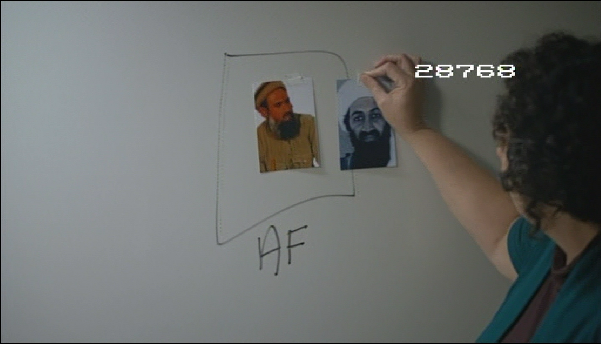
    It’s the beginning of the game that interests me most — Jonas says that the moves are quickly made in the beginning, and in Manhunt there’s a moment where Cindy Storer pins the first puzzle piece — a photo of Abdullah Azzam, whose book The signs of Ar-Rahmaan in the Jihad of Afghanistan I’ve discussed before — into the first board space, which she’s labeled AF:
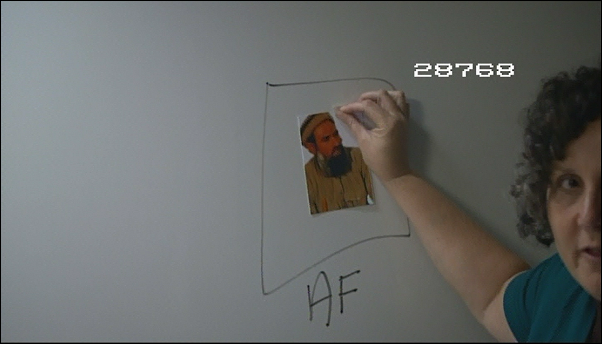
    with the words:

    Your starting point is Afghanistan. Abdullah Azzam is the Godfather of the Afghan jihad…

    That’s a cinematic description of the process, of course, and there must have been a small flotilla of facts floating around in her brain — and the other brains working with her — at the time. Nevertheless, disciplined thought has to have a starting point, and Afghanistan, Azzam and the muj war against the Soviets offer the immediate context for the next face up and central focus of the pursuit, that of Osama bin Laden

    whose photo she pins up with the words “and his partner is Osama bin Laden…”

    **

    For additional context, here are some other quotes from Manhunt about the process:

    A link chart is the visual representation of a terrorist network and it’s what terrorism analysts spend much of their time building.

    and:

    My mental image is that, you know, I’m doing Jacob’s Ladder, you’ve got this string where you’re pulling the strings in your fingers, I feel like that’s what I feel I’m doing mentally.

    and:

    You know, trying to keep track of all the threads of various threats and which ones are real and which ones aren’t real and what connects to what. And, you know, people say, why didn’t you connect the dots? Well, because the whole page is black.

    **

    A sea of thoughts, then, in more than one mind yet strongly interconnected by whatever intel comes across the transom, conversations, memories, that needs to become physically represented in a way which represents links between the parties and their ideas, stated or surmised. With wild-cards, seepage, and needless duplication. Some oriented to materiel, some to morale: from munitions to Qur’anic meditations. A “semantic network“, with links as vertices, people and ideas as nodes (cf also “conceptual graphs“).

    Something very like, in fact, Hermann Hesse‘s Glass Bead Game — only with a focus on threat, rather than conceptual elegance across the full range of human thought…

    **

    It’s a formidable task, then, moving first from copious scraps of intel to human minds that perform their own evaluative sorting. Here I’d invoke Coleridge‘s “hooks and eyes of memory” and suggest the process, like other forms of combinatorial insight, may require passionate examination, sub-conscious-threshold processing, and some reverie or rest time in which the unanticipated connection can be presented to consciousness… in a highly complex iterative process. And with each new connection or cluster of dots requiring is own drilling down for verification, and weighting adjustment so that salient masses and intriguing outliers are both held in steady remembrance…

    — I think this whole process is what Ms Bakos was talking about when earlier she gave us the overall injunction, “you’re letting the information tell you what the picture is going to be” –_

    And all this without the benefit of the “red and yellow thumbs” that Jonas talks about in jigsaw puzzles [ see interview here ], or more accurately, with the exact nature of the thumbs ranging from quantifiable links between telephones to near-stochastic leaps from a theological imperative to a tactic…

    And with a board that doesn’t have the neat rectangular frame of a picture puzzle, where the frame is in fact the particular analyst’s account — a geographic area, a nation perhaps, or some other area of specific expertise. So there are no “easy corners” to find, just a buzz of data, a murmuration…

    It’s magnificently hard. It’s epiphanic, it’s magical. Much of the magic takes place below the threshold of consciousness, but consciousness is not fond of admitting that. And Cindy Storer’s comments, to my ear, convey a whole lot of that magic without “capturing” it.

    John Livingstone LowesThe Road to Xanadu: A Study in the Ways of the Imagination, is I’m not mistaken, is a guided tour through the superb analytic puzzle piece and dot connecting mind o Samuel Taylor Coleridge, and a fir bed-time read for analysts. And I could go on, but this is long enough already.

    **

    My thanks to HBO, the crew and cast of Manhunt — and congratulations on the Emmy.

    We’re at the beginning of an understanding of how the mind puts puzzle pieces together, connects dots, spots needles in haystacks, and in general recognizes patterns and irregularities, at this point– and there’s much more to be uncovered.

  • I recommend the Loopcast with Nada Bakos, and the series in general.
  • I recommend the Greg Barker / HBO documentary, Manhunt
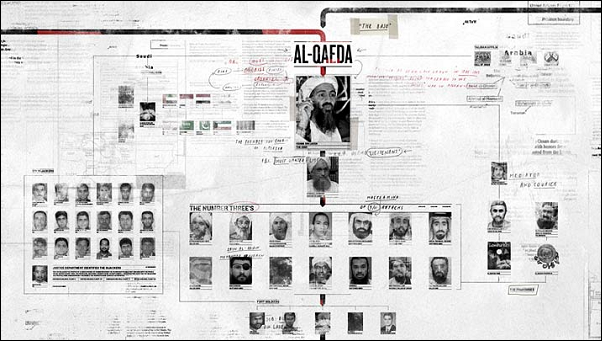
  • and you might also like to watch the fascinating mini-docu about the film’s title graphics
  • and read this comprehensive account of the titles
  • **

    Filmcraft, like tradecraft, goes an order of magnitude above and beyond what is easily noticed to achieve its effect…

    And damn, I still want time and attention to give that movie the close review it richly deserves!


    Switch to our mobile site