zenpundit.com » Islam

Archive for the ‘Islam’ Category

Cherry blossom season 02

Sunday, April 9th, 2017

[ by Charles Cameron — cherry blossoms and kamikaze, Palm Sunday and istishhad ]
.

It’s cherry blossom season, it’s Palm Sunday. Blossoms fall, while temporary followers of Christ — they’ll abandon him to crucifixion later in the week — celebrate Christ’s arrival in Jerusalem strewing palm leaves at this feet.
**

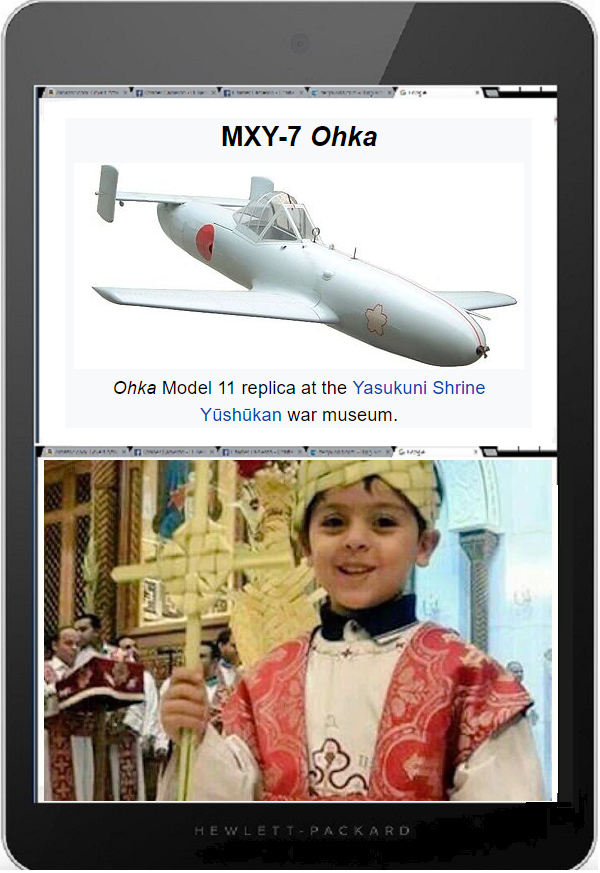
In the upper panel, Japanese self-sacrifice with intent to kill Americans:

The Yokosuka MXY-7 Ohka (“cherry blossom”) was a purpose-built, rocket powered human-guided anti-shipping kamikaze attack aircraft employed by Japan towards the end of World War II

Kamikaze pilots — the term translates to “divine wind” — drew strong associations between the transience of cherry blossoms and their own lives.

From WIkipedia:

The names of four sub-units within the Kamikaze Special Attack Force were Unit Shikishima, Unit Yamato, Unit Asahi, and Unit Yamazakura.[22] These names were taken from a patriotic death poem, Shikishima no Yamato-gokoro wo hito towaba, asahi ni niou yamazakura bana by the Japanese classical scholar, Motoori Norinaga. The poem reads:

If someone asks about the Yamato spirit [Spirit of Old/True Japan] of Shikishima [a poetic name for Japan] — it is the flowers of yamazakura [mountain cherry blossom] that are fragrant in the Asahi [rising sun].

From Emiko Ohnuki-Tierney, Kamikaze Diaries: Reflections of Japanese Student Soldiers:

As Hayashi entered the military and struggled to come to terms with death, he came to identify himself with cherry blossoms. In a letter to his mother, he laments his fate: the cherry blossoms at the Wo?n-san Base in Korea, where he was stationed, have already fallen, and yet the time for his sortie has not come. To his younger brother he writes from the Kanoya Base: “Cherry blossoms are blooming and I am going” (90). Hayashi consciously draws an analogy between himself and the fl owers; their falling signifi es the time for his death.

Other people also used the metaphor of cherry blossoms to refer to Hayashi. A poem written by his mother after the end of the war contains the idiomatic expression the “falling of my son,” applying the word conventionally used for the falling of cherry petals to the death of Ichizo¯. Hayashi’s friend Hidemura Senzo¯ laments that “Hayashi’s youth is fallen,” like cherry petals, but adds: “Peace arrived but not the peace you wished to bring through your sacrifi ce; it is only in the miserable aftermath of defeat.” Hidemura concludes, “Beauty appears in a sensitive vessel and life is short” (143–47).

See also: Ohnuki-Tierney, Emiko (2002). Kamikaze, Cherry Blossoms, and Nationalisms: The Militarization of Aesthetics in Japanese History.

**

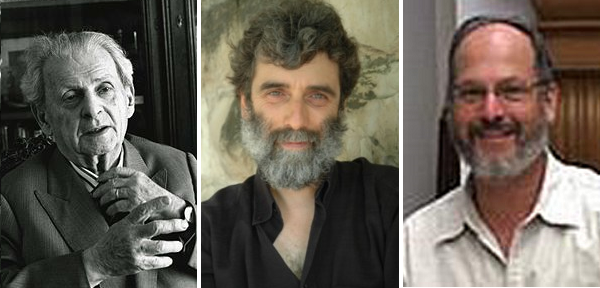
In the lower panel, the face of a child killed in the ISIS-claimed suicide bombing of a church in Egypt this Palm Sunday, following an earlier ISIS announcment that they would be targeting Egyptian (Coptic) Christians.

ISIS Claims 2 Deadly Explosions at Egyptian Coptic Churches on Palm Sunday

TANTA, Egypt — Islamic State suicide bombers attacked two Coptic churches in Egypt on Palm Sunday, killing at least 40 worshipers and police officers stationed outside in the deadliest day of violence against Christians in the country in decades.

The militant group claimed responsibility for both attacks in a statement via its Aamaq news agency, having recently signaled its intention to escalate a campaign of violence against Egyptian Christians.

The first explosion occurred about 9:30 at St. George’s Church in the Nile Delta city of Tanta, 50 miles north of Cairo, during a Palm Sunday Mass. Security officials and a witness said that a suicide bomber had barged past security measures and detonated his explosives in the front pews, near the altar.

At least 27 people were killed and 71 others injured, officials said.

Hours later, a second explosion occurred at the gates of St. Mark’s Cathedral in the coastal city of Alexandria. That blast killed 13 people and wounded 21 more, the Health Ministry said.

The patriarch of the Egyptian Coptic Church, Pope Tawadros II, who is to meet with Pope Francis on his visit to Egypt on April 28 and 29, was in the church at the time but was not injured, the Interior Ministry said.

See also:

‘God gave orders to kill every infidel’ ISIS vows to massacre Christians in chilling video<

**

The joyous palm leaves of Sunday, greeting Christ‘s arrival in Jerusalem, will ritually and symbolically turn to ashes later in the week, as the adoring crowd turns vicious and demands his crucifixion.
Footnoted readings 02 – Acts of corporal mercy

Sunday, April 2nd, 2017

[ by Charles Cameron — a note at the intersection of material with spiritual ]
.

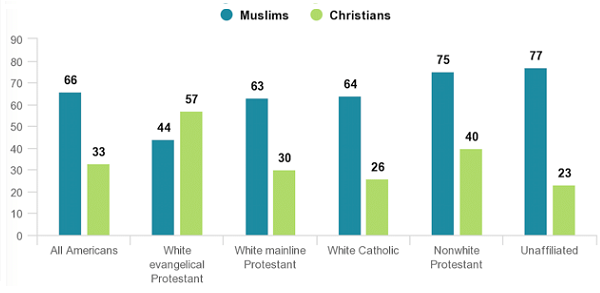
left to right: Emmanuel Levinas, Gershom Gorenberg, Elliott Horowitz

**

Gershom Gorenberg in March 28th’s Washington Post tells three stories from his own life of what I believe Catholicism would call “acts of corporal mercy” — feeding the hungry, giving drink to the thirsty, clothing the naked, visiting prisoners, visiting the sick, harboring strangers, and burying the dead (Matthew 25. 34-40). He concludes, honoring his mentor, Israeli historian Elliott Horowitz:

He said, without pride or embarrassment, that he acted out of religious conviction. In Israel, the political stereotype of Orthodox Jews is of people concerned exclusively with settling the occupied territories. In the world, commitment to the most traditional forms of faith — Jewish, Christian, Muslim or other — is often confused with building walls between people.

Elliott believed that faith demanded breaking down barriers between human beings created in God’s image. I believed that, too, but he pushed me to act.

**

It’s a story by and about a friend, and about human goodness. Apart from those two sterling but not uncommon facts, why should I care?

I care because the story illustrates the Jewish proverb of which Emmanuel Levinas reminds us:

the other’s material needs are my spiritual needs

It’s not easy to bridge the gap between subjective experience and objective, physical reality, which is why the hard problem in consciousness is called the hard problem in consciousness — but this quote bridges the gap effortlessly, and in a manner that instructs us.

Obama explaining Trump’s success in 2008? inter alia

Sunday, March 12th, 2017

[ by Charles Cameron — and why white evangelicals feel Christians are discriminated against ]
.

An Atlantic headline yesterday read: White Evangelicals Believe They Face More Discrimination Than Muslims

**

That headline carried me back to Obama‘s “they cling to guns or religion” remarks —

You go into these small towns in Pennsylvania and, like a lot of small towns in the Midwest, the jobs have been gone now for 25 years and nothing’s replaced them. And they fell through the Clinton administration, and the Bush administration, and each successive administration has said that somehow these communities are gonna regenerate and they have not.

And it’s not surprising then they get bitter, they cling to guns or religion or antipathy toward people who aren’t like them or anti-immigrant sentiment or anti-trade sentiment as a way to explain their frustrations.

— which now seem to me to be eerily prophetic of Trump‘s victory, and Hillary‘s very similar “basket of deplorables” —

We are living in a volatile political environment. You know, to just be grossly generalistic, you could put half of Trump’s supporters into what I call the basket of deplorables. Right?

The racist, sexist, homophobic, xenophobic, Islamaphobic — you name it. And unfortunately there are people like that. And he has lifted them up. He has given voice to their websites that used to only have 11,000 people — now how 11 million. He tweets and retweets their offensive hateful mean-spirited rhetoric.

— both of which must make those who feel addressed — many of them “White Evangelicals” — sneered at.

**

If I felt personally slighted by such remarks — and aggrieved by many other small injuries to my faith, monuments carrying the Ten Commandments removed or statues of Baphomet erected to “balance” crosses or crucifixes, for example — I might well answer a question about who faces more discrimination on the basis of that sense that I and my ways are despised — whereas if I am mainline Protestant, Catholic, or unaffiliated, I am less liable to be carrying that sense of personal injury and more likely to answer in terms of the news, in which Muslims (and Jews, why weren’t Jews included in the poll?) are on the receiving end of more overt violence than Christians..

My explanation for the poll results, then, is that “White Evangelicals” have more to take personally than the other groups polled.

And Trump’s victory? Doesn’t that Obama quote tell us pretty much all we need to know?

On riding a rapidly accelerating world.. in slower motion

Wednesday, March 8th, 2017

[ by Charles Cameron — not by revolution but by centering ]
.

**

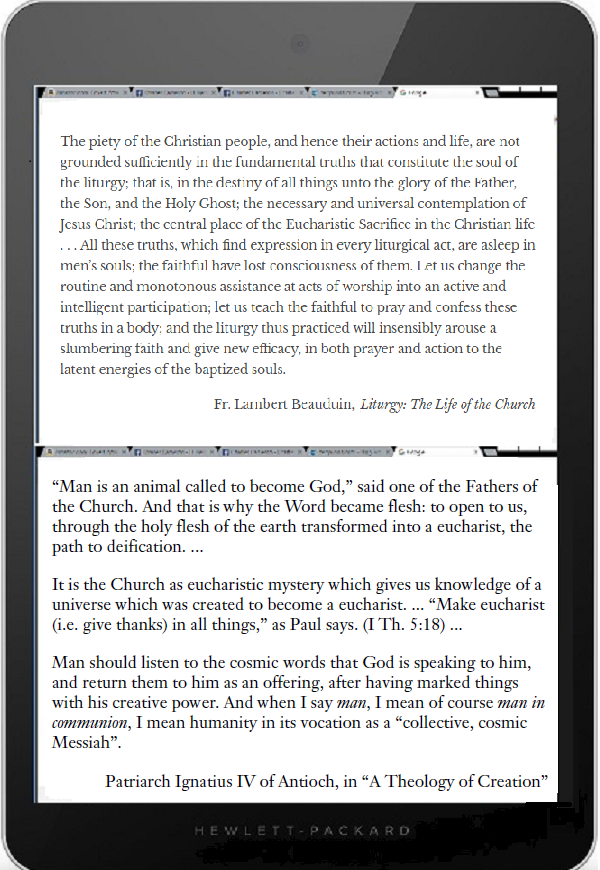
If I might shift the angle from which the current conversation views the world situation — rather than looking for revolution or evolution, might we not hope for transfiguration, theosis?

**

For what it’s worth, I’m under the impression that the translucence of the world can also be found in the Bezels of Wisdom of Ibn Arabi, in the Mountains and Rivers sutra of Dogen, in The Centuries of Thomas Traherne

You never enjoy the world aright, till the Sea itself floweth in your veins, till you are clothed with the heavens, and crowned with the stars: and perceive yourself to be the sole heir of the whole world, and more than so, because men are in it who are every one sole heirs as well as you. Till you can sing and rejoice and delight in God, as misers do in gold, and Kings in sceptres, you never enjoy the world.

Till your spirit filleth the whole world, and the stars are your jewels; till you are as familiar with the ways of God in all Ages as with your walk and table: till you are intimately acquainted with that shady nothing out of which the world was made: till you love men so as to desire their happiness, with a thirst equal to the zeal of your own: till you delight in God for being good to all: you never enjoy the world.

To many of us it seems as though the world is speeding up. The notion is a hopeless paradox — and yet the acceleration itself is both evident and excessive. Both the acceleration and the paradox are solved only in contemplation..

Daveed Gartenstein-Ross in Foreign Affairs, my oblique analysis

Sunday, March 5th, 2017

[ by Charles Cameron — in which Gartenstein-Ross reminds me of Albrecht Dürer ]
.

Daveed speaks:

Daveed is worth reading and heeding, especially when he says he’s written something of particular consequence — so read his Foreign Affairs piece.

**

My topic is triggered by a single sentence in Daveed’s piece, and is orthogonal to his. Daveed writes:

These spaces included both literal ungoverned territory and discursive spaces

In the overall flow of Daveed’s piece that’s a simple introductory remark, an observation of fact. From my point of view, though, there’s more to it than that — it’s a disjunction & conjunction of the two realms of geography and cognition, matter and mind, or “outer and inner space” if you will. And that’s something always worth noting.

In fact, Daveed’s comment reminds me of Albrecht Dürer and his illustrations of Saint Michael Fighting the Dragon, from The Apocalypse:

Here, the supernatural sits comfortably above (Latin: super) the natural.

**

The physical-metaphysical (body-mind; outer-inner; objective-subjective) disjunction & conjunction is recognizable in Descartes, and takes contemporary form as the so-called hard problem in consciousness. It’s significant that the “war in heaven” of Durer’s vision no longer fills the skies in our contemporary images of war, though heaven and hell are no less with us than before..

And so I note that, en passant, Daveed has alluded to what is perhaps the great schism of our time, that between visionary and factual truths.

Kathleen Raine, poet — and mentor of my youthful self:

Fact is not the truth of myth; myth is the truth of fact.

Witness her distress as we abandon truth of myth shining “above” truth of fact, for truth of fact alone:

Chemistry dissolves the goddess in the alembic,
Venus the white queen, the universal matrix,
Down to molecular hexagons and carbon-chains,

John of Patmos, the alchemists, Durer, Blake, Jung, Raine, have the richer vision.


Switch to our mobile site