zenpundit.com » Islam

Archive for the ‘Islam’ Category

Takfir squared, Prisoners Dilemma and MC Escher

Friday, January 16th, 2015

[ by Charles Cameron — call it backlash, backfire, or blowback, somewhere they’re dclaring takfir on the takfiris ]
.

Ali Minai at BrownPundits has a worthwhile take on what he calls, paradoxically enough, Unreal Islam, from which I’ve excerpted this paragraph:

However, another version of takfir is now afoot in the world. Call it “reverse takfir”. Unlike the militant version, it is well-intentioned and self-consciously humane, but it is also dangerous. This “benign” version of takfir is epitomized by the idea that the acts of violence being committed by self-proclaimed holier-than-thou Muslims are not the acts of “real Muslims” and do not represent “real Islam”. In effect, it declares the terrorists to be infidels! The idea is widespread, and is espoused in three different contexts: By well-meaning non-Muslims (such as Presidents Bush and Obama) seeking to avoid stereotyping and the implication of collective guilt; by ordinary Muslims wishing to dissociate themselves from the beheaders; by Muslim sectarians wishing to separate their brand of orthodoxy from that espoused by terrorists; and – most ironically – by Muslim governments and security forces seeking an “Islamic” justification for attacking extremist fellow Muslims, thus implicitly buying into the central jihadi argument of apostasy as a capital offense. The urge to do this reverse takfir is understandable and not without factual basis: Most Muslims are indeed not violent extremists who wish to kill infidels. And it does help protect innocent Muslims from backlash, which is rather important. The problem, however, is that it also feeds the narrative of denial and deniability that allows the militancy to thrive.

**

Call it reversal, call it backlash, backfire, blowback, call it enantriodromia, eye-for-an-eye, tit-for-tat — the return of violence for violence seems both instinctual, in the sense that a desire for vengeance seems to spring unprompted in the individual, and culturally embedded, in that it can be found in Torah and Pashtunwali alike, and elsewhere, and elsewhere.

Whether the individual instinct can usefully be separated from cultural instinct is at least a question, perhaps a koan — but it was Axelrod‘s insight, working on the Prisoners Dilemma in game theory, that the “strategy” of tit-for-tat may best be considered as an iterative process, .. for-tit-for-tat-for-tit-for-tat-for .. rather than as an isolated instance, tit-for-tat-period.

Gandhi made the same leap to iterative thinking when he said:

An eye for an eye makes the whole world blind

— or did he?

**

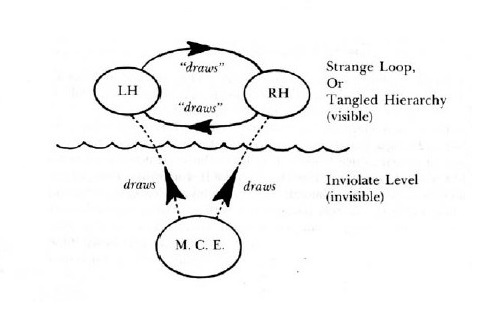
Iteration requires that we pull back, to see not just “my / our” response — which is probably self-evident, if not so all-consuming as to be omnipresent and invisible — but to see “both sides”.

We move from:

Escher one hand drawing

— which is the natural or “default” view, equivalent to the righteous indignation of one’s own side in a conflict, to:

Escher drawing_hands

— which definitely seems paradoxical on the face of it, and which notably doesn’t give preference to one side or one hand over the other — Doug Hofstadter‘s celebrated diagram illustrates the process thus:
Hofstadter Escher hands

**

Lincoln uses this strategy in his Second Inaugural, in describing the Civil War:

Each looked for an easier triumph, and a result less fundamental and astounding. Both read the same Bible and pray to the same God, and each invokes His aid against the other. It may seem strange that any men should dare to ask a just God’s assistance in wringing their bread from the sweat of other men’s faces, but let us judge not, that we be not judged. The prayers of both could not be answered. That of neither has been answered fully.

It is to a large extent the elevation of Lincoln’s comments above partisanship into inclusivity, surely, which gives that great speech its greatness.

**

For your further consideration:

Robert Axelrod:

  • The Evolution of Cooperation, 1984
  • The Complexity of Cooperation, 1997
  • The Evolution of Cooperation, revised 2006
  • Doris Schattschneider:

  • M.C. Escher: Visions of Symmetry
  • The Islam we hope to read into Sisi’s al-Azhar speech

    Tuesday, January 13th, 2015

    [ by Charles Cameron — bearing in mind Ian McEwan’s comment, “General Sisi or Isis — the palindrome is apt” ]
    .

    Sisi speaks at al-Azhar

    President Sisi speaks at al-Azhar

    **

    President Sisi of Egypt made a remarkable speech to the assmbled dignitaries of al-Azhar the other day. The Coptic Christian scholar Raymond Ibrahim has a translation of the relevant section:

    I am referring here to the religious clerics. We have to think hard about what we are facing — and I have, in fact, addressed this topic a couple of times before. It’s inconceivable that the thinking that we hold most sacred should cause the entire umma [Islamic world] to be a source of anxiety, danger, killing and destruction for the rest of the world. Impossible!

    That thinking — I am not saying “religion” but “thinking” — that corpus of texts and ideas that we have sacralized over the centuries, to the point that departing from them has become almost impossible, is antagonizing the entire world. It’s antagonizing the entire world!

    Is it possible that 1.6 billion people [Muslims] should want to kill the rest of the world’s inhabitants — that is 7 billion—so that they themselves may live? Impossible!

    I am saying these words here at Al Azhar, before this assembly of scholars and ulema — Allah Almighty be witness to your truth on Judgment Day concerning that which I’m talking about now.

    All this that I am telling you, you cannot feel it if you remain trapped within this mindset. You need to step outside of yourselves to be able to observe it and reflect on it from a more enlightened perspective.

    I say and repeat again that we are in need of a religious revolution. You, imams, are responsible before Allah. The entire world, I say it again, the entire world is waiting for your next move… because this umma is being torn, it is being destroyed, it is being lost — and it is being lost by our own hands.

    **

    Let me first draw a few relevant distinctions in regards to an Islamic Revolution (Sisi’s term), Reformation (cf Luther) or Enlightenment (cf Voltaire):

  • there is what Sisi would like to see
  • there is what Sisi would like to communicate
  • there is what various schools of Islam think Sisi intends
  • there is what we would like to think Sisi wants to communicate
  • there is what we would like to think Sisi would like to see
  • there is what we ourselves would like to see
  • **

    Mark Movsesian at First Things offers this caution:

    Some are praising Sisi for his bravery. That’s certainly one way to look at it. When Sisi calls for rethinking “the corpus of texts and ideas that we have sacralized over the years,” he may be advocating something quite dramatic, indeed. For centuries, most Islamic law scholars—though not all—have held that “the gate of ijtihad,” or independent legal reasoning, has closed, that fiqh has reached perfection and cannot be developed further. If Sisi is calling for the gate to open, and if fiqh scholars at a place like Al Azhar heed the call, that would be a truly radical step, one that would send shock waves throughout the Islamic world.

    We’ll have to wait and see. Early reports are sometimes misleading? there are subtexts, religious and political, that outsiders can miss. Which texts and ideas does Sisi mean, exactly?

    That last comment in particular encapsulates my own response to Sisi’s speech. When Sisi speaks of “that corpus of texts and ideas that we have sacralized over the centuries” is he referring to the Qur’an? I am certain he is not. The ahadith of Bukhari? I strongly doubt it. The accumulated corpus of fiqh? That would be my guess.

    Perhaps someone with access to the original of Sisi’s speech can clarify these matters.

    **

    In any case, it is worth noting that Sisi is not the first to make such a call.

    Prof. Ali Khan‘s paper, The Reopening of the Islamic Code: The Second Era of Ijtihad, opens with the observation:

    For more than a hundred years now, an accord has gradually emerged among Muslim scholars that Islamic classical jurisprudence (fiqh) must be reformulated to meet the needs of Muslim communities

    In more detail:

    Mainstream Muslim scholars and jurists from across the world seem to have reached a near-consensus that, although the Basic Code cannot be abandoned, it must be re-interpreted to establish legal systems that respect classical fiqh but also incorporate change. This evolutionary call — “that history, as a continuous movement in time, is a genuinely creative movement and not a movement whose path is already determined” — is made to extract Muslims from historical stalemate and expose them to ceaseless dynamism. Every day, in the words of the Quran, shines with new splendor, majesty and freshness.

    What, in Khan’s view, comnstitutes the Basic Code?

    This article is founded on a fundamental premise that the Quran and the Sunna constitute the immutable Basic Code, which should be kept separate from ever-evolving interpretive law (fiqh).

    Khan notes:

    Muslims have at least three options with respect to the Basic Code. First, they privatize faith, embrace secularism, and divorce lawmaking from the Basic Code. Second, they alter the text of the Basic Code to meet modern needs. Third, they accept the Basic Code as a permanent guide for individual and social life but see the Code as a flexible and evolutionary source.

    He then comments:

    The first option has been tried but the confrontation with religious forces opposing secularism has often maligned the secular state. The second option is unacceptable to all Islamic communities. The third option seems to be the most suitable alternative for the material and spiritual development of the Muslim world.

    I hope that provides some background to Sisi’s remarks…

    Another formulation of what we might look for from a renewal of Islamic scholarship comes from Bassam Tibi:

    To me religious belief in Islam is, as Sufi Muslims put it, “love of God,” not a political ideology of hatred. .. In my heart, therefore, I am a Sufi, but in my mind I subscribe to ‘aql/”reason”, and in this I follow the Islamic rationalism of Ibn Rushd/Averroes. Moreover, I read Islamic scripture, as any other, in the light of history, a practice I learned from the work of the great Islamic philosopher of history Ibn Khaldun. The Islamic source most pertinent to the intellectual framework of this book is the ideal of al-madina al-fadila/”the perfect state”, as outlined in the great thought of the Islamic political philosopher al-Farabi.

    And there’s plenty of reading to follow up on there…

    ** ** **

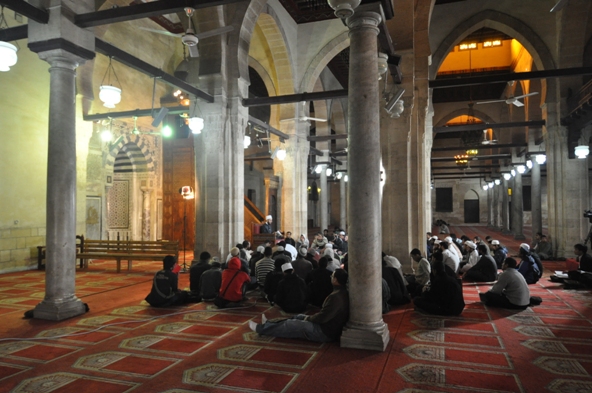
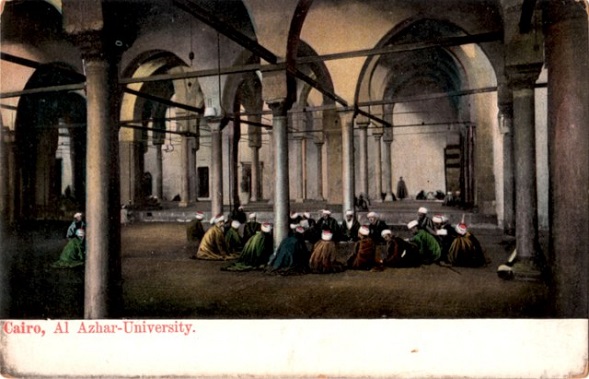
    Older even than my beloved Oxford —

    al-azhar-lecture
    A lecture in al-Azhar mosque, Cairo, 12 December 2011. Photo credit: Tom Heneghan

    A lecture at al-Azhar, undated postcard, image credit Postcard Memory Palace

    A lecture at al-Azhar, undated postcard, image credit Postcard Memory Palace

    — the tradition of Islamic scholarship at al-Azhar has been with us beyond than a thousand years.

    Paris, a literary DoubleQuote

    Tuesday, January 13th, 2015

    [ by Charles Cameron — I was tempted to call this post “Hebdoevsky” but resisted ]
    .

    SPEC DQ Hebdo Dosto

    **

    Today I was reminded of Dostoevsky‘s Grand Inquisitor, portrayed here in some apparently rare 1975 footage by Sir John Gielgud:

    A tip of the hat, then, to Akil N. Awan, whose post The Charlie Hebdo Attack: The Double Alienation Dilemma suggested this DoubleQuote to me.

    **

    Interestingly, The Grand Inquisitor can now be read online in at least three translations:

  • HP Blavatsky, which should be of interest to occultists
  • Constance Garnett, the old classic standby translation, nicely formatted, and
  • Richard Pevear & Larissa Volokhonsky, horribly formatted, reputedly the best modern version
  • Qur’anic recitation of Commander Abu Usamah al-Maghribi

    Sunday, January 11th, 2015

    [ by Charles Cameron — analysis of religious violence requires the skilled use of both mind and heart if it is to comprehend passion with clarity ]
    .

    There is a lot of discussion of the complex relationship between religion and politics — presumably including the continuation of politics by other means — these days.

    Here Abu Usamah al-Maghribi of ISIS, the immediate precursor of IS, recites the Qur’an:

    This clip, incidentally, nicely illsutrates the dilemma facing those poor folks at YouTube who are responsible for determining what videos should be withdrawn for breach of their user contract. On the one hand, it shows a militant leader encouraging his subordinates towards martyrdom, while on the other it is something quite other, turned to that purpose: a recitation from the revealed scripture of a global and diverse religion, one and a half billion people strong…

    **

    The text of the recitation is that of the Qur’an, Sura 9, 38-39:

    O you who have believed, what is [the matter] with you that, when you are told to go forth in the cause of Allah , you adhere heavily to the earth? Are you satisfied with the life of this world rather than the Hereafter? But what is the enjoyment of worldly life compared to the Hereafter except a [very] little.

    If you do not go forth, He will punish you with a painful punishment and will replace you with another people, and you will not harm Him at all. And Allah is over all things competent.

    The reciter, Abu Usamah al-Maghribi, was killed last year by fighters from Jabhat al-Nusra.

    **

    I’m not sure that language alone can ever quite sort the different strands that rise and fall in the human beings involved, nor that the distinction we draw between heart and mind is even close to a subtle enough instrument to account for human process. What I want to present here, though, is not an answer or even the suggestion of an answer to such questions, but a vivid evidence of the coexistence of militant intent with religious fervor.

    After years of monitoring and reporting on religious violence, it is not its existence but its potential for overwhelming sincerity that I would like to communicate, so that we do not underestimate it — our analysts being, as John Schindler put it in his brilliant piece, Putin’s Orthodox Jihad, “mostly secularists when not atheists” — and thus liable to pay matters of religious passions little or no attention.

    More on Schindler’s piece shortly.

    Paris, the Prophet and his veiled face

    Sunday, January 11th, 2015

    [ by Charles Cameron — the role of iconography vs idolatry within Islam and Christianity ]
    .

    Karim Sadjadpour of the Carnegie Endowment for International Peace tweeted an image of Muhammad today:

    This image, according to Wikipedia, is not merely Persian but specifically Shiite, “reflecting the new, Safavid convention of depicting Muhammad veiled”. It is also non-satirical.

    As such, it is neither offensive in the sense of insulting the person of the Prophet, nor does it in fact show the features of his face, nor is it the product of the Sunni “mainstream” branch of Islam.

    **

    In considering the revulsion that many Muslims feel at the images of their Prophet in Charlie Hebdo, it may be helpful to understand the respect in which the Prophet is held within their faith.

    The Qur’an says of the Prophet:

    And We have not sent you but as a mercy to the worlds.

    Muhammad is sent “as a mercy”, and thus whatever representation of the Prophet, his words and deeds serves to carry human thought towards the divine participates in that divine mercy, whereas whatever representation scorns that mercy or merely distracts us from it is to be avoided.

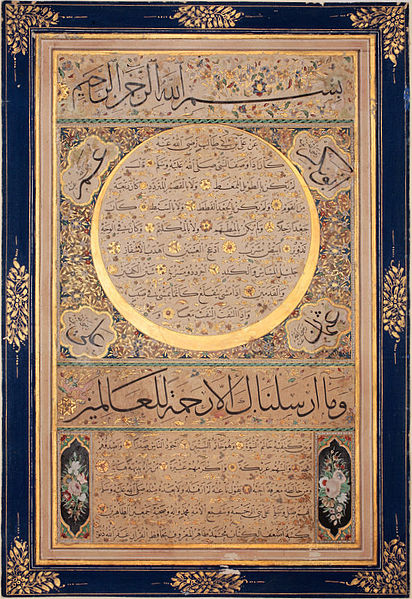
    The normative manner in which the Prophet is represented within Islam, then, is abstract and calligraphic, with the artist showing devotion and respect for the Prophet through the care with which the work itself is endowed with beauty:

    412px-Hilye-i_serif_7

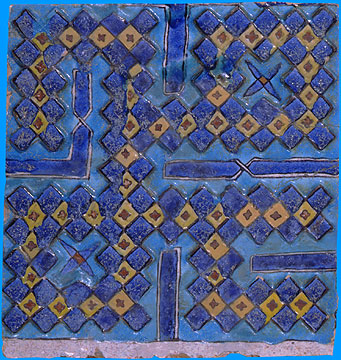
    Simpler, and in its own way no less beautiful, is this calligraphic representation of the Prophet’s name in tile from Samarkand:

    Muhammad_calligraphy_tile

    **

    Icon or idol?

    One facet of the controversy over Charlie Hebdo has to do, then, with a deep issue in representation, which crops up elsewhere in the jihadists’ relish in destroying “idols” — the Bamiyan Buddhas, yes, but also the tombs of Muslim prophets and saints; there has even been discussion within Saudi circles of the destruction on the Prophet’s tomb and relocation of his remains to an anonymous grave.

    Within Christianity, there have been those who encouraged the painting of icons, believing that they carry the minds and hearts of believers deep into the mysteries of faith — and those who would tear them down, holding them to be “graven images” (via Judaism, Exodus 20.4) that give mind and heart a resting place far short of those same mysteries: iconodules and iconoclasts.

    Wars have been fought in Christendom too over such questions [in both East and West].

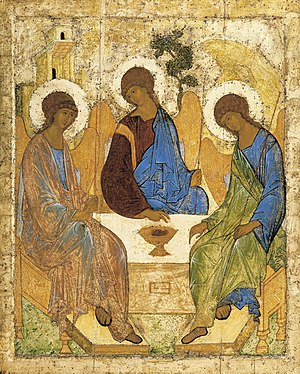
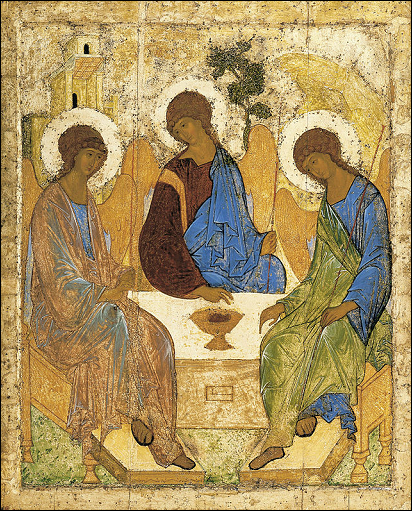
    The great Russian iconographer Andrei Rublev‘s most celebrated icon is often referred to as The Trinity — though literally (or should I say, figuratively) speaking, it portrays the three angels who visited Abraham at the Oak of Mamre (Genesis 18. 1-15):

    Rublev Trinity icon

    It is significant for our context that Rublev has not in fact attempted to portray the Trinity, a mystery deemed beyond human comprehension — the Athanasian Creed, speaking of the Three Persons in one God says explicitly “there are not three incomprehensibles .. but one incomprehensible” — but these three angels, considered as “types” or foreshadowings of the Trinity, which can therefore both veil and represent it.


    Switch to our mobile site