zenpundit.com » Islam

Archive for the ‘Islam’ Category

Materials from the Archive 1: Cameron on Abu Musab al-Suri

Tuesday, January 14th, 2014

[ by Charles Cameron — capturing items no longer at their original links ]
.

I’m grateful to the Internet Archive for still holding copies of web-pages I occasionally want to link to, but which have disappeared from their original URLs. I’m reposting a couple of them here, and will use the “Materials from the Archive” beading for any others that come along.

First, from The [US] Air force Research Institute site, my review of Jim Lacey‘s Terrorist’s Call to Global Jihad

**

A Terrorist’s Call to Global Jihad: Deciphering Abu Musab al-Suri’s Islamic Jihad Manifesto

Jim Lacey’s Terrorist’s Call to Global Jihad is an abridged translation (from 1,600 to 200 pages) of the premier contemporary manual of jihad, Abu Musab al-Suri’s Call to Global Islamic Resistance (Da‘wat al-muqawamah al-islamiyyah al-‘alamiyyah). US Joint Forces Command sponsored this book and two others as part of the Terrorist Perspective Project, which aims to allow “joint warfighters to get inside the terrorists’ decision cycle” by understanding the “mind of the jihadi movement.” The other members of the trilogy, all edited by Lacey and all published by the Naval Institute Press in 2008, include The Terrorist Perspectives Project: Strategic and Operational Views of Al Qa’ida and Associated Movements, which provides an overall synthesis of jihadist thought, and The Canons of Jihad: Terrorists’ Strategy for Defeating America, which supports this synthesis by offering selections from a variety of important jihadist texts. Thus, taken together, the three books offer a background in jihadist thought, some significant historical and near-contemporary readings from that tradition, and a detailed study of its most significant single document. In many ways, Jim Lacey is an appropriate choice as editor of Terrorist’s Call to Global Jihad given his position as an analyst with the Institute for Defense Analyses and his experience as an infantry officer and  a journalist for Time magazine, embedded with the 101st Airborne during the invasion of Iraq.

Al-Suri is also the subject of Architect of Global Jihad: The Life of Al-Qa’ida Strategist Abu Mus’ab al-Suri, a biography by Norwegian scholar Brynjar Lia of the Norwegian Defense Research Establishment. That book complements Terrorist’s Call to Global Jihad by offering us a portrait of the man and an unabridged translation of two key chapters from al-Suri’s work. In the context of other jihadist literature, al-Suri’s Call to Global Islamic Resistance is a major event. In their article “Stealing Al Qaeda’s Playbook” (Studies in Conflict and Terrorism, June 2006), Jarret Brachman and William McCants write that “as the author of a massive handbook on global insurgency—or, as he calls it, ‘the remedy for the U.S. disease’—Mustafa Setmarian Nasar [i.e., al-Suri] has written his way into the intellectual heart of today’s jihadi-Salafi movement.” An individual named “Bearer of the Sword,” posting a comment about the Fort Hood shootings on the English language Ansarnet forum, called al-Suri “the greatest military theoretician our Ummah have had in this age.” Clearly, Lacey and Lia are introducing us to a major treatise on contemporary jihadism.

Biographically speaking, Lacey’s portrait of al-Suri is brief, but he quotes a memorable remark from CNN journalist Peter Bergen, who contacted al-Suri for a celebrated interview with bin Laden: “He seemed to be a very intelligent guy, a very well informed guy, and a very serious guy. . . . He was certainly more impressive than bin Laden.” Prior to his capture in Quetta, Pakistan, in October 2005, Suri received military training from the Iraqi and Egyptian militaries, served as an instructor in the Afghan-Arab camps in Afghanistan during the late 1980s, lived in Spain and the United Kingdom in the 1990s, and served as a media liaison for al-Qaeda in Afghanistan.

Lacey suggests that al-Suri’s work is comparable to Hitler’s Mein Kampf, and Lia terms it “the most significant written source in the strategic studies literature on al-Qa’ida.” Obviously, it is crucial to understand what Lacey offers us of al-Suri’s work and what he omits. The preface lays out the book’s program: “Recognizing that 1,600-page documents of densely written ‘jihadi thought’ would deter all but the most dedicated analyst, Lacey has produced this condensed version and translation of al-Suri’s work capturing the essence of his thoughts.” What follows is an analysis of the jihadist current, beginning with al-Suri’s own experiences in Syria (1980), passing via Madrid (1991) and London (1996) to Afghanistan (1997–2001), and following through to include the US invasion of Iraq (2003–4)—presented as background for the “third generation” of mujahideen “created by the events of September (9/11/2001), the occupation of Iraq and the apex of the Palestinian intifada.” Chapters explore the status of Muslims today, sharia rulings appropriate to the situation, and a history of jihad from 1990 onwards (in three chapters), omitting a major discussion of al-Qaeda, which Lacey deems inappropriate since (1) it would require book-length treatment and (2) the war on that front is ongoing.  He closes with chapters on the doctrinal foundations of jihad, sharia-based decision making, and the role of the media.

The book does suffer from one serious omission. As mentioned in the preface, “Where appropriate, we have also removed most of the repetitive theological justifications undergirding these beliefs.” The final pages of Call to Global Islamic Resistance are what Jean-Pierre Filiu terms “a hundred-page apocalyptic tract” concerning “signs of the end times.” Sadly, both Lacey and Lia pay little attention to this specifically Mahdist element. In al-Suri’s reading of jihadist history, “one event brings another event and then another, leading inevitably to the arrival of the Mahdi.” Given the importance of apocalyptic expectation as a potential (and potent) force multiplier, we await the English translation of Filiu’s L’Apocalypse dans l’Islam for further insight into a serious and hitherto neglected part of al-Suri’s message.

Lacey’s Terrorist’s Call to Global Jihad opens a significant window on the jihadist mind-set. However, downplaying the religious doctrine that al-Suri includes alongside his strategic guidance blocks our view of the importance of religion in persuading people to follow that guidance.


Charles Cameron

Forestville, California

A Terrorist’s Call to Global Jihad: Deciphering Abu Musab al-Suri’s Islamic Jihad Manifesto edited by Jim Lacey. Naval Institute Press, 2008, 205 pp., $19.00.

On Islam 2: Pope Francis

Tuesday, November 26th, 2013

[ by Charles Cameron — from the Pope’s apostolic exhortation, Evangelii Gaudium ]
.


.

Pope Francis has now presented his first Apostolic Exhortation, a 58-page overview of his views on a range of topics, many of which will no doubt be explored in detail elsewhere. Here, I would like simply to quote the two paragraphs he dedicates to relations between the Catholic Church and Islam:

252. Our relationship with the followers of Islam has taken on great importance, since they are now significantly present in many traditionally Christian countries, where they can freely worship and become fully a part of society. We must never forget that they “profess to hold the faith of Abraham, and together with us they adore the one, merciful God, who will judge humanity on the last day”.[198] The sacred writings of Islam have retained some Christian teachings; Jesus and Mary receive profound veneration and it is admirable to see how Muslims both young and old, men and women, make time for daily prayer and faithfully take part in religious services. Many of them also have a deep conviction that their life, in its entirety, is from God and for God. They also acknowledge the need to respond to God with an ethical commitment and with mercy towards those most in need.

253. In order to sustain dialogue with Islam, suitable training is essential for all involved, not only so that they can be solidly and joyfully grounded in their own identity, but so that they can also acknowledge the values of others, appreciate the concerns underlying their demands and shed light on shared beliefs. We Christians should embrace with affection and respect Muslim immigrants to our countries in the same way that we hope and ask to be received and respected in countries of Islamic tradition. I ask and I humbly entreat those countries to grant Christians freedom to worship and to practice their faith, in light of the freedom which followers of Islam enjoy in Western countries! Faced with disconcerting episodes of violent fundamentalism, our respect for true followers of Islam should lead us to avoid hateful generalisations, for authentic Islam and the proper reading of the Koran are opposed to every form of violence.

It will be interesting to see what, say, the Grand Sheikh of Al-Azhar or Iran’s Supreme Jurisprudent make of the Roman Pontiff defining “authentic Islam and the proper reading of the Koran” as being opposed to every form of violence, while also addressing the existence of “violent fundamentalism”… but the Pope’s message to his own flock — “to avoid hateful generalisations” — strikes a positive note, and his strongly-worded request —

I ask and I humbly entreat those countries to grant Christians freedom to worship and to practice their faith, in light of the freedom which followers of Islam enjoy in Western countries!

— strikes (in my opinion) just the right diplomatic note from the Christian to the Islamic world…

On Islam 1: Reuel Mark Gerecht

Tuesday, November 26th, 2013

[ by Charles Cameron — on an impressive video, featuring Matt Levitt and Reuel Gerecht on Hezbollah ]
.

Matthew Levitt‘s contribution to a recent panel at the International Soy Museum was a tour de force. Levitt, whose work as a CT analyst has included stints with both the FBI and Treasury, was discussing his most recent book, Hezbollah: The Global Footprint of Lebanon’s Party of God — both the book and his talk are strongly recommended.

It is, however, his colleague Reuel Marc Gerecht‘s contribution to that session that I wish to highlight here, because [starting at 44.40] he made a point about Hezbollah from his own CT experience that he still finds it necessary to make in 2013, some two decades after his service with the CIA commenced in the 1990s:

One of the things I was struck by when I came into the Agency, and I was struck by it on the day that I left the Agency, which was: you almost never had officers either on the clandestine side or in the directorate of analysis, the Directorate of Intelligence, talk about God. You just didn’t have that many people sort of put it together and talk about what actually motivated people.

You know, there was almost an assumption out there, Oh, the Iranians were upset with us because of our dealing with the Shah etcetera, but the actual analysis of the Iranian complaint against the United States was distinctly secular. Even the analysis of the Hezbollah was distinctly secular. And it never made any sense, particularly if you started to have some exposure to these individuals, and you suddenly realized that no, their motivations aren’t secular usually, their motivations are actually deeply spiritual, they’re religious, they’re about God.

— and [starting 53.04]:

There is a profound reflex in the West to look at a group like Hezbollah, and to look at their Iranian sponsors, and to take God out of the equation. Don’t do that. We wouldn’t do it with al-Qaida. Don’t do it with these groups either. If you do that, if you neuter them of their religious belief, if you look at it as just an ethnic movement, if you look at it as just a sectarian movement, if you look at it as just the Shi’a getting even in Lebanon, then you’re making an atrocious analytical mistake, which will bushwhack you, I guarantee you, over and over again. You have to keep God in this equation…

The one bright spot in this dismal account of the secular mindset blinding itself to religious passion is Gerecht’s statement: “We wouldn’t do it with al-Qaida”.

**

For more on the way our own worldviews can blind us to the worldviews of others, see my post on Gaidi Mtaani, together with the two follow ups to that post which I shall be posting here shortly.

Serpent logics: the marathon

Sunday, November 24th, 2013

[ by Charles Cameron — oh, the sheer delightful drudgery of finding patterns everywhere ]
.

I’ll start this post, as I did the previous one to which this is a sort of appendix, with a (deeply strange, tell me about it) example of the…

Matrioshka pattern:


That’s a piece of jewelry made out of disembodied pieces of Barbies from the extraordinary designer’s mind of Margaux Lange, FWIW.

**

This post is the hard core follow up to my earlier piece today, Serpent logics: a ramble, and offers you the chance to laugh and groan your way through all the other “patterns” I’ve been collecting over the last few months. My hope is that repeated (over)exposure to these patterns will make the same patterns leap out at you when you encounter them in “real life”.

Most of the examples you run across may prove humorous — but if you’re monitoring news feeds for serious matters, my hunch is that you’ll find some of them helpful in grasping “big pictures” or gestalts, noting analomalies and seeing parallels you might otherwise have missed.

Have at it!

**

Here’s another Matrioshka, from the structural end of lit crit that my friend Wm. Benzon attacks with gusto over at New Savannah:

**

Enantiodromia:

You’ll recall this is the pattern where something turns into its opposite… as described in this quote from the movie Prozac Nation:

I dream about all the things I wish I’d said.
The opposite of what came out of my mouth.
I wish I’d said
“Please forgive me. Please help me.
I know I have no right to behave this way?”

Here are a few examples…

Ahmed Akkari Repents Violent Opposition to Danish Cartoons Lampooning Islam:

After a Danish newspaper published cartoons satirizing the Muslim Prophet Muhammad, Ahmed Akkari spearheaded protests that ultimately cost the lives of 200 people. Now he says he’s sorry. Michael Moynihan on what changed Akkari’s mind.

That’s impressive!

That one’s run of the media mill…

And this one’s from my delightful, delicious boss, Danielle LaPorte:

**

A friend sent me this:

**

Let’s just plough ahead…

Nominalism:

Nominalism is the category where the distinction between a word and what it represents gets blurry — a very significant distinction in some cases —

How’s this for naming your donkey after your President?

Consider this one, another instance of nominalism in action, from the French justice system:

A mother who sent her three-year-old son Jihad to school wearing a sweater with the words “I am a bomb” on the front, along with his name and ‘Born on September 11th’ on the back, was handed a suspended jail sentence on Friday for “glorifying a crime”. A court of appeal in the city of Nimes, southern France, convicted Jihad’s mother Bouchra Bagour and his uncle Zeyad for “glorifying a crime” in relation to the terrorist attacks in the United States on September 11th 2001.

The classic nominalist image — with which I’d compare and contrast the French three-year-old with the unfortunate name and tsee-shirt — is Magritte’s cdelebrated “Ceci n’est pas une pipe”:

And here’s one final nominalist example:

**

The spiral:

Here’s a potential downwards spiral, for those watching India:

**

Straight parallelism:

This one’s from Jonathan Franzen:

And meanwhile the overheating of the atmosphere, meanwhile the calamitous overuse of antibiotics by agribusiness, meanwhile the widespread tinkering with cell nucleii, which may well prove to be as disastrous as tinkering with atomic nucleii. And, yes, the thermonuclear warheads are still in their silos and subs.

**

Simple Opposition:

**

Some of these categories seem pretty fluid — or to put that another way, some of these examples might fit with equal ease into several doifferent categories. Here’s another oppositional class:

Arms crossed:

From Ezra Klein and Evan Solta blogging at WaPo’s Wonkbook: The Republican Party’s problem, in two sentences:

It would be a disaster for the party to shut down the government over Obamacare. But it’s good for every individual Republican politician to support shutting down the government over Obamacare.

A great “values” juxtaposition:

And hey, nice phrasing:

**

Here’s an example of one of the central patterns of violence and justice:

Tit for Tat:

[ the account this tweet came from, which was a media outlet for Shabaab, has since been closed — hence the less than euqal graphical appearance of this particular tweet… ]

**

And here, without too much further ado, is a whole concatenation of…

Serpents biting their tails:

[ … and that last one of Nein‘s appears to have been withdrawn from circulation ]

This one I love for its lesson on biblical pick-and-choose:

This one is also a DoubleQuote:

when closely followed by:

And this one really bites:

**

To close the series out with more of a bang than a whimper, here’s Serpent bites Tail with apocalypse & gameplay for additional spice:

Monk Wirathu’s 969 quotes the Dalai Lama’s Kalachakra

Sunday, October 27th, 2013

[ by Charles Cameron — a Buddhist instance of the widespread use of sacred texts as offering sanction for religious violence, with Muslims depicted as the enemy on this occasion ]
.

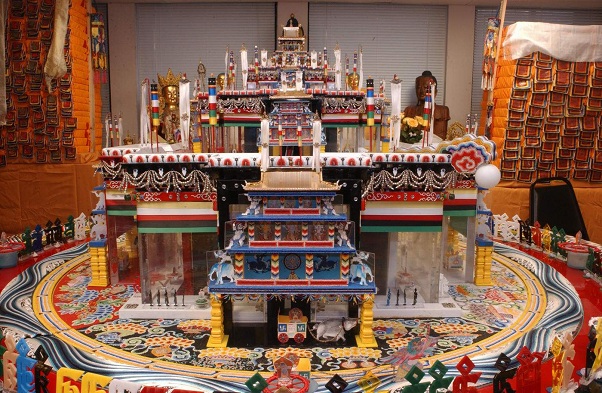
Three dimensional Kalachakra mandala by Arjia Rinpoche, photo credit kalachakranet.org

.

I have commented a couple of times on texts from the Kalachakra Tantra literature about a future war between Buddhism and Islam, first in In a time of Religious Arousal and later more fully in Apocalypse Not Yet? — and today I ran across a reference to the same texts on the web page of the 969 movement in Myanmar.

969 is the monk-led Buddhist movement which has been rioting recently against the Rohingya Muslims, and the monks concerned are Therevadins. The Kalachakra Tantra is the empowerment HH the Dalai Lama gives in the cause of peace, and the tantras are Vajrayana teachings. I think this para from the current Wikipedia article on Buddhism gives the relevant distinctions in a non-contentious form:

Two major branches of Buddhism are generally recognized: Theravada (“The School of the Elders”) and Mahayana (“The Great Vehicle”). Theravada has a widespread following in Sri Lanka and Southeast Asia (Cambodia, Laos, Thailand, Myanmar etc.). Mahayana is found throughout East Asia (China, Korea, Japan, Vietnam, Singapore, Taiwan etc.) and includes the traditions of Pure Land, Zen, Nichiren Buddhism, Tibetan Buddhism, Shingon, and Tiantai (Tendai). In some classifications, Vajrayana — practiced mainly in Tibet and Mongolia, and adjacent parts of China and Russia — is recognized as a third branch, while others classify it as a part of Mahayana.

I won’t go into the theological, philosophical and ritual differences, which are considerable, complex — and somewhat contested.

**

To refresh your memory of the relevant details regarding the Kalachakra’s treatment of “holy war”, here are my key paragraphs on the topic from Apocalypse Not Yet?:

Alexander Berzin has been tutored by HH the Dalai Lama and HHDLs own tutors on the interpretation of the Kalachakra Tantra, and served for some years as HHDL’s translator when HHDL was giving the Kalachakra initiation: indeed his book on the Kalachakra initiation carries a Foreword by HHDL.  His writings are thus among the most scholarly and trustworthy available in the western world on the topic of the initiation which the Dalai Lama will impart for world peace again this July.

Berzin’s words introducing the topic of Holy Wars in relation to the Kalachakra, Buddhism and Islam, are therefore important:

Often, when people think of the Muslim concept of jihad or holy war, they associate with it the negative connotation of a self-righteous campaign of vengeful destruction in the name of God to convert others by force. They may acknowledge that Christianity had an equivalent with the Crusades, but do not usually view Buddhism as having anything similar. After all, they say, Buddhism is a religion of peace and does not have the technical term holy war.

A careful examination of the Buddhist texts, however, particularly The Kalachakra Tantra literature, reveals both external and internal levels of battle that could easily be called “holy wars.” An unbiased study of Islam reveals the same. In both religions, leaders may exploit the external dimensions of holy war for political, economic, or personal gain, by using it to rouse their troops to battle. Historical examples regarding Islam are well known; but one must not be rosy-eyed about Buddhism and think that it has been immune to this phenomenon. Nevertheless, in both religions, the main emphasis is on the internal spiritual battle against one’s own ignorance and destructive ways.

Specifically, he writes:

In The Abridged Kalachakra Tantra, Manjushri Yashas explains that the fight with the non-Indic people of Mecca is not an actual war, since the real battle is within the body. The fifteenth-century CE Gelug commentator Kaydrubjey elaborates that Manjushri Yashas’s words do not suggest an actual campaign to kill the followers of the non-Indic religion. The First Kalki’s intention in describing the details of the war was to provide a metaphor for the inner battle…

**

That, then, is the context — “the fight with the non-Indic people of Mecca is not an actual war” but a metaphorical one. Here, by contrast, is the interpretation given to the same text by the 969 movement in an article titled Kalachakra Tantra and 969, posted on their website two months ago (Sept 1st, 2013):

The Kalachakra is a Tibetan Buddhist doctrine on the cycles of time. In addition to being a text, meditation practice, and initiation ritual, Kalachakra is a prophecy for the victory of the Buddhist religion in a war with Islam.

Beginning in 712AD and continuing through 1030AD, India was subject to massive annual invasions from Muslims who eventually conquered and destroyed much of the cultural heritage of India. In a final desperate act to annihilate Buddhism, in 1193, Nalanda University which was home to the greatest center of learnings in the East was destroyed, with thousands of monks beheaded. The destruction of the temples, monasteries, centres of learning at Nalanda and northern India to be responsible for the demise of ancient Indian scientific thought in mathematics, astronomy, alchemy, and anatomy. Much of what modern scholarship of Buddhist studies puzzles over today was contained in the manuscripts and minds of those who were lost during this calamity. However as the Kalachakra Tantra shows, the war between Dhamma and Islam is not over, nor is it. The prophecy includes detailed descriptions of the future invaders as well as suggested ways for the Buddhist teachings to survive these onslaughts.

The Dalai Lama has stated that the public exposition of this tantra is necessary in the current degenerate age. The initiation may be received simply as a blessing for the majority of those attending, however, many of the more qualified attendees do take the commitments and subsequently engage in the practice.

In a phrase, “Kalachakra is a prophecy for the victory of the Buddhist religion in a war with Islam”.

That’s the opening of the article, clearly identifying the Kalachakra as a text about Buddhism vs Islam. There follows a curious incomplete sentence:

We must be diligent in reminding the

I’d love to know what the author wanted to remind us of, and what the rest of that paragraph — or group of paras? — had to say about the Kalachakra, but the rest of the text as printed is no longer talking about warfare, but explaining some basic notions in Buddhism:

It is important to notice what Alexander Berzin wrote how “Karmic potentials, in fact, give rise to a broad array of impulses that affect our lives. Collective karmic potentials from previous actions of a huge number of beings – including ourselves – give rise, for example, to the impulse for a universe to evolve with specific environments and life forms into which we and these beings subsequently take rebirth.” Collective karma can be seen as the actions that have generated us in our present bodies, from the decisions of our parents, ancestors, and peers that gives us the appearance of our lives (Janaka kamma or the kamma that determines birth). We are all recipients of karma beyond our control. Put in another way, our DNA contains a vast storehouse of kamma.

This sad state of affairs is where the Kalachakra initiation takes its cue. By harnessing ritual and intention, the Kalachakra initiation at its highest level bestows a daily practice for awakening that an army of practioners around the world are also engaging in. This collective kamma has the subtle effect of making the conditions of purifying bad kamma’s and unwholesome dhamma’s into virtuous ones.

Ultimately we feel this will have the eventual effect of producing a Dhamma centered world based on the natural laws of mind that the founders of the 969 Movement are striving to achieve.

Whether or not warfare, as suggested in the first section of the article, is compatible with Buddhism, as expressed in the second, is a matter for Buddhist theological debate — as is the nature of “war” as envisioned in the Kalachakra itself.

My own purpose in making this post is to point out that the 969 movement, led by Buddhist monks in Myanmar, is now quoting a prophecy of war against Islam, found in the Kalachakra literature, which in turn is taught as a instrument of peace by HH the Dalai Lama. To my ears, that sets up a howl of cognitive dissonance.


Switch to our mobile site