zenpundit.com » sacrament

Archive for the ‘sacrament’ Category

I’ve seen Christianity described as..

Wednesday, March 30th, 2016

[ by Charles Cameron — a little matter of rising (i trust) between the two stools of belief and unbelief ]
.

I have seen Christianity described as —

The popular belief that a celestial Jewish baby, who is also his own father, born from a virgin mother, died for three days so that he could ascend to heaven on a cloud and make you live forever if you symbolically eat his flesh, drink his blood, and telepathically tell him you accept him as your Lord and master, so he can remove an evil force from your spiritual being that is present in all humanity because an immoral woman made from a man’s rib was hoodwinked by a talking reptile possessed by a malicious angel to secretly eat forbidden fruit from a magical tree.

Don’t these atheists understand anything about poetry?

**

Don’t the Christians understand anything about poetry?

Try this as an exercise for the imagination — picture this —

To suppose the Eucharist

Suppose the hypothetical all of everything
in unspooling itself chose to exhibit itself in
one human, suppose further all the sun’s
light were caught in wheat and baked into
bread, all the world’s pains and passions
crushed like grapes into wine, suppose the
one person took loaf and cup and with
word and gesture raised them blood, body

of his own self to be supped and sipped,
thus woven into his one flesh, blood, mind —
just when his flesh is torn, blood spills —
suppose then that his mind to love were to
entrain this new body of many bodies to
heal with all radiance each instance of pain..

**

I offer this poem as a bridge in two directions — to allow the sensible atheist a means of glimpsing what might be admirable in his Christian friend’s faith.. — and to allow the Christian on the brink of leaving the faith for “sensible atheism” a means of retaining much of the deep beauty of that faith while leaving behind both the bribes of heaven and the threats of hell.

ISIS: Paganism with an Islamic Face?

Wednesday, October 7th, 2015

[by Mark Safranski, a.k.a “zen“]

“And thou shalt not let any of thy seed pass through the fire to Moloch, neither shalt thou profane the name of thy God: I am the LORD.”

– Leviticus 18:21 

“They rejected the commandments of the Lord … and served Baal. They consigned their sons and daughters to the fire”

– 2 Kings 17:16–17

“And do not kill your children for fear of poverty. We provide for them and for you. Indeed, their killing is ever a great sin”

  – Qur’an 17:31

In a recent comment section conversation with Charles Cameron and RAND scholar David Ronfeldt on the character of Fascism and its resurgence, I remarked that ISIS adopting a Fascist style in its propaganda and governance may be drawing upon a ghastly and ancient lineage:

ISIS is really embracing Fascism. It’s ceremonial public executions actually supercede what the Nazis and Fascists did only symbolically with blood flags and heroic cenotaphs and so on. It is reaching back to something very dark and protean, human sacrifice, as a political symbol. I think [ Moshe] Halbertal’s book On Sacrifice, is a useful reference here on how deep this goes culturally, to the bronze age or earlier.

ISIS has for some time been making quite a perverse spectacle of its executions of prisoners, combatant and non-combatant alike, releasing videos to international fanfare and glorying in the resultant horror and global infamy. The precedent for this macabre “propaganda of the deed“was initially set by the forefather of ISIS, the Jordanian jailbird upjumped to “terrorist mastermind”, the late Abu Musab al-Zarqawi, who originally led al Qaida in Iraq during the American occupation of Iraq. Prior to expiring after U.S. forces dropped a 500 lb bomb on his head, al-Zarqawi pioneered the use of  beheading videos, usually featuring himself being filmed incompetently and gruesomely sawing off an orange jumpsuit-clad captive’s head with a large knife, blood spraying everywhere.

Zarqawi’s ghoulish innovation in terrorist messaging admittedly held a certain fascination for the psychopathic segment of Sunni Islamist extremists and it attracted foreign fighters of this nature to Iraq who in turn lionized Zarqawi as “the Sheikh of Slaughterers”; but the beheading videos also generally horrified public opinion in the Muslim world and repelled even hardened jihadis, earning Zarqawi a rebuke from al Qaida number two, Ayman al-Zawahiri:

….Among the things which the feelings of the Muslim populace who love and support you will never find palatable – also- are the scenes of slaughtering the hostages. You shouldn’t be deceived by the praise of some of the zealous young men and their description of you as the shaykh of the slaughterers, etc. They do not express the general view of the admirer and the supporter of the resistance in Iraq, and of you in particular by the favor and blessing of God.

….However, despite all of this, I say to you: that we are in a battle, and that more than half of this battle is taking place in the battlefield of the media. And that we are in a media battle in a race for the hearts and minds of our Umma. And that however far our capabilities reach, they will never be equal to one thousandth of the capabilities of the kingdom of Satan that is waging war on us. And we can kill the captives by bullet. That would achieve that which is sought after without exposing ourselves to the questions and answering to doubts. We don’t need this. 

Zarqawi’s Iraqi bloodlust ended only because it was interrupted by the American military, but the leaders of ISIS have carried on. Far from accepting Zawahiri’s advice, they have doubled down, greatly upgrading the marketing of ritualistic murder from Zarqawi’s crude snuff films to slick videos with professional editing and high production values that have become central to the online “brand” of the ISIS “caliphate”. Like the hosts of a sinister game show, ISIS spokesmen have found the time to murder creatively in order to keep their audience of Islamist terrorist wannabes in the West tuned in and captivate the attention of the global media (though sometimes, things do not work  out as planned).


However effective this circus of horrors has been at daunting their enemies and attracting the allegiance of “zealous young men” to ISIS, it reveals an atavistic impulse at play that no amount of Quranic hand-waving can paper over and conceal. Jurisprudence is absent here; not even the grim and rough Islamic “justice” of the Taliban is given to prisoners of ISIS, which violates the customary protections given under Islamic law or historical Muslim judicial practices. These choreographed and sensationalized executions by ISIS are really a cryptic revival of the ancient and terrible practice of human sacrifice, that in most cultures and religions had long been replaced by symbolic ritual, but once reigned supreme during the Bronze Age, not least in ancient Iraq, which if new findings are to be believed was like Aztec Mexico, a charnel-house of slaughter.

Originating in the Stone Age, human sacrifice in the religious sense of an offering to the gods or God, lasted a surprisingly long time. Setting aside the preColumbian cultures of the New World, the ancient Romans, for example, did not formally outlaw human sacrifice until the first century BC, though the practice had become archaic and Rome vigorously sought to stamp it out among the Gauls and Britons, among whom human sacrifice was an accepted part of Druidic religion. Nor was human sacifice entirely unknown among the ancient Greeks of the classical period while child sacrifice was probably central to Carthaginian state rites to such a degree that other peoples of the time, including the Romans, found abhorrent.

What occurred in many cases is that as civilizations evolved in social complexity, substitutionary practices for human sacrifice developed that served the same impulse, to propitiate and honor their God(s) and create powerful emotional bonds among the participants:  animal sacrifice, burial ceremoniesmysteries, religious ritual, necromancy, symbolism in theater and political matters of state religion. The Biblical tale of Abraham and Isaac is itself a scriptural admonition to the ancient Hebrews to adopt animal sacrifice as most pleasing to God, a practice the Israelites and Jews of the classical period continued until the destruction of the second temple by the Roman general Titus. From that point on, from the close of the first century AD, Jews and the early, still Judaic, Christians moved away from the practice of animal sacrifice and substituted prayer and theology of salvation, respectively. Sacrifice, especially human sacrifice, became a distinguishing mark of paganism and the subject of Christian crusades in the middle-ages, like the brutal war waged by the Teutonic Knights against the human sacrificing Old Prussians and Lithuanian barbarian tribes.
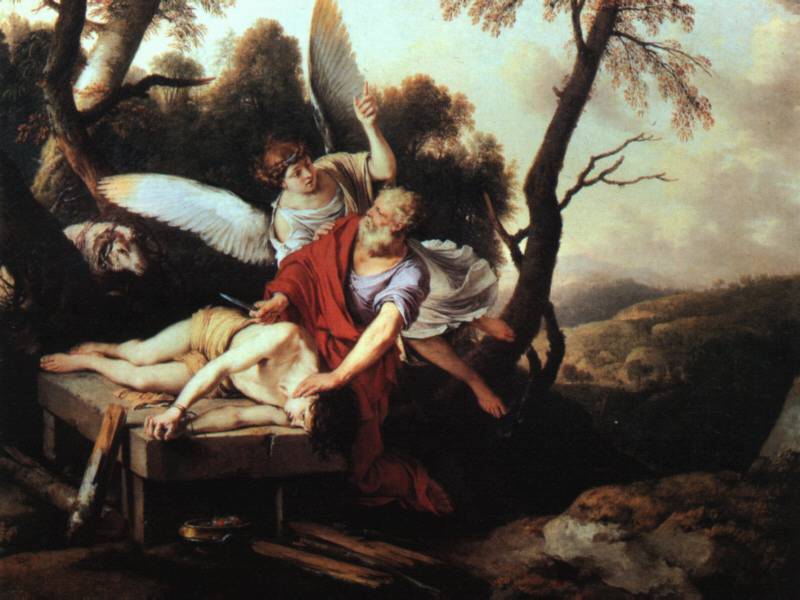
The Binding of Isaac

The end of late medieval European religious warfare and the rise of the Westphalian system after the Thirty Year’s War slowly shifted the symbolic moral center of sacrifice from God to the State, with divine right monarchy serving as a waystation for the incubation of modern nationalism. There was an epistemic shift, as Halbertal argues in On Sacrifice from a sacred and mystical “sacrificing to” the sovereign God borrowed from the examples of Jewish martyrdom by early Christians who shared in the Romans the same persecutors. This shift opened the gates of permissible sacrifices, legitimating a new secular and political “sacrificing for” the glory of the State.

It is a profound difference but occurring within the same phenomena, as illustrated by two quotes:

…And it came to pass after these things, that God did tempt Abraham, and said unto him, Abraham: and he said, Behold, here I am.

And the Lord said, Take now thy son, thine only son Isaac, whom thou lovest, and get thee into the land of Moriah; and offer him there for a burnt offering upon one of the mountains which I will tell thee of.

                                                                              – Genesis 22:2

And:

….But, in a larger sense, we can not dedicate – we can not consecrate – we can not hallow, this ground – The brave men, living and dead, who struggled here, have hallowed it, far above our poor power to add or detract. The world will little note, nor long remember what we say here; while it can never forget what they did here.

It is rather for us, the living, we here be dedicated to the great task remaining before us – that, from these honored dead we take increased devotion to that cause for which they here, gave the last full measure of devotion – that we here highly resolve these dead shall not have died in vain; that the nation, shall have a new birth of freedom, and that government of the people, by the people, for the people, shall not perish from the earth.

     – Abraham Lincoln

Gettysburg and Antietam were not Mount Moriah. Neither were the Somme or Stalingrad the same as the Tophet. From time of the Patriarch Abraham to the presidency of Abraham Lincoln, nations of men ceased to sacrifice usually helpless others but moved to sacrifice themselves in what they reckoned as the highest cause. Movement away from human sacrifice as practiced by ancient Carthaginian or animal sacrifice as practiced by most peoples of antiquity, including the Jews, to gentler substitutionary practices, Moshe Halbertal has called the “cataclysmic shift” in the history of civilization.

If so, it is a shift that ISIS has begun to reverse.

In their outstanding ISIS: The State of Terror, counterterrorism scholars Jessica Stern and J.M. Berger analyze the dark obsession ISIS has demonstrated in its propaganda messaging with exquisitely orchestrated executions:

….As we have noted, ISIS’s psychological warfare is directed at its potential victims. But it is also directed at those it aims to control. It is deliberately attempting to blunt its follower’s empathy by forcing them to participate in or observe acts of brutality. Over time, this can lead to secondary psychopathy, or a desire to harm others, and contagion of violence. Beheadings are one such tool for blunting empathy.

Berger and Stern are likely correct that the methodical character of ISIS demonstrations of brutality are intended to desensitize the participants and (as they further explained) a tendency to cultivate secondary psychopathology in ISIS recruits, especially the young. A similar process occurred during the Holocaust with Nazi Einsatzgruppen and reserve unit police battalions detailed to assist the SS mobile killing squads on the Eastern front. Many serving in these units, already fanatical National Socialists, became inured to the suffering of women, children and the old who were shot and dumped still alive into mass graves, though some SS men showed signs of PTSD, depression and higher rates of severe alcoholism, desertion and suicide.

The comparison between the genocidal cruelty of the SS and ISIS, while natural, is limited by a very important distinction. However zealous their ideological fanaticism and dedicated in their murderous mission to exterminate European Jewry, the SS lacked the context of moral certainty and the psychological reinforcement effects of religious exaltation enjoyed by ISIS killers. Even the malevolent Heinrich Himmler, in his secret speech to Nazi gauleiters and SS leaders, regarded the Final Solution as a terrible burden that the SS shouldered on behalf of the Fuhrer to assure Germany’s future; a “glorious” crime that Himmler believed must be kept forever hidden from history and the German people.

Not so ISIS, which revels in its bloody terror. Worse, the repetition of garish executions as public celebrations by ISIS, with a vague but constant religious context, devoid of any shred of Islamic legality, inevitably acquire over time the theological characteristics of Halbertal’s “sacrificing to”  – what began as harsh jihadi jurisprudence and psychological warfare mutated under conditions of lazy, sociopathic brutality and totemic invocations of Islam into ritual “offering” by ISIS of its prisoners of war as human sacrifices in the manner of the ancient pagans. A perverse blasphemy, but one that draws on a powerful archetype deeply buried in the human psyche.

ISIS leaders have not only looked into the Abyss, they have descended into and become one with it.

Miraculous!

Thursday, June 11th, 2015

[ by Charles Cameron — miracle in Egypt, human perfection in Russia ]
.

It’s not entirely clear, then, why he would need to be “shriven ” — have his confession heard and be granted absolution — by Abbot Ephraim

To be fair, though — Putin‘s exact words, as reported in the body of the Independent post:

It appears that the Lord built my life in a way that I have nothing to regret.

Not quite the same thing as “God wanted him to be perfect” — although, doesn’t God want that for everyone? Matthew 5.48, at least in the King James version.

**

Meanwhile in Egypt:

Pope Francis and the artists who move him

Thursday, September 19th, 2013

[ by Charles Cameron — Dostoevsky, Hopkins, Caravaggio, Mozart, Bach, Fellini, Cervantes — that’s who! ]
.

For context and contrast, first read this:

Pope Francis decided at the last minute not to attend a Beethoven concert last evening, Fox News and others reported. Fox News comments, “Unlike his predecessor Benedict, who was well-known as a music lover, Francis has shown scant interest in music, liturgical or otherwise.” The concert, an event long planned for the Year of Faith, included Beethoven’s 9th symphony with choir and orchestra.

Pope Francis supposedly said “I am not a Renaissance prince who listens to music instead of working,” Vatican Insider first reported, later softening its report to preserve the general sense without quoting the pope directly.

— then this, from the first extended interview of Pope Francis, which has just been released.

While I’m sure plenty of others will mull over other aspects of what he has to say for himself, I’m taking my own insights into his character from the artists in whose work he finds inspiration:

I have really loved a diverse array of authors. I love very much Dostoevsky and Hölderlin. I remember Hölderlin for that poem written for the birthday of his grandmother that is very beautiful and was spiritually very enriching for me. The poem ends with the verse, ‘May the man hold fast to what the child has promised.’ I was also impressed because I loved my grandmother Rosa, and in that poem Hölderlin compares his grandmother to the Virgin Mary, who gave birth to Jesus, the friend of the earth who did not consider anybody a foreigner.

I have read The Betrothed, by Alessandro Manzoni, three times, and I have it now on my table because I want to read it again. Manzoni gave me so much. When I was a child, my grandmother taught me by heart the beginning of The Betrothed: ‘That branch of Lake Como that turns off to the south between two unbroken chains of mountains….’ I also liked Gerard Manley Hopkins very much.

Among the great painters, I admire Caravaggio; his paintings speak to me. But also Chagall, with his ‘White Crucifixion.’ Among musicians I love Mozart, of course. The ‘Et incarnatus est’ from his Mass in C minor is matchless; it lifts you to God! I love Mozart performed by Clara Haskil. Mozart fulfils me. But I cannot think about his music; I have to listen to it. I like listening to Beethoven, but in a Promethean way, and the most Promethean interpreter for me is Furtwängler. And then Bach’s Passions. The piece by Bach that I love so much is the ‘Erbarme Dich,’ the tears of Peter in the ‘St. Matthew Passion.’ Sublime. Then, at a different level, not intimate in the same way, I love Wagner. I like to listen to him, but not all the time. The performance of Wagner’s ‘Ring’ by Furtwängler at La Scala in Milan in 1950 is for me the best. But also the ‘Parsifal’ by Knappertsbusch in 1962.

We should also talk about the cinema. ‘La Strada,’ by Fellini, is the movie that perhaps I loved the most. I identify with this movie, in which there is an implicit reference to St. Francis. I also believe that I watched all of the Italian movies with Anna Magnani and Aldo Fabrizi when I was between 10 and 12 years old. Another film that I loved is ‘Rome, Open City.’ I owe my film culture especially to my parents who used to take us to the movies quite often.

Anyway, in general I love tragic artists, especially classical ones. There is a nice definition that Cervantes puts on the lips of the bachelor Carrasco to praise the story of Don Quixote: ‘Children have it in their hands, young people read it, adults understand it, the elderly praise it.’ For me this can be a good definition of the classics.

**

Mozart, Et incarnatus est:

Mozart, played by Clara Haskil:

Bach, Erbarme dich, from the Matthew Passion:

Fellini, La Strada, innocence:

Fellini, La Strada, despair:

No wonder, then, that he loves the poetry of his fellow Jesuit, the poet Gerard Manley Hopkins:

No worst, there is none. Pitched past pitch of grief,
More pangs will, schooled at forepangs, wilder wring.
Comforter, where, where is your comforting?
Mary, mother of us, where is your relief?
My cries heave, herds-long; huddle in a main, a chief
Woe, wórld-sorrow; on an áge-old anvil wince and sing —
Then lull, then leave off. Fury had shrieked ‘No ling-
ering! Let me be fell: force I must be brief.”‘

O the mind, mind has mountains; cliffs of fall
Frightful, sheer, no-man-fathomed. Hold them cheap
May who ne’er hung there. Nor does long our small
Durance deal with that steep or deep. Here! creep,
Wretch, under a comfort serves in a whirlwind: all
Life death does end and each day dies with sleep.

— nor the works of Caravaggio, whose rap sheet was impressive to say the least:

Arriving in Rome in 1595 at the age of 25, the hot-headed painter’s police dossier — hand-written in Latin and vernacular Italian and bound in great volumes that were stored in the archives until now — makes Caravaggio come across as almost compulsive in his lawlessness. For instance, the man was weapon-obsessed, sporting a sword, dagger, and pistol at various times. He was twice thrown in the clink for carrying arms without a permit, and known for beating strangers in late-night fights and pelting police with rocks.

The documents add fresh color to well-known parts of the Caravaggio legend. Regarding the 1606 brawl during which the artist killed one Ranuccio Tommassoni, leading the artist to flee Rome and causing Pope Paul V to issue a death warrant, the documents reveal that the fight was over a gambling debt, and not a woman, as some accounts have suggested.

It is all the more appropriate, then, to close this post with Caravaggio’s own meditation on the martyrdom by crucifixion of the first Pope, St Peter, whose chair Francis now holds:

_______________________________________________________________________________

.

h/t Damian Thompson, who tweeted “I never thought I’d hear a Pope rave about Haskil’s Mozart, Furtwängler’s Beethoven and Knappertsbusch’s legendary 62 Parsifal.”

Pussy Riot IX, Of films, riots and hatred IV: Notre Dame 1950

Saturday, September 29th, 2012

[ by Charles Cameron — more food for thought on religious and irreligious outrage — and Paris again, too ]
.

Michel Mourre (in friar's habit) and Serge Berna reviewing "The Declaration of Mourre"

.

It will not have escaped the eagle-eyed readers of Zenpundit that three of the incidents we have been discussing recently — the Pussy Riot affair, the Innocence of Muslims video and the Charlie Hebdo cartoons — all revolve around issues of blasphemy and free speech.

I’m indebted to whoever it was pointed me to Colin Jager‘s Pussy Riot’s punk prayer, posted on the SSSR’s Imanent Frame blog ten days ago as a comment on the punk grrls incident:

Perhaps its most obvious precursor is the intervention staged by several young lettrist poets at Notre Dame Cathedral, on Easter Sunday, 1950. In the middle of the service Michel Mourre, dressed as a Dominican monk, climbed into a pulpit and began to read a sermon/poem that condemned the Catholic Church for “infecting the world with its funeral morality,” and announced that God was dead “so that Man may live at last.” As Greil Marcus details in Lipstick Traces, the response was dramatic: the Cathedral’s guards attacked the four with their swords, and the crowd chased them out of the Cathedral and down to the Seine, where they were apprehended by the police.

**

That’s the sort of hint I like to follow up on, so I found my way to Greil Marcus‘ book, and to this paragraph for starters:

At 11:10 A.M. on 9 April 1950, four young men — one got up from head to foot as a Dominican monk — entered Notre-Dame in Paris. Easter high mass was in progress; there were ten thousand people from all over the world in the cathedral. “The false dominican,” as the press called him — Michel Mourre, twenty-two — took advantage of a pause after the credo and mounted the altar. He began to read a sermon written by one of his co-conspirators, Serge Berna, twenty-five.

Let me say right away that there is at least one pointer here suggesting that Marcus may not be the best observer of religious detail. Marcus says Mourre “took advantage of a pause after the credo and mounted the altar” before reading his sermon — Mourre’s own account has him “mounting the pulpit”. Curiously enough, the writer of the Immanent Frame piece makes a similar error in describing Pussy Riot:

Singing “Mother of God, Chase Putin Out!,” and clad in brightly colored dresses, leggings, and balaclavas, the women danced, kneeled, and crossed themselves in front of the Cathedral’s high altar.

Only in a stretched sense can the Pussy Rioters be described as performing their act “in front of the Cathedral’s high altar.” They were in front of the great doors of the ikonostasis, which when opened, lead to the altar. But the ikonostasis itself is no more an altar than a pulpit is.

Sacred architecture, gentle readers: these are differences here that do make a difference.

**

Marcus then gives the text of the sermon, which can be found on Wikipedia and concludes with the line:

We proclaim the death of the Christ-god, so that Man may live at last.

Compare the Pussy Riot prayer, the Guardian’s translation of which can be found here, and which includes the lines:

Fight for rights, forget the rite – Join our protest, Holy Virgin.

**

Moving along, Greil next allows us to glimpse the response, which included the drawing of swords and the threat of lynching:

The cataclysm that followed went beyond anything expected by Mourre and his fellows, who first planned merely to let loose a few red balloons. The organist, warned that a disruption might take place, drowned out Mourre just after he pronounced the magic words “God is dead.” The rest of the speech was never delivered: swords drawn, the cathedral’s Swiss Guards rushed the conspirators and attempted to kill them. Mourre’s comrades took to the altar to shield him — one, Jean Rullier, twenty-five, had his face slashed open. The blasphemers escaped — his habit streaked with Rullier’s blood, Mourre gaily blessed the worshippers as he made for the exit — and were captured, rather rescued, by the police: having chased the four to the Seine, the crowd was on the verge of lynching them.

You may recall for comparison with this incident that the sum total of weaponry attributed to Christ’s disciples in the Gospels was two swords, worn on just the one evening —

And they said, Lord, behold, here are two swords. And he said unto them, It is enough.

— [Luke 22.38], and that the sum total of wounds inflicted by those swords was the loss of one ear, which was quickly and miraculously replaced by the savior himself —

And one of them smote the servant of the high priest, and cut off his right ear. And Jesus answered and said, Suffer ye thus far. And he touched his ear, and healed him.

— [Luke 22:50-51]

**

Next up, here is Michel Mourre’s own, retrospective account, from his book In Spite of Blasphemy:

It would be absurd to expect that the incident I was organizing with my friends was going to bring about a change in the state of the Church. In the fever of excitement we were in at the time, some of my friends, particularly one who was a former monk, a Spanish Jesuit, really believed it would. But I knew only too well that I had no message to deliver, no reforms to attempt, since I as in a far more wretched moral condition than so many others. I did not believe that God could be found anywhere outside His Church or that God could be an ally of ours against the Catholic Church. In this connection there was the example of all the pseudo-saintly sinners, the pseudo-mystics, the pseudo-illuminaries, both Buddhist and otherwise, who flourished in Saint-Germain-des Pres, and the “hidden knowledge,” the “esoteric intuitions,” the “visions” of the diabolical procession in honor of Satan, the Devil-Lucifer, of which at least one initiate could be found any evening in a Saint-Germain bar ready to describe his “trances.” All these voluntary outcasts from the Church, all these madmen drunk on occult fumes and in search of a substitute God, a substitute Church and Mysteries, discouraged, by the very excess of their nonsense, any attempt to look for God outside the discipline and rules of the Church.

No, I had really no idea of changing anything in the Church! I was trying rather to convince myself that God no longer counted for me, nor did His Church, nor above all did the atmosphere of sacredness that could be felt in the ceremonies of the Church. By this insult to God, by this small sacrifice I was going to make, but not without anxiety or fear, I was trying to make God equal in my eyes with human, transient things which are destined to die and which can be trodden underfoot relentlessly and without regret.

And yet, once I was embarked on the details of our scheme for creating a disturbance during the Easter service at Notre Dame, I began to take it all quite seriously. To my feverish mind the cry of revolt which we decided on at a table in the Mabillon was like a message to the Church, to the world, and I found it quite natural to put on my monk’s habit again before mounting the pulpit. For me the habit of Saint Dominic was an exasperating symbol, an object of reproach. By profaning it I hoped to be rid of it.

Next day, after the Credo of the Easter High Mass in Notre Dame, dressed as a Dominican and wearing a tonsure, I mounted the pulpit and shouted out the old blasphemy: “God is dead!” But the blasphemy is no longer what it was in Nietzsche’s day, the prelude to a hymn of joy; it is only a cry of madness and horribly sad.

**

While the Moscow Cathedral and Notre Dame incidents are similar in some ways, the Notre Dame venue — Paris, 1950 — prefigures both the students at the barricades in 1968 and the Last Temptation troubles that I reported in connection with the Innocence of Muslims video — and Charlie Hebdo, too. The motivations, however, are quite dissimilar, as the quotes from the grrls closing statements, which I’ve excerpted here and which are extensively quoted in the Jager piece, suggest:

Maria Alyokhina, for example, asserted that for the Orthodox Church “[t]he Gospels are no longer understood as revelation, which they have been from the very beginning, but rather as a monolithic chunk that can be disassembled into quotations to be shoved in wherever necessary.” Noting that Jesus himself had been accused of blasphemy, Alyokhina goes on: “I think that religious truth should not be static, that it is essential to understand the instances and paths of spiritual development, the trials of a human being, his duplicity, his splintering. That for one’s self to form it is essential to experience these things.” And she makes the link to contemporary art explicit: “all of these processes—they acquire meaning in art and in philosophy. Including contemporary art. An artistic situation can and, in my opinion, must contain its own internal conflict.”

and:

The radical power of that diagnosis becomes most clear in Yekaterina Samutsevich’s closing statement: “In our performance,” she writes, “we dared, without the Patriarch’s blessing, to unite the visual imagery of Orthodox culture with that of protest culture, thus suggesting that Orthodox culture belongs not only to the Russian Orthodox Church, the Patriarch, and Putin, but that it could also ally itself with civic rebellion and the spirit of protest in Russia.” Most striking here, perhaps, is the language of “uniting” orthodox and protest culture, rather than setting them against each other. This is done, Samutsevich suggests, in the name of a democratic ideal: both orthodox and protest culture are properties of the people rather than of one group or another. The performance, on this analysis, becomes a visual and aural demonstration of what Alyokhina had called “internal conflict,” something posed by all three women as the space in which religious revelation happens. Thus art, religion, and the state are not conceptually separated here but deliberately mixed up, in the name of religious truth.

**

It is worth noting that Michel Mourre, who had been a Dominican friar before the event in Notre Dame, came back into the Church and lived until 1977, writing a number of books including Religions et Philosophies d’Asie, Le Monde à la mort du Christ and L’Histoire vivante des moines, as well as his Dictionnaire d’histoire universelle.

As the world spins, so spins my head.


Switch to our mobile site

