zenpundit.com » will mccants

Archive for the ‘will mccants’ Category

On the horrors of apocalyptic warfare, 1: its sheer intensity

Wednesday, February 17th, 2016

[ by Charles Cameron — first in a series of four posts on the central theme of a proposed book ]
.

Saint Michael Fighting the Dragon

In a previous post, I introduced my work on a book proposal concerning Coronation: The Magic and Romance of Monarchy. The second book proposal I’ve put together, which is also currently in the hands of an agent and making the publishing rounds, is titled Jihad and the Passion of ISIS: Making Sense of Religious Violence.

**

We now have, I believe, a strong undertanding of the Islamic State and its origins in such books as Stern & Berger, ISIS: The State of Terror, Jason Burke, The New Threat, Joby Warrick, Black Flags: The Rise of ISIS, and Weiss & Hassan, ISIS: Inside the Army of Terror. Delving directly into the key issue that interests me personally, the eschatology of the Islamic State, we have Will McCants‘ definitive The ISIS Apocalypse. My own contribution will hopefully supplement these riches, and McCants’ book in particular, with a comparative overview of religious violence across continents and centuries, and a particular focus on the passions engendered in both religious and secular movements when the definitive transformation of the world seems close at hand.

What follows is the first section of a four-part exploration of the horrors of apocalyptic war.

**

I’ve attempted to give a sense of those passions in my post So: how does it feel at World’s End? — invoking Sylvia Plath‘s extraordinary couplet:

By the roots of my hair some god got hold of me.
I sizzled in his blue volts like a desert prophet.

That’s the intensity of the feeling aroused, I’d suggest, in the throngs who followed Muhammad Ahmad al-Mahdi to Khartoum, and Winston Churchill in his book The River War, conveys the intensity of their jihad in these words:

the force of fanatical passion is far greater than that exerted by any philosophical belief, its function is just the same. It gives men something which they think is sublime to fight for..

Churchill is really pretty astounding on the topic of the Mahdi — a messianic figure in a religion he characterized as laying dreadful curses on its votaries inclouding “the fanatical frenzy, which is as dangerous in a man as hydrophobia in a dog”, and a warrior of whom he said that a future Arab historian should place him “foremost among the heroes of his race”.

Here is another Churchillian description of that “fanatical frenzy”:

Then came the Mahdi .. it should not be forgotten that he put life and soul into the hearts of his countrymen and freed his native land of foreigners. The poor miserable natives, eating only a handful of grain, toiling half-naked and without hope, found a new, if terrible magnificence added to life. Within their humble breasts the spirit of the Mahdi roused the fires of patriotism and religion. Life became filled with thrilling, exhilarating terrors. They existed in a new and wonderful world of imagination. While they lived there were great things to be done; and when they died, whether it were slaying the Egyptians or charging the British squares, a Paradise which they could understand awaited them.

**

Let me make the general point more explicit. Dr Tim Furnish, a frequent commentator on these pages and author of Holiest Wars: Islamic Mahdis, Their Jihads, and Osama bin Laden, opens his book as I have cited frequently with this analogy:

Islamic messianic insurrections are qualitatively different from mere fundamentalist ones such as bedevil the world today, despite their surface similarities. In fact, Muslim messianic movements are to fundamentalist uprisings what nuclear weapons are to conventional ones: triggered by the same detonating agents, but far more powerful in scope and effect.

Will McCants makes it very clear in his The ISIS Apocalypse that the Islamic State as we currently encounter it is a caliphal movement rather than a Mahdist one, in other words that it is in an earlier stage of the same process leading eventually to the Mahdi’s arrival — although its propaganda, quoting its “founding father” Abu Musab al-Zarqawi, is clearly apocalyptic…

**

Up next: On the horrors of apocalyptic warfare, 2: to spark a messianic fire

On the horrors of apocalyptic warfare, 2: to spark a messianic fire

Wednesday, February 17th, 2016

[ by Charles Cameron — it’s what we won’t notice that can blindside us ]
.
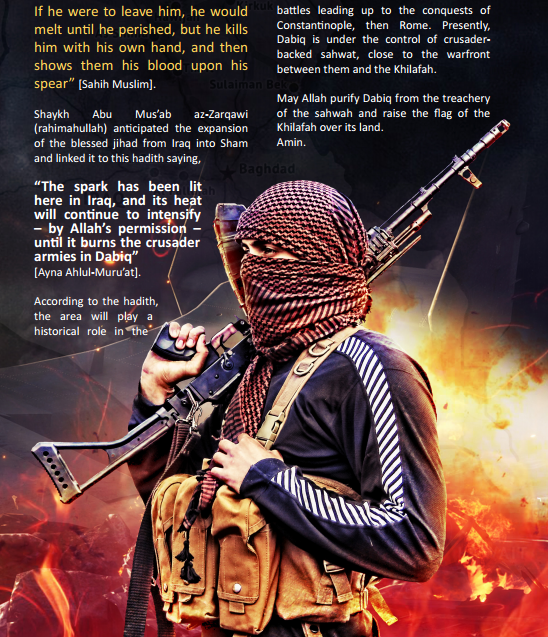
Dabiq issue 1 graphic
al-Malhamah al-Kubra, the great end-times battle

**

To recapitulate: in my previous post I suggested that “apocalyptic, end-of-days” movements are qualitatively different by virtue of the immediacy of their divine / transcendant mandate. Richard Landes sums the matter up nicely in his book Heaven on Earth: The Varieties of the Millennial Experience:

For people who have entered apocalyptic time, everything quickens, enlivens, coheres. They become semiotically aroused — everything has meaning, patterns. The smallest incident can have immense importance and open the way to an entirely new vision of the world, one in which forces unseen by other mortals operate. If the warrior lives with death at his shoulder, then apocalyptic warriors live with cosmic salvation before them, just beyond their grasp.

**

Here’s my concern, having lived a while in Malibu — and once watched on a friend’s TV in Santa Monica as a fire that had leapt the Ventura Freeway and swept down towards the Malibu Colony – rerouted by the fire service to go down the sparsely inhabited Corral Canyon, where as it happened I then lived..

Brush fires.

The human terrain is dry tinder, not yet ablaze – but a spark will ignite it, and the blaze then spread “like wildfire”.

The problem here is that we are far more disposed to read surfaces than undercurrents, news articles than the comments beneath them, what’s happening than what’s primed to happen, kinetic rather than potential energies. And so when potential goes kinetic, we are blindsided, caught off guard, faced with events we then characterize in retrospect as “unanticipated” — even though a little observation of what’s stirring below the surface would have allowed us to anticipate them…

What’s the equivalent, in contemporary Islamic terms, of dry underbrush of the sort that can suddenly ignite?

An expectation of the Mahdi’s coming – present enough in AQ some years back that AQ Central issued a caution against its people making premature claims concerning the Mahdi; present in IS but distanced by the possibility of a sequence of Caliphs preceding the Mahdist moment [cf McCants, Appendix 4]; and overall present to a considerable degree in the Islamic countries Pew polled in 2012:

The survey also asked respondents about the imminence of two events that, according to Islamic tradition, will presage the Day of Judgment: the return of the Mahdi (the Guided One who will initiate the final period before the day of resurrection and judgment) and the return of Jesus. .. In nine of the 23 nations where the question was asked, half or more of Muslim adults say they believe the return of the Mahdi will occur in their lifetime, including at least two-thirds who express this view in Afghanistan (83%), Iraq (72%), Turkey (68%) and Tunisia (67%).

A qualification is in order here. The British scholar Damian Thompson has shown in his remarkable study, Waiting for Antichrist, that it is possible for people to express expectation of a messianic “soon coming”– and still save for the college tuition of children who would presumably arrive at college age during the epoch of the “new heaven and new earth”. Expressing expectation, then, in a soon-coming Mahdi as much as a soon-coming Christ, does not necessarily imply “on the edge of one’s seat” expectation in real time. It is, however, suggestive…

Given dry conditions, then, to return to our analogy, what sort of spark can start a wildfire?

**

The Zipper metaphor.

In my simplistic way — and switching metaphors — I like to use the analogy of the zipper on a windbreaker. There are two elements that need to come together, in my view: some ancient prophetic utterance in scripture, and what appears to be a strong confirmatory event in contemporary affairs. Let me give you two examples:

The Chernobyl zipper

Nicolai Berdyaev, in his The Russian Idea, declared that “Russian people, in accordance with their metaphysical nature and vocation in the world, are a people of the end.”

Revelation 8. 10-11 reads in the English of the King James Version:

Then the third angel sounded: And a great star fell from heaven, burning like a torch, and it fell on a third of the rivers and on the springs of water. The name of the star is Wormwood. A third of the waters became wormwood, and many people died from the water, because it was made bitter.

Nothing especially marks this visionary verse as prophetic to Anglophone ears — but to our cousins in the Orthodox world, it suddenly attained significance on April 26, 1986, when the Chernobyl power plant blew up in a Level 7 nuclear event, showering Belarus, Ukraine and Russia with massive amounts of radiation – for as The Orthodox Study Bible notes:

Wormwood (in Slavonic, “Chernobyl”), an extremely bitter plant that would make water undrinkable, symbolizes the bitter fruits of idolatry…

Chernobyl had already been the site of an apocalyptic movement in the eighteenth century, when a group of Old Believers known as Chernobylites “preached the arrival of the Antichrist and the imminent end of the world.” I’m drawing here on my colleague Michael J. Christensen’s presentation, The Russian Idea Of Apocalypse: Nikolai Berdyaev’s Theory Of Russian Cultural Apocalyptic delivered at the Center for Millennial Studies conference in 1998. As you can see from his paper, the topic is a complex one, but the key comment for my purposes is this one, analogous to the Pew research referenced above:

According to a survey of 485 Belarusian citizens I commissioned in April 1996 (during the 10th anniversary of Chernobyl), nearly one third (31.2%) considered the Chernobyl nuclear disaster a prophecy specifically predicted in the Bible.

The Israel Zipper:

My other and perhaps more powerful example concerns Israel, and is a clincher that isn’t only notable to eastern Europeans. Tim LaHaye, in Charting the End Times, describes Israel as “God’s Super Sign of the End Times, writing:

The study of Bible prophecy is divided into three major areas: the nations (Gentiles), Israel, and the church. More detail is given prophetically concerning God’s future plans for His nation — Israel. When the church takes these prophecies that relate to Israel literally, as we do, then we see a great prophetic agenda that lies ahead for Israel as a people and nation. When the church spiritualizes these promises, as she has done too often in history, then Israel’s prophetic uniqueness is subsumed and merged unrealistically in the church. God has an amazing and blessed future for elect individual Jews and national Israel. Israel is God’s super sign of the end times.

Mark Hitchcock describes the connection between the founding of the State of Israel and prophecy in his 2003 book, The Second Coming of Babylon:

In the 1940s, who would ever have believed that the Jewish people would have a national homeland by 1948? The Jewish people were exiled from their homeland in AD 70. It had been almost 1900 years! It was unthinkable. But the Jews endured the horror of the Nazi death camps, and within a few years thousands of them were home. Over the past fifty years, millions of Jews have returned to Israel. About 37 per cent of the Jews in the world now live there. The current and continuing stream of Jews back to Israel is setting the stage for the Antichrist’s peace covenant with Israel that will trigger the seven-year Tribulation (see Daniel 9.27).

Once again, it’s a powerful “proof” – and once it’s accepted as validating the connection between prophecy and current affairs, it’s only too easy to fit the rest of current affairs, seductively if selectively, into the same overall pattern. The cover of Charles Dyer’s The Rise of Babylon all but screams at his 1991 readers:

Saddam Hussein is rebuilding the lost city of Babylon. The Bible says Babylon will be rebuilt in the last days. Could ours be the last generation?

But then we invaded Iraq, captured, tried, and executed Saddam.. and twenty-five years have passed since Dyer’s prophetic book was published..

In sum:

When there’s one single, strong (perceived) correlation between prophecy and news, in other words, the connection between them works like the zipper on a windbreaker – connect these two particular pieces together, and its fairly easy from then on to “see” current events in prophecy / prophecy in current events all over the place. The single strong case validates all sorts of other apparent correlations that would seem a lot less definite in its absence.

**

Next up: On the horrors of apocalyptic warfare, 3: Taiping and Falun Gong
Not Dubuque, Dabiq — DAH-biq

Saturday, January 30th, 2016

[ by Charles Cameron — hopefully, we live and learn — plus a quiet, personal announcement ]
.

Here’s Marco Rubio, from earlier in the month:

Apparently he said much the same last night, though I haven’t found the video.

I’m grateful to Will McCants for this clarification, too:

I’ve been guilty of the same mistake. And I still don’t know how often or egregiously I offend in mixing diffrerent methods of Romanizing Arabic in a single post.

**

Okay, that’s the tiny but hopefully helpful point I wanted to make, and what follows is by way of a grace note.

Rubio’s comments last night seem to be good for book sales, too. For McCants:

and for Tim Furnish:

**

Oh, and an announcement:

I now have a proposal making the rounds for a book exploring the nature of religious and specifically apocalyptic violence — across continents and centuries, in great religions and small sects — drawing on comparative religious, anthropological and depth psychological angles to provide context for a richer understanding of contemporary jihadism and the passion that drives it.

Early notes on McCants’ The ISIS Apocalypse

Sunday, November 29th, 2015

[ by Charles Cameron — a couple of grace-notes while I’m working on my review of Will McCants‘ book, The ISIS Apocalypse ]
.

One:

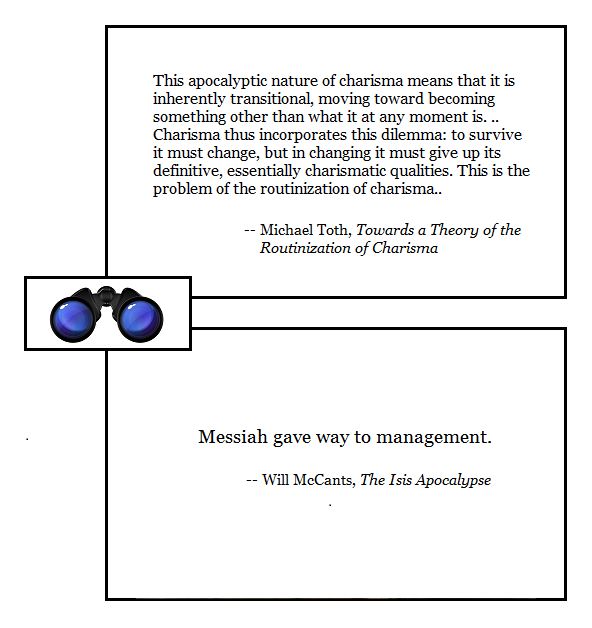
My first note concerns the elegant way in which McCants‘ view of the changing state of IS eschatology as it has developed in practice conforms to Max Weber‘s theory of the routinization of charisma:

SPEC DQ Weber McCants

Toth, Toward a Theory of the Routinizationnof Charisma
McCants, p 147

**

Two:

There are four sentences that fall in series in Will McCants’s Conclusion — three of a kind followed by one with a different quality to it. Each one ends a section, and the last ends the Conclusion as a whole:

  • This is not Bin Laden’s apocalypse.
  • This is not Bin Laden’s insurgency.
  • This is not Bin Laden’s caliphate.
  • This may not be Bin Laden’s jihad, but it’s a formula future jihadists will find hard to resist.
  • The relevant pages respectively are pp. 147, 151, 153, and 159.

    Apocalypse soon from Lapido, McCants from Sources & Methods

    Thursday, September 10th, 2015

    [ by Charles Cameron — my latest for LapidoMedia gives Sunni, Shia background, & importantly the shift from Zarqawi to Baghdadi — followed by a chaser from Will McCants ]
    .

    My latest from Lapido, opening paras:

    TO SENIOR military officers, intelligence analysts and policy-makers, blood and guts are more real than fire and brimstone.

    To the followers of ISIS – which now calls itself the Islamic State – however, not only do the concepts of hell fire and the gardens of paradise seem real, the hope of heaven and fear of hell are powerful recruiting tools, morale boosters and motivating forces.

    While the battlefield is real to them, to lose one’s life on that battlefield is viewed as victory, and as martyrdom rewarded with a painless death, avoidance of Judgment Day and a direct passage to paradise.

    And that vivid expectation of paradise is accompanied by a sense that in any case, ‘the end is nigh’.

    That is why the ‘caliphate’ established by Abu Bakr al-Baghdadi has named its English-language magazine after the town of Dabiq.

    Indeed, Dabiq’s first issue opens with a quote from Abu Musa’b al-Zarqawi, the brutal founder of the group that became the Islamic State:

    ‘The spark has been lit here in Iraq, and its heat will continue to intensify – by Allah’s permission – until it burns the crusader armies in Dabiq.’

    The town of Dabiq is obscure enough that you won’t find it indexed in David Cook’s Contemporary Muslim Apocalyptic Literature, nor in French diplomat-scholar Jean-Pierre Filiu’s Apocalypse in Islam.

    Will McCants, in his book The ISIS Apocalypse: The History, Strategy, and Doomsday Vision of the Islamic State due out later this month, quotes a leader of the Syrian opposition as saying, ‘Dabiq is not important militarily.’

    And yet Abu Bakr al-Baghdadi, like Abu Musa’b al-Zarqawi before him, makes it a centrepiece of his strategy and propaganda.

    Read the whole thing on the LapidoMedia site

    **

    Will McCants gave a useful response in his Sources & Methods podcast interview yesterday, at the 35.00 mark — answering a question about apocalypticism in IS:

    I think it’s really important in terms of attracting foreign fighters from the west. If you think about what gets a foreigner motivated to leave their home and travel to an insanely violent conflict zone, there are few things that might motivate people more than the belief that the end times are right around the corner. So I see a lot of that apocalyptic propaganda from the Islamic State really directed towards foreign fighters. But also you know in the Middle East, after the Iraq war in 2003, apocalypticism began to get a lot more currency than it used to have. You know, before the war, apocalypticism among Sunnis was really kind of a fringe subject as compared to the Shia, for whom it’s been an important topic for centuries – for modern Sunnis, they kind of looked down on it, that’s something that the Shia speculate on, but that’s not really our bag. The US invasion of Iraq really changed the ways that Sunni’s thought about the end times. And then with the Arab Spring coming, and all the political turmoil that followed in its wake, it’s given an apocalyptic framework far more currency than it ever had as a way to explain political upheaval in the region.

    Listen to the whole thing at Sources and Methods.


    Switch to our mobile site