zenpundit.com » will mccants

Archive for the ‘will mccants’ Category

The Boston IS and Apocalyptic Conference

Thursday, July 16th, 2015

[ by Charles Cameron — I was (unexpectedly) almost totally deaf at the time, so the videos of the conference allowed me a second go-around, for which I’m profoundly grateful ]
.

CMS Landes 602
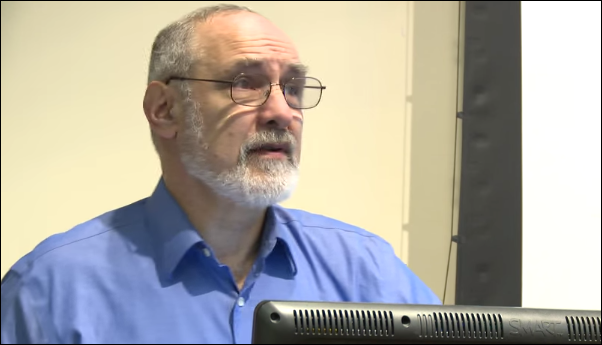
Richard Landes, opening the Boston conference
**

With what I hope will turn out to be the wisdom of a fool, I am going to propose the importance of (a) Richard Landes‘ now defunct Center for Millennial Studies at Boston University, and (b) its recent resurgence as a single and singular conference on Apocalyptic Hopes, Millennial Dreams and Global Jihad.

Bear with me, I’m an enthusiast.

**

Gregory Bateson died thirty-five years ago July 4th, the day I started writing this post — a fact I only know because I’m inclined to associate the Boston Conference as one of the great cross-disciplinary and initially underestimated conferences alongside the early Macy conferences on Cybernetics, in which Gregory Bateson was so significant a partner — or the seminal Eranos Conferences attended by the friends of CG Jung.

The Macy conferences ushered in the computer age, the Eranos conferences celebrated the highest level of cross-cultural and cross-disciplinary exchanges between psychologists, philosophers, religious scholars and physicists — while the Millennial Studies conferences focused on a studiously ignored area of knowledge that has swung into heightened significance via the arrival on scene of Al-Qaida and the Islamic State.

**

Participants, Macy and Eranos:

The Macy Cybernetics Conferences included such participants as William Ross Ashby, William Grey Walter, Kurt Lewin, J. C. R. Licklider, Warren S. McCulloch, Margaret Mead, Oskar Morgenstern, F. S. C. Northrop, Walter Pitts, I. A. Richards, Claude Shannon, Heinz von Foerster, John von Neumann, and Norbert Wiener.

The Eranos Conferences included presentations by Carl Gustav Jung, Rudolf Otto, Mircea Eliade, Wolfgang Pauli, Karl Kerényi, Erich Neumann, Henry Corbin, G van der Leeuw, Louis Massignon, Gilles Quispel, Hellmut Wilhelm, Hugo Rahner, Erwin Schrödinger, Gershom Scholem, Heinrich Zimmer and Martin Buber.

In each case, the ideation was intensely and deliberately cross-disciplinary, and the importance of the series of conferences only widely apparent at a later date.

**

Participants, Center for Millennial Studies:

In the case of the Boston conference on Apocalyptic Hopes, Millennial Dreams and Global Jihad, the series in whicb it partakes is that of the new defunct Center for Millennial Studies, an extraordinary organization which studied millennial movements from the Dead Sea Scrolls via the Taiping Rebellion (20-30 million dead), and the Siege of Mecca (1979 CE), to Aum Shinrikyo, Waco and Y2K — with implications for future events at least as far as the 2000th anniversary of the crucifixion in the 2030s and the start of the next Islamic century in the 2070s.

Among the attendees at this year’s conference were Richard Landes, William McCants, Graeme Wood, Timothy Furnish, Cole Bunzel, Jeffrey M. Bale, myself, David Cook, JM Berger, Itamar Marcus, David Redles, Paul Berman, Charles Strozier, Brenda Brasher, Mia Bloom and Charles Jacobs. Husain Haqqani was expected to attend and intended to speak about the Ghazwa e-Hind but couldn’t make it, and Ayaan Hirsi Ali cancelled her appearance for security reasons as a result of the Garland, TX, shooting the day before.

Speakers at previous CMS conferences included, in additiopn to some of the above, Steven O’Leary, Michael Barkun, Albert Baumgarten, Chip Berlet, Bruce Lincoln, Moshe Idel, Michael Tolkin, Gershom Gorenberg, Damian Thompson and Robert Jay Lifton.

**

You can see the entire series of CMS 2015 Conference videos

  • here
  • In particular and given my own special interests, I recommend the talks by

  • Will McCants (on IS eschatology)
  • Cole Bunzel (on the 1979 Mahdist assault on Mecca), and
  • David Cook (on Islamic apocalyptic and Boko Haram)
  • You can follow those up with such friends and worthies as Tim Furnish, JM Berger, and (on Palestinian messaging) Itamar Marcus — Itamar’s brilliant presentation shifted my thinking on the Israeli-Palestinian question by about ten degrees.

    My own contribution is

  • here
  • **

    My recent discombobulations (see previous post) and an over-busy writing schedule have prevented me from posting separately on each of the talks at the conference, which I had hoped to do — but McCant’s forthcoming book will soon be with us, and this brief introduction (and my three reading lists) will hopefully provide background while we await it.

    The book I brought with me, for (heh!) light reading, was A. Azfar Moin‘s The Millennial Sovereign: Sacred Kingship and Sainthood in Islam. Path-breaking, scholarly, intelligent, unfailingly curious, written with grace — a true delight!
    Gaming the Islamic State three ways from Sunday

    Thursday, July 16th, 2015

    [ by Charles Cameron — what hipbone thinking / gaming could and should bring to the natsec table ]
    .

    I have just been browsing the Institute for the Study of War‘s report on its ISIS wargame, and thought I’d wargame ISIS a bit myself, using my DoubleQuotes game.

    **

    The ISW report, in its 32 pages, barely mentions religious drivers, features one use of the word “apocalyptic” in a pretty non-specific sentence that implies nothing about what that word implies in terms of religious instensity — “ISIS intends to expand its Caliphate and eventually incite a global apocalyptic war” — and generally focuses on everything but “knowing” the enemy..

    If they’d invited me and added a round or three of DoubleQuotes during a coffee break, I’d have been grateful for the coffee and the visit to DC, and very quickly played these two double-moves:

    For wide context:

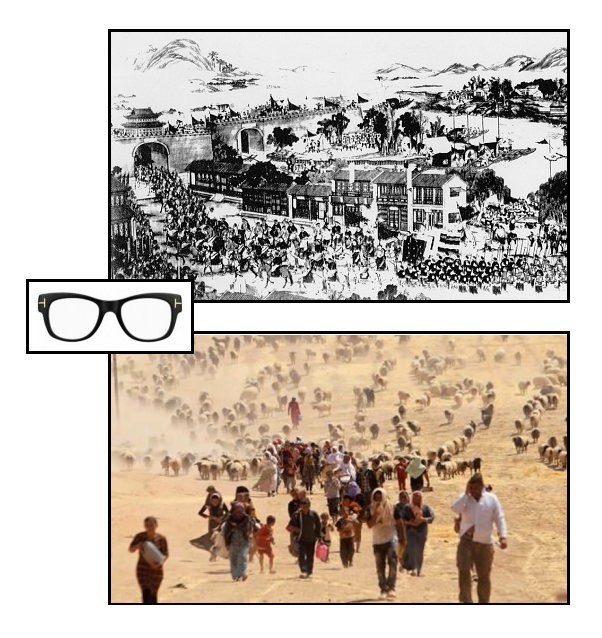
    SPEC DQ Taiping IS

    Upper panel: the Taiping Rebellion, an apocalyptic (in the true sense) movement in China, 1850 to 1864, with between 20 million and 30 million dead — as a reminder that apocalyptic movements can have, ahem, far-reaching consequences.

    Lower panel: Refugees fleeing the Islamic State, a movement whose apocalyptic (in the true sense) strategy includes a focus on great end-times battle to be fought at Dabiq in Syria, Dabiq being the name of their English lnaguage magazine.

    Read into the record in support of these two visuals:

  • Jonathan Spence, God’s Chinese Son: The Taiping Heavenly Kingdom of Hong Xiuquan
  • William McCants, The ISIS Apocalypse: The History, Strategy, and Doomsday Vision of the Islamic State
  • And with narrower focus:

    here, on the brutality levels permitted in two rival jihadist groups in Syria:

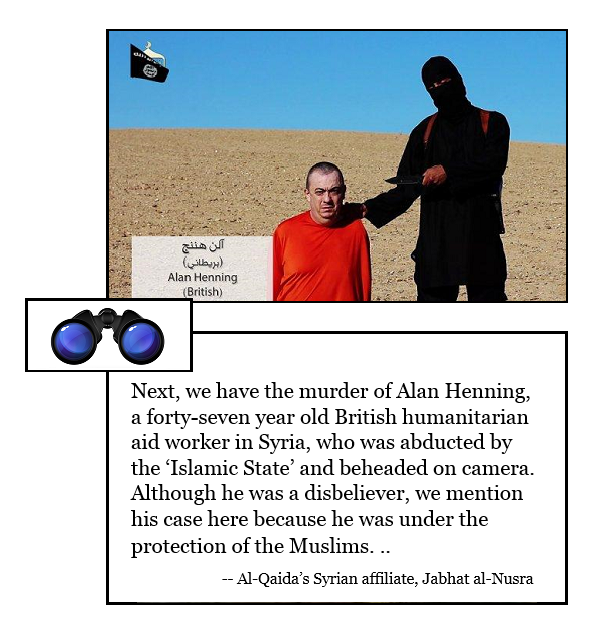
    SPEC DQ IS vs Jabhat

    Upper panel: the Islamic State brutally executes British aid worker Alan Hemming

    Lower panel: AQ affiliate Jabhat al-Nusra points out that he was under an offer of protection binding on all Muslims.

    There would be background reading to explore and expand that DoubleQuote too. But the main point is: the contest of ideas, not simply that of troop movements and materiel, would have been part of the picture.

    **

    The Atlantic Council has also held two wargaming sessions on IS [1, 2], but again the insights to be gained into the Islamic State’s end-times motivations and their implications are almost nonexistent:

    ISIS carries the seeds of its own destruction primarily because it has an extremely small constituency within Islamist populations around the world, an apocalyptic vision, an unsustainable strategy of us-against-theworld, and a failed governance project.

    And that’s about it.

    **

    McCants’ presentation at the Boston conference, and his forthcoming book (above), both make it clear that the apocalyptic stress of today’s “caliphate” has morphed significantly from the more immediate apocaypticism in IS’ Zarqawi-era predecessor, Al Qaeda in Iraq.

    And for a nuanced understanding of time-urgency in apocalyptic rhetoric, Stephen O’Leary‘s Arguing the Apocalypse: A Theory of Millennial Rhetoric is the definitive work.

    So when do we start introducing ideational war (and/or peace) games alongside our games of brute force?

    And how do you factor esprit, morale, and “angels, rank on rank” (Quran 8.9, 89.22) into troop movements and so forth?

    Hint: they’re force-multipliers.

    Hipbone update & request for your vote!

    Wednesday, June 17th, 2015

    [ by Charles Cameron — 3 Quarks Daily, Boston Apocalyptic conference, LapidoMedia, World Religions and Spirituality Project, Bellingcat, Loopcast, Pragati, Sembl ]
    .

    First, please vote!

    .
    [ Note added: voting is now closed: my story received the fifth highest tally of votes out of 45 entries, and is now up for consideration by the 3QD editors in the next round — many, many thanks! ]

    My story, War in Heaven, is in the running for the 3 Quarks Daily Arts & Literature Prize. 3 Quarks Daily is a great aggregator site, I’m honored to have made the cut so far, and would love to make it to the next level. My entry is #33 in the alphabetical list here, and votes can be cast at the bottom of the page. Networking for votes is all part of the game, so I’m hoping you’ll vote — & encourage your friends to go to that page & vote my entry up.

    If you haven’t read it, here’s my story. It was a finalist in the Atlantic Council‘s Scowcroft Center Art of Future Warfare Project‘s space war challenge, in association with War on the Rocks.

    There’s even a Google Hangout video in which Atlantic Council Non-Resident Senior Fellow August Cole, who directs the Art of Future Warfare project, interviews the contest’s winner and finalists, myself included. August’s book, Ghost Fleet: A Novel of the Next World War, is in the running for next great Tom Clancy like techno-thriller.

    You’ll find plenty of other good entries at the 3QD contest page, and daily at 3QD as well — as I say, it’s excellent in its own right, and one of the richest contributors of varied and interesting posts on my RSS feed.

    **

    Then, in no particular order — check ’em all out —

    The Boston conference on Apocalyptic Hopes, Millennial Dreams and Global Jihad:

    To my way of thinking, the critical thing to know about the Islamic State is its “apocalyptic, end-of-days strategic vision” as Martin Dempsey put it — and the implications of that statement, both in terms of strategy and of recruitment & morale. That’s what the Boston conference focused on, and that’s why I think it was no less significant for being sparsely attended. In a series of future blogs I hope to go over the videos of the various presentations and spell some of their implications out — Will McCants‘ book, The ISIS Apocalypse, is due out in September, and I’d like to have filled in some background by then.

    Here, though, as I’m giving an update on my own doings, is my presentation — an attempt both to tie together some of the strands of the panel I was commenting on (but could barely hear, but that’s a tale or another day), and to express my sense of the importance of apoclyptic thinking, not merely as an intellectual exercise but as an emotional and indeed visceral relaity for those swept up in it:

    The other speakers were Richard Landes, WIlliam McCants, Graeme Wood, Timothy Furnish, Cole Bunzel, Jeffrey Bale, David Cook, J.M. Berger, Itamar Marcus, Charles Jacobs, David Redles, Mia Bloom, Charles Strozier, Brenda Brasher and Paul Berman — quite a stellar crew.

    **

    My two latest pieces for LapidoMedia, where I’m currently editor:

    ANALYSIS: Understanding the jihadists through their poetry and piety
    12th June 2015

    YOU might not think that ‘what jihadis do in their spare time’ would be a topic of much interest, but it’s one that has been under-reported and is just now breaking into public awareness.

    Much of the credit for this goes to Robyn Creswell and Bernard Haykel for their current New Yorker piece, Battle lines: Want to understand the jihadis? Read their poetry.

    But behind Creswell and Haykel’s piece lurks a striking presentation given by the Norwegian terrorism analyst Thomas Hegghammer at St Andrews in April.

    Hegghammer’s Wilkinson Memorial lecture was titled Why Terrorists Weep: The Socio-Cultural Practices of Jihadi Militants…

    Read the rest

    I’m still intending to do a longer and more detailed write-up for Zenpundit on Hegghammer’s highly significant lecture.

    Today:

    The Bamiyan Buddha lives again

    A CHINESE couple, dismayed by the Taliban’s destruction of Bamiyan’s two Buddha statues, has brought the larger of the statues back to life.

    Locals and visitors can once again see the Bamiyan Buddha through the use of laser technology – this time not in stone but in light.

    Carved into the great cliff face towering over the fertile valley of Bamiyan in Afghanistan, two Buddha statues stood for centuries.

    In 2001 the Taliban dynamited the statues, built in the Sixth century in the Gandhara style, the larger of them standing 55 metres tall.

    It was not the first attack against them.Lapido aims to provide (mostly secular) journalists with insight into the religious & spiritual values behind current events.

    Read the rest

    I stood there, atop the Bamiyan Buddha: it’s personal.

    **

    At the World Religions and Spirituality Project at Virginia Commonwealth University, I’m one of two Project Directors for the JIHADISM Project. We’re very much a work in progress, aiming to provide a resource for scholarship of religion as it relates to jihadism.

    **

    Justin Seitz made a post titled Analyzing Bin Ladin’s Bookshelf on Bellingcat, to which I responded, and we had a back-and-forth of emails &c.

    Justin then gave our discussion a shoutout at The Loopcast

    — the immediate context starts around the 30 min mark, and runs to around 35 — and followed up with a second Bellingcat post, Analyzing Bin Ladin’s Bookshelf Part 2 — in which he quoted me again. Key here is his remark:

    a human with domain expertise is always going to be in a better position to make judgement calls than any algorithm

    Agreed — & many thanks, Justin!

    Bellingcat — definitely an honor to get a shoutout there,

    **

    Pragati: The Indian National Interest Review

    My latest on Pragati was my review of JM berger & Jessica Stern’s ISIS: the State of Terror, which I’ve already noted & linked to here on ZP.

    Up next, my review of Mustafa Hamid & Leah Farrall‘s The Arabs at War in Afghanistan

    **

    And last but not by any means least…

    Cath Styles’ new Sembl slideshow:

    It’s a terrific feeling to see the next runner in a relay race take off from the handover… Cath is getting some high praise for her work on Sembl for the museum world, including the following:

    Sembl incredibly succesfully mixes competitive and collaborative play, creativity and expression, and exploration and inspiration. It’s the sort of game you think about when you’re not playing it, and it’s the sort of game that helps you see the world in new ways.

    Paul Callaghan
    Writer, Game Developer, Lecturer at Unversity of East London

    Meanwhile, I’m still quietly plugging away at some other aspects of the HipBone / Sembl project.

    A dozen or so books on Islamic apocalyptic

    Wednesday, April 29th, 2015

    [ by Charles Cameron — since this topic is at last swinging into focus ]
    .

    It is my impression that Islamic apocalyptic has finally surfaced as a significant contributor to those interested in questions of contemporary national security — first, through CJC Martin Dempsey‘s 2014 comment that IS has “an apocalyptic, end-of-days strategic vision”, second, through Graeme Wood‘s article What ISIS Really Wants in the Atlantic, third, through the publication of Stern & Berger‘s ISIS: the State of Terror, and fourth (as yet upcoming), Will McCants’ The ISIS Apocalypse: The History, Strategy, and Doomsday Vision of the Islamic State.

    While we’re reading Stern & Berger and waiting for McCants book, though, I thought it might be useful to compile a couple of lists of relevant books, first (here) on Islamic apocalyptic, and second (soon) on the complex relationship between apocalypticism (of whatever stripe) and violence (soon).

    Here’s my list, with comments, of books on Islamic apocalyptic:

    **

    First choice:

  • Jean-Pierre Filiu, Apocalypse in Islam
  • My Jihadology review gets into some detail, but the book is superb. From the concluding pages:

    For the moment, only the Iraqi militia known as the Supporters of the Imam Mahdi has actively sought to translate the rise of eschatological anxiety into political action. Yet one day a larger and more resourceful group, eager (like Abu Musab al-Suri) to tap the energy of the “masses” as a way of achieving superiority over rival formations, may be strongly tempted to resort to the messianic gambit. An appeal to the imminence of apocalypse would provide it with an instrument of recruitment, a framework for interpreting future developments, and a way of refashioning and consolidating its own identity. In combination, these things could have far-reaching and deadly consequences.

    **

    Overviews:

  • Richard Landes, Heaven on Earth
  • Heather Selma Gregg, The Path to Salvation
  • Landes’ book gives an impressive, nay encyclopedic, tour of apocalyptic movements across time and space, excluding Judaic and Christian versions to make space for his expansive survey across time and space (featuring, eg, the Xhosa cattle-slaying of the 1850s), and concludimng with a chapter on contemporary Islamist apocalyptic. Gregg’s slimmer olume is an information-packed tour of “religious violence from the Crusades to Jihad” and from Jerusalem to Ayodhya.

    **

    Varieties of Islamic apocalyptic:

  • David Cook, Studies in Islamic Apocalyptic
  • David Cook, Contemporary Muslim Apocalyptic Literature
  • David Cook’s high-level scholarship explores ancient and contemporary Islamic apocalyptic texts in detail. It was David who introduced me to the topic in the late ’90s at a Center for Millennial Studies conference, not unlike the one David, JM Berger, Will Mcants, Tim Furnish, myself and others will speak at on IS and apocalyptic in early April.

    **

    For specific angles on the issue:

  • Timothy Furnish, Holiest Wars: Islamic Mahdis, Their Jihads, and Osama bin Laden
  • Anne-Marie Oliver & Paul Steinberg, The Road to Martyr’s Square
  • Thomas Hegghammer & Stephane Lacroix, The Meccan Rebellion
  • Gershom Gorenberg, The End of Days
  • A Azfar Moin, The Millennial Sovereign
  • Joel Richardson, The Mideast Beast
  • Furnish discusses the history of Mahdist movements; Oliver and Steinberg write a passionately engaging narrative of life in Gaza, with special focus on suicide bombers and Hamas street propaganda; Hegghammer and Lacroix cover the Mahdist revolt that kicked off the new Islamic century in Mecca, getting into theological details that resonate to this day; and Gorenberg covers the three competing apocalypticisms of Judaism, Christianity and Islam with respect to the Temple Mount / Noble Sanctuary in Jerusalem, which he terms “the most hotly contested piece of real estate on earth”. Azfar Moin’s book gives an account of the quasi-Mahdism of Safavid Iranian and Mughal Indian kingship, in which sufi notions of sanctity and courtly notions of royalty mix and mingle — simply mind-boggling. And Joel Richardson views Islamic apocalyptic through Christian apocalyptic eyes.

    **

    For Shi’ite eschatology:

  • Abdulaziz Sachedina, Islamic Messianism
  • cf Sachedina’s translation of Ayatullah Ibrahim Amini‘s Al-Imam al-Mahdi, The Just Leader of Humanity
  • Abbas Amanat, Apocalyptic Islam and Iranian Shi’ism
  • **

    Reading Islamic scriptures in and out of context:

  • Jonathan Brown, Misquoting Muhammad: The Challenge and Choices of Interpreting the Prophet’s Legacy
  • It is all too easy to cherry pick quotes to show that Islam is peaceful, warlike or whatr have you: Dr Brown shows us how variously the texts can be interpreted, tus opening the door to a more cautious, context-driven and historically aware of what we read in opposing contemporary polemics. Brilliant.

    **

    In a following post, I shall list books predominantly from the religious studies area, as various authors examines violence in new religious movements, many of which are millenarian / apocalyptic in orientation.

    Boston: Apocalyptic Hopes, Millennial Dreams and Global Jihad

    Sunday, April 19th, 2015

    [ by Charles Cameron — “The now defunct Center for Millennial Studies at Boston University (1996-2003) brings to the public one final conference on apocalyptic beliefs” ]
    .

    If this was a movie, I’d say the speakers at this conference were a “stellar cast”! Will McCants, Graeme Wood, Cole Bunzel, Timothy Furnish, David Cook, JM Berger, Husain Haqqani.. Paul Berman and Ayaan Hirsi Ali..

    I participated in several of the old Center for Millennial Studies conferences that Richard Landes organized around the turn of the millennium, and they were intense academic highlights for me. I thought it very short-sighted when CMS funding was cut after the turn of the year 2000, agreeing with Dr Landes that millenarianism was unlikely to go away any time soon — and AQ, and IS even more so, have more than proven his point — hence this “final” conference.

    If you can attend, by all means do — highly recommended. I’m delighted to have been invited to attend myself, and hope to keep Zenpundit readers well informed.

    **

    Apocalyptic Hopes, Millennial Dreams and Global Jihad: May 3-4, 2015, Boston University

    Sponsored by the BU History Department and Scholars for Peace in the Middle East

    Most Westerners associate the terms apocalyptic and millennial (millenarian) with Christian beliefs about the endtime. Few even know that Muhammad began his career as an apocalyptic prophet predicting the imminent Last Judgment. And yet, for the last thirty years, a wide-ranging group of militants, both Sunni and Shi’i, both in coordination and independently, have, under the apocalyptic belief that now is the time, pursued the millennial goal of spreading Dar al Islam to the entire world. In a manner entirely in keeping with apocalyptic beliefs, but utterly counter-intuitive to outsiders, these Jihadis see the Western-driven transformation of the world as a vehicle for their millennial beliefs, or, to paraphrase Eusebius on the relationship between the Roman Empire and Christianity: Praeparatio Califatae.

    The apocalyptic scenario whereby this global conquest takes place differs from active transformative (the West shall be conquered by Da’wa [summons]) to active cataclysmic (bloody conquest). Western experts have until quite recently, for a wide range of reasons, ignored this dimension of the problem. And yet, understanding the nature of global Jihad in terms of the dynamics of apocalyptic millennial groups may provide an important understanding, both to their motivations, methods, as well as their responses to the inevitable disappointments that await all such believers. The now defunct Center for Millennial Studies at Boston University (1996-2003) brings to the public one final conference on apocalyptic beliefs, co-sponsored by the BU History Department and Scholars for Peace in the Middle East (SPME).

    **

    Schedule:

    *All events will take place in the Stone Science Building (645 Commonwealth Ave), room B50

    Sunday, May 3

    10:00-12:00 Introduction:

    1. Richard Landes, “Globalization as a Millennial Praeparatio Califatae: A Problematic Discussion
    2. William McCants, Brookings Institute: “ISIS and the Absent Mahdi: Studies in Cognitive Dissonance and Apocalyptic Jazz”
    3. Graeme Wood, Yale University, Atlantic Monthly: “On the Resistance to seeing Global Jihad as Apocalyptic Movement”

    12:00-1:30 Break for Lunch

    1:30-3:30 Panel II: The Millennial Goal: Global Caliphate

    1. Cole Bunzel, Yale U.: ISIS: From Paper State to Caliphate: Hotwiring the Millennium
    2. Timothy Furnish, Independent Scholar: “Varieties of Transformative (non-violent) Jihadi Millennialism
    3. Jeffrey Bale: Monterey Institute of International Studies, “The Persistence of Western ‘Mirror Imaging’ and Ideological Double Standards: Refusing to Take Islamist Ideology Seriously

    4:00-5:30 Panel III: Case Studies in Apocalyptic Jihad

    1. David Cook, Rice University: “ISIS and Boko Haram: Profiles in Apocalyptic Jihad”
    2. JM Berger, Brookings Institute, “The role of communications Technology in mediating apocalyptic communities”
    3. Mehdi Khalaji, Washington Institute of Near East Policy: “Apocalyptic Revolutionary Politics in Iran”

    Monday, May 4

    10:0-12:00 Panel IV: Conspiracy Theory and Apocalyptic Genocide

    1. Itamar Marcus, Palestinian Media Watch, “Anti-Semitism, Conspiracy Theory and Apocalyptic Global Jihad”
    2. Charles Small, “Ideology and Antisemitism: Random Acts or a Core Element of the Reactionary Islamist Global Jihad?”
    3. Richard Landes, BU, “Active Cataclysmic Apocalyptic Scenarios, Demonizing and Megadeath: Taiping, Communists, Nazis, and Jihadis.”
    Comments: David Redles, Michael Barkun

    12:00-1:30 Break for Lunch

    1:30-4:00 Final Panel Discussion

    Paul Berman, Independent Scholar
    Ayaan Hirsi Ali, Independent Scholar
    Jessica Stern, Harvard University
    Husain Haqqani, Hudson Institute
    Charles Strozier, John Jay College
    Brenda Brasher, Tulane University

    **

    Selected Work

    Ayaan Hirsi Ali
    Read “Those Who Love Death: Islam’s Fatal Focus on the Afterlife” from Heretic (2015) Here

    Jeffrey Bale
    Read “Islamism and Totalitarianism” (2009) Here
    Read “Political Correctness and the Undermining of Counterterrorism” (2013) Here

    J.M Berger
    Read “The ISIS Twitter Consensus” (2015) Here
    Professor Berger’s latest book, coauthored with Jessica Stern, ISIS: State of Terror, can be purchased Here

    Paul Berman
    Read “Why is the Islamist Death Cult So Appealing?” (2015) Here

    Cole Bunzel
    Read “From Paper State to Caliphate: The Ideology of the Islamic State” (2015) Here

    Medhi Khalaji
    Read “Apocalyptic Politics: On the Rationality of Iranian Policy” (2008) Here

    Richard Landes
    Read “Enraged Millennials” from Heaven on Earth: The Varieties of the Millennial Experience (2011) Here

    William McCants
    Read “The Sectarian Apocalypse” (2014) Here

    Jessica Stern
    Read “The Coming Final Battle” from ISIS: State of Terror (2015) Here

    Charles Strozier
    Professor Strozier’s book, The Fundamentalist Mindset can be purchased Here

    Graeme Wood
    Read “What ISIS Really Wants” (2015) Here


    Switch to our mobile site

