
Nassim Nicholas Taleb, author of The Black Swan: The Impact of the Highly Improbable and Fooled by Randomness: The Hidden Role of Chance in Life and in the Markets
 , had an op-ed in FT.com entitled “Ten principles for a Black Swan-proof world” (Hat tip to John Robb and Pundita). Taleb was addressing the global economic crisis, but I was particularly drawn to Taleb’s fifth principle, which
  has a more general implication:
5. Counter-balance complexity with simplicity. Complexity from globalisation and highly networked economic life needs to be countered by simplicity in financial products. The complex economy is already a form of leverage: the leverage of efficiency. Such systems survive thanks to slack and redundancy; adding debt produces wild and dangerous gyrations and leaves no room for error. Capitalism cannot avoid fads and bubbles: equity bubbles (as in 2000) have proved to be mild; debt bubbles are vicious.
Taleb has encapsulated many important concepts very well here. Up to a certain point, increasing complexity represents a advantage for an evolving system (biological, financial, physical etc.) by increasing efficiency through adding specialization, interconnection, diversification, redundancy and checks for mitigation of risks. Complexity, in the earlier part of a development curve can add to a system’s overall resiliency – to a point.
Superfluous complexity, that which goes beyond the minimum required for additional gains in systemic efficiency or productivity, is a net drag on the system, an economic waste, a source of friction, a cancer, a useless eater of resources and the earliest sign of the system’s inevitable decay. Worse, excess complexity represents an increasing probability of systemic failure by multiplying the number of variables involved in the normal process of the system. There are more things that can go wrong and more choke points where a catastrophic failure can occur. Increasing the degree of complexity moves the system away from simplicity and reliability and toward chaos and the creativity of emergent properties, but like an ice skater seeking ever greater range, go too far and the ice will crack under one’s feet.
This is an effect familiar to engineers and scientists but one that appears to escape the majority of politicians, corporate executives and economists. My co-blogger at Chicago Boyz, Shannon Love, took GE to task for trying to get on the Federal dole by advocating needlessly complicating the nation’s power grid:
If Your Grid Had a Brain
GE is advertising to build political support for Obama’s plan to purchase billions of dollars of GE tech in order to make the power grid “smart”. After all, who would want a “dumb” anything when they could have a “smart” something?
The reason we should keep things dumb is that in engineering the word “dumb” has a different connotation. In engineering, “dumb” means simple and reliable.
Increasing complexity in any networked system increases possible points of failure. Worse, the more interconnected the system, i.e., the more any single component affects any other randomly selected component in the system, the faster point-failures spread to the entire system. Power grids are massively interconnected. Every blackout starts with a seemingly trivial problem that, like a pebble failing on a mountain side, triggers an avalanche of failure.
In the social and political domain, back in the 1990’s Philip K. Howard wrote a book called The Death of Common Sense: How Law is 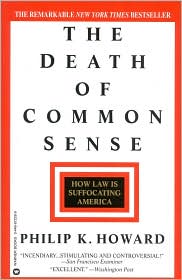 Suffocating America
 in which he detailed example after example of how the overlawyering of regulatory systems in America by an emerging and hyper-aggressive legal class was producing neither restraint on government abuses nor fine-tuned social outcomes but instead created a state of paralyzed rigidity, risk aversion, perverse incentives and general dysfunction; in other words, chaos instead of order.
The Obama-ites in the White House are not “socialists” ( at least not most of them) but there is a great love of liberal-minded technocracy there, and a seemingly boundless self-confidence in the ability of high-minded, upper-middle class, progressive, wonks and lawyers from the “good schools” (or investment houses – in some cases, both) to micromanage not just our lives for us, or even the United States of America but the global economy itself. Sort of a Superempowered Oligarchy of Good Feelings.
The ancient Greeks had a word for that: hubris. More importantly, the Obama-ites are wrong here – adding endless amounts of regulatory complexity is not going to give them the kind of granular control or positive returns that they seek to obtain from the system. Counterintuitively, they should be radically simplifying where and to the degree they safely can instead.

 by
by . Col. Osinga credits Boyd associate Dr. Grant Hammond and The Mind of War with introducing him to the ideas of John Boyd and inspiring him in his own intellectual journey as a student to try to understand and explain Boyd’s strategic theories.
 , Hammond enjoyed the advantage of having had a personal and intellectual relationship with Col. Boyd, one that Hammond called “Transforming”. This gives Hammond’s shorter biography insights into how Boyd’s mind worked that Coram and Osinga miss (or more properly, could not have known), including the “perverse glee” Boyd felt in discovering and exploring the Darwinian mismatch between perception and unfolding reality. While Robert Coram wrote about the demanding aspect that collaborators sometimes felt when dealing with the relentlessly autodidactic John Boyd, who could call at any time of the day or night and talk for hours, Hammond was actually on the receiving end of this treatment for six years:
 , Ernst Mayer’s
  , Gerard Radnitsky and W.W Bartley’s edited collection entitled
  (focus on particularly on Karl Popper’s essay and that of Donald T. Campbell) and Stuart A. Kauffman’s
  .
. emerging threat. Current efforts from the F-22 and the Future Combat System appear to be particularly out of step with the evolving environment. Smaller and more efficient systems such as unmanned aerial vehicles and coordination systems built on open platforms (as in a Intranet) that alloworganic growth in complexity make much more sense.
 channel and get things done by going from one thing to another. But A.D.D. minds tend to be very synthetic. They reach out and pull things out of the air, or through other persons who are not linked in any way. They see patterns that other people don’t see. They can gather together unusual elements and bring them together into a whole that is a brilliant synthesis of things that would be lost on other people.

