zenpundit.com » ideas

Archive for the ‘ideas’ Category

Why the NSC Structure Matters – and When it Does Not

Tuesday, February 10th, 2009

J. at Armchair Generalist gets a big hat tip for his post Reforming the National Security Council that pointed to this WaPo article on the interview of National Security Adviser, Gen. James Jones.  The new APNSA opines on the coming of a “strong” NSC process for the Obama administration:

….The result will be a “dramatically different” NSC from that of the Bush administration or any of its predecessors since the forum was established after World War II to advise the president on diplomatic and military matters, according to national security adviser James L. Jones, who described the changes in an interview. “The world that we live in has changed so dramatically in this decade that organizations that were created to meet a certain set of criteria no longer are terribly useful,” he said.

….”The whole concept of what constitutes the membership of the national security community — which, historically has been, let’s face it, the Defense Department, the NSC itself and a little bit of the State Department, to the exclusion perhaps of the Energy Department, Commerce Department and Treasury, all the law enforcement agencies, the Drug Enforcement Administration, all of those things — especially in the moment we’re currently in, has got to embrace a broader membership,” he said

New NSC directorates will deal with such department-spanning 21st-century issues as cybersecurity, energy, climate change, nation-building and infrastructure. Many of the functions of the Homeland Security Council, established as a separate White House entity by President Bush after the terrorist attacks of Sept. 11, 2001, may be subsumed into the expanded NSC, although it is still undetermined whether elements of the HSC will remain as a separate body within the White House.

Presidents rarely get the national security process they want but they usually get what they deserve by default of their own unwillingness to  police their subordinates when they stray from the blueprint laid out in their first NSC-drafted executive order – usually titled PDD-1 or NSDD-1 ( “Presidential Decision Directive”, “National Security Decision Directive”). When a Henry Kissinger, or a Zbigniew Brzezinski or a Dick Cheney “grab power” from whomever is supposed to have it, you can be certain that these coups have implicit presidential approval.

 It is unusual that such a directive has not already been issued by the Obama administration, if the WaPo article is correct. Normally, this is a new president’s first (or one of the first) executive order that the transition team prepares in case the administration begins with a national security crisis. If that has not happened yet it’s a troublesome sign but I will give the Obama administration credit for attempting to create a new structure outside conventional Cold War and statutory arrangements for the NSC. That is long overdue, as is some hard thinking about what role the NSC should play in crafting national strategy and policy.

Presidents need an NSC Adviser and staff to do three things, not all of which are compatible:

1. Be an “honest broker” and coordinator between State, Defense and the IC on behalf of the POTUS ( Scowcroft Model).

2. Critically evaluate the policy options provided to the POTUS by Cabinet bureaucracies and offer creative alternatives (Kissinger Model).

3. Act as the “enforcer” and monitor to make certain presidential policy is being implemented and identify those who are obstacles, free-lancers and bureaucratic sabotuers for reprimand or removal (Sherman Adams/H.R. Haldeman* Model).

* Adams and Haldeman were WH Chiefs of Staff who were the designated and much feared “enforcers” of their administrations. One of Reagan’s numerous APNSAs, Judge Clark, was concerned with enforcing Reagan’s ideological line in foreign policy but he is too obscure a figure and his tenure too short to serve as an effective example.


One is easy. Two are difficult but common enough. Success at three is virtually unknown.

A president who is himself a product of the establishment consensus – a George Bush, Sr. or a Dwight Eisenhower– is looking for a National Security Adviser who is an honest broker and staffs his NSC with military and foreign service officers, with a sprinkling of CIA and DIA veterans. They will expect obedience from State and the Pentagon but as their policy choices coincide with Beltway conventional wisdom, they get it most of the time anyway.

A president who comes to Washington as an “outsider” in some fashion or as a “change agent” – a Richard Nixon, Jimmy Carter, Ronald Reagan or Bill Clinton– will pick a National Security Adviser who will build a staff of what one national security scholar has called a “team of academic superstars” who will aid the president in taking control of American foreign policy. Clashes between the White House and the career bureaucracy will be frequent and increasingly vicious, particularly with State, though in the Bush II administration that role was played by the senior managers of the CIA.

Some presidents have a dysfunctional NSC process – a category that includes John F. KennedyRonald Reagan, Bill Clinton and George W. Bush – where the inmates take over the asylum and free-lancing by deputy assistant secretaries reigns supreme. Both Kennedy and Clinton strongly resisted a formal NSC decision making structure for their administration that would inhibit their ability to “pop in” to offices, chat up whomever and issue snap decisions. While this stance flowed from their desire to keep their options open and remain free of “handling” by their own staffers, it ultimately led to chaos and dangerously amateurish improvising during crisis moments.  Reagan and Bush II by contrast had formal structures in place but undermined them overtly ( Reagan in NSDD-2) or covertly ( Bush in letting his Vice-President operate a shadow mini-me NSC of his own). In Reagan’s case, this was aggravated by an unwillingness to fire anyone, no matter how much the rat-bastard deserved it, and a general distaste for confrontation.

Unless a president supports his NSC adviser down the line, the bureaucracies will do as they please to the point of making his administration’s top officials into laughingstocks. While you might not know it from the State Department’s current broken down condition, it was historically amongst the very worst offenders in this regard ( though both the Pentagon and Langley could rise to the occasion), regularly abusing the interagency process and blatantly defying presidential instructions. Give Foggy Bottom strategic planning, USAID or Public Diplomacy and they will let these nascent “competitors” wither on the vine.

The problem largely is that the State Department is filled with bright and talented but fairly insular individuals who imagine themselves more capable and informed and ultimately deserving of authority than the guy actually sitting in the Oval Office who was elected by the American people or any of his appointees. They need a strong hand at SecState and consistent follow-up by the NSC; and if given these conditions, State can perform amazing feats of diplomacy for a president. Absent that, State can create great friction for an administration.

The Obama administration is setting itself up for a very “strong” NSC process. Jones and Chief of Staff Emanuel are a potent combination and Defense, State and the CIA all have been given major political heavyweights as principals. Moreover, Jones appears to be in sync with Robert Gates as to the need for imaginative “new thinking” in national security affairs ( maybe we should send him this). However all the potential on paper in the world, at this stage of the game, means nothing.

It ultimately comes down to the President of the United States. What does he want ?

SWJ: My Interview with Tom Barnett

Thursday, February 5th, 2009

The Small Wars Journal has published an interview I conducted with Dr. Thomas Barnett regarding his new book Great Powers: America and the World After Bush.

Ten Questions with Thomas P.M. Barnett

…. 4. In Great Powers, you delve deeply into American history. What lessons did you find in our nation’s past that the diplomat overseas, the Army colonel in Afghanistan or the U.S. Aid worker in Africa should know to navigate their mission today?

This is all about frontier integration. Globalization is like America’s rapid and aggressive push Westward across the 19th century: a lot of the same bad actors and a lot of the same tools applied. So don’t be surprised when the Pinkertons show up, or when the covered wagons are attacked, or when the Injuns head to the Badlands for sanctuary. Thus, the goals of our frontline players are fairly straightforward: create the baseline security to allow the connectivity to grow. Focus on social trust and institutions as much as possible, but co-opt existing structures whenever and wherever you can. It doesn’t have to be perfect and it sure as hell doesn’t have to measure up to America’s mature standards. This is a frontier setting within globalization-treat it as such. The good news is, the settlers are already there, with more uncredentialed wealth than we realize (see Hernando DeSoto), if you respect their existing rule-sets and realize they will change only when the locals see the need themselves, so no instant rule-set packages applied by outsiders, please. Finally, acknowledge that with growing connectivity with the outside world, you will see more nationalism, more ethnic tensions, and more religious identity. These are all natural reactions, and not signs of your failure, so patience is the key.

Read the whole thing here.

Special thanks to Dave Dilegge for providing the forum and to Sean Meade and Lexington Green with editorial assistance and astute advice.

When Old Government Intersects with New Media

Thursday, January 22nd, 2009

Galrahn at Information Dissemination:

Admiral, Do You Tweet Sir?

….In no small part due to a comment in the article by John Nagl, the Small Wars Journal gets an honorable mention in this article as an example where new media is having influence in the national security debate. While it is possible other areas of new media are having a similar effect, I would argue the Small Wars Journal is the exception, not the rule, and is the only place this is happening. What makes the Small Wars Journal unique?Because it is where active and retired members of the military want to debate their ideas, want their opinions in the open source on any given topic, and Dave has tapped into a community that has become comfortable with their ideas debated in an open forum. The Small Wars Journal has the capacity to “help shape the public debate about national security policy” primarily because those involved in the debate have found value participating in the public debate.

As I have noted in the past, each military service has taken a unique approach to new media. The article highlights unique examples where our military leadership has found utility within new media to introduce and discuss their message. I follow all of these discussions, and they have all met the same challenge: the discussion is still one way and while there is a network, it is yet to become a truly interactive network of idea sharing, or just as relevant, idea shaping.

….What is the role of new media in the national security debate? I have asked this question on the blog since I began blogging, and have seen some brilliant answers in my email and in the comments. This CSM article added another slide to a brief I am building that answers this question. I think it is a really good brief, but the question I still haven’t answered is whether the better audience for the brief is the military services, or the think tanks. That John Nagl hasn’t suggested CNAS buy the Small Wars Journal from Dave suggests to me that the think tanks somehow believe the Web 1.0 model they all currently use will somehow stay relevant in the rapidly evolving information age.

Read the rest here.

Very interesting thoughts by Galrahn and I agree with his assessment of the value of SWJ as it evolved under the stewardship of Dave Dilegge and Bill Nagle though I’m not certain SWJ is unique so much as it is  a succcessful “first” because Dave and Bill did everything right. They allowed a community to form from the ground-up without trying to ramrod an ideological agenda. Sure, SWJ is primarily about COIN but opposing views are invited, welcomed, heard and debated because the moderators are honest brokers and that imparts credibility to the entire enterprise. Intellectual integrity begets quality as well as quantity in terms of readership and submissions.

Tradtional think tanks are not set up to do what SWJ does because they come with either ideological baggage (Heritage, Brookings Carnegie) or institutional affiliations (SSI, CNA, Hoover) that preemptively circumscribe membership, discussion and research interests for fear of drying up the revenue stream. Few large donors, be they Uncle Sam, Richard Mellon Scaife or George Soros, are motivated to open their checkbook by the idea of unfettered inquiry and unlimited time horizons or providing a platform to their professional or political opponents. Attempts by official orgs to imitate SWJ will result in costly but sterile echo chambers. Genuine Web 2.0 interactivity is not desired because it is spontaneous and unpredictable but without that interactivity there’s no spark, no insight and no intellectual productivity.

The Obama White House just started a “blog” but despite the sleek visual design, “The Briefing Room” is a very Web 1.0 format. Media expert Jay Rosen of Press Think  on Twitter described it as “press releases” and scanning the posts leads me to agree with him. It’s very hard for established legacy entities – even one now filled with techies – to embrace the risk of uncontrolled discussion. Perhaps the blog should be farmed out to whatever Obama is calling his private political action group; lacking comments or an authentic, personal, voice The Briefing Room is likely to become a tepid EOB version of Dipnote – except even less interesting.

The SWJ Model can be replicated for other fields but the requirements of independence, community-building, intellectual diversity, relative transparency, openness to membership and free debate appear to be non-negotiable elements. Features, not bugs. 

New Adds for the Antilibrary

Saturday, January 17th, 2009


Dr. Chet Richards Certain to Win

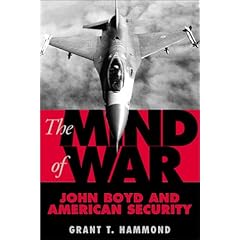
Dr. Grant T. HammondThe Mind of War: John Boyd and American Security

On “Learning Organizations”

Monday, December 29th, 2008

The SWJ Blog published an op-ed by Colonel David Maxwell entitled “Random Thoughts on Irregular Warfare and Security Assistance (Full PDF Article)“. Like a lot of more open-ended, ruminating pieces, Maxwell’s post was “generative” in the sense of trying to articulate insights regarding a complex situation, which Col. Maxwell accomplished. Here’s the section that raised my eyebrow:

…First we need to look at ourselves critically and ask if we have been able to develop effective strategies and campaign plans and then support and execute them, respectively. I think that most all of our challenges can be attributed to our strategies and campaign plans (and I will caveat this and say we need to understand that in this world of irregular warfare, complex operations and hybrid warfare there is no cookie cutter strategy or campaign plan template that will work the first time, every time. We need to be agile and flexible and be able to adapt to constantly morphing conditions). But I would say that this is where we need to focus most of all because our forces at the tactical level from all Services have proven very adept and capable and have demonstrated that they are truly learning organizations

Why would the “tactical”level have acheived “learning organization” status and not the “operational” and “strategic” levels of military command? Some possibilities:

  • The social networks within the official hierarchical org at the tactical level can effectively leverage both weak and strong ties 
  • Greater degree of shared purpose and sense of mission
  • The tactical level, being a “smaller world” in systems terms than the operational or strategic levels, has a much better “signal to noise” ratio.
  • The social networks within the hierarchical org at the tactical level create an environment of greater transparency -discussion may be squelched but situational awareness can’t be.
  • Encouragement of critical discussion and incentives for problem-solving.
  • Greater tolerance for uncertainty and ambiguity.
  • Tacit knowledge is likely to quickly become explicit organizational, knowledge through “shop talk”, the grapevine, de-briefing and formal “lessons learned” dissemination procedures.
  • The stress and danger of the tactical evironment itself is an incentive to adapt and learn – “Depend upon it, sir, when a man knows he is to be hanged in a fortnight, it concentrates his mind wonderfully.” Dr. Samuel Johnson.
     

Can the operational and strategic levels of the military ( or any organization with a bureaucratic structure – schools, corporations, government agencies etc.) become a “learning organization” despite greater scale, distance from events, degrees of abstraction and other obstacles? Of course. However it depends greatly on two things – creating a “tighter” network with a high velocity of meaningful communication and a new kind of leadership committed to the hard work of re-engineering the organizational culture around adaptive “fitness” and learning.


Switch to our mobile site