zenpundit.com » time

Archive for the ‘time’ Category

Sunday surprise the first — neat tweets from KarlreMarks

Sunday, July 3rd, 2016

[ by Charles Cameron — Brexit, graphical thinking, serpents — there’s never a dull moment with Karl Sharro on Twitter! ]
.

Karl Sharro is reMarkable and indeed reTweetable:

**

An hour or so before I saw that tweet from Sharro, I’d tweeted a quote from Suzanne Langer:

I was quoting Langer’s Philosophy in a New Key — hat-tip: Steven H. Cullinane:

Visual forms— lines, colors, proportions, etc.— are just as capable of articulation, i.e. of complex combination, as words. But the laws that govern this sort of articulation are altogether different from the laws of syntax that govern language. The most radical difference is that visual forms are not discursive. They do not present their constituents successively, but simultaneously, so the relations determining a visual structure are grasped in one act of vision.”

I think that’s generally right, and goes some way to explaining why “reading” a HipBone Game is cognitively different, even when the game is played entirely in verbal moves, from an equivalent reading of the same “move” tests in sequence.

I noted Sharro’s visual example — worth clicking all the way through to see it full scale — because although it’s a visual representation of a cluster of texts, it follows a timeline from left to right, and is thus simultaneously sequential and synchronic. A neat trick.

BTW, Sharro is celebrated for an earlier diagram I’ve posted here — with glee, and with his amazing purely textual equivalent!

**

OK so now my focal length is just right for KarlreMarks Twitter feed, and I find this beauty — also about Brexit — too:

What’s so neat here? Well, it appears to be a paradox of self-reference — ourobouros, a serpent biting its own tail if you like — and it’s very nicely done. The “large numbers of people” gathered in London, of course, aren’t the “large numbers of people” they say shouldn’t be heard, and if Sharro had tweeted —

Large numbers of people gather in London to demand that large numbers of other people shouldn’t be heard”

— the paradox would have been gone, the serpent biting its own tail morphed into a serpent biting another serpent — a far less interesting spectacle.

Or would it? At the level of particular crowds, yes, the paradox would vanish, one crowd biting another, but at the level of implied principle, a crowd voicing the denial of the principle that the voices of crowds deserve a hearing would still be self-refuting in just the way Sharro plays on.

So the paradox would be like Schrodinger’s cat, dead while alive — or even better, the Cheshire Cat, niow here now gone, perhaps?

**

Life, she is rich in paradox.
Sunday surprise: Synchronize watches!

Sunday, June 26th, 2016

[ by Charles Cameron — from science and religion, two prime resources for scenario planners ]
.

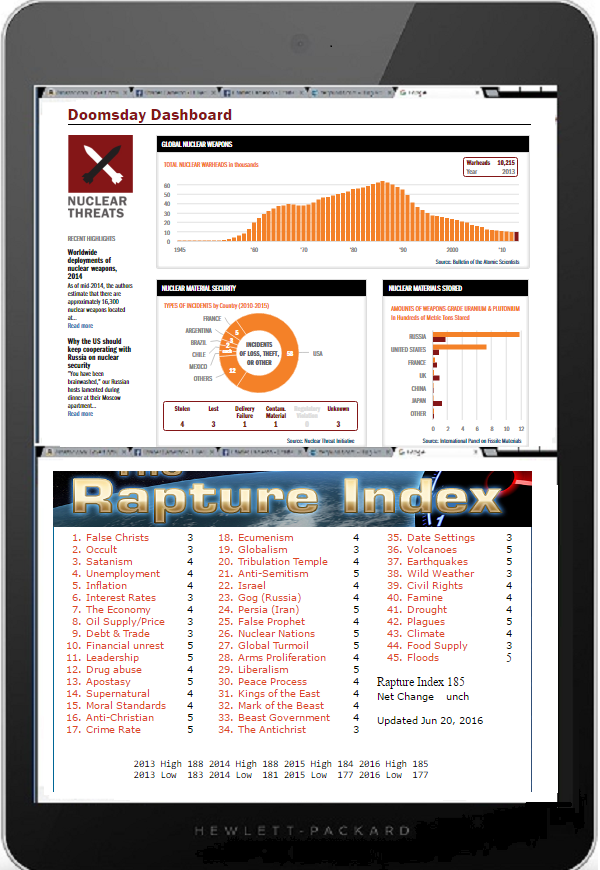
Here are two versions of how close we may be to The End of Story. In the upper panel, a glimpse of the Bulletin of the Atomic Scientists’ Doomsday Dashboard, representing their version of the scientific view:

DQ Doomsday Rapture

In the lower panel, the current state of the Rapture Index, representing the view of a Christian website dedicated to reading the signs and keeping us updated on our proximity to a day that, per scripturam, “knoweth no man, no, not the angels of heaven, but my Father only.”

**

Sources:

  • Bulletin of the Atomic Scientists, Doomsday Dashboard
  • The Rapture Index, updated June 20, 2016
  • Matthew 24.36 (KJV), But of that day and hour knoweth no man
  • Subzin movie quotes, Synchronize watches
  • **

    Who you gonna believe?

    As Tim Furnish might say, BREXIT is not the Apocalypse, not even close — it hasn’t even merited an uptick in the Rapture Index.

    On the felicities of graph-based game-board design: three

    Monday, August 24th, 2015

    [ by Charles Cameron — cross-posted from Sembl ]
    Following up on two previous posts on graph-based design: Preliminaries and Two dazzlers

    **

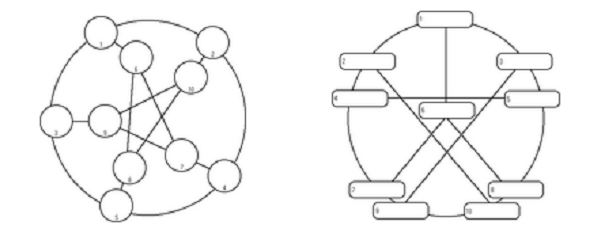
    Here are two old HipBone boards that have the curious property of looking very different while being, in fact, topologically identical. Moves played on either board will feature the same set of links — although, given the visual impac ts of proximity and distance, they may “feel” very different to the players themselves:

    Petersen graph boards

    I call them the Pentagram and Mercedes boards, for what I trust are obvious reasons. They are both based on versions of the Petersen graph, and I’m grateful to Walter Logeman and Miles Thompson for introducing me to them.

    **

    One of the vivid differences between my childhood memories and present experience has to do woth the time when the table, the place where food or whatever was, was above my head.

    Of course, the table was flat — but it was flat above my head, and I had to reach up into that unknown flatland to grab what I could. Unless of course there was a tablecloth trailing over the edge of the flat, down towards eye-level, in which case.. voila!

    Hence my ongoing notion that something tasty might be literally above my head, and my associated excitement. Hence, too, my excitement at the prospect that tasty ideas might also be above my head, and that I might reach up into unknown intellectual flatlands — or pull them down to my own level with a tug of the intellectual tablecloth.

    **

    That may sound foolish, but it’s entirely in line with Eric Drexler’s advice — and Drexler published the first scientific paper on molecular nanotechnology [.pdf] in 1981.

    Here’s what Drexler has to say about reading scientific journals:

    Read and skim journals and textbooks that (at the moment) you only half understand. Include Science and Nature.

    Don’t avoid a subject because it seems beyond you – instead, read other half-understandable journals and textbooks to absorb more vocabulary, perspective, and context, then circle back.

    **

    Okay, I’m in over my head as they say.

    Here’s an artist’s rendering of something called, I guess, an amplituhedron, a (relatively) newly discovered mathematical object that has the world of physics all excited:

    amplutihedron_span

    Here’s another, titled for some reason “droplet”:

    droplet

    Neither of those is anything I could conceivably use to come up with a HipBone or Sembl board, is it?

    But get this:

    nima-permutation-grassmannian-final-picture

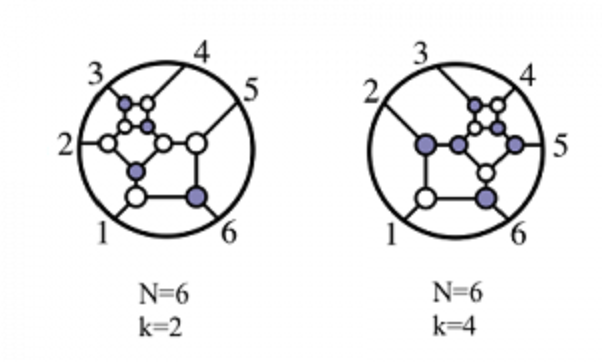
    This is another way of looking at the same corner of mathematical physics — one of over a hundred diagrams in the same paper— and here are the two “lesser” diagrams that caught my attention and made me think back to the Petersen graph boards earlier on today:

    twistor-diagrams- scientists discover a jewel

    Now my itch is to figure out what use the “filled” and “open” nodes in these two graphs might serve in game-playing terms, and how on earth to interpret in game terms the complex weavings of the colored lines in the larger image / board.

    **

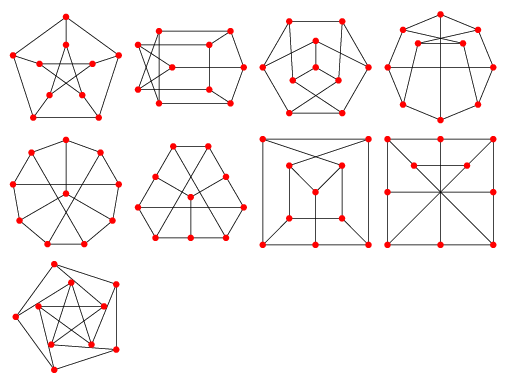
    And hey, while we’re at it, Here are the Wolfram variants on the Petersen graph — striking, aren’t they?

    PetersenGraphEmbeddings wolfram

    Food for thought is food for play.

    **

    Sources:

  • N. Arkani-Hameda et al, Scattering Amplitudes and the Positive Grassmannian
  • Nima Arkani-Hameda and Jaroslav Trnkab, The Amplituhedron
  • Check out the stunning physics — deeper than time and space? — if you don’t already know it, and explain it if you do!

  • Natalie Wolchover, A Jewel at the Heart of Quantum Physics
  • And for Wolfram on the Petersen Graph:

  • Eric W. Weisstein, Petersen Graph
  • At a snail’s pace

    Sunday, December 29th, 2013

    [ by Charles Cameron — leap frog in very slow motion, and leap razor too ]
    .

    As a poet, I don’t much like that old saw about a picture being worth a thousand words — but there’s a density of information in each of the images below that’s worth considering:

    **

    Two very striking images, in parallel, juxtaposed. What can we read into them, or out of them?

  • That a snail’s pace is always the same, no matter what obstacles it encounters?
  • That slow and steady wins the race?
  • That you can take the easy way, or you can take the hard way?
  • That you [Chinese Buddhists] can go for gradual or sudden enlightenment?
  • That the snail in the upper panel (in an artwork by Nancy Fouts) is enacting and or paying hommage to Colonel Kurtz‘s celebrated line from Apocalypse Now?

    I watched a snail crawl along the edge of a straight razor. That’s my dream; that’s my nightmare. Crawling, slithering, along the edge of a straight razor… and surviving.

  • What else? What do you see?
  • There’s power in images, and even more in juxtapositions.

    **

    Daffodils

    If one picture is worth
    a thousand words,
    what’s a bunch of Wordsworth?

    **

    Here the actor Jeremy Irons gives a refreshingly fresh reading of Wordsworth‘s poem:

    On Time and timeframes

    Monday, July 1st, 2013

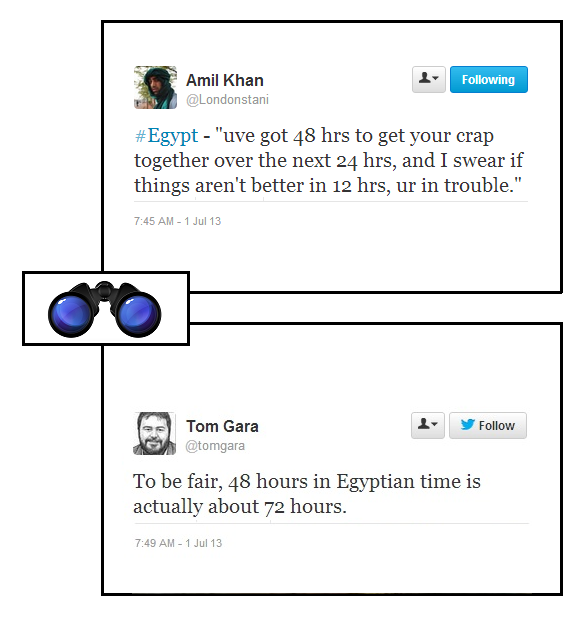
    [ by Charles Cameron — 48 hours, Egyptian time, can mean many things, also DoD foresight, next 48 hrs ]
    .

    We seem to have at least four “times” here, ranking from 12 to 72 hours — or zero to 72 if you take the Army’s announcement itself as a sort of starting pistol — and they’re operating, obviously enough, under different frames. The army likes nicely rounded numbers like “48 hrs”, PERT chart thinking gives you the least time available in which to take the first step towards a desired aim, here “12 hours” — and “24 hours” is the latest target time for serious, visible progress to avert “worst case” response preparations. Or something along those lines.

    And “72 hours”? That may be Egyptian elastic time, and thus roughly comparable to Lakota time

    The Lakota view of time was simple. “Time was never a specific minute, but rather spaces of time,like early morning, just afternoon or just before midnight. The real meaning of time could be summed up by the phrase “nake nula waunyelo” loosely translated it means:

    “I am ready for whatever, any place, any time, always prepared”.

    When work needed to be done, people were prepared to work late inthe fields or stay up until 3 am to finish goods to be sold at market.When no work needed to be done, they didn’t work.

    The irony is in the next comment:

    Policy makers saw an opportunity to improve things by installing awestern time ethic and a respect for the clock.

    I don’t know Egypt — but I have spent time “on Lakota time” and don’t wear a watch or carry a phone these days… The piece I drew those quotes from, Lessons from the Lakota: Time lessons for today’s managers, may or may not be useful advice for managers, but its overview-with-graphic of different time systems is worth a quick look. Anthropologists would be able to tell you more about individual cultures, but my point is that differing timeframes are among the major features of different worldviews, and we need to have a decent sense of them when we interface with them.

    So “72 hours” may be an instance of relaxed but purposive time, okay? Which wouldn’t necessarily fit well with starched and pressed military time.

    **

    And here’s the blockbuster:

    According to the Congressional Budget Office’s Analysis of DoD’s Future Years Defense Program from 2013, military foresight time runs five years ahead, while USG foresight time runs to 2030 at least:

    In most years, the Department of Defense (DoD) provides a five-year plan, called the Future Years Defense Program (FYDP), associated with the budget that it submits to the Congress. Because decisions made in the near term can have consequences for the defense budget well beyond that period, the Congressional Budget Office (CBO) regularly examines DoD’s FYDP and projects its budgetary impact over several decades. For this analysis, CBO used the FYDP provided to the Congress in March 2012, which covers fiscal years 2013 to 2017; CBO’s projections span the years 2013 to 2030.

    That’s confidence of a kind… but consider this:

    I know, I know — whatever happens in Egypt “momentarily” may turn out to be no more than an eddy briefly interrupting a larger time-flow in the “mid-term” — a phenomenon I’d like to map nicely with some river graphics one of these days.

    **

    But time? What was it St Augustine said of it?

    What, then, is time? If no one asks me, I know what it is. If I wish to explain it to him who asks me, I do not know.


    Switch to our mobile site