zenpundit.com » sunni

Archive for the ‘sunni’ Category

US Foreign Policy, Egypt and the Muslim Brotherhood

Wednesday, January 30th, 2013
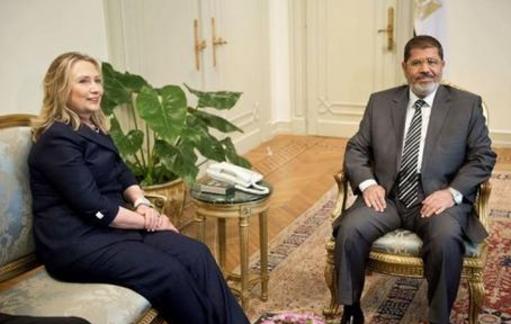
The Obama administration, though they would not characterize it as such nor have much desire to acknowledge it at all, have attempted  a strategic detente with the “moderate” elements of political Islam.

This policy has not been entirely consistent; Syria, for example, is a quagmire the administration has wisely refrained from wading directly into despite the best efforts of R2P advocates to drag us there.  But more importantly, under President Obama the US supported the broad-based Arab Spring popular revolt against US ally, dictator Hosni Mubarak, and pushed the subsequent ascendancy of the Muslim Brotherhood in Egypt and the Libyan revolution against the entirely mad Colonel Gaddafi. These appear to be geopolitical “moves” upon which the Obama administration hopes to build.

I would like to emphasize that there is one legitimate and valid strategic pro to this sub rosa policy; namely, if everything went well, it would provide the United States with powerful triangulation against revolutionary, apocalyptic, radical Islamism as expressed by al Qaida and various Salafi extremist movements. There are reasons, rooted in takfirism, strategy and the politics of lunacy that our terrorist enemies frequently hate and revile the Brotherhood as traitors, apostates or whatever. Isolating the most actively dangerous and violent revolutionary enemies from a large mass of potential allies is, at least, a good strategic goal.

It is also my view, that this “outreach” is as politically sensitive  to the Obama administration as was the China Opening was to Nixon and about which they have been equally opaque and misleading for fear of a domestic backlash. The weird, foot-dragging, dissembling, embittered, kabuki drama inside the Beltway about public statements and intelligence on whether Benghazi was caused by obscure crackpot Islamophobic film makers or a well-orchestrated terrorist attack  is in my view due to a major foreign policy strategy never having been framed in public for what it is. I’m sure people will differ strongly with me on this (which is fine), but I would characterize detente with Islamists as a strategic shift on par with the “Pivot to Asia”.

The downside here is that first, things are not likely to come out well at all, as unfinished revolutions tend to give birth to monsters; and secondly, any detente with “moderate” political Islam is an uncertain gamble based on certain exceptionally optimistic conceptions of not only what the Brotherhood might do, but about it’s very nature.

While the removal of Arab dictators resonated with American values , it was questionable realpolitik while the administration’s de facto support of  Egypt’s Muslim Brotherhood faction over poorly organized secular liberal modernists was an act of realpolitik that required a compromise of the democratic values so recently invoked to justify abandoning Mubarak. This was cynical diplomatic flexibility worthy of Talleyrand.

Unfortunately, the most democratic thing – perhaps the only thing – about Mr. Morsi and his Brotherhood supporters was his election.

The Egyptian people who are subjected now to thuggery from both Morsi’s Islamist stormtroopers and from the security forces of the Egyptian military are less sanguine than are the Brotherhood’s cheerleaders inside the administration. The Egyptian people, in fact, seem to be in revolt against domination by the Muslim Brotherhood’s shadow government.

The first question to ask in assessing if the Obama administration policy here is wise would be “What is the nature of the Muslim Brotherhood?” Americans love to personalize foreign policy, but if  Morsi were to be toppled or die, the Brotherhood will remain what it currently is, the best organized political force in Egypt and one widely influential throughout the Arab world and the West itself.

I am not an expert on the Muslim Brotherhood, nor am I an Arabist by education. Most of us aren’t – a group that I fear includes most of the Obama administration officials involved in shaping this policy. Almost fifty years after King Faisal determined to export Wahhabism, more than thirty years since Khomeini’s Revolution and more than ten years since 9/11 the USG still has less in-house expertise related to Islam than it did about the Soviet Union and Communism a decade after the Berlin Blockade.

Perhaps we all should begin learning more?

Here is an analysis from FPRI; it is extremely critical but it touches on organizational aspects of the Muslim Brotherhood that I have not seen elsewhere (hat tip to David Ronfeldt). Feel free to suggest others, both for and against. The Brotherhood is a very large group with a long history that includes violence , terrorism and subversion on one hand and peacefully representing expressions of pious, middle-class, social conservatism in other places and times:

Lecture Transcript: What Every American Should Know about Egypt’s Muslim Brotherhood, Delivered by Eric Trager 

….Two years ago when I was doing my dissertation fieldwork in Cairo, I sought out interviews with leaders from the Muslim Brotherhood, and I was referred to a man named Muhammad Morsi, now the President of Egypt. At the time, President Mubarak was ill and had gone off to Europe for operations amid a lot of mystery surrounding his health. I asked Muhammad Morsi whether the Muslim Brotherhood would run a presidential candidate if Mubarak died tomorrow. Here is what he said:

[From an audio file played by Trager]

Eric Trager: You don’t see the Muslim Brotherhood nominating a presidential candidate [if Mubarak dies tomorrow]?

Muhammad Morsi: No… because society is not ready… Our society is not ready yet to really defend its worth. We want a society to carry on its responsibilities, and we are part of this society. Another thing, if we are rushing things, then I don’t think that leads to a real stable position.

When he made that statement, I don’t think he was lying, and I don’t think he was being coy. I think that he didn’t expect that he would be faced with this reality in a mere six months. He did not expect that Mubarak would step down six months later and, to be completely honest with you, neither did I. My dissertation was entitled “Egypt: Durable Authoritarianism”—until the revolution.

What did Morsi mean when he said that the Brotherhood was trying to build a society? Let me give you some background on the Muslim Brotherhood. It was founded in 1928 by Hassan al-Banna, who was a schoolteacher in Ismailia. The Muslim Brotherhood’s goal was then—and remains now—to establish an Islamic state in Egypt. The way it pursues this goal is by trying to Islamize Egyptian society. Through social services, education, and the mosque, it sought to make Egyptians more religious and more Islamic as a grassroots strategy for building an Islamic state. That’s very, very different from a strategy that says, “We’re going to run for president, run for the Parliament, and use that power to transform society.” Rather, the Brotherhood says, in effect, “We’re going to Islamize society to build towards power.” It was a long-term strategy; it took them 84 years before they ran for and won the presidency. So Morsi told me in 2010 that the Muslim Brotherhood was not going to run for the presidency because it was not done Islamizing Egyptian society….

Read the rest here.

Rabbis, Islam & End of Days II, also 2013 Mahdism Update, II

Tuesday, January 22nd, 2013

[ by Charles Cameron — continuing my updating of Mahdist issues, also surprising parallels and oppositions ]
.

By the time you’ve learned the various signs of the times — pre-, mid- and post-trib rapture dispensationalist, preterist, Mormon, I dunno, ecological, Sunni, Shiite — the list, like Tolkien‘s Road, goes ever on — who’s on which side, and who might be somebody else’s something — you may feel as confused as I do.

**

The very first sentence of Tim Furnish‘s book, Holiest Wars: Islamic Mahdis, their Jihads and Osama bin Laden — which I may never tire of quoting — reads:

One man’s messiah is another man’s heretic.

I was rereading the amazing section on the Gharqad tree in Anne Marie Oliver and Paul Steinberg‘s book, The Road to Martyrs Square, the other day, and noticed on p. 21 yet another intriguing variant on Furnish’s point:

Even before the intifada, the figure of the Dajjal was equated by many Islamists with the Jewish Moshiach, the Messiah, as when the highly influential Pakistani Islamist Malauna Maududi claimed in the 1960s that “the stage has been set for the emergence of the Dajjal who, as was foretold by the Holy Prophet (PBUH), will rise as a ‘Promised Messiah’ of the Jews.” By the late intifada, the equation was commonplace in the West Bank and Gaza. When the Lubavitcher Hasidim in the early 1990s began to refer to Rabbi Menachem Mendel Schneerson as the Messiah, the claim had considerable effect on Palestinian Islamists. Some actually began to include Schneerson on their list of False Prophets, referring to him as “the Antichrist Liar.”

**

Compare this, however, with the Muslim Harun Yahya‘s willingness to declare his expectation of the King Messiah / Moshiach in the screen-cap below. Yahya is presumably referring to the same salvific end-times figure he elsewhere refers to as the Mahdi.

Here we have the reverse possibility to the one Furnish points to — it certainly looks as though here, one man’s Messiah is another man’s Mahdi. On one of his websites, King-Messiah.com, Yahya makes the identification of these figures from two traditions explicit:

And “King Messiah” is a particularly interesting phrase for Yahya to use — among other things, it’s the term some followers of the late Lubavitcher Rebbe Schneerson use to describe their rebbe.

**

As I pointed out two days ago in Expecting the unexpected: Rabbis, Islam, and the End of Days, there’s a whole lot going on here, and it takes patience to tease all the strands out…

One of these days I’ll have to put together an extended list of messiah / mahdi correspondences — and prophet / false prophet and christ / antichrist correspondences between competing eschatologies, too, both within specific religions and across them.

I suspect Ayatollah Muhammad Baqir al-Sadr was thinking along similar lines to Yahya when he wrote the paragraph I quoted towards the end of The Messianic Mahdist Moebius strip — or maybe Maze?:

The Mahdi is not an embodiment of the Islamic belief but he is also the symbol of an aspiration cherished by mankind irrespective of its divergent religious doctrines. He is also the crystallization of an instructive inspiration through which all people, regardless of their religious affiliations, have learnt to await a day when heavenly missions, with all their implications, will achieve their final goal and the tiring march of humanity across history will culminate satisfactory in peace and tranquility. This consciousness of the expected future has not been confined to those who believe in the supernatural phenomenon but has also been reflected in the ideologies and cult which totally deny the existence of what is imperceptible. For example, the dialectical materialism which interprets history on the basis of contradiction believes that a day will come when all contradictions will disappear and complete peace and tranquility will prevail.

The Iranian scholar Muhammad Ali Shumali, whom I also quoted, said much the same:

Imam Mahdi is not a saviour for [just] the Shias. Imam Mahdi is a saviour for all mankind…

**

Parallels and oppositions…

My language here will probably not be precise enough for mathematicians or logicians — but isn’t the thing that most closely resembles another thing its exact opposite?

And to give this already twisty rope yet another twirl… not in terms of apocalyptic, but of Jewish / Muslim relations more generally…

Here’s Pastor John Hagee — the preacher who was so far right that Sen. John McCain rejected his endorsement in the 2008 presidential campaign — talking with Rabbi Daniel Lapin about Muslims being blessed, and how their five-times-daily prayers are particularly listened to by God:

These unpredictable “outlier” nuances and their attendant shocks and surprises are ongoing…

**

The “signs” graphic at the head of this post is from a post titled Preparing for the Second Coming on LDS Why? — you can download their answers for teens in Chapter 12 of the book The Big Picture. It begins:

Imagine it’s a bright and sunny afternoon, and as you drive down the road with your parents you look up and notice that the sky looks different than normal. The clouds are luminescent, bright, and heavenly. Suddenly, without warning, the sky seemingly bursts open and the veil between heaven and earth is split. Trumpets start sounding from the sky, and you see above you the most glorious being your mind could ever conceive of descending out of heaven and touching down on earth — Jesus Christ in all His glory…

That’s a sign that might be hard to miss…

Ashura: the Passion of Husayn

Sunday, November 25th, 2012

[ by Charles Cameron — today’s solemn commemorations in Iraq, Afghanistan, Pakistan and India in comparative religious perspective ]
.

I was listening to Mozart‘s Requiem last night, and it is rich in grief shot through with glory. That’s the thing about mourning celebrations in which death is accompanied by the “sure and certain hope of the Resurrection into eternal life”.

One such observance is found in Shia Islam, and falls this year on the 25th of November — today. It is the day of Ashura, the 10th day of Muharram in the Islamic calendar, and its epicenter is at Karbala in Iraq. As the saying goes:

Every day is Ashura and every land is Karbala.

For the Shia, Ashura commemorates the martyrdom of Husayn, grandson of the Prophet, at the Battle of Karbala, when he refused to give allegiance to the Umayyad caliph Yazid. Husayn’s martyrdom is dramatized in Ta’zieh, passion plays, giving us a hint that the martyrdom of Husayn at Ashura figures in the devotional life of the Shia much as the passion and death of Christ figures within Christianity, both in passion plays such as that at Oberammergau and in Catholic rituals such as the Stations of the Cross. This may seem a far-fetched analogy to some of my readers, but both deaths are viewed as redemptive. As another saying has it:

A single tear shed for Husayn washes away a hundred sins.

**

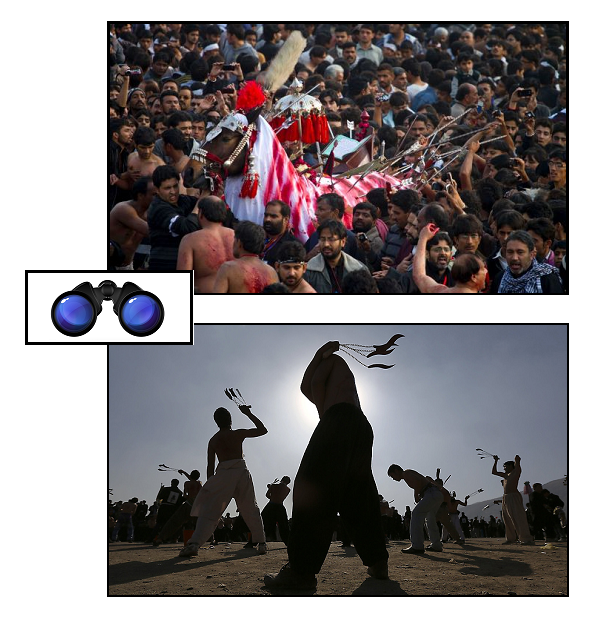
As you can see depicted in the lower panel above, Shiite mourning can include flagellation with chained blades, not something that sits easily with most westerners — yet as Roy Mottahedeh has said (quoted in SA Hayder, Reliving Karbala: Martyrdom in South Asian Memory):

Self-mutilation in emulation of the “passion” of heroes who are human yet divine is no stranger to the West: flagellants who whipped themselves both in penance and in remembrance of the scourging and crucifixion of Jesus appeared in almost every western European country in the Middle Ages…

The upper panel above depicts Husayn’s horse, riderless and bloody, and can perhaps give us some sense of the dark ceremonial beauty of the occasion for those whose grief transcends time and unites them in aspiration with Husayn himself — their flagellation attesting to their wish that they themselves could have stood beside him on that day so long ago, standing for truth against an army of injustice.

**

Their grief may be trans-temporal, but the possibility of dying for their faith persists to this day, for Sunni militants of the jihadist sort view Ashura differently — primarily as a day of fasting first performed by Moses and continued by Muhammad — and detest the breakaway sect of the Shia as rafidun, heretics.

In Iraq, Ashura there has seen millions of pilgrims visiting Karbala this year, with comparatively little violence:

Millions of Shiites flooded the Iraqi shrine city of Karbala on Sunday for the peak of Ashura rituals, which have been largely spared the attacks that struck pilgrims in past years. A bomb wounded 10 pilgrims in Diyala province, north of Baghdad, but it was the first such attack since a car bomb against pilgrims killed three people on November 17.

Farther afield, what the Pakstani police describe as a “major terror plot to attack the Muharram processions in Karachi” was avoided this year when “large amounts of explosive material, two suicide jackets and grenades” were confiscated during a raid, with the Minister for Religious Affairs declaring that the Tehreek-e-Taliban were behind the plots. Elsewhere in Pakistan:

At least five persons were killed and over 70 others injured on Sunday when a Shia procession was targeted with a bomb at Dera Ismail Khan in Pakistan’s restive northwest, the second such attack in the city in as many days.

Meanwhile in Kabul:

For the past week, the Afghan capital has been draped with black cloth arches and festooned with huge colored banners. Mournful, pounding chants pour from loudspeakers across the city, filling the air with slow martial intensity.

The dramatic display is all part of Muharram and the 10-day Shiite festival that commemorates the slaying of Imam Hussein, a 7th-century holy figure and early champion of Islam. But it is also a symbol of the growing religious and political freedom that Afghanistan’s long-ostracized Shiites have had in the past decade.

That’s from a Washington Post piece yesterday titled Afghan’s Shiite minority fears a return to old ostracism — and the next two paragraphs bear out the title:

Now, as Western military forces prepare to leave the country by 2014, Afghan Shiites, most of whom are from the Hazara ethnic minority, fear that their window of opportunity may slam shut again, leaving larger rival ethnic groups as well as Taliban insurgents, who are radical Sunni Muslims, dominating power.

“Everything we have achieved, our ability to come out and participate in society, has been in the shade of the international community and forces,” said Mohammed Alizada, a Hazara Shiite who was elected to parliament in 2009. “We are very concerned that once they leave, the fundamentalists will reemerge, ethnic issues will return, and we will lose what we have gained.”

Tribal politics, sectarian issues, the impending departure of US forces, the Taliban, cross-border alliances — and the sheer power of devotion — all these are intricately intertwined in today’s Afghanistan and its future. We may do well to understand something of the meaning of this day of Ashura, in our own calendar, 25th November 2012.

**

Annemarie Schimmel, the great Harvard scholar of Islamic mysticism, has a fine essay on the poetry of Ashura, encompassing both Sunni and (strongly Shia-influenced) Sufi traditions, Karbala and the Imam Husayn in Persian and Indo-Muslim literature. The mindset is very different from contemporary secular westernism, seeing death itself — and the grief that accompanies it — as a prelude to resurrection, and thus part of the timeless love-play of God with those who love him:

In having his beloved suffer, the divine Beloved seems to show his coquetry, trying and examining their faith and love, and thus even the most cruel manifestations of the battle in which the ‘youthful heroes’, as Shah Latif calls them, are enmeshed, are signs of divine love.

The earth trembles, shakes; the skies are in uproar;
This is not a war, this is the manifestation of Love.

The poet knows that affliction is a special gift for the friends of God, Those who are afflicted most are the prophets, then the saints, then the others in degrees’, and so he continues:

The Friend kills the darlings, the lovers are slain,
For the elect friends He prepares difficulties.
God, the Eternal, without need what He wants, He does.

**

The spirit here is not too far from that of the Greek philosopher Plotinus, who wrote in his Enneads [III.ii.15]:

Men directing their weapons against each other- under doom of death yet neatly lined up to fight as in the pyrrhic sword-dances of their sport- this is enough to tell us that all human intentions are but play, that death is nothing terrible, that to die in a war or in a fight is but to taste a little beforehand what old age has in store, to go away earlier and come back the sooner.

together with that of the early Christian Father, Origen, who wrote [De Martyrio, 39]:

And let each of us remember how many times we have been in danger of an ordinary death, and then let us ask ourselves whether we have not been preserved for something better, for the baptism in blood which washes away our sins and allows us to take our place at the heavenly altar together with all the companions of our warfare.

**

In India, indeed, the martyrdom of Husayn takes on an interfaith character in some places, as Hindus and Christians join Muslims in Ashura commemorations, as Naim Naqvi relates:

One can observe the richness and beauty of the diversity of Indian Culture at the occasion of Muharram. Since the martyrdom of Imam Hussain, Muharram ceremonies are observed all over the world including India. Hindus take part in them with great reverence and devotion. The tragedy of Karbala has become the harbinger for interfaith understanding in the Indian sub-continent. Participation of Hindus in the mourning rituals of Imam Hussain has been a feature of Hinduism for centuries in large parts of India. Hindus, Sikhs, Jains and even Christians observe Muharram. In the city of Varanasi which is the holiest city for Hindus many Hindu families participate in Muharram processions.

Describing the participation of one such Hindu family in Orissa, we read:

District police chief Lalit Das said Padhihary family has been doing this every year for the last 338 years, adding other local Hindu families also participate in the procession.

Muslims said it reflected the perfect harmony between the two communities in the area.

An army in Sham, an army in Yemen, and an army in Iraq

Thursday, November 1st, 2012

[ by Charles Cameron — uh-oh, it’s Mahdi time again.. giving a little wide-angle context, then passing along a hadith of possible current interest — also an aside about an end-times Shiite trinity ]
.

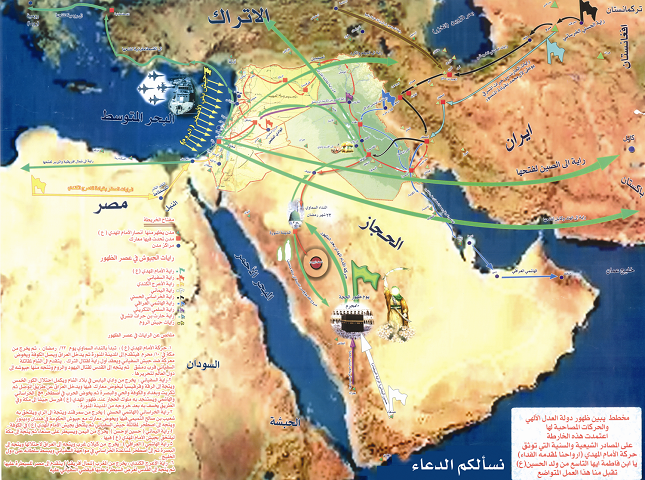
a ShiaChat map of one end times scenario: the Sufyani will attack Iran, black banners come from Khorasan

.

We live, as everyone pretty much agrees, in some place called “here” (although that shifts) at a particular moment called “now” (although that shifts too) in a medium often called “spacetime” in honor of Albert Einstein.

The Game-changing Coming Ones of many religions and sects – and even their secular variants, the Game-changing Coming Ideologies and Leaders) – are situated in another area of the same “spacetime” continuum for their respective believers: next up after “wars and rumors of wars” or “come the revolution” or “when the Mayan Calendar runs out” or “next year in Jerusalem”…
.

When:

My old friend Stephen O’Leary suggests there’s a shifting “window of opportunity” for people who preach “soon comings” – if you warn people that the world will end in a couple of thousand years, or with the heat death of the sun, or even that sea levels are liable to rise precipitously over the next few decades unless remedial action is taken, the view is long-range enough to seriously diminish your impact. Conversely, if you announce the end of the world will occur three minutes from now, nobody has time to get scared or prepared – or to propagate your message.

So “soon coming expectations” generally predict the coming is a little ways around the corner, close enough to matter but no close enough to sell all that you possess and climb Mt Ararat this week.
.

Where:

The “where” is interesting, though. We have news cameras focused 24/7 on the Mount of Olives to catch the Second Coming of Christ, although most observant Jews won’t be expecting that Christianity will be finally vindicated as the true inheritor of Judaism’s mantle there any time soon, and many Muslims expect he’ll descend at one of the minarets of the Umayyad Mosque in Damascus.

And the Mahdi? Two popular points of anticipated arrival are beside the Kaaba in Mecca, or out of the well behind the Jamkaran mosque, not too many miles from Qom.

But Islamic apocalyptic geography doesn’t end with either place – it extends, minimally, from Khorasan (Iran or Afghanistan) to Jerusalem, with a possible side-expedition to India (the Ghazwa-eh-Hind) and with possible tributaries from Africa and who knows where else… and in at least some Shia strands of apocalyptic thinking, the city of Kufa in Iraq will be the Mahdi’s seat of government.
.

And now, the hadith:

All this is simply to provide some context for a specific hadith that my friend Aaron Zelin pointed to me today, as recorded yesterday on the Kavkaz Center webpage:

Hadith about Syria, Iraq and Yemen

Publication time:
30 October 2012, 14:58

Sham – the territory of Syria, Palestine, Jordan and Lebanon

Abdullah ibn Hawalah [Allah's blessings be on him] narrated from the Messenger of Allah (pbuh) that he said:

"Matters will run their course until you become three armies: an army in Sham, an army in Yemen, and an army in Iraq".

Ibn Hawalah said:

"Choose for me, O Messenger of Allah! in case I live to see that day".

The Messenger of Allah (pbuh) said:

"You should go to Sham, for it is the best of Allah's lands, and the best of His slaves will be drawn there!

And if you refuse, then you should go to the Yemen and drink from its wells. For Allah has guaranteed me that He will look after Sham and its people!"

(Imam Ahmad 4/110, Abu Dawud 2483. Authenticated by Imam Abu Hatim, Imam ad-Diya al-Maqdisi, Sheikh al-Albani and Sheikh Shu'aib Al-Arnaut).

Department of Monitoring
Kavkaz Center

.
Further reading:

For more on this, see especially J-P Filiu‘s Apocalypse in Islam, noting in particular his account of “the revelation of Abu Musab al-Suri” (pp. 186-193), including specifically his discussion of “Sham” in a paragraph on p. 189.

*****

And an intriguing aside:

And since were talking Yemen and the greater Sham here, it may be worth noting as an aside, the presence in Islamic apocalyptic traditions of a figure known as the Yemeni — sometimes identified in Iranian Shia apocalyptic as Hezbollah’s Hasan Nasrallah. Filiu writes (p.156) of:

Shaykh Nazrallah’s transformation into the apocalyptic figure of the Yemeni, completing a very political trinity in which Ayatollah Khamenei served as the standard bearer of the Mahdi and Ahmadinejad as the commander of his armies.

Filiu’s book was published in France in 2008, but the same trinity can also be found in the fairly recent video The Coming is Upon Us attributed by Reza Kahlili to circles around Ahmadinejad. I’ve taken this account of the video and the trinity as it reports it from the Counter Jihad Report, because their version succinctly draws together the strands that most concern me here:

A little-noticed documentary titled “The Coming is Upon Us” was produced by Ahmadinejad’s office last year and it lays out the regime’s beliefs and planned path forward, much like Mein Kampf did. And it debunks the notion that the U.S.S.R. and the Iranian regime are equivalent. The film makes the case that the regime’s leaders are the incarnations of specific End Times figures foretold in Islamic eschatology.

Iran is the “nation from the East” that paves the way for the Mahdi’s appearance. Supreme Leader Khamenei is Seyed Khorasani, “the preparer” who comes from Khorasan Province with a black flag and a distinct feature in his right hand. Khamenei’s right hand is paralyzed from an assassination attempt. Khorasani’s commander-in-chief is Shoeib-Ebne Saleh, who the film says is President Ahmadinejad. Hezbollah chief Hassan Nasrallah is the incarnation of Yamani, a commander with a Yemeni ancestry who leads the Mahdi’s army into Mecca.

These three “preparers” wage war against the Antichrist and “the Imposters”-the U.S., Israel and the West’s Arab allies. The film also mentions that a figure named Sofiani will side with Islam’s enemies. Former Iranian Revolutionary Guards officer Reza Kahlili, who leaked the film, told me that the full-length version identifies him as Jordanian King Abdullah II.

The film lists various End Times prophecies that have been fulfilled to argue that the Mahdi’s appearance is near. The 1979 Islamic Revolution in Iran; the invasion of Iraq from the south and subsequent sectarian violence and death of Saddam Hussein; the Houthi rebellion in Yemen; the fall of Egyptian President Hosni Mubarak and the increasing amount of open homosexuality, cross-dressing, adultery and women taking off the hijab are correlated to specific Islamic prophecies.

As to the video’s authenticity and provenance, I can only express my ignorance and keen interest — but whatever the case, it seems likely that the split between Khamenei and Ahmadinejad, together with the latter’s “soon going” from office, renders that particular strain of prophecy moot.

Particular prophetic timelines may fail, and indeed do so repeatedly — the apparatus of apocalyptic hope simply incorporates new figures and events into its calculations, and moves its sense of urgency a little further up along the timeline…

The Messianic Mahdist Moebius strip — or maybe Maze?

Monday, October 29th, 2012

[ by Charles Cameron — a quick look at some confusing clashes between messianisms, with specific reference to the MUJAO — also the late Ayatollah Baqir al-Sadr sounding an ecumenical note ]
.

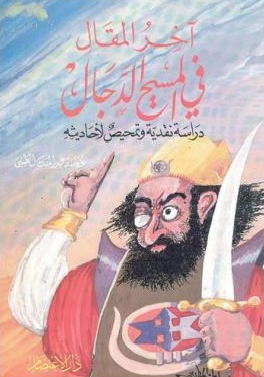
image: Dajjal, from Okasha Abdelmannan al-Tibi's The Whole Truth about the Antichrist

.

Tim Furnish opens his book Holiest Wars: Islamic Mahdis, their Jihads and Osama bin Laden, with the words:

One man’s messiah is another man’s heretic.

What he doesn’t state outright, which is also true, is that all too often that heretic is the anti-Messiah.

**

I use that term “anti-Messiah” deliberately, because in discussing Islamic end times beliefs, the term “Antichrist” is frequently used by both Christians and Muslims to refer to the Muslim “equivalent” of the Christian Antichrist — ie the “deceiving messiah” or Masih al-Dajjal, whose coming at the end of days is predicted in Islamic apocalyptic narratives in negative counterpoint to the coming of the Mahdi, in much the same way that some Christian apocalyptic narratives predict the coming of the Antichrist in negative counterpoint to the return of the Christ.

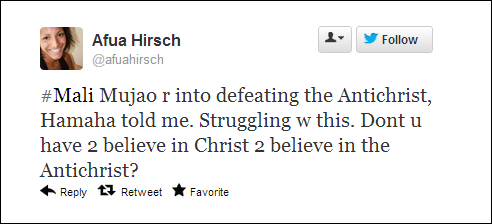
This issue was brought home to me once again today when Aaron Zelin pointed me to this tweet from Afua Hirsch [ @afuahirsch ], West Africa Correspondent for the Guardian:

Frankly, I think that’s a very natural question to raise, and one that has an even more intriguing answer.

**

One other note, which I’ve separated out between asterisks here because I think it’s a crucial one at that:

by Afua Hirsch’s account, Mali’s Movement for Unity and Jihad in West Africa (MUJAO) has the apocalyptic fever…

**

Strange things happen when different views of the end times, as prophesied one way or another in various branches of all three Abrahamic religions, clash.

Here’s where I see the moebius strip effect, whereby apocalyptic figures are turned into their opposites by rival sets of beliefs:

Some Muslims call the Dajjal (literally, “the deceiver”) the Antichrist — here, for instance, is a video clip of Sheikh Imran Hosein, whom I have discussed on Zenpundit before, quoting a hadith or tradition of the Prophet from the Sahih Muslim collection, and using the term “Antichrist” without further comment in his translation of the term Dajjal —

While some Christians call the Mahdi the Antichrist — as does Joel Richardson in his book currently issued under the title The Islamic Antichrist: The Shocking Truth about the Real Nature of the Beast. Reviewing the book in its first edition under its earlier title, Dr David R. Reagan sums Joel’s basic points succinctly:

Joel Richardson in his book Antichrist: Islam’s Awaited Messiah argues that the Mahdi will be the Antichrist of the Bible and that the Muslim Jesus will be be the False Prophet of the Bible who serves the Antichrist and his purposes. Both will be destroyed when the true Jesus returns at the end of the Tribulation.

We were talking about the Sufyani just the other day, right? Here’s a stunner to spin your head a further 180 degrees — the Sufyani as a second (and more dangerous) Dajjal than the Dajjal:

While the great Dajjal focuses on atheism and fights Christianity, the Islam Dajjal, Sufyan, fights Islam, which is the only true religion before Allah, openly. Therefore he is regarded as more frightening.

There’s also a question of one and / or many Antichrists in Christianity, of course — see 1 John 2:18:

Little children, it is the last time: and as ye have heard that antichrist shall come, even now are there many antichrists; whereby we know that it is the last time.

And hey, bear with me, I’m not done yet: members of the Ahmadi school quote a hadith from the Sunan Ibn Majah collection which says:

There is no Mahdi but Jesus son of Mary.

Ibn Majah, however, also has a hadith in which it is stated that at the time of the Mahdi’s advent he will invite the returning Jesus to lead the evening dawn prayer [as quoted here]:

…while their Imaam will have advanced to pray the Fajr prayer with them, Eesa, the son of Mary will descend [at the time of the Fajr prayer]. The Imaam will draw backward so that ‘Eesa would go forward and lead the people in prayer. However, ‘Eesa would put his hand between his shoulders and say to him: “Go forward and pray, as it is for you that the call for the prayer was called, so their Imaam would lead them in prayer.”

**

Confusing?

I think so, unless you are paying close attention.

My own recommendation would be that the phrase “the Islamic Antichrist” should be replaced by “the Islamic equivalent of an Antichrist” when referring to the Dajjal, and “the Mahdi viewed as Antichrist” when referring to the Mahdi.

I know, I know — the chances of changing people’s verbal habits across the board are pretty slender.

But have I made things seem complicated enough?

**

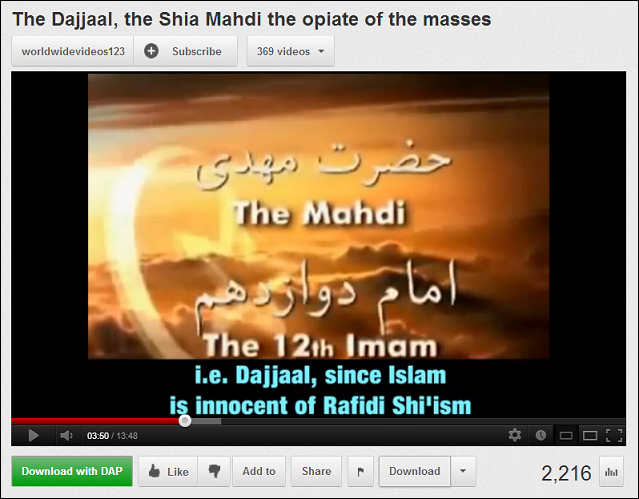
This whose business naturally gets just a tad more complicated once one adds in the Sunni concept — I am not sure how widespread it is, but it would make a fascinating topic for research for someone with the requisite language skills — that the Mahdi of the Shiites will be the Dajjal of the Sunni… as shown in this screen cap of a YouTube video.

[Rafidi means one who has deserted the truth, and is a derogatory term, in this case used by Sunnis to disparage the Shiites.]

Or this one — with its equation of the Shiites with the Jews:

Of course, Christianity too has its share of internecine apocalyptic mud-slinging: Rev. Ian Paisley (long-time leader of the Ulster Unionists and Moderator of the Free Presbyterian Church of Ulster) interrupted Pope John Paul II‘s speech at the European Parliament to denounce him as the Antichrist — while Rev. JD Manning gives Oprah Winfrey that title

**

Everything I have described above is dualistic in nature and sectarian in its specifics. It comes as something of a surprise, then, to find the late Ayatollah Muhammad Baqir al-Sadr quoted as writing:

The Mahdi is not an embodiment of the Islamic belief but he is also the symbol of an aspiration cherished by mankind irrespective of its divergent religious doctrines. He is also the crystallization of an instructive inspiration through which all people, regardless of their religious affiliations, have learnt to await a day when heavenly missions, with all their implications, will achieve their final goal and the tiring march of humanity across history will culminate satisfactory in peace and tranquility. This consciousness of the expected future has not been confined to those who believe in the supernatural phenomenon but has also been reflected in the ideologies and cult which totally deny the existence of what is imperceptible. For example, the dialectical materialism which interprets history on the basis of contradiction believes that a day will come when all contradictions will disappear and complete peace and tranquility will prevail.

The point is made even more clearly in a speech given by the Iranian scholar Muhammad Ali Shumali:

So, our own camp comprises of people who have this understanding: First of all, they are the people who believe in the Ahl al-Bayt. Yet, in our camp it is possible for there to be people who work for the Ahl al-Bayt without knowing the Ahl al-Bayt. This is also something very important. You may have a non-Shia who works for the Ahl al-Bayt better than many Shias. Indeed, you have some Shias that work against the Ahl al-Bayt. You may even have non-Muslims who are working for Imam Mahdi—for the cause of Imam Mahdi, for justice, for many things—and they may not even know who Imam Mahdi is. So it is not that whoever is not a Shia is not in our camp.

and:

I believe that the majority of the people of the world are not against us; it is just our failure to present our ideas and to convince them that what we have is for all mankind. I think in particular, in the case of Imam Mahdi, we must do the same thing: we must not present Imam Mahdi as a saviour for the Shias. Imam Mahdi is not a saviour for [just] the Shias. Imam Mahdi is a saviour for all mankind…

**

And then you see what you yourself see, and believe what you yourself believe.


Switch to our mobile site