zenpundit.com » bach

Archive for the ‘bach’ Category

A trumpet voice above Trump’s

Monday, July 25th, 2016

[ by Charles Cameron — for those wishing for discourse above the political fray ]
.

Yesterday, Sunday, I was going to post a “Sunday surprise” about a voice that transcends that of Donald Trump — the voice of Alison Balsom, trumpeter extraordinaire. But my thread linking Balsom and Trump was a slender one — Trump and trumpet — and I thought better of it, and deleted my reliminary notes for that post.

Today, though, I read Humera Afridi‘s Dance of Ecstasy: Bridging the Secular, Sacred, and Profane, and found therein:

Amjad Sabri, an eminent Pakistani qawwal -— a Sufi devotional musician in the tradition of world-renowned Nusrat Fateh Ali Khan, and son of the famous singer Ghulam Fareed Sabri of the Sabri Brothers — had been shot dead in his car in Karachi ten days earlier by the Pakistani Taliban. He’d been praising the Prophet Muhammad (pbuh) and his noble family a little too much for the Taliban’s liking. And so they had their way with him. In a nation inured to violence, Sabri’s death, nevertheless, struck at the communal soul of Pakistan. ..

Thousands of Pakistanis came out on the streets, united in grief, to protest Sabri’s death. Sabri was a child of Pakistan’s own soil. He belonged to a venerable, centuries-old musical dynasty. His spiritual attunement and the muscular faculty of his voice transported people to ecstasy, raising mere mortals above the denseness of an earthly, mired existence, above differences of class and wealth into a celebration of the Divine. Sabri’s music was a glorification. And it belonged to a distinct tradition of South Asian music, a legacy irrefutably inherent in the DNA of Pakistan, twinned to the devotional practice of Islam and its syncretic cultural roots in the region. Invoking a transcendent joy, Sabri’s qawwali created a milieu of harmony—completely antithetical to the Taliban’s backward, beclouded ideology of hate which thrives on sowing seeds of discord.

**

It’s that second paragraph I’m interested in, because it says so exactly what I was trying to get at in my deleted post about Alison Balsom: that “mere mortals” can be lifted, lofted “above the denseness of an earthly, mired existence, above differences of class and wealth into a celebration of the Divine”.

Here’s a taste of Amjad Sabri, for those who appreciate the Sufi tradition and the haunting ecstasies of the Qawwals:

**

And here’s Balsom, whose trumpet voice likewise lifts us, for those with ears more attuned to the western classical tradition:

*

— and best of all, though I’ve posted it here before:
Sunday surprise: Bach BWV 998

Sunday, July 17th, 2016

[ by Charles Cameron — with a ramble via his peerless peer, Shakespeare ]
.

What’s a piece of music worth, on paper?

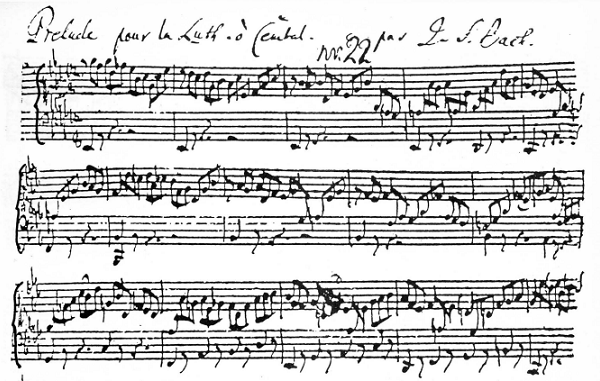
BWV 998 MS image

**

I had the good fortune some decades ago to be invited to attent Dr Homer Swander‘s seminar at the Oregon Shakespeare Festival in Ashland. Dr Swander is notable among Shakespearean scholars for his insistence that the texts we have of the plays are not themselves works of art, but serve the same function with respect to actual performances that an anrchitect’s blueprints serve with respect to a house, or a musical score to the performance of a work of music. Dr Swander dedicated much of his life to Shakespeare‘s plays, so we should not imagine that he thought little of the First Folio — or indeed of the First Quarto of Hamlet with its truncated soliloqy beginning:

To be or not to be, ay there’s the point,
To die, to sleep, is that all? Ay all:

[for the original spelling, see this facsimile ©The British Library]

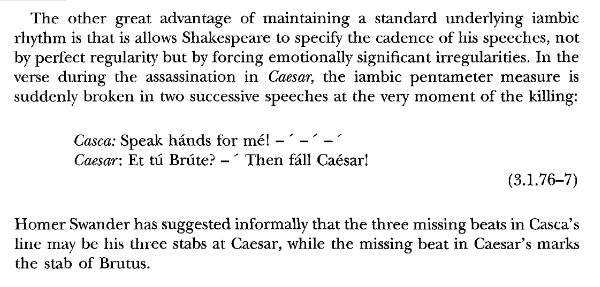
— it’s simply that he saw them as prelimiaries, not the thing itself. This in turn allowed him to “see” aspects of the plays from a director’s standpoint, with intriguing results:

Swander Caesar
Hugh Macrae Richmond, Shakespeare’s Theatre: A Dictionary of His Stage Context

You should have seen Dr Swander stab that point home!

But to return to Johann Sebastian Bach.. Similarly, we may ask ourselves, what’s the manuscript score of a great work of music worth?

**

Christie’s auction house in London has one answer for us in ther case of Bach’s Prelude, Fugue, and Allegro in E-flat major, BWV 998 — $3.3 million:

Valuable Bach manuscript goes under the hammer

The manuscript’s value was originally estimated at between 1.5 and 2.5 million pounds (between 2 and 3.3 million dollars). At the auction on Wednesday (13.07.2016) in London, the final bid came in at the high end of expectations.

Likely written between 1740 and 1745, the Prelude, Fugue and Allegro in E-flat Major (BWV 998) is a favorite among both harpsichords and lutenists. Like many works by Johann Sebastian Bach (1685-1750), it can be played on different instruments, which is expressly indicated on this score in the composer’s handwriting: “Prelude pour la Luth ò Cembal” (for lute or keyboard).

That’s its current cash value as judged by the market.

**

But what’s it worth — to you, to me, to life?

Nicholas Harnoncourt
explains:

**

I am grateful as always to my friend Michael Robinson of Ornamental Peasant for pointing me to the sale at Christie’s — and to this remarkable piece.

That Bach Chaconne

Sunday, May 8th, 2016

[ by Charles Cameron — JS Bach in Palmyra, in the DC Metro, and variously on YouTube ]
.

I have to applaud Putin and the Russians for bringing the full orchestra of the Mariinsky Theater from St Petersburg to Palmyra now that the Islamic State has departed, with added kudos for choosing Bach‘s towering Chaconne from his Partita No. 2 in D minor, BWV 1004 as one of three works to be played there — by the Tchaikovsky Competition winning soloist Pavel Milyukov:

As I say, I applaud the gesture. OTOH, British Foreign Secretary Philip Hammond, according to Breitbart, called the event “a tasteless attempt to distract attention from the continued suffering of millions of Syrians” and said it “shows that there are no depths to which the regime will not sink.”

**

This may not be the greatest performance of that work musically, but the work itself is extraordinary. Johannes Brahms said of it:

On one stave, for a small instrument, the man writes a whole world of the deepest thoughts and most powerful feelings. If I imagined that I could have created, even conceived the piece, I am quite certain that the excess of excitement and earth-shattering experience would have driven me out of my mind.

**

It was famously this Chaconne that violinist Joshua Bell played — twice — with his violin case open to receive tips, in DC’s L’Enfant Plaza metro station, during a 45 minute anonymous session in which he netted $32. $32 and change, for a man whose upcoming performance with the National Symphony Orchestra at DC’s Kennedy Center (February 11, 2017) is ticketed at $216 or $223, depending on how well seated you wish to be…

Here’s the poorly recorded, hidden videocam account of the second of those performances, which starts at about the 30’15” mark:

Gene Weingarten‘s description of the event in the Washington Post, Pearls Before Breakfast, won the Pulitzer..

**

For the fullest musical appreciation, here is that same Joshua Bell playing the Chaconne in 2014 in the DeLaMar Theater, Amsterdam:

Hillary Hahn, also superb:

The no less beautiful Hélène Grimaud, playing the Busoni transcription for piano:

And last, violinist Christoph Poppen plays the Chaconne, with added chorale motifs as reconstructed by violinist turned musicologist Helga Thoene sung by the Hilliard Ensemble — the culmination of the group’s celebrated album, Morimur:

Post-modern adaptation, or quintessential Bach? Either way, I find the entire project enthralling.

Theology for artists and musicians, Buddhist & Christian

Monday, April 18th, 2016

[ by Charles Cameron — with side-trips to China, ancient and modern ]
.

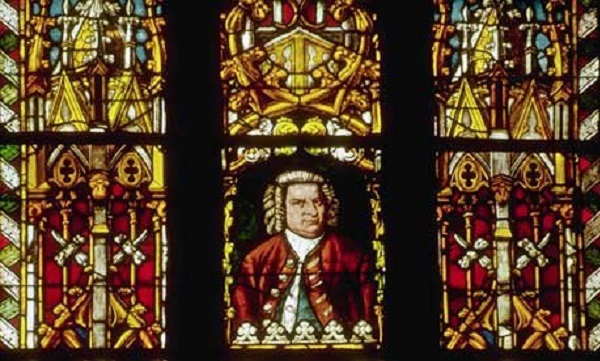
The-Bach-Window-Saint-Tho-007
Bach window in the Thomaskirsche, Leipzig, where Bach was Cantor

**

The Dalai Lama has a fascinating article out about reincarnating lamas (“tulkus”) which has direct relevance to discussions of what happens when he died — whether he decides to reincarnate as a new Dalai Lama, whether the Chinese decide to do it for him, etc.

I learned a lot — but the piece that really caught my eye was this:

The Emanation Body is three-fold: a) the Supreme Emanation Body like Shakyamuni Buddha, the historical Buddha, who manifested the twelve deeds of a Buddha such as being born in the place he chose and so forth; b) the Artistic Emanation Body which serves others by appearing as craftsmen, artists and so on; and c) the Incarnate Emanation Body, according to which Buddhas appear in various forms such as human beings, deities, rivers, bridges, medicinal plants, and trees to help sentient beings.

I love the ontology that gives us “human beings, deities, rivers, bridges, medicinal plants, and trees” and which reminds me of Borges‘ scheme, allegedly derived from a Chinese encyclopedia, The Celestial Empire of benevolent Knowledge, for the classification of animals:

In its remote pages it is written that the animals are divided into: (a) belonging to the emperor, (b) embalmed, (c) tame, (d) sucking pigs, (e) sirens, (f) fabulous, (g) stray dogs, (h) included in the present classification, (i) frenzied, (j) innumerable, (k) drawn with a very fine camelhair brush, (l) et cetera, (m) having just broken the water pitcher, (n) that from a long way off look like flies.

**

But really, that’s a bonus.

It’s the inclusion of “craftsmen, artists and so on” as being potentially Artistic Emanation Bodies of Buddha that gets me. I see it as a viable counterbalance to the current emphasis in the west — and in the westifying east — on STEM topics, science, technology, engineering and mathematics, as the ultimate desirables in education.

And for what it’s worth, the idea is not without comparative equivalents. July 28 is the commemoration, in the Episcopalian Calendar of Saints, of “Johann Sebastian Bach, 1750, George Frederick Handel, 1759, and Henry Purcell, 1695, Composers” — while the Lutherans on the same day commemorate “Johann Sebastian Bach, 1750; Heinrich Schütz, 1672; George Frederick Handel, 1759; musicians”.

From a set of Episcopalian lectionary readings:

Almighty God, beautiful in majesty and majestic in holiness: Thou gavest to thy musicians Johann Sebastian Bach, George Frederick Handel, and Henry Purcell grace to show forth thy glory in their music. May we also be moved to sound out thy praises as a foretaste of thy eternal glory; through Jesus Christ our Savior, who liveth and reigneth with thee and the Holy Spirit, one God, for ever and ever. Amen.

Arthur Waley, in his slim volume on Li Po, puts a somewhat ironic spin on the idea, telling us:

It was commonly believed that immortals who had misbehaved in Heaven were as punishment banished to live on earth for a fixed time, there they figured as wayward and extraordinary human beings. They were what was called ‘Ministers Abroad of the Thirty-Six Emperors of Heaven.’

Falling, drunk, into the Yellow River while attempting to kiss the moon would appear to qualify one for this honorific.

**

Not to worry, btw. According to an announcement issued yesterday:

The Tibetan spiritual leader told a group of abbots not to worry as he is in good health and still has recurring dreams indicating that he will live for at least 113 years.

Bach and the sacramental arts

Tuesday, April 5th, 2016

[ by Charles Cameron — closing out a thread that began with anoither recent post of mine ]
.

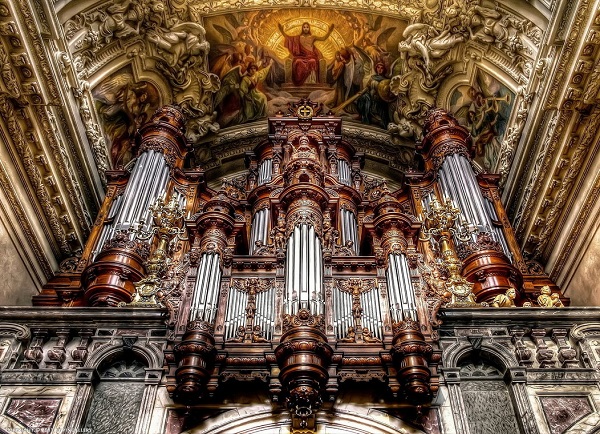
Berlin Cathedral
Organ, Berlin Cathedral

**

The immediate occasion for this [second] post is my reading about the book Eucharistic Poetry: The Search for Presence in the Writings of John Donne, Gerard Manley Hopkins, Dylan Thomas, and Geoffrey Hill, by Eleanor J. McNees. Her subtitle names four poets I greatly admire, and whose company I would aspire to keep:

Though widely separated chronologically, all four poets use the Anglican and Roman Catholic doctrine of eucharistic Real Presence (the literal embodiment of Christ in the sacrament of Holy Communion) as model for their own poetry. Each poet seeks to charge his words with a dual physical/spiritual meaning that abolishes the gap between word and referent and so creates an immediate presence that parallels Christ’s Real Presence in the Eucharist.

**

That pasage, in turn, reminds me of some words John Eliot Gardiner spoke on the topic of Bach and grace,
on the DVD of a rehearsal of Bach’s cantata Christen, ätzet diesen Tag (BWV 63) right after Sara Mingardo sings O Selger Tag. Gardiner first quotes Bach, then translates him:

Nota bene: Bei einer andächtigen Musik ist allezeit Gott mit seiner Gnaden Gegenwart.” Now I find that very, very significant. That he’s saying wherever there is devotional music, God with his grace is present.

How close is that to the poets McNees talks about, creating with their poems “an immediate presence that parallels Christ’s Real Presence in the Eucharist”?

And then he comments —

Which, from a strict theological point of view is probably heresy, heretical, because it’s saying that music has an equivalent potency to the word of God.

I’m not so sure about the heresy, but this is the point at which I turn to Lexington Green‘s comment on a recent post of mine, in which he quoted the Cathecism of the Catholic Church:

1374 The mode of Christ’s presence under the Eucharistic species is unique. It raises the Eucharist above all the sacraments as “the perfection of the spiritual life and the end to which all the sacraments tend.” In the most blessed sacrament of the Eucharist “the body and blood, together with the soul and divinity, of our Lord Jesus Christ and, therefore, the whole Christ is truly, really, and substantially contained.” “This presence is called ‘real’ – by which is not intended to exclude the other types of presence as if they could not be ‘real’ too, but because it is presence in the fullest sense: that is to say, it is a substantial presence by which Christ, God and man, makes himself wholly and entirely present.”

**

Whether in the performance and hearing of Bach, Christ can be said to be “wholly and entirely” or “devotionally and musicially” present is a delicate question, one part ontological and absolute, I’d suppose, and one part epistemological and subjective.. but I find myself in warm agreement with Gardiner’s elaboration of his theme..

And I think that in essence is why Bach is so attractive to us today because he is saying that the very act of music-making and of coming together is, in a sense, an act which invokes the latency, the potency, the potentiality of God’s grace, however you like to define God’s grace; but of a benediction that comes even in a dreadful, overheated studio like Abbey Road where far too many microphones and there’s much too much stuff here in the studio itself, that if one, as a musician, puts oneself in the right frame of mind, then God’s grace can actually come and direct and influence the way we perform his music.

I really must read me some Hans Urs von Balthasar.


Switch to our mobile site