zenpundit.com » paradox

Archive for the ‘paradox’ Category

China as the balance between DPNK and the US

Saturday, August 12th, 2017

[ by Charles Cameron — once again, it’s the formal properties that interest me here ]
.

You may agree or disagreee, but in two-party negotiation I’d say, speaking as a moderator, bridge-builder, peace-maker, there’s a natural parity between the two parties

— this parity will be there, somehow, even if not immediately apparent, or something is seriously amiss.

**

Here, then, are two of countless ways in which China must handle disparities between the parties, if she is to maintain a balance between the US and Korth Korea:

The population balance — or imbalance — is pretty extreme, and the nuclear arenal imbalance even moreso:

**

I’ve included the moderator (China) along with the two parties in my weightings above, pondering whether it makes a difference when the moderator is “heavier” than either party, or when one party “heavily” outweighs the moderator.

I don’t know, I’m feeling my way towards an intuitive grasp of something here, not presenting a certainty of some kind.

The WaPo article that brought me to these considerations is full of “balance” and “imbalance” imagery..

At issue is “a series of threats and counterthreats by the U.S. and North Korean governments.”

Russia’s foreign minister, Sergei Lavrov, said there had been an “overwhelming amount” of “belligerent rhetoric” from Washington and Pyongyang.

Even-handedly:

China has repeatedly warned both Washington and Pyongyang not to do anything that raises tensions or causes instability on the Korean Peninsula, and it strongly reiterated that message Friday.

In an editorial, the Global Times said China should make it clear to both sides that “when their actions jeopardize China’s interests, China will respond with a firm hand.”

And considering how things can get worse:

China hopes that all relevant parties will be cautious in their words and actions, and do things that help to alleviate tensions and enhance mutual trust, rather than walk on the old pathway of taking turns in shows of strength, and upgrading the tensions.

And better:

“The side that is stronger and cleverer” will take the first step to defuse tensions..

**

All this is, on the one hand, obvious, and barely needs saying — and on the other hand, fascinating and instructive in its abstract formalism. Of course, there are details that I’m omitting to bring that formalism front and center, but you have the WPo article to give you those.

Most interesting, perhaps, is that final observation:

“The side that is stronger and cleverer” will take the first step to defuse tensions..

It reminds me of another quote I included in a post here on ZP recently:

the problem of defense in the modern world is the paradoxical one of finding ways for the strong to defeat the weak.

Paradox, too, is a matter of form, and thus of particular interest when it occurs in an analytic context.

Metaphors, analogies, parallelisms, paradoxes — my stock in trade — are delicate matters, and should be treated with care.

**

Okay, now how do you diagram the balance mentioned in the WaPo article, In dealing with North Korea, Trump needs allies — not bombast?

Tillerson’s impossible job: Balancing North Korea, China and Trump

**

Sources:

  • Business Insider, Where the World’s 14,995 Nuclear Weapons Are
  • Worldometers, Countries in the world by population (2017)

  • Washington Post, Beijing warns Pyongyang: You’re on your own if you go after the US
  • Hat-tip, btw, to xkcd for painstakingly providing the number graphics via the xkcd Radiation page.
    Similarity in graphical mechanism?

    Wednesday, June 7th, 2017

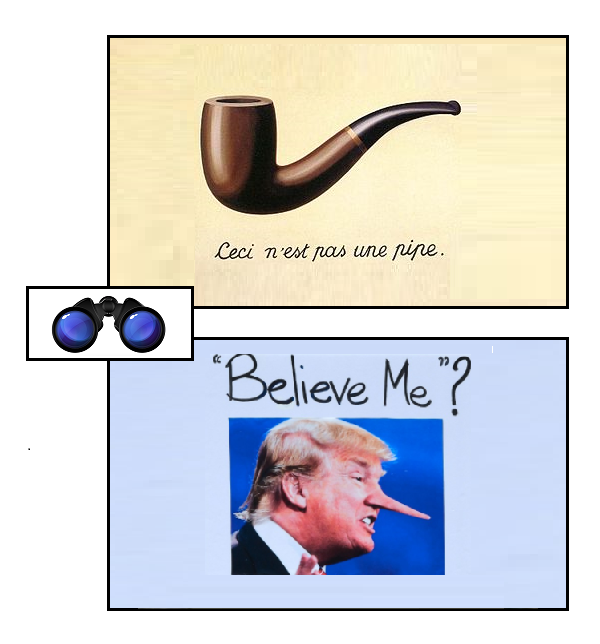
    [ by Charles Cameron — a matter of visual rhetoric, NYT’s Trump and Magritte ]
    .

    I’m intuiting that these two graphical representations somehow use the same visual logic to achieve their ends:

    **

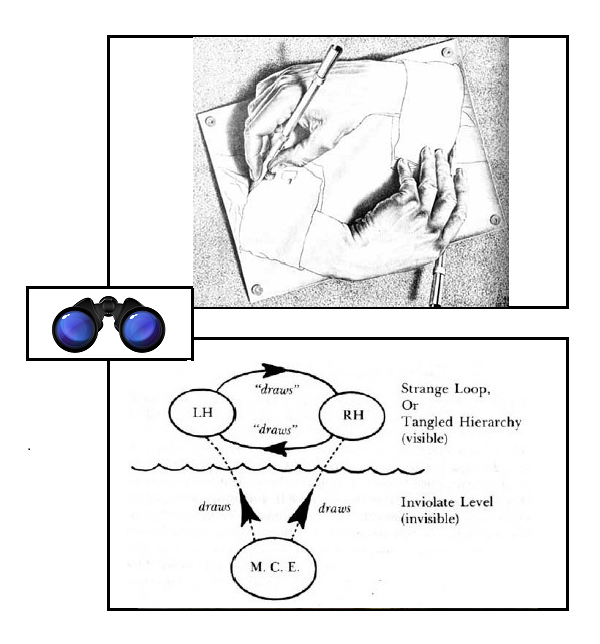
    If I was more alert in some semi-defined sense, I’d be able to diagram them in a manner similar to that which Douglas Hofstadter uses to diagram the conceptual working of MC Escher‘s hands drawing hands —

    — another brilliant ouroboros, for those who are keeping count!

    **

    How does “let not thy left hand know what thy right hand doeth:” fit into this (Escher) picture?

    Trolleys come to Terror

    Tuesday, October 18th, 2016

    [ by Charles Cameron — a western koan makes it onto German TV? ]
    .

    What Hala Jaber calls a supermarket trolley in this tweet is not what this post is about — but it sure does connect trolley and terror!

    **

    Here’s the terror side of things, in a tweet from John Horgan:

    The BBC halls it an “interactive courtroom drama interactive courtroom drama centred on a fictional act of terror” and notes:

    The public was asked to judge whether a military pilot who downs a hijacked passenger jet due to be crashed into a football stadium is guilty of murder.

    Viewers in Germany, Switzerland and Austria gave their verdict online or by phone. The programme was also aired in Slovakia and the Czech Republic.

    The vast majority called for the pilot, Lars Koch, to be acquitted.

    Here’s the setup:

    In the fictional plot, militants from an al-Qaeda offshoot hijack a Lufthansa Airbus A320 with 164 people on board and aim to crash it into a stadium packed with 70,000 people during a football match between Germany and England.

    “If I don’t shoot, tens of thousands will die,” German air force Major Lars Koch says as he flouts the orders of his superiors and takes aim at an engine of the plane.

    The jet crashes into a field, killing everyone on board.

    So, is the pilot guilty, or not guilty?

    **

    At the very least, he has our sympathy — but how does that play out in legal proceedings?

    What’s so fascinating here is the pilot’s dilemma, which resembles nothing so much as a zen koan.

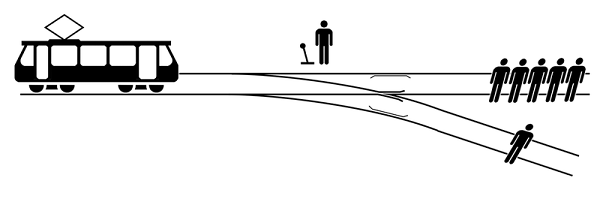
    Except for the Trolley Problem:

    trolley_problem
    Image from Wikimedia by McGeddon under license CC-BY-SA-4.0

    **

    Substitute an Airbus for the trolley, 164 people for the lone individual on the trolley line, and 70,000 people for the cluster of five — and the pilot for the guy who can make a decision and switch the tracks.

    There you have it: terror plot and trolley problem running in parallel.

    To be honest, I think the full hour-plus movie is far more immersive, to use a term from game design, than the Trolley Problem stated verbally as a problem in logic — meaning that the viewer is in some sense projected, catapulted into the fighter-pilot’s hot seat — in his cockpit, facing a high speed, high risk emergency, and in court, on trial for murder.

    It’s my guess that more people would vote for the deaths of 164 under this scenario than for the death of one in the case of the trolley — but that’s a guess.

    **

    The German film scenario — adapted from a play by Ferdinand von Schirach — is indeed a courtroom drama, a “case” in the sense of “case law”. And it’s suggestive that koans, too, are considered “cases” in a similar vein. Here, for instance, is a classic definition of koans :

    Kung-an may be compared to the case records of the public law court. Kung, or “public”, is the single track followed by all sages and worthy men alike, the highest principle which serves as a road for the whole world. An, or “records”, are the orthodox writings which record what the sages and worthy men regard as principles [..]

    This principle accords with the spiritual source, tallies with the mysterious meaning, destroys birth-and-death, and transcends the passions. It cannot be understood by logic; it cannot be transmitted in words; it cannot be explained in writing; it cannot be measured by reason. It is like a poisoned drum that kills all who hear it, or like a great fire that consumes all who come near it. [..]

    The so-called venerable masters of Zen are the chief officials of the public law courts of the monastic community, as it were, and their collections of sayings are the case records of points that have been vigorously advocated.

    **

    Relevant texts:

  • John Daido Loori, Sitting with Koans
  • John Daido Loori, The True Dharma Eye
  • Coffee & Donuts, a topological DoubleQuote

    Monday, October 10th, 2016

    [ by Charles Cameron — sadly, now dunkin’ diabetes ]
    .

    Some might claim that Dunkin is the link between Coffee and Donuts — it’s certainly a link I’ve appreciated myself on more than one occasion. Here’s another, and arguably more subtle linkage — topology.

    In verbal format, it’s a mathematician’s inside joke:

    The joke goes about topologists is that they can’t tell the difference between a coffee mug and a doughnut. For those who are not familiar with topology, topology is the study of geometrical objects where you don’t care about lengths and you don’t care about angles, what matters is how the spatial relations relate to each other.

    Even better, here’s the same joke, illustrated — or refuted, if you prefer — in video by a master maker:

    The only problem here — it’ll all prove a little pointless if you dunk your donut into the coffee cup without first supplying some coffee..

    But morphing! What an ingenious way to provide and prove a DoubleQuote!

    Three self-references already, and its only 8am

    Tuesday, October 4th, 2016

    [ by Charles Cameron — with an eye for form, paradox, self-reference ]
    .

    I’ve found three self-references already today, and its only 8am.

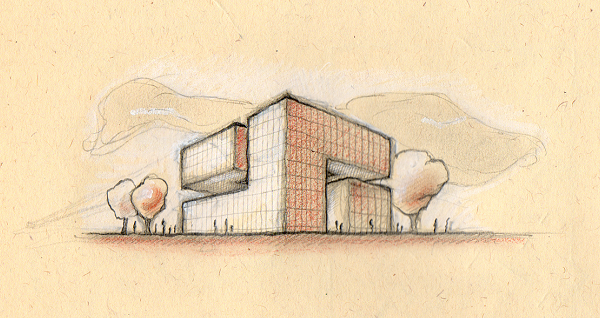
    Unless of course you count architect Matteo Pericoli‘s building design to illustrate the structure of Friedrich Dürrenmatt’s mystery novel The Judge and His Hangman:

    perspective

    — in which case, I’ve found four. Pericoli comments:

    As in the novel — with its surprise ending that flips everything upside down, transforming the structure we had taken for granted into a profound moral and existential dilemma — in the building, what seemed to obscure now illuminates, what once concealed now is hidden, what seemed to give support is now nothing but a weight to bear and understand.

    Now tell me, is that self-referential and ouroboric, or merely boustrophedonic or enantiodromic?

    For Greek fun, wait till the end of this post*.

    **

    On firmer self-referential ground, my first self-referential account has to do with a Nobel Prize, just awarded. Gina Kolata and Seawell Chan in the New York Times explain:

    Yoshinori Ohsumi, a Japanese cell biologist, was awarded the Nobel Prize in Physiology or Medicine on Monday for his discoveries on how cells recycle their content, a process known as autophagy, a Greek term for “self-eating.” It is a crucial process.

    Self-eating: even the ouroboros can’t say it plainer than that.

    **

    The second comes from an article on artist Jennifer Trask titled Death and Decay Lurks Within These Stunning Works of Art in the Smithsonian magazine. The description of Jennifer and her work begins:

    Those who encounter a piece by Jennifer Trask are likely first struck by its elegance: a baroque gold-coated necklace or an intricate floral broach. But a closer look reveals much more happening below the gilt surface: antlers woven into the necklace; snake vertebrae used as the “petals” of the broach’s flower, giraffe femurs…

    Death, here, as in earlier artistic tradition, is a reminder of the fickleness of life. The article gives us the self-referential paradox as it explains:

    Trask draws on the tradition of vanitas — moralistic paintings that were popular in 16th- and 17th-century Netherlands. She says her interest is now focused on the “symbolism and the ironic nature” of the paintings, and “how the vanitas itself ultimately became another of the luxurious objects they were meant to warn against.”

    **

    And the third might even count as two recursions — one analogous to the other.

    You may have read the New Yorker‘s profile, Sam Altman’s Manifest Destiny: Is the head of Y Combinator fixing the world, or trying to take over Silicon Valley?, and you may just be cooler than I, and either way you may already know that the Y Combinator is the startup starter-upper par excellence.

    Here’s the self-ref, from their FAQ:

    Why did you choose the name “Y Combinator?”

    The Y combinator is one of the coolest ideas in computer science. It’s also a metaphor for what we do. It’s a program that runs programs; we’re a company that helps start companies.

    A hat-tip here to Steven H. Cullinane, whose Log 24 blog today pointed me to this particular quote.

    **

    *It’s all Greek to me:

  • ouroboros, a snake or dragon devouring its tail, standing for infinity or wholeness
  • boustrophedon, written from right to left then left to right, as in ploughing with oxen
  • enantiodromia, tendency of things to change into their opposites, as a natural principle
  • **

    Well, it’s past 9am now, but I haven’t been scouting around for further examples since I began this post.


    Switch to our mobile site