zenpundit.com » critical thinking

Archive for the ‘critical thinking’ Category

Point and Counterpoint on Defining War

Saturday, December 8th, 2012

A quick note. There’s a provocative article at SWJ by a USAF Lt Col., Jill Long that attempted to pose an alternative definition of war and Jason Fritz at Inkspots has written a tough rebuttal; both are worth reading:

Jill Long – What is War? A New Point of View

….The Spectrum of War in the Global Era

Michael Howard summarizes the changing environment as shifting from one centered on the control of territory, to one focused not only on territorial control but the effective exploitation of the resources of that territory.[8]  This concept leads to a new approach to view and define war…within the context of globalization.  As the global finance crisis illuminated, economies can no longer be managed/controlled internally but in fact are impacted by events and decisions made across the world.[9]  One only needs to reference the so called “CNN effect,” the Arab Spring or current anti-American protests to understand the impact digital communications and the 24-hour news cycle have had on regional and world affairs.[10]  The bottom line: “interconnected systems of trade, finance, information, and security” demand a larger perspective when considering the engagement of imposing national will on others.[11]

One method to approach this broader perspective is to view war as a spectrum of discord, a continuum where unrestrained armed conflict and world peace are at opposing ends.  By establishing this graphic scale, it is relatively easy to conceptualize that as a nation approaches peace (or harmony) with other entities’ values, objectives, and ideals, there is an abeyance of hostilities.  War is not over, a nation’s desire to impose its will remains; it simply does not require the use of armed conflict to achieve its goals.  What might appear on the surface to be the age old argument between Thomas Hobbes’ theory of man’s natural state as one of war and John Locke’s more peaceful perspective, is actually providing the answer to that debate…both may be right.  If a nation’s will is in harmony with other entities’ then the natural tendency will lean towards world peace.  As discord develops between a nation’s will and other nation-states or non-state actors the natural tendency will increasingly lean towards more aggressive national engagement and armed conflict.  This theory purposefully focuses on nation-states and/or non-state actors versus the individual.  While one may argue it can be applied to individual interaction, this is not the author’s intent. 

This spectrum facilitates understanding that the art of war encompasses much more than the concept of armed conflict and acknowledges a nation’s capability to change their “natural state” based on the will of the people, political landscape, as well as a nation’s strength, ability, and desire to project power. […]

And now, from the other side……

Jason Fritz–  Our definition of war is pretty good as it is

…..Long fails to adequately describe how the world has changed or how the “Global Era” plays into this. She states that the terrorist attacks on September 11, 2001 have changed how we should perceive the world. It seems that the she believes that that day should have awakened Americans to the threat of non-state actors. Long also states that “‘interconnected systems of trade, finance, information, and security’ demand a larger perspective when considering the engagement of imposing national will on others.” Both of these points are stated in defiance of history. Globalists enjoy selling the greatness and threats of our “interconnected systems” in the modern day, but that presumes that the world is newly interconnected. We know this is not true. Interconnection in today’s world may be faster and easier, but it is not new. States and other political groups have interacted over the elements listed for millennia – look only to the period of global colonization to see how long we as humans have been at this. Long does not describe how today’s globalization is unique and why that changes how we define war.The issue of state versus non-state actors, as pertains to the definition of war, is a silly discussion. The idea that this new “globalization” has resulted in the rise of non-state actors is also historically inaccurate and is prima facie absurd.  Civil wars have raged as long as long as humans have fought wars (indeed, civil war comprise a significant proportion of the wars humans have fought). Who are these wars supposed to have been fought by if not by non-state actors? Insurgencies and terrorism are also not new to the 21st Century (or even the Common Era) and it would take a peculiar interpretation of history to argue otherwise.

It is important to note that in his definition, Clausewitz does not describe war as act of force between states. War is engaged between enemies as the means to achieve political objectives. Of course, political objectives are not the sole purview of states as many non-state groups have exhibited and Mao so logically codified. This is not to say that Clausewitz did not intend his definition and the rest of the book to discuss war between states in the best traditions of the post-Westphalian world. He clearly speaks of states throughout the book, as indicated in the parenthetical comment in his definition of war (I did say I would return to that point). But this does not limit On War solely to war between states as mean scholars have, most prominently historian John Keegan and strategist Martin van Creveld to name a couple. It does not take that large of a leap of thought to read On War and understand that states can be any organized political group, that princes can be any leaders of those political groups, and armies can be the armed elements of those political groups. A literalist reading of Clausewitz would be as unwise as a literalist reading of Plato or Aristotle and saying their writings do not apply to the modern world because we are no longer city-states. A non-literalist exegesis of On War easily provides for the incorporation of non-state war into Clausewitz’s thesis. As a last point on non-state actors, Long indicates that these offspring of globalization are driving this need for a new definition of war and yet her new definition specifies that means required are to bring about “sufficient adherence to a nation’s will.” This suggests that only nations have wills or that the means of war could only be used to achieve national wills. Ergo, only nations can be at war. I suspect that non-state actors would like to know how to label their activities if “war” is closed to them. [….]
I am pressed for time, as usual, this morning, but i will try to offer my own comments later tonight.

Congratulations!!

Tuesday, December 4th, 2012

To Lexington Green and James Bennett, for finishing their new book, America 3.0 – due out (I think) in 2013 published by Encounter Books.

A political vision for an era desperately short on imagination and needing statecraft of inspiration.

On the HipBone and Sembl games: update

Thursday, November 29th, 2012

[ brief intro by Charles Cameron, then shorter version of Dr. Cath Styles‘ presentation of Sembl at the National Digital Forum in New Zealand, 20 November 2012 ]
.

Charles writes:

I’ve been working for almost twenty years on the development of a playable variant on Hermann Hesse‘s concept of the Glass Bead Game.

It’s an astonishing idea, the GBG — that one could build an architecture of the greatest human ideas across all disciplinary boundaries and media — music, religion, mathematics, the sciences, anthropology, art, psychology, film, theater, literature, history all included — and it has engaged thinkers as subtle as Christopher Alexander, the author of A Pattern Language [See here, p. 74]. Manfred Eigen, Nobel laureate in Chemistry and author of Laws of the Game [see here], and John Holland, the father of genetic algorithms [see here].

Here’s Hesse’s own description of the game as a virtual music of ideas:

All the insights, noble thoughts, and works of art that the human race has produced in its creative eras, all that subsequent periods of scholarly study have reduced to concepts and converted into intellectual values the Glass Bead Game player plays like the organist on an organ. And this organ has attained an almost unimaginable perfection; its manuals and pedals range over the entire intellectual cosmos; its stops are almost beyond number.

My own HipBone Games were an attempt to make a variant of the game that would be simple enough that you could play it on a napkin in a cafe, and has in fact been played online — and more recently, my friend Cath Styles has adapted it for museum play, and introduced the basic concept and our future hopes in a presentation at the National Digital Forum 2012, New Zealand — which you can see very nicely recorded in Mediasite format.

Do take a look — Cath makes a first-rate presentation, and I love the Mediasite tech used to capture it.

Since the slides are shown in a small window concurrently with Cath’s presentation, I’ve edited her presentation for Zenpundit readers, and reproduced many of her slides full-size with some of her commentary below.

**

Sembl, the game of resemblance

Cath speaking:

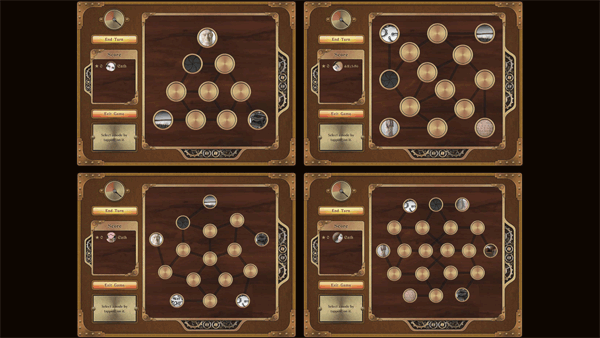
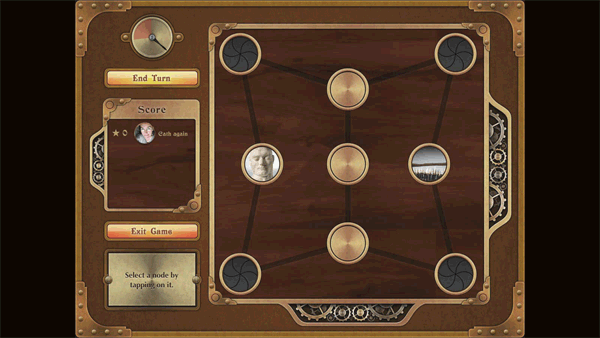
In its first form, Sembl is an iPad game, called The Museum Game, at the National Museum of Australia. We’ve just released it in beta as a program for visiting groups.

Cath then talks about feedback from children and adults about their experience of playing the game. Some kids homed in on the principle of resemblance, others emphasised the social side of the game. She talks, too, about their teacher, and her observations about the ways the game engaged her kids.

She then shows us various Sembl gameboards for iPad:

Sembl Museum gameboard for four teams of younger players

Four different Sembl Museum gameboards

Cath speaks:

But The Museum Game is just one form of Sembl. The Museum Game is played in real time, on site, and players take photos of physical objects to create nodes on the board.

The next step is to make a web-based form, that you could play at your own pace, and from your own place. Then, Sembl becomes a game-based social learning network, which amplifies the personal value of the game – it becomes social networking with cognitive benefits.

But it’s the bigger picture – of humans as a community – that I most want to explore: Sembl as an engine of networked ideas, or linked data.

Charles notes: I’m skipping the educational part — and the bit about my own role in the game’s development, to get to the core of her presentation as I see it: the cognitive facilitation it provides

Cath again:

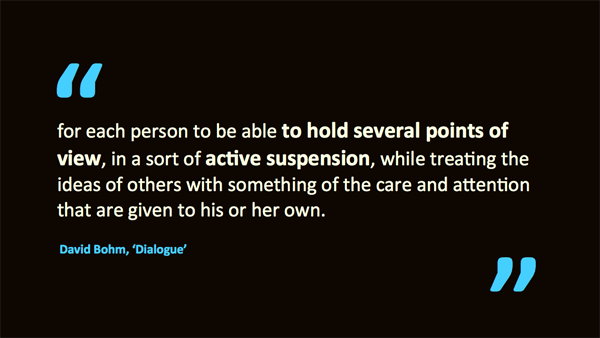
Another way of saying this is that the Game provides a structure and impetus for dialogue, between the museum and visitors, between visitors and things, among visitors and between things. And this is not dialogue in the sense of an everyday conversation. It’s deeper than that. It’s a mutual experience of looking both ways, simultaneously.

Cath next quotes David Bohm, the eminent quantum physicist:

to hold several points of view in active suspension – quotation of David Bohm

Cath speaks:

For Bohm, dialogue means holding several points of view in active suspension. He regarded this kind of dialogue as critical in order to investigate the crises facing society. He saw it as a way to liberate creativity to find solutions.

Cath then drops in an important topic header:

Toward a game-based social learning network

Cath:

The concept of Sembl, in its deepest sense, is social learning – game-based social learning. In its first instantiation, it is game-based social learning in a museum and – if things turn out as I hope they will – from next year it will be playable at any other exhibiting venue that has the infrastructure and the will to host games – galleries, libraries, botanic gardens, zoos and so on.

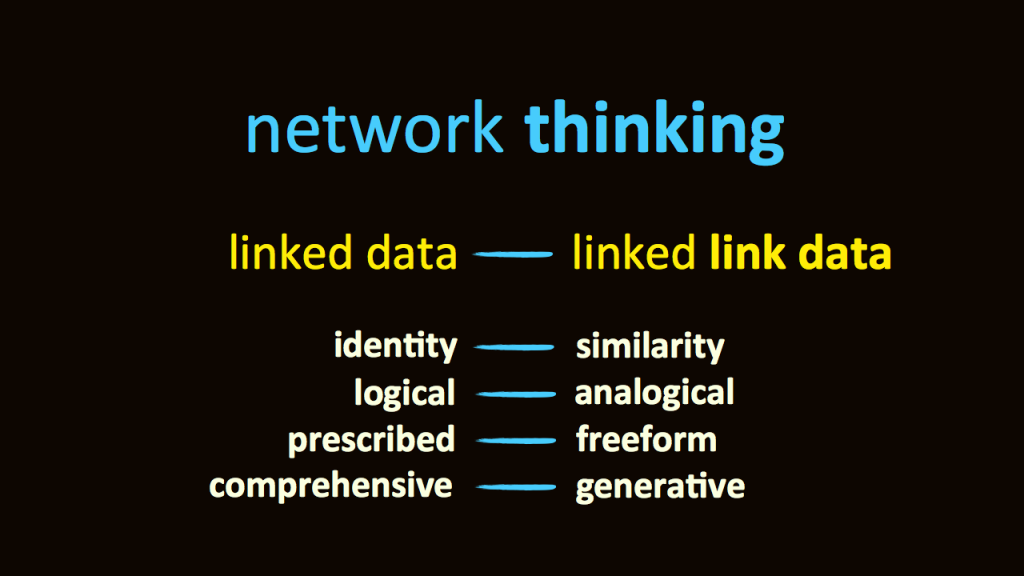
network thinking – how Sembl network links differ from traditional linked data links

A web-based form of Sembl can generate linked data with a difference. It’s linked link data, and quite different to normal linked data.

  • Instead of connections based on what a thing is – sculpture, or wooden, or red – Sembl generates connections based on a mutual resemblance between two things. Which, amazingly enough, is a great way of gaining a sense of what each thing is. And if your interest is to enable joyful journeying through cultural ideas, or serendipitous discovery, this approach just wins…
  • Instead of compiling logical links, Sembl cultivates the analogical.
  • Instead of building and deploying a structured, consistent set of relationships, Sembl revels in personal, imprecise, one-of-a-kind, free association, however crazy.
  • Instead of attempting to create a comprehensive and stable map of language and culture, Sembl links are perpetually generative, celebrating the organic, dynamic quirks of cognitive and natural processes.

But the most important way that Sembl is distinct from other systems of network links is that those who generate the links learn network thinking. Which is a critical faculty in this complex time between times, as many smart people will tell you.

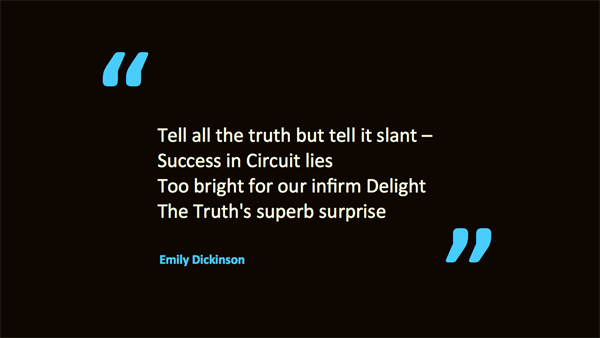
Poets have always known the virtues of analogy as a path to the truth.

Tell all the truth but tell it slant – poem by Emily Dickinson

Sembl promotes dialogic, non-linear thinking, and new forms of coherence.

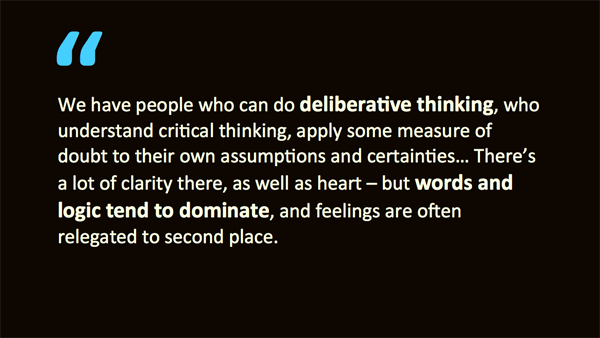
deliberative thinkers – quotation of Charles Cameron

It’s distinct from deliberative thinking, which is rational and causal and logical and linear.

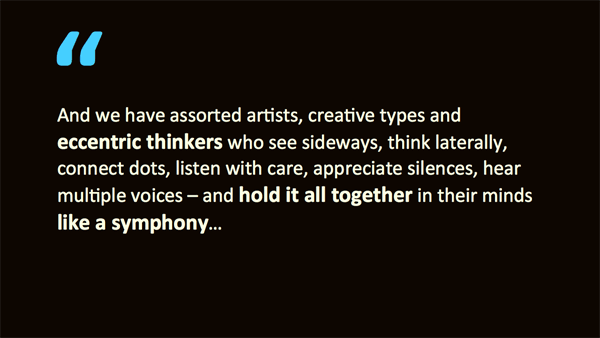
eccentric thinkers – quotation of Charles Cameron

It’s another kind of thinking, which might be informed by rational thought, but its purpose is not singular.

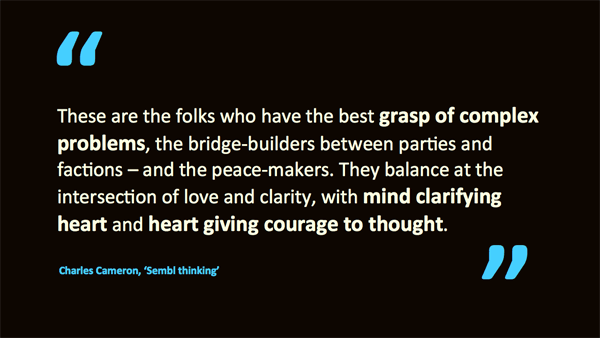
bridge-builders – quotation of Charles Cameron

You might say its purpose is to create – and cohabit – a state of grace, from which ideas simply emerge.

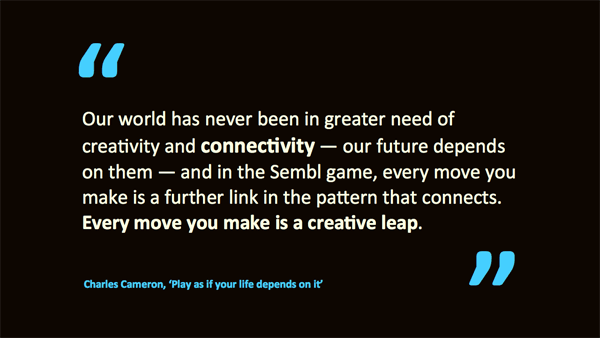
every move you make is a creative leap

If playing Sembl gives us practice in polyphonic thinking, if it helps cultivate connectivity and our capacity to find solutions to local and global problems, it is good value. As Charles says, every move is a creative leap.

Cath concludes:

If you’re interested in working with us to supply content, develop strategy or raise capital, we’re keen to talk.

And I can’t tell you how much I’m anticipating being able to invite everyone to play.

thanks

**

Cath can be reached via Twitter at @cathstyles, and I’m at @hipbonegamer. The Sembl site is at Sembl.net.

Next up: what Sembl has to offer the IC.

Reading a partisan cartoon: the parable of a dog’s ears and teeth

Friday, November 16th, 2012

[ by Charles Cameron — on the difficulties that may be posed when “reading” graphics ]
.

**

The question I want to ask in this post is: how much can you safely read into a political cartoon?

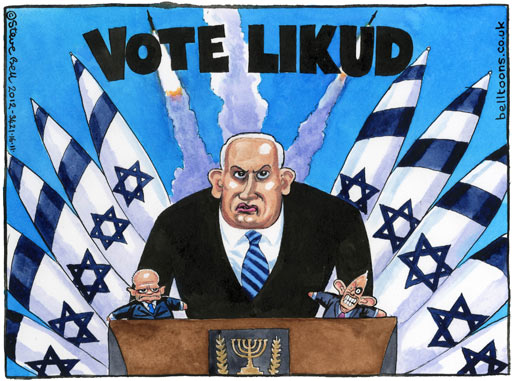
Here is the particular cartoon I have in mind:

It was published in The Guardian (UK) yesterday, and as you may be able to see, it portrays Israeli PM Benjamin Netanyahu as a puppet-master, with British politicians Tony Blair and William Hague as his puppets, and was published to illustrate the cartoonist’s view of British reaction to the Gaza situation.

How much can we read into it?

**

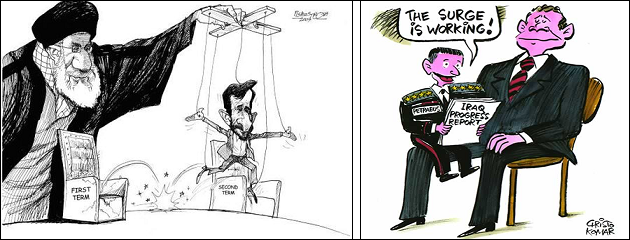
If you are used to seeing cartoons such as these —

showing Khamenei pulling Ahmadinejad‘s strings and Petraeus as a puppet of GW Bush, when you come across the Netanyahu cartoon in the Guardian, you may well view it as another in a long series of political cartoons suggesting that someone is running someone else’s show behind the scenes. It’s the old idea of the eminence grise, in other words, expressed in cartoon form.

**

If, on the other hand, you’ve been exposed way too often to cartoons like these —

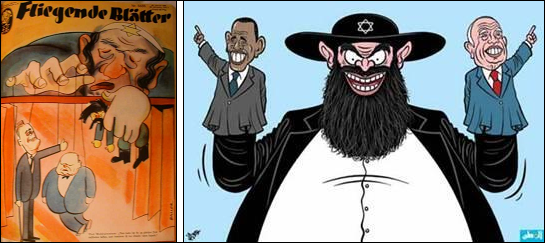
the one portraying Churchill, FDR and Stalin as Jewish puppets, taken from a 1942 issue of the Nazi paper, Fliegende Blätter, or the one depicting McCain and Obama as Israeli puppets, taken from a 2008 issue of the Saudi paper, Al-Watan… you may well see the same cartoon in a very different — and distinctly antisemitic — light.

**

The last two graphics, at least, are extremely offensive, and I would like to offer another graphic here — one which also uses our “puppet master” theme — as a visual equivalent of offering a glass of water to cleanse the palate:

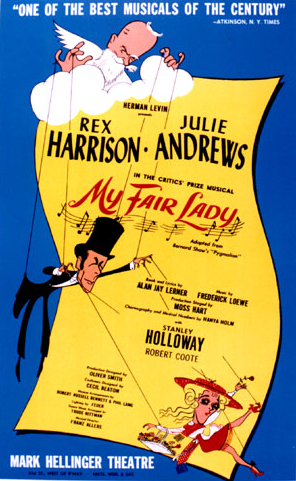
I’ll be addressing this My Fair Lady poster from a very different angle, in a later post in my “form is insight” series — this one on “dolls within dolls”, the “world stage which we have dotted with stages of our own devising” and “turtles all the way down”…

**

Having hopefully reduced the emotional freight which some of the cartoons above must surely have carried with them, I would now like to offer you some background which seems relevant to me. Characteristically, perhaps, it comes from a very different field of knowledge.

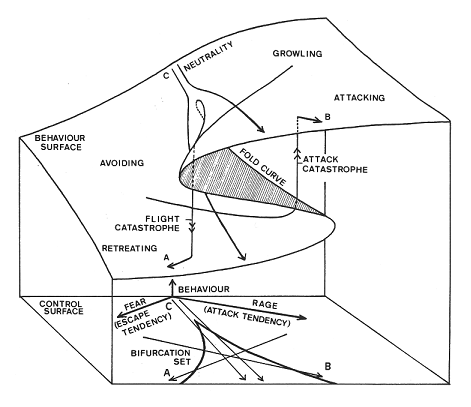
EC Zeeman‘s April 1976 article Catastrophe Theory in the Scientific American was my introduction to the mathematician Rene Thom’s remarkable body of work, an introduction which sailed mostly over my head — but one of Zeeman’s points, which he illustrated with the graphic below, made perfect sense to me.

The annotation to this illustration read in part:

If an angry dog is made more fearful, its mood follow* the trajectory ‘A’ on the control surface. The corresponding path on the behaviour surface moves to the left on the top sheet until it reaches the fold curve; the top sheet then vanishes, and the path must jump abruptly to the bottom sheet. Thus the dog abandons its attack and suddenly flees. Similarly, a frightened dog that is angered followes the trajectory ‘B’. The dog remains on the bottom sheet until that sheet disappears, then as it jumps to the top sheet it stops cowering and suddenly attacks.

My translation:

A dog that reaches the point where its ears are fully pinned back, indicating full-on fear, and its teeth are also fully bared, indicating full on rage, will behave differently depending on whether its fear level or its rage level was the first to be raised to “full”.

Just as a dog’s reaction to a full on mix of rage and fear may depend on which stimulus came first, so — I am suggesting — our own reaction to the cartoon in question — inherently antisemitic, or merely critical of a particular Israeli operation — may depend on our previous exposure to cartoons, politics, the Israeli-Palestinian conflict, or antisemitism.

**

We now have several levels of ease or difficulty in reading graphics. The Zeeman graphics are hard to read because they’re too small to be legible — but put them in the context of Zeeman’s article, and view them full size as originally published, and the only problem might be in following Zeeman’s text, itself a popularization and simplification of Rene Thom‘s work.

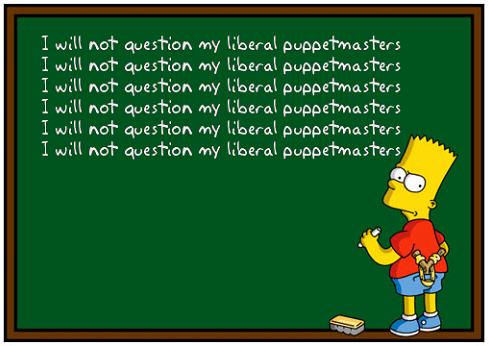
The Bart Simpson graphic is fairly straight forward, and regular viewers of the show would “read” it in line with hundreds of similar frames in which Bart writes repeated lines on a classroom chalkboard, from Season 1 episode 2’s “I will not waste chalk” to Season 23’s “There’s no proven link between raisins and boogers”.

And then there’s the disputed Netanyahu graphic… which can be “read” differently, depending on what previous “puppet master” associations the viewer beings to the task. Here, it seems to me, the task of interpretation can be viewed in one of two ways: (i) as an exploration of how it is likely to be read, which I’m suggesting will depend on previous association, and (ii) as an exploration of what “must have been” in the cartoonist’s heart.

**

Assessing the cartoon’s probable impact on segments of the public is one thing — knowing what the cartoonist intended, even though we tend to conflate the two, is quite another. Not for nothing does St Paul in I Corinthians 2.11 ask (in my own translation)

Who knows the qualities of a man but the spirit of that man within him?


Switch to our mobile site