zenpundit.com » foreign policy

Archive for the ‘foreign policy’ Category

IVN Article:Competition in the Age of Frenemies

Saturday, August 4th, 2012

I have a short piece up at IVN:

Competition in the Age of Frenemies 

competition in the age of frenemies 47130 Competition in the Age of Frenemies

Credit: lib.utexas.edu

Ideology is being replaced by realpolitik in the world political arena, with competition and cooperation between frenemies perhaps becoming the norm. The war on terror began on September 11, 2001 in New York City and Washington DC, where teams of terrorists professing a militant brand of Sunni Islamism killed thousands of Americans using commercial airliners, brought down the World Trade Center, damaged the Pentagon and caused roughly $100 billion in direct and indirect economic damage and possibly $2 trillion in subsequent expenditures on military operations and security.

….By 2012, the global picture has drastically changed. Osama bin Laden is dead and his fanatical followers are able to operate freely only in the poorest, most remote or desolate regions of the earth – northern deserts of Mali, the lawless hinterlands of Yemen, Pakistan’s wild tribal belt and ruined villages in war-torn Syria. Instead of a laser-like focus on al Qaida, the next President will have to  worry more about economic collapse in Europe, China bullying it’s neighbors over the South China Sea, civil wars in Mexico and Syria and Iran’s quest for the nuclear bomb. 

Read the rest here. 

This is a quick synopsis of an idea I am playing with lately.

It is of course, contingent. If Egypt takes a nasty turn and a post-Assad Syria falls to Salafi-Takfiri extremists ( creating a religious variant of the old Nasserite UAR alliance) we might be talking about a “Sunni Axis” with a radicalized Pakistan giving new life to transnational, revolutionary jihadism.

Without that , the prospects for al Qaida’s vision of political Islam look increasingly grim. As the the AQ strategist al-Suri noted, the loss of Afghanistan in 2001 as a secure base of operations, training ground and state sponsor was a heavy blow to the forces of radical Islamism.  A lack of replacement after ten years is an embarrassing state of affairs for a militant movement whose political center of gravity in the Islamic world is the claim of doing God’s will against the infidel.

The Twilight War—a review

Monday, July 23rd, 2012

[by J. Scott Shipman]

The Twilight War, The Secret History of America’s Thirty-year Conflict with Iran, by David Crist

When President Obama made a heartfelt opening, a smug Iranian leadership viewed it as a ruse or the gesture of a weak leader. Iran spurned him. Obama fell back on sanctions and CENTCOM; Iran fell back into its comfortable bed of terrorism and warmongering. Soon it may no longer be twilight; the light is dimming, and night may well be approaching at long last. [emphasis added]

Thus concludes senior government historian David Crist’s The Twilight War, and be assured Crist’s language is not hyperbole. Crist masterfully details the tumult of U.S.-Iranian relations from the Carter administration to present day. Using recently released and unclassified archived data from principals directly involved in shaping and making American foreign policy, Crist provides the reader an up-front view of “how the sausage is made;” and, as with sausage, the view often isn’t pretty for either side. Crist’s access wasn’t limited to U.S. policy makers, as he conducted interviews with principles on the other side as well, for instance, he had secret meetings/interviews with pro-Iranian Lebanese officials in south Beirut. In all, Crist estimated he interviewed over “four hundred individuals in the United States and overseas.”

Crist begins his story with the Shah of Iran in the last days of his leadership, as popular sentiment was turning against both his regime, as well as his American enablers. He reveals the Carter administration’s fleeting notion of military intervention following the fall of the Shah, and includes details how the clerics reigned in professional Iranian military members, purging the “unreconstructed royalists.” From the start, the U.S. learned how difficult, if indeed impossible, relations were going to be with the new Iranian leadership. One State Department report summed up the situation:

It is clear that we are dealing with an outlook that differs fundamentally from our own, and a chaotic internal situation. Our character, our society are based on optimism—a long history of strength and success, the possibility of equality, the protection of institutions, enshrined in a constitution, the belief in our ability to control our own destiny. Iran, on the other hand has a long and painful history of foreign invasions, occupations, and domination. Their outlook is a function of this history and the solace most Iranians have found in Shi’a Islam. They place a premium on survival. They are manipulative, fatalistic, suspicious, and xenophobic.

While I am certain the writer of this report was not intending to be prophetic, as it turns out this paragraph captures the essence of our conflict. Each American president has thought himself equal to the challenge and each has thus far failed.

The Twilight War includes the birth of Hezbollah, accounts of the Marine barracks bombing in 1983 (from the men who were there), and the details of the Kuwaiti request for American protection of their tanker fleet from the Iranians. From this decision, the U.S. committed military force to protect Middle East oil—a difficult and at times, contentious decision. This decision resulted in continued sporadic confrontations between the U.S. and Iranian forces in the Persian Gulf.

Crist’s book is an illustration writ-large of a book previously reviewed here at Zenpundit.com; Derek Leebaert’s Magic and Mayhem, The Delusions of American Foreign Policy—as both “magic” and “mayhem” figure large in our on-going relationship with Iran. Most U.S. administrations when dealing with Iran came to rely on the “magic, ” and often divorced, or worse, ignored the realities.

At 572 pages, the fast paced narrative is a must read for anyone wanting insight into the origins and issues that remain in the ongoing U.S.-Iran conflict. The Twilight War is exhaustively sourced.  Crist says in the Notes his book was twenty-years in the making and it shows. Further, this book comes with excellent maps, so keeping up with the geography is made easier.

Tom Ricks said, “this is the foreign policy book of the year, perhaps many years,” and Ricks may be right. The Twilight War is an important and timely book on a vital topic, and comes with my strongest recommendation.

Postscript:

A copy of The Twilight War was provided to this reviewer by the publisher.

Numbers by the numbers: four

Wednesday, July 18th, 2012

[ by Charles Cameron — importance of the ratio form (“this is to that as thus is to so”) as a bridge between domains and silos, creative leaps, the glass bead game, and finally, Chittick’s joke about camels, sex and translations from the Arabic ]
.
.

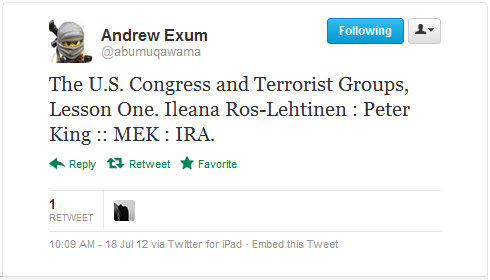
I retweeted this tweet of Andrew Exum‘s to my friend Paul Pilkington because I know he’s working on a project to find out what “this is to that” is to some other “this is to that” — across a wide swathe of human culture.

Note particularly that Exum is using this formal device to illuminate, to give insight, in an area of importance to analysts, strategic thinkers and decision makers.

I’m also retweeting Exum to Paul because I believe Paul’s simple experiment, based as it is on his reading of Hermann Hesse‘s Glass Bead Game, has the capacity to build an architecture of thought (a) crossing all disciplines and (b) spanning the trivial with the profound.

I’m doing something similar with Cath Styles in our Sembl games project — but this time I want to concentrate on Paul’s approach, and since there are four moving parts in an a is to be as c is to d configuration, I’m calling this post Numbers by the numbers: four — number three will just have to wait a while.

**

To get a sense of what Paul is up to, we can go to his Twitter Project page, which describes the fourth in a series of books he’s writing — and also follow him on Twitter, where he posts as Just Knecht.

Two of Paul’s recent tweets express his sense of the task pretty incisively:

The whole of language is the holding up of one unlike thing to compare, contrast and connect with another

Curating is a matter juxtaposition of work against work, artist against artist, place against place – A.Searle on Documenta 13, The Guardian

On his Twitter Project Page, he tells us:

Each tweet is an individual Glass Bead Game move, which is a comparison (metaphor, simile or analogy) across different areas, and may be either a statement or a question.

In question form, these are not unlike analogy questions from SAT tests with an additional dimension of general knowledge, cultural invention and intellectual playfulness. The basic challenge is to work out the relationship between two terms in one context, and apply it in another. Sometimes a tweet will extend an analogy further, which would be the beginning of forming a larger game from an individual move.

Some of the most interesting moves do not have right or wrong answers. Some have canonical or original answers, but they’re not necessarily right. In fact, very often I will post something I’ve picked up from elsewhere which I would love to see improved on, challenged, or at least better explained by others.

He then poses some of the sorts of questions that intrigue him:

Who is the J.H.Prynne of contemporary dance? Like Prynne in contemporary poetry they need to have been ‘out there’ right at the edge of theory and practice for some time, and also deeply steeped in tradition at the same time. Merce Cunningham? Suggestions welcome … And Heston Blumethal or Ferran Adrià might be the Prynne of cookery. But what about the Prynne of contemporary warfare?

What is the equivalent of sonata form in architecture? Goethe and Hegel both said ‘architecture is frozen music’ but neither really explained what they meant. If it is, then is there an architectural equivalent in Western architecture of the key structural form in Western art music? Suggestions welcome …

So, Zenpundit readers — who is the JH Prynne of contemporary warfare?

**

Not so long ago, in Numbers by the numbers: one, I posted a series of self-referential tweets that I’d collected over the last month or two — here I’d like to present some of Paul’s recent tweets:

Let’s start with one that’s a foreign policy insight, arguably as significant to day as it was when Vance first said it:

16 Jul @justknecht
“The Strait of Hormuz is the jugular vein of the West” (Cyrus Vance)

If these tweets can be timeless, they can also be timely:

4 Jul @justknecht
The Higgs boson is the quantum of the Higgs field, just as the photon is the quantum of the electromagnetic field

As they accumulate over time, they can build a conceptual “mesh” that engages an entire field — in this case, recent classical music — while linking it to a variety of other areas:

16 Jul @justknecht
“Boulez’ Derive 2 sounds like birthday cakes ought to” – Philip Clark, Gramophone

22 Jun @justknecht
Wagner was a beautiful sunset that was mistaken for a dawn – Claude Debussy, quoted by Geoffrey Norris in Gramophone

30 May @justknecht
Fauré’s Theme and Variations (no. 9) is like an evening star falling slowly from the sky – Bryce Morrison cites Alfred Cortot in Gramophone

11 May @justknecht
Kraftwerk is the Warhol of pop music – The New Yorker

There’s profundity here:

9 Jun @justknecht
“Space is to place as eternity is to time.” – Joseph Joubert

This could be, as Paul says, “the beginning of forming a larger game from an individual move” — that quote in itself could plausibly be the keystone of an architecture bridging science with religion…

There are historical parallels to consider:

31 May @justknecht
Robert Burton : Oxford :: Jeremy Prynne :: Cambridge

Catty remarks by Nobel laureates:

21 May @justknecht
“Thinking is to humans as swimming is to cats” (Nobel laureate Daniel Kahneman)

Near-tautologies:

21 May @justknecht
Macon Telegraph: Recipes are to food as blueprints are to buildings.

And, ooh, exotic forms of slander!

18 May @justknecht
“[Your daughter] has lovers as numerous as the striking of tablas on Palm Sunday” – Arabic satire by Abu Nawas, 756 – 813 AD

Once again, it’s form that generates insight, not content. Get used to form, play around with it, and content will leap out at you from the page, from the screen.

**

I’m no Arabist myself, but ah! that last quote reminds me irresistibly of the difficulties faced by translators from the Arabic, as recounted by William Chittick in The Self-disclosure of God: Principles of Ibn Al-‘Arabi’s Cosmology (SUNY Press, 1998, pp. xxxv-xxvi.)

An old joke among orientalists tells us that every Arabic word has four meanings: It means what it means, then it means the opposite of what it means, then it has something to do with sex, and finally it designates something to do with a camel …. The rational mind tends to push the meaning of a word away from experience to ‘what it means’ but the imaginal mind finds the self-disclosure of the Real in the sex and the camel … it is in the world’s concrete realities that God is found, not in its abstractions.

I’d been looking for an excuse to post that quote on Zenpundit — now I’ve found it!

Putin and Syria: Siloviki Realism in Geopolitical Strategy

Thursday, July 12th, 2012


Russian President Vladimir Putin made a foreign policy speech to Russia’s ambassadors and Foreign Ministry officials that is very much worth reading in context of his dispatch to Syria of a fleet of warships, including a battleship, to the modest Russian naval base in Tartus. Under Putin’s hand, Russian support for the bloody regime of Bashar Assad has consistently been more about safeguarding and expanding Russia’s strategic place in world than about Syria:

….We are forced to admit that no reliable solution for overcoming the global economic crisis has been found yet. Indeed, the prospects are looking more and more worrying. The debt problems in the Eurozone and its slide towards recession are just the tip of the iceberg as far as the global economy’s unresolved structural problems go. The traditional powerhouses of global development – the USA, the EU, and Japan – are seeing their leadership erode, but the absence of new development models is putting a brake on global growth. There is increasing competition for access to resources, and this provokes abnormal fluctuations on the raw materials and energy markets. The traditional Western economic powers are being weakened by the crisis, which has exacerbated social and economic problems in the developed economies, and by the multi-vector nature of global development today. We can already see this for a fact now. 

Colleagues, this is no cause for joy. We should not take delight in this turn of events, and much less feel malicious glee. On the contrary, we cannot but worry over these developments, because the consequences of these tectonic shifts in the global economy are not yet clear, nor are the inevitable shifts in the international balance of power and in global policy that will follow. 

We are all the more worried when we see attempts by some actors in international relations to maintain their traditional influence, often by resorting to unilateral action that runs counter to the principles of international law. We see evidence of this in so-called ‘humanitarian operations’, the export of bomb and missile diplomacy, and intervention in internal conflicts.

We see how contradictory and unbalanced the reform process is in North Africa and the Middle East, and I am sure that many of you still have the tragic events in Libya before your eyes. We cannot allow a repeat of such scenarios in other countries, in Syria, for example. I believe that we must do everything possible to press the parties in this conflict into negotiating a peaceful political solution to all issues of dispute. We must do all we can to facilitate such a dialogue. Of course this is a more complex and subtle undertaking than intervention using brute force from outside, but only this process can guarantee a lasting settlement and future stable development in the region, and in Syria’s case, in the country itself….

It would be harder for Putin to have been more clear about what his priorities were, or that for Russia, R2P as a doctrine has no standing whatsoever in international law [ incidentally, he’s correct on that point] and Syria is not going to be allowed to go the way of Libya, if the Kremlin can prevent it.

Generally, the media reported this speech, highly misleadingly, as Putin’s prediction of “Western decline” when the message was Russia’s opposition to Western military intervention in Syria to remove Assad from power. Putin neither overestimates the means at Russia’s disposal to accomplish his limited objective (blocking intervention) nor inflates his objective to an unrealizable, vaguely defined, abstraction.

Contrast, with the speech on Syria made recently by SECSTATE Hillary Clinton. Here is a snippet that gives the tenor of her remarks:

….What was accomplished in Geneva by the action group was, for the very first time, to enlist not only all five permanent members of the Security Council including Russia and China, but also important leaders in the region and in the Arab League in support of such a transition. The issue now is to determine how best to put into action what was accomplished there and is continuing here. And I really hope everyone reads the communique from Geneva, because for example, one of the earlier speakers from Syria expressed concern there was nothing about political prisoners. Well, indeed there is. And a call for the release from detention. So it would be very helpful to get everybody on the same page if we’re going to work together about what we have already done and what we need to be doing as we move forward.

Under the Geneva communique, the opposition is for the first time put on an even basis with the government. They are given equal power in constituting the transition governing entity that will have, as we just heard, full executive authority. That could not have been imagined three months ago, let alone a year ago.

So although none of us here is satisfied or comfortable with what is still going on inside of Syria, because it is against every norm of international law and human decency for a government to be murdering its own people, there has been in the last several months, starting in Tunisia, a steady, inexorable march toward ending this regime. What we need to do is to follow through on what each of us can contribute to the end of the Assad regime and the beginning of a new day for Syria. 

….Now what can every nation and group represented here do? I ask you to reach out to Russia and China and to not only urge, but demand that they get off the sidelines and begin to support the legitimate aspirations of the Syrian people. It is frankly not enough just to come to the Friends of the Syrian People, because I will tell you very frankly, I don’t think Russia and China believe they are paying any price at all – nothing at all – for standing up on behalf of the Assad regime. The only way that will change is if every nation represented here directly and urgently makes it clear that Russia and China will pay a price, because they are holding up progress – blockading it – that is no longer tolerable. 

First of all, the Secretary of State needs a more effective speechwriter. Period.

Secondly, there is a substantive problem here with an obsession with the minutia of process, possibly because the legal principle behind American policy on Syria is a novelty of intellectuals and is not accepted by two veto-wielding great powers that sit on the UN Security Council. Moreover this focus on minutia of process obstructs clear thinking in regard to the larger geopolitical picture and the ways to get to the end in mind – the removal of Assad’s regime – or the consequences for opposing American policy. Russia and China are told their continued support for the Assad regime, which they see as being in their own interests, is “intolerable” – an outburst of unseemly frustration as we have no stick and strangely offer no carrots for these states to change their positions. Instead we choose to moralize  in public, a diplomatic technique with a long pedigree of failure.

The comparison of statecraft between Russia and the United States is unflattering. Russia has vastly fewer cards to play, but because  Putin has grounded his policy in a siloviki assessment the realities of power, has limited his objectives to those within Russia’s means and related those to the larger diplomatic context that would appeal to other powers, he has played those cards well. Moreover, Putin has positioned Russia to be an indispensable party in a peaceful resolution of the conflict in Syria at very little cost, as Secretary Clinton herself has admitted and capped it off with a naval show of force in the eastern Mediterranean.

We, who have a wealth of resources to employ, have squandered them ineffectively and navigate the ship of state with our heads in the clouds. We forced a vote in the UNSC on Syria, ignoring all signals that the end result would be failure. Syria shoots down a Turkish warplane intruding in it’s airspace (likely at our request) and we had no plan to capitalize on the incident. We gratuitously leak information or disinformation about covert operations that serves more to make us look amateurish than to intimidate our opponents. We do not even appear to be well-informed about the Syrian opposition we are aiding inside Syria, as opposed to expatriate organizations. Some of the fighters in the opposition are as morally objectionable as Assad’s militia thugs and secret police killers.

We play at tactical geopolitics while the Russians do strategy.

Anne-Marie Slaughter on Twitter as “your private CNN”

Wednesday, July 11th, 2012

[ by Charles Cameron — importance of social media ]
.

h/t @caidid — on Twitter, naturally!


Switch to our mobile site