zenpundit.com » complexity

Archive for the ‘complexity’ Category

When they say it’s a game-changer…

Thursday, July 26th, 2012

[ by Charles Cameron — are they talking about shooting for a goal, hitting your target, making a move — or lofting one up the fairway? ]
.

As you may have gathered, I really love that quote from the philosopher MacIntyre. Here we go again:

Image courtesy of my friend Oink, aka Peter Feltham. It seems like gameplay gets more risky by the hour…

The most important post about Aurora doesn’t mention Aurora

Thursday, July 26th, 2012

[ by Charles Cameron — futurism, making, printing, printable guns, time of your life, intersecting timelines ]
.


.

We only have one mouth, so we’re linear speakers, confined to speaking one thought at a time. And we only have one body, so we tend to think of our lives along a single timeline — although other people with their own uncontolled timelines are constantly crisscrossing our paths and making things better (hey, thanks!) or worse (damn it!) or just plain interesting (okaaay) or boring (unhh)… but the world itself includes the crisscrossing of all those paths in its own timeline, and what this means in practice is that linear thinking doesn’t catch the drift.

Which is why it’s interesting that the most important blog-piece on the Aurora tragedy today doesn’t mention Aurora once.

It’s by John Robb, and it’s about printing these:

And it’s important because the world-line it talks about will cross the path of the Columbine > Virginia Tech > Utøya > Aurora timeline at some point.

**

It begins like this:

Printing Weapons at Home for Fun and Mayhem

.
It’s now possible to print functional weapons at home. This is going to progress rapidly now.

Think: global file sharing of designs for servicable weapons, from pistols on up to ?, that can be printed at home. What you can print — from the materials to the size/quality of the object to the completeness (snap together construction) — is already moving forward quickly. The weapons effort will just be along for the ride.

But read the whole thing. And read Duncan Kinder and the other comments there, too.

**

That’s John Robb’s message for the day — and apart from the fact that it talks about reliable home-printed weaponry, a line of development which will I suggest will cross that Columbine > Virginia Tech > Utøya > Aurora line some time in the not too distant, there’s one unremarkable little remark in there that’s well worth remarking on. John says:

The weapons effort will just be along for the ride.

**

Along for the ride. Side effects. Adverse reactions. Serendipity. Unintended consequences. Unknown unknowns. Black swans.

We have a variety of terms we use for the things that blindside us, for better or worse. Our future is full of them, our past is littered with the results…

So it’s interesting that if a bunch of us are thinking along the broad line of maker-printables, a few will be thinking printable guns. A bunch of us will be making films, a bunch more will be going to the movies to see them. And some will have far darker thoughts in mind.

**

Crisscross your thinking. Weave your world with care for the future, please.

Aurora, Samarra, Vermont…

Tuesday, July 24th, 2012

[ By Charles Cameron — the gun issue, complexity, human beings being humans and the world we live in ]
.

As always, I’m a fence-sitter bridge-builder, not wanting to take sides, preferring to talk with them.
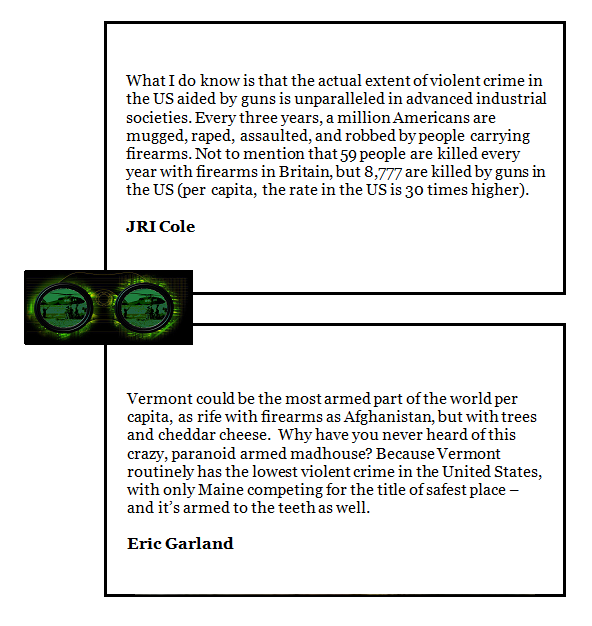
The irritating beauty of these two quotes is that either one taking separately might seem like a “case closed” argument in favor of guns or gun control — but taken together, they show the world to be a dappled place.

Here’s the lead-in to that Vermont quote:

One facet of Vermont life is neither famous nor quaint: Vermonters are armed to the teeth. Guns are absolutely everywhere. Rifles. Pistols. Shotguns. Muzzle-loaders. Semi-automatics. 50 caliber tripod-mount “semi” automatics that could take out aircraft. Every firearm you can possibly imagine. Vermont could be the most armed part of the world per capita, as rife with firearms as Afghanistan, but with trees and cheddar cheese…

Things are weird that way: just when you think you’ve got them figured out, there’s an exception to the rule… a black dot in the white part of the yin-yang symbol… an anomaly that challenges the easy paradigm.

Dappled, as Hopkins puts it.

**

Pied Beauty
by Gerard Manley Hopkins, SJ
.

GLORY be to God for dappled things—
For skies of couple-colour as a brinded cow;
For rose-moles all in stipple upon trout that swim;
Fresh-firecoal chestnut-falls; finches’ wings;
Landscape plotted and pieced—fold, fallow, and plough;
And áll trádes, their gear and tackle and trim.

All things counter, original, spare, strange;
Whatever is fickle, freckled (who knows how?)
With swift, slow; sweet, sour; adazzle, dim;
He fathers-forth whose beauty is past change:
Praise him.

**

The world is complex: scientists using microscopes and a suite of 128 computers recently (and triumphantly) managed to simulate the genome of one of the smallest micro-organisms in the world, Mycoplasma genitalium (neat name, that):
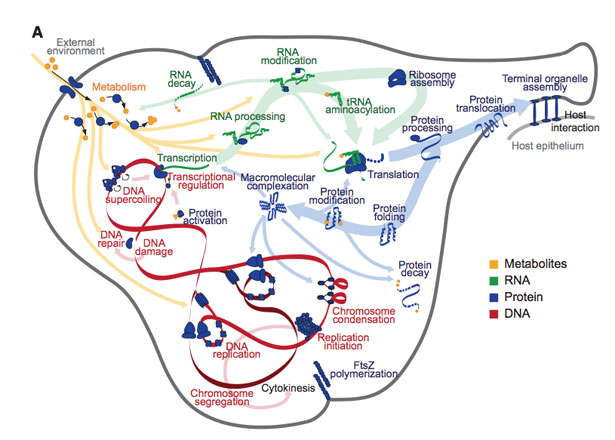
Alexis Madrigal (another neat name, btw) writes:

“Right now, running a simulation for a single cell to divide only one time takes around 10 hours and generates half a gigabyte of data,” lead scientist Covert told the New York Times. “I find this fact completely fascinating, because I don’t know that anyone has ever asked how much data a living thing truly holds.”

One cell. One division. Half a gig of data. Now figure that millions of bacteria could fit on the head of a pin and that many of them are an order of magnitude more complex than M. genitalium.

Yup. So think how complex the world is. No wonder we name things, divide stuff up into categories — use quite a large chunk of our brains for making distinctions.

But then think how complex the humans studying M. genitalium (still like that name, but this’ll be the last time I mention it) themselves must be… As Madrigal (really a nice name, you can almost sing it) goes on to point out:

Or ponder the idea that the human body is made up of 10 trillion (big, complex) human cells, plus about 90 or 100 trillion bacterial cells. That’s about 100,000,000,000,000 cells in total. That’d take a lot of computers to model, eh? If it were possible, that is.

**

Complexity looks at complexity with a view to modeling it. Simple, you think? Complex, you’d say?

The world’s a subtle place, and I might just go live in Vermont.

But people get shot in Vermont too, from time to time — there’s always a black and bleeding bullet-hole in the white half of the yin yang symbol — this world is hopelessly dappled.

And you know that story Somerset Maugham tells about Samarra?

There was a merchant in Bagdad who sent his servant to market to buy provisions and in a little while the servant came back, white and trembling, and said, Master, just now when I was in the marketplace I was jostled by a woman in the crowd and when I turned I saw it was Death that jostled me. She looked at me and made a threatening gesture, now, lend me your horse, and I will ride away from this city and avoid my fate. I will go to Samarra and there Death will not find me. The merchant lent him his horse, and the servant mounted it, and he dug his spurs in its flanks and as fast as the horse could gallop he went. Then the merchant went down to the marketplace and he saw me standing in the crowd and he came to me and said, Why did you make a threating getsture to my servant when you saw him this morning? That was not a threatening gesture, I said, it was only a start of surprise. I was astonished to see him in Bagdad, for I had an appointment with him tonight in Samarra.

Idries Shah tells a version of the same story as “When Death Came to Baghdad” in his Tales of the Dervishes, but with Samarkand rather than Samarra as the fatal destination.

It just might be the same with Vermont.

Two annexes to my post: It’s an abomination!

Saturday, July 21st, 2012

[ by Charles Cameron — finding feedback loops in blindspots, truths in symbols, strength in ideas ]
.

photo credit: Mobile News UK

.

It is in the nature of analogical thinking that it moves sideways, or more precisely, in honeycomb fashion, rather than forwards — and so it is that my just completed post It’s an abomination! leads me to two other considerations:

**

My first is to compare the situation of the Pakistani gentleman preparing and selling flags for burning

The man who dominates much of the supply chain of American flags to religious groups, 30-year-old Mamoon-ur-Rasheed – who’s been publishing anti-American placards and hand-made stars and stripes since his school days, when he was angered by the Clinton administration’s sanctions on Pakistan following its nuclear weapons testing in 1998 – is now remarkably dispassionate about his services, as well as about the short shelf-life of his flammable goods.

“We work hard for our product, and we get paid for our product,” says Rasheed, clad in a camouflage baseball cap and seated behind a desk that takes up most of the space in his eight-by-six-foot office in Gulashan-e-Iqbal, one of the city’s oldest working class neighborhood.

“So what if it burns? The purpose of the flag is to last for an hour. It’s unfortunate, but if the demand is for an hour, then the supplier must meet such demand too,” he says.

— with the no less entrepreneurial fellows in Cambodia who capture birds for the express purpose of selling them to those who wish to set them free:

Merit release — procuring animals that are about to be slaughtered and releasing them back into the wild — is a tradition practiced, to different degrees, by various Buddhist groups each year. It sounds like a good — and yes, meritorious — idea, but you might want to think twice before trying it. Why?

Well, as Conservation Magazine reports, hundreds of thousands of birds are caught in Asia each year just so they can be bought for merit release, putting them through the unnecessary stress of catching them just to be set free again. But there’s more. Many of these birds are infected with avian flu virus and other pathogens, and they can infect other birds, animals and people when they’re released. According to the study, published in Biological Conservation, 10 percent of the Cambodian birds the researchers tested were infected with avian influenza. “The presence of pathogenic viruses and bacteria among birds available for merit release is a concern both to wild bird populations and to humans involved in the trade,” the authors write.

The lesson here being that there are always more things going on than catch the eye, and that feedback loops in your blindspots are liable to getcha

**

My second is to compare Coleridge‘s observation about symbols:

On the other hand, a Symbol is characterized by a translucence of the Special in the Individual or of the General in the Especial or of the Universal in the General. Above all by the translucence of the Eternal through and in the Temporal. It always partakes of the Reality it renders intelligible; and while it enunciates the whole, abides itself as a living part in that Unity, of which it is the representative.

with the quote from Anais Nin that I referenced recently in relationship with Marisa Urgo‘s comment on Zawahiri:

The personal, if it is deep enough, becomes universal, mythical, symbolic…

And here the moral is that words can at times cut deeper than sticks and stones — in the words of that 2006 National Strategy for CT I just quoted, that winning the War on Terror means winning the battle of ideas — or as another poet, Muriel Rukeyser famously put it, that:

The universe is made of stories, not of atoms.

At the round earths imagin’d corners

Friday, July 20th, 2012

[ by Charles Cameron — mapping, holding two worldviews in mind at one time, a conductor’s score, complexity thinking ]
.


.

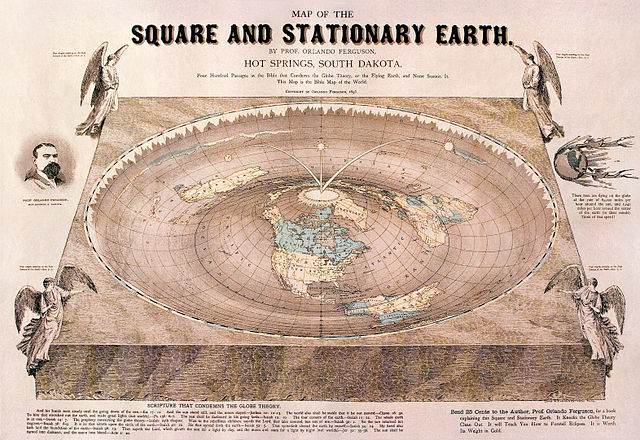
About a year ago, the Atlantic reported that the Library of Congress had been given a map of the flat earth, designed according to Biblical principles — yet showing knowledge of the border between the United States and Canada…

Thanks to a post from Jason Wells, I saw it today.

The view that the earth is flat is one worldview, of course, and no longer the prevailing one. As Nicholas Jackson noted at the Atlantic:

The interesting thing about the map is that it was created about 120 years ago by Orlando Ferguson, then a practicing physician in Hot Springs [South Dakota]. This is more than 500 years after most educated people gave up on the idea of the Earth as flat and accepted the spherical viewpoint first expressed by the Ancient Greeks.

**

It is, however, possible to hold two worldviews in mind at the same time. John Donne manages it in the first line of his extraordinary poem, written at a time when the two views were clashing:

At the round earths imagin’d corners, blow

AT the round earths imagin’d corners, blow
Your trumpets, Angells, and arise, arise
From death, you numberlesse infinities
Of soules, and to your scattred bodies goe,
All whom the flood did, and fire shall o’erthrow,
All whom warre, dearth, age, agues, tyrannies,
Despaire, law, chance, hath slaine, and you whose eyes,
Shall behold God, and never tast deaths woe.
But let them sleepe, Lord, and mee mourne a space,
For, if above all these, my sinnes abound,
‘Tis late to aske abundance of thy grace,
When wee are there; here on this lowly ground,
Teach mee how to repent; for that’s as good
As if thou’hadst seal’d my pardon, with thy blood.

Donne accomplishes the task of holding two worldviews in mind at one time with four simple words: “round earths imagin’d corners”.

**

I don’t know how many melodic “lines of thought” the mind can hold in counterpoint at once. I do know it’s an important cognitive skill for us to cultivate. A classical conductor must surely be able to hold as many lines as there are in this page of Olivier Messaien‘s Oiseaux:

As I pointed out in a recent comment here, “somewhere above three and before eleven there’s a point — Miller’s ‘magical number seven, plus or minus two‘ where the human mind can’t hold any more detail, so that’s a cut-off of sorts.”

Well, Messaien clearly imagines the conductor’s mind can follow more than eleven paths…

**

And then there’s Bob Milne.

I’ll let the Philosophy Compass take it from here:

Bob is predominantly known for his piano concerts of Ragtime and Bogie-Woogie music – and was given the moniker of ‘National Treasure’ by the United States Library of Congress. It was at one of these concerts that drew the attention of Penn State neuroscientist Kerstin Bettermann. At his concerts, Bob often carries on conversations, telling stories and jokes, while simultaneously modulating key signatures over the polyrhythmic Ragtime music. In their broadcast, Radiolab discusses with Dr. Bettermann why this is so surprising.

Language use and musical competency often use the same neural resources: the prototypical language areas in the left hemisphere of the brain, and the working memory circuit that keeps information available and rapidly accessible for a short-period of time. Our ability to use language and engage with music should, on most models of the brain, be competing for these neural resources and interfere with one another. Not so with Bob – he appears to be able to tackle both tasks with ease. Further, while most people can approach this kind of competency in multi-tasking, it usually involves many learning trials, a process of sedimenting the learning into what psychologists call procedural memory, which may have its roots in a different brain region, the cerebellum. But Bob can hear a tune just once, and play it back with commentary.

But that’s not all Bob can do.

In their interview, Dr. Bettermann heard Bob claim something extraordinary. He claims not only to be able to hear a symphony in his head, but that he normally does this with two symphonies simultaneously. Where most individuals would only hear a cacophonous mess – Bob claimed he could dial the relative volume of either symphony up or down, and could zoom in or out of individual instrumentations. To return to the considerations above, Bob further states on the Radiolab website that he does this while driving – another procedural memory task and presumable source of interference. But when Dr. Bettermann challenged him, Bob reluctantly claimed that he could probably do the same (not while driving, mind you) with four simultaneous symphonies.

The claim is something like this: Bob states that he can hold and listen to four symphonies with different keys, instrumentation, tempo and style in his working memory at the same time. And what is stunning is that when they put Bob into an fMRI machine, they verified his claim. Bob could be stopped at any time during his imaginative trip through the four simultaneous symphonies, and hum out the exact phrase that the original recording would be on. Remarkable.

**

This in turn takes us back to that point Edward Said made, which gave me the basic concept for my Said Sympohony (must get back to that soon):

When you think about it, when you think about Jew and Palestinian not separately, but as part of a symphony, there is something magnificently imposing about it. A very rich, also very tragic, also in many ways desperate history of extremes — opposites in the Hegelian sense — that is yet to receive its due. So what you are faced with is a kind of sublime grandeur of a series of tragedies, of losses, of sacrifices, of pain that would take the brain of a Bach to figure out. It would require the imagination of someone like Edmund Burke to fathom.

Edward W. Said, Power, Politics, and Culture, p. 447 — from the section titled “My Right of Return,” consisting of an interview with Ari Shavit from Ha’aretz Magazine, August 18, 2000.

I asked in a post yesterday how good we now are at modeling or simulating ideas in the “war of ideas” — just for a moment, suppose we could think through all complex geopolitical issues in this polyphonic, contrapuntal way…

**

Okay, you deserve a reward for faithful reading if you’ve come this far with me. Here’s the incomparable Richard Burton reading Donne’s poem — the text is up above, if you want to follow along:


Switch to our mobile site