zenpundit.com » complexity

Archive for the ‘complexity’ Category

Countering Violent Extremism: variants on a theme II

Monday, April 2nd, 2012

[ by Charles Cameron — modeling / scoring recruitment conversations as a flow of ideas, continued from CVE Variants I ]
.

Look, in any guidance, in any persuasion, there’s a conversation.

In the image above, the flow is from Anwar al-Awlaki, who already knows and speaks, to Nidal Hasan, who listens and thinks and is persuaded.

But what interests me more than that specific conversation, limited as it was to a handful of emails, is the overall route taken by many different conversations between what the NYPD calls a “spiritual sanctioner” and a prospective recruit.

We know that like a river, any conversation will have its eddies and flows — but if it’s a successful conversation, if it leads to persuasion, if it radicalizes the recruit… then the eddies won’t have prevented or reversed the flow, they’ll just have been a natural part of it.

*

Mitchell D. Silber and Arvin Bhatt addressed the stages they believed the radicalization process generally followed in their report for the NYPD, Radicalization in the West: The Homegrown Threat, and the steps they described after self-identification — in which the proto-jihadist comes to think of themselves as within the broad Salafist thought-stream, were these:

Indoctrination is the phase in which an individual progressively intensifies his beliefs, wholly adopts jihadi-Salafi ideology and concludes, without question, that the conditions and circumstances exist where action is required to support and further the cause. That action is militant jihad. This phase is typically facilitated and driven by a “spiritual sanctioner”.

While the initial self-identification process may be an individual act, as noted above, association with like-minded people is an important factor as the process deepens. By the indoctrination phase this self-selecting group becomes increasingly important as radical views are encouraged and reinforced.

Jihadization is the phase in which members of the cluster accept their individual duty to participate in jihad and self-designate themselves as holy warriors or mujahedeen. Ultimately, the group will begin operational planning for the jihad or a terrorist attack.

*

For the record: I do understand that the “conversational terrain” of the radicalization process is going to be considerably more twisty and convoluted than any map — as indeed do Silber and Bhatt, who write “Although this model is sequential, individuals do not always follow a perfectly linear progression.”

Let’s take a close look.

Here, for starters, is a diagram from Jeff Conklin, the guy who brought us wicked problems, showing in red the linear path that the creativity books tell you you should take from problem to solution — and in blue, the zigzag path an “actual” designer’s mind might take on its way to that solution — from the first chapter of Conklin’s book, Dialogue Mapping: Building Shared Understanding of Wicked Problems

I’ve paired Conklin’s diagram with a Von Kármán Vortex Street (I wrote about those recently in Having eyes to see) showing eddies within a successful flow, from M Van Dyke‘s An Album of Fluid Motion — both images are a little too “pure” and “diagrammatic” to fit the actual complexity of human thought.

Recruitment conversations will have their eddies, but it’s both the general route of the flow and the specificities of those eddies that would interest me — not because I wish to “police” those thoughts but because I wish to understand them — and any eddies that repeat themselves from one recruitment conversation to the next will likely contain useful hints as to inherent weak points in the sanctioner’s argument.

*

Let me be clear about this. As to our using such an understanding in an attempt to police the thoughts of a “suspect” community – I would think that would be a piss-poor approach to take, with pretty immediate blowback effects.

What I am trying to get at here is not “how to do CVE” – a topic best left to others, and specifically to those who contest the thrust of the recruitment argument from within the same general theological tradition – but how to better understand the conceptual drivers in play in the recruitment process. I am asking, if you like, for concept-level mapping of the terrain. And I should probably have said something about that in my first post in this series.

Here again, non-linearity seems to be the order of the day — and we need to understand what that implies and learn to think in comparably non-linear ways.

*

Spiritual sanctioner: what a concept! That’s someone who gives you the fear of hell for after-burners and the hope of paradise as your aim and destination…

And those after-burners burn hot, hot, and that aimed-for Paradise is cool, so very cool…

*

Leaping quickly back to non-linearity, then: Dan McCauley, in a very recent Small Wars Journal article, Creative Thinking: Linking Environment, Vision, Change, and Strategy, explains:

The human mind does not work in a linear or list-like fashion. The most common forms of communication are speech or writing, but these are limited by time and space to one word at a time. Research shows that the brain is far more multidimensional and capable of processing enormous amounts of information using images, color, relationships, associations, and other depictions in addition to speech or the written word. Defined as “seeking original ways to reach goals when the means to do so are not readily apparent,” creative thinking uses divergent and convergent thinking. Divergent thinking begins at a common point and generates a variety of thoughts, whereas convergent thinking begins from various data points or potential solutions and searches for the one that best addresses the competing requirements.

So there’s more to non-linearity than just adding some feedback loops into a model that would otherwise move smoothly from premise to conclusion. There’s a whole, rich and ambiguous broth of a world in which each problem is found, and the whole, rich and ambiguous broth of each mind with which we approach it…

*

By the time he presented his testimony before the Senate Homeland Security and Governmental Affairs Committee in November, 2009, Silber had developed his idea of the sanctioner one stage further:

In 2007, we discussed the concept of a “spiritual sanctioner”, an individual who provides religious justification for violent political extremism for individuals who are radicalizing. Within the last six months we have identified a new catalyst for radicalization – what we call the “virtual spiritual sanctioner”. Although he is not the only one, Anwar al Awlaqi, based in Yemen is exemplar of this concept.

The recognition of an online component to recruitment may have been pretty obvious even then — but the February 2011 Lieberman / Collins report, A Ticking Time Bomb: Counterterrorism Lessons From The U.S. Government’s failure To Prevent The Fort Hood Attack picks up on the notion of “virutal spiritual sanctioners” and adds a small but significant detail to the overall picture of how we currently think about (and hence model and prepare ourselves against) such threats:

These individuals provide a false sense of religious justification for an act of terrorism over the internet.

*

Which brings me to my last point. As David Martin Jones and MLR Smith say in Whose Hearts and Whose Minds? The Curious Case of Global Counter-Insurgency:

The process of radicalisation is obviously a complex one. Certainly, the passage to the act of terrorism cannot be reduced solely to religion.

That’s right: but to label the religious element in the recruitment discourse “a false sense of religious justification” comes close to dismissing it as irrelevant.

To return to my earlier statement, the after-burners of hell and the aim of Paradise alike are extremely vivid in the imagination to those whose sensibilities are attuned to them.

That’s why Hafez Abdul Qayoom of the Afghan Ulema Council could tell Rod Nordlund of the NY Times:

To Muslims, and especially to Afghans, religion is much higher a concern than civilian or human casualties … When something happens to their religion, they are much more sensitive and have much stronger reaction to it.

That’s why Robert R Fowler wrote of his al-Qaeda in the Islamic Maghreb captors:

Kidnappings of Westerners have fueled debate among securocrats as to whether our AQIM captors might simply bandits flying an Islamic flag of convenience. I know that to be the wrong answer. Our kidnappers were utterly focused religious zealots who believed absolutely in their cause.

We post-enlightenment westerners mostly have a hard time accepting, let alone intuitively feeling this.

One for Madhu — A Meditation in Time of War

Friday, March 23rd, 2012

[ by Charles Cameron — a poem of mine, with continuing exploration of Koestler’s notion of creativity at the intersection of fields, showing how three thoughts are braided in a single polyphony ]
.

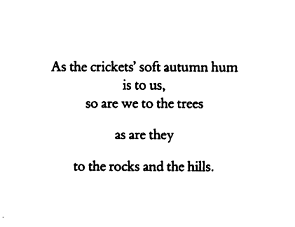
A Meditation in Time of War
.

It is for the artist to see skeleton behind flesh
when depicting war, tho’ beauty too
deserves a hint of her inevitable decay,
flesh being heir to dust and dust its progeny:

nothing is so mechanical visioned in paint
as the tubing that supplies a gas mask with air,
yet the throat is no different, constricted
by an urgency to breathe as breath snuffs out:

gone, gone, paragon, quintessence of dust, svaha!

.

William Butler Yeats has a well-known poem with the same title, so I am borrowing from, flattering, and wondering whether I might sneak under the same mantle as a member of the illustrious departed here.

And Madhu, friend and friend of this blog, encouraged me some while back to post poems here on occasion, so this one is for her by way of a response.

I also wanted to post this particular poem here, though, because its last line nicely illustrates the same notion of overlapping or juxtaposed elements that Koestler claims lies at the heart of the creative process which I have been exploring in my recent posts on Klimt, on Nancy Fouts, and constellational thinking.

Because yes, I now have a book project under way, and it concerns the development of a new style of multifaceted, complex / simplex thinking.

*

The first lines of my poem were triggered by one of those fleeting glances at a blog logo — in this case, the logo of the Kings of War blog from London, which I’ve shaved down a bit to give you a taste of here:
.


.

It’s impressive, eye-catching — and then you get used to it.

So a couple of nights ago when I glimpsed it, I slowed down enough to take a quick but deliberate look, came away with an impression — not necessarily accurate as to detail, but giving me my emotional response to the piece — and worked and played to get it into words, making this what I believe is technically called an ekphrastic poem, a poem about a painting.

The original painting is a mural — José Clemente Orozco‘s Catharsis (1934), from the Museo Palacio de Bellas Artes in Mexico City.

So that, with a little wandering of the mind, is what gives us the first eight lines. It’s the ninth and last line I want to comment on, here.

*

That last line reads:

gone, gone, paragon, quintessence of dust, svaha!

And what’s happening here that delights me, and that gives the poem either a perplexing close or a powerful one, depending on the associations which the reader brings to bear on it, “happens” as follows:

I am letting two, or you might say three, streams of language that are very dear to me braid together in that last line.

There’s the mantra that sums up the entire Prajnaparamita or Perfection of Wisdom literature — a major strand in Buddhist teachings — at the end of the Heart Sutra:

Gate, gate, paragate, parasamgate, bodhi, svaha!

There’s the English translation of the same, which Thich Nhat Hanh explains thus:

Gate means gone. Gone from suffering to the liberation of suffering. Gone from forgetfulness to mindfulness. Gone from duality into non-duality. Gate gate means gone, gone. Paragate means gone all the way to the other shore. So this mantra is said in a very strong way. Gone, gone, gone all the way over. In Parasamgate sam means everyone, the sangha, the entire community of beings. Everyone gone over to the other shore. Bodhi is the light inside, enlightenment, or awakening. You see it and the vision of reality liberates you. And svaha is a cry of joy or excitement, like “Welcome!” or “Hallelujah!” “Gone, gone, gone all the way over, everyone gone to the other shore, enlightenment, svaha!”

— and which I remember from my days at Oxford in Edward Conze‘s much earlier English version:

Gone, gone, gone beyond, gone altogether beyond…

And there’s this, from Hamlet, Act 2 scene 2:

What a piece of work is a man! how noble in reason! how infinite in faculty! in form and moving how express and admirable! in action how like an angel! in apprehension how like a god! the beauty of the world! the paragon of animals! And yet, to me, what is this quintessence of dust?

*

So “gate, gate, paragate” gives me “gone, gone, paragon…” — and “paragon” brings me to “paragon of animals … quintessence of dust”.

If you have all three of these utterances in mind — and each one of them is memorable the way a passage in Isaiah or Job, or some great Churchillian speech, or phrase in Melville or Dickens can be memorable — they will all three be present, braided together as a single music, a polyphony, a constellation of meanings, in that one last line.

Roll them on your tongue, taste the beauty in each one of them, the nobility, the evanescence of this human life. And now read the poem through again.

Of Kony and Constellation

Friday, March 23rd, 2012

[ by Charles Cameron — non-linearity, complexity, “constellational thinking”, a quick spin around the blogosphere, history, Walter Benjamin — following on from Nancy Fouts ]
.


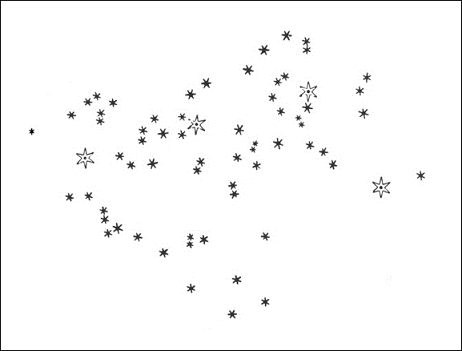
image: Galileo Galilei, Siderius Nuncius (i.e. The Starry Messenger), 1610

.
The novelist Teju Cole has a piece in the Atlantic that’s triggered by the Kony2012 business, and zooms out to touch on much else besides. His piece is titled The White Savior Industrial Complex, and as I was reading it, I came across a phrase that tweaked my keen interest. Cole is talking about Nicholas Kristof, and writes:

His good heart does not always allow him to think constellationally. He does not connect the dots or see the patterns of power behind the isolated “disasters.” All he sees are hungry mouths, and he, in his own advocacy-by-journalism way, is putting food in those mouths as fast as he can. All he sees is need, and he sees no need to reason out the need for the need.

By my lights, “he sees no need to reason out the need for the need” is a powerful tongue-twister, but it’s the phrase “to think constellationally” that interests me here.

Cole returns to a slight variant on the phrase later, this time saying:

Success for Kony 2012 would mean increased militarization of the anti-democratic Yoweri Museveni government, which has been in power in Uganda since 1986 and has played a major role in the world’s deadliest ongoing conflict, the war in the Congo. But those whom privilege allows to deny constellational thinking would enjoy ignoring this fact.

Constellational thinking, then, connects the dots, sees the patterns behind isolated events, sees not just the events themselves but also the circumstances that caused them – and its absence allows us to reduce complexly-interwoven reality to one or more simplistic polarities — better suited to sound bites than to analysis.

*

Cole also points us to Rosebell Kagumire‘s video response to the Kony affair, and she in turn has her own way of addressing the same kind of reduction of complexity to simplicity. She wrote, back on March 8th:

For the last many hours i have followed a campaign by Invisible Children NGO called KONY2012 that has gone viral getting more than 20 million hits on Youtube. I am a story teller and i know the danger of a single story.

So simple, that: I know the danger of a single story.

Remember the Ocean of the Streams of Story diagram in my post almost a week ago, Countering Violent Extremism: variants on a theme? Edward Tufte designed it, to illustrate a paragraph by Salman Rushdie

The truth of a complex situation lives in the interweaving of many stories, not in a single strand, a single view.

*

Constellations — of thoughts, of ideas.


image: Eugen Gomringer, Constellation, ca 1960

I did some digging – I’m not the Oxford English Dictionary, and I can’t say for sure that any particular use of “constellation” marks its first appearance in the sense that interests me here – Eugen Gomringer‘s Constellations (from 1954 onwards, example above) may be relevant in an avant-garde way– but my search brought me to a post by Liz Danzico at Bobulate titled Celestial History, in which Liz wrote:

Teaching constellations is an exercise in storytelling. You see, dots, these anonymous light encrusted patterns, must be memorized and categorized, and it’s only through stories that one can make sense of them. Starting with the north star, and systematically creating relationships in the winter sky among Hercules and Sagittarius, Libra and Polaris, we told tales. We’d trade stories on top of the old stone building in the middle of dark campus until late into the night. Creating these stories, giving Hercules a relationship to Cassiopeia — true or not, good or not, believable or not, it didn’t matter — what mattered were that patterns were found and marked.

Marking patterns and making content accessible through stories is what we do. And often, still, when we begin, we’re in the dark.

*

This post in turn lead Robin Sloan at Snarkmarket to write a quick note of praise, Explosions in the sky, which drew a comment from Tim of Short Schrift that said:

After the Copernican revolution, a constellation isn’t even a constellation. Instead, it’s a two-dimensional flattening of a three-dimensional reality. Actually, we should probably say a FOUR-dimensional reality. The light from stars at varying distances, leaving their sources at various times in the distant past, gets mistaken, from our earthbound point-of-view, as a simultaneous two-dimensional pattern.

BUT! That distortion, that accident, produces something extremely powerful — both imaginatively and practically.

Take “constellational thinking” and apply it to something besides stars in space. Let’s say — history.

Over here, you’ve got the Roman Republic, over there, the French Revolution. Distant in time, distant in geography, no kind of causal proximity let alone a relationship between them.

But bam! Slap them together. View them as a single event, a collapse of time.

Now you begin to see the French Revolution the way part of the Revolution saw itself, as an explosion of the continuum of history.

Now — and sorry if I slow-played this — you’re in Walter Benjamin’s “On the Concept of History.” Now you’re performing a genuinely three-dimensional nonlinear reading of historical time.

Consider that process, spelled out in the phrases “Distant in time, distant in geography, no kind of causal proximity let alone a relationship between them. But bam! Slap them together. View them as a single event, a collapse of time.”

Consider how that “fits” the same Arthur Koestler model of thinking I was on about yesterday in my post Nancy Fouts and the heart of the matter, in which I described:

the “release of cognitive tension” that occurs when some form of analogy, similitude, overlap allows the mind to join conceptual clusters from two fields in a “creative leap”

*

Well, I’m not along in finding this sort of thing useful. Here’s bethr from Mixed Bits writing on tumblr:

Constellational thinking

Omigosh… I’ve been using this phrase in numerous conversations for at least 4 years, usually when attempting to describe how I seem to process information and think, in contrast to the linear thinking which is more prevalent and encouraged in my profession. I’ve never heard anyone else use this phrase…it excites me that others have applied the same phrase and metaphor to the same idea and have articulated it much better than I ever have.

*

And Walter Benjamin:


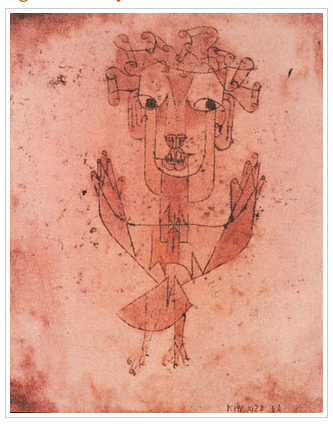
image: Paul Klee, Angelus Novus, 1920

Turning to Walter Benjamin’s On the Concept of History for a moment, we find a remarkable and justly celebrated paragraph about the angel depicted above, a 1920 Paul Klee painted etching which Benjamin himself once owned, now housed in the Israel Museum, Jerusalem:

There is a painting by Klee called Angelus Novus. An angel is depicted there who looks as though he were about to distance himself from something which he is staring at. His eyes are opened wide, his mouth stands open and his wings are outstretched. The Angel of History must look just so. His face is turned towards the past. Where we see the appearance of a chain of events, he sees one single catastrophe, which unceasingly piles rubble on top of rubble and hurls it before his feet. He would like to pause for a moment so fair, to awaken the dead and to piece together what has been smashed. But a storm is blowing from Paradise, it has caught itself up in his wings and is so strong that the Angel can no longer close them. The storm drives him irresistibly into the future, to which his back is turned, while the rubble-heap before him grows sky-high. That which we call progress, is this storm.

*

More prosaically, Benjamin then gives us the twinned realities to which Tim had pointed in his comment at Snarkmarket:

For Robespierre, Roman antiquity was a past charged with the here-and-now, which he exploded out of the continuum of history. The French revolution thought of itself as a latter day Rome. It cited ancient Rome exactly the way fashion cites a past costume. Fashion has an eye for what is up-to-date, wherever it moves in the jungle of what was.

*

Benjamin’s “moment” — his here-and-now — has passed, perhaps. The nuances discoverable through juxtaposition, counterpoint, overlay, constellational thinking, remain.

The Said Symphony: move 19

Sunday, March 18th, 2012

[ by Charles Cameron – extended analytic game on Israeli-Palestinian conflict — for those who wish to catch up, our game thus far consists of an intro to the game and game board, followed by moves 1-5, 6-9, then moves 10-11 which together constitute a meditation, moves 12, 13-15, 16-17, and most recently before this, move 18 with cadenza ]

Move 19: The view from above

Move content:

Discussing strategy, the very canny LTG (USMC, Ret’d.) Paul Van Riper had this to say:

What we tend to do is look toward the enemy. We’re only looking one way: from us to them. But the good commanders take two other views. They mentally move forward and look back to themselves. They look from the enemy back to the friendly, and they try to imagine how the enemy might attack them. The third is to get a bird’s-eye view, a top-down view, where you take the whole scene in. The amateur looks one way; the professional looks at least three different ways.

A bird’s-eye view, a hawk’s eye view, a top-down view, an overview, a view from 30,000 feet, a God’s eye view, a view from above, a zoom…

If move 18 and its cadenza gave us a view of the depth of vision or insight that is necessary for a full and rich understanding of the world we live in — its qualitative or spiritual scope, if you like — this next move, with its picnic and drone-sight, addresses its breadth in space and time — materially and quantitatively speaking.

The classic expression of the sheer material scope of the universe was put together by Charles and Ray Eames in their justly celebrated film, Powers of Ten, from which the lower of these two images is drawn:

Here are some other relevant scans of the scope of things, in terms of time and space:

The Scale of the Universe 2
A Brief History of The Universe
The Known Universe
A Time-Lapse Map of Every Nuclear Explosion Since 1945

These are impressive videos to be sure, but as an aside I’ll invite you to ask yourselves how well they compare with this zoom in words, a poem by the zennist, ecologist, essayist and poet Gary Snyder, from his book, Axe Handles: Poems:

Such breadth of vision, such craft.

*

If this “material scope of things” too has a cadenza, it would be that all of this is shot through with some primary oppositions, dappled as the poet Gerard Manley Hopkins would have it, with swift, slow; sweet, sour; adazzle, dim — as indicated in the drone-sight and picnic double image at the head of this move.

This dappling, this constant flux of opposites, takes many forms — day and night lead to the more abstract light and dark, which can then be interpreted morally as good and evil, to which we respond with repulsion and attraction as the case may be, building our worldviews from love or fear…

At different scales the opposites that matter most to us may have different names and shadings, but here I’d just like to draw attention to the dappling of our world with:

competition and cooperation
Darwin‘s natural selection and Kropotkin‘s mutual aid
duel and duet (ah! — a favorite phrasing of mine)
war and peace

Provocatively, we find this dappling in scriptures, too, wherein the ripples of such verses as “The LORD is a man of war: the LORD is his name” (Exodus 15.3) dropped like a stone into the pond of the human mind, meet with the ripples of other verses such as “God is love; and he that dwelleth in love dwelleth in God, and God in him” (I John 4.16).

There are times when we take such oppositions literally, perhaps too literally, and times when we begin to see oppositions as abstract and theoretical end-points to what is in fact a yin-yang process continually unfolding…

Which brings me by a commodius vicus of recirculation to this image of the great opposition between war and peace, its dappling, its unfolding:

Links claimed:

To the Lamb, move 18: this move presents the material scope of the universe in counterpoint to its visionary scope as laid out in move 18 with its cadenza.

To Revelation, move 17 — the word revelation means unveiling, as we have seen, and our sciences and technologies, with their spectra of telescopes, microscopes, cameras and zooms, are unveiling and revealing to us much about the physicality of the world we live in — much that was accounted for in other times and places through intuition, vision and poetry.

This scientific and technical revelation of material existence, for many of us moderns, has largely eclipsed the mode of visionary revelation of move 17 — yet it cannot eradicate it. Implicit in this move, then, is the sense that we carry with us both subjective and objective, inner and outer, qualitative and quantitative understandings — though the data that “sight” and “insight” provide us with may be different in kind, and resolving them may be something of a koan to us, the deep problem in consciousness as philosophers of science have named it — and that we can discount neither one if we are to have and maintain a rich sense of our situation.

Comment:

If the two previous moves have shown us the scope of the universe we co-inhabit, perhaps we should now make our own zoom in, much as James Joyce did when he had the schoolboy Stephen inscribe his name and address in his geography book as Stephen Dedalus, Class of Elements, Clongowes Wood College, Sallins, County Kildare, Ireland, Europe, The World, Universe – an address that Stephen then read both forwards and backwards, finding himself in one direction, and finding in the other that he had no means of knowing what might lie beyond the universe…

Imagine then, skipping rapidly from (unimaginable) cosmos via such things as the intriguingly named End of Greatness to galaxy or nebula…

…solar system and planet — whence we can slow down and zero gently in on the Middle (or as my friend Ralph Birnbaum would call it, the Muddle) East, Israel / Palestine, Jerusalem / Al Quds / the Temple Mount / Noble Sanctuary – and to such matters of contemplative vision and tribal passion as the first, second and projected third Temples, the al-Aqsa mosque.

Our increasing focus will bring us, then, to that the rock which Jews believe marks the place where Abraham bound his son Isaac (the Akedah), and which Muslims believe to be the place of ascent of the Prophet to the celestial realms (the Mi’raj) on his Night Journey (Qur’an, Al-Isra).

Here again myth and history collide, and both visionary and material considerations merge in the heart of the what my friend the Israeli journalist Gershom Gorenberg has justly called “the most contested piece of real estate on earth”.

Klimt under the microscope, then on to bigger things

Saturday, March 17th, 2012

[ by Charles Cameron – the “internal” complexity from which we relate to both the simplest and most complex issues and problems in the “external” world ]
.

The painting is by Gustav Klimt: your eye sees it, you know it’s a painting, reproduced here in pixels, you can read the text that accompanies it — a Nobel laureate wrote it — which describes just one chemical level of the complexity in you that responds to the painting, reproduction, pixels, blog post..

Viewing the painting, reading the accompanying text — they’re complex activities. You notice the woman’s head, “detached” for her body by that golden necklace, might see the beheaded head she’s holding almost out of the picture frame, lower right — might or might not know the story of Judith and Holofernes, which gives the painting a cultural intensity of particular interest to Israel under threat — Alexander Kafka sketched the background thus in the Chronicle article that brought all this to my attention today:

In 590 BC, to protect her besieged city of Bethulia, the alluring Jewish widow Judith drank with and seduced the attacking Assyrian general Holofernes. When he fell into a drunken, sated heap, she decapitated him with his own sword and displayed his head as trophy, rallying her fellow citizens to rout the Babylonians.

And if the writer hadn’t forewarned you, you might well have missed that echo effect of the beheaded Holophernes and the necklaced head of his beheader.

All of which touches on meaning, while Nobel laureate (and long-time Klimt collector) Eric Kandel‘s commentary deals in neurotransmitters: dopamine, oxytocin, vasopressin, norepinephrine, serotonin, acetylcholine

*

Gilles Fauconnier and Mark Turner have a fine book out called The Way We Think: Comceptual Blending and the Mind’s Hidden Complexities in which they lay out some fascinating aspects of how the brain builds for us the “blend” of different impulses, correspondences and perceptions that we consider to be “the world we live in”…

They quote Sir Charles Sherrington‘s celebrated description of the mind waking from sleep as an enchanted loom in his Man on his Nature:

The brain is waking and with it the mind is returning. It is as if the Milky Way entered upon some cosmic dance. Swiftly the head mass becomes an enchanted loom where millions of flashing shuttles weave a dissolving pattern, always a meaningful pattern though never an abiding one; a shifting harmony of subpatterns.

And it’s with that “shifting harmony of subpatterns” within us that we meet and attend to the shifting patterns of the world around us — a world that features its own “complex, n-dimensional and constantly shifting” problems, which we seek to understand and resolve via insights and solutions %i(that would also make good tight soundbites) for the TV.

*

Indeed — are those two weaves of complex shifting patterns, within us and around us, distinct — or one and the same?

Eh?


Switch to our mobile site