zenpundit.com » complexity

Archive for the ‘complexity’ Category

Excess Complexity is the Route to Extinction

Friday, April 10th, 2009


Nassim Nicholas Taleb, author of The Black Swan: The Impact of the Highly Improbable and Fooled by Randomness: The Hidden Role of Chance in Life and in the Markets, had an op-ed in FT.com entitled “Ten principles for a Black Swan-proof world” (Hat tip to John Robb and Pundita). Taleb was addressing the global economic crisis, but I was particularly drawn to Taleb’s fifth principle, which has a more general implication:

5. Counter-balance complexity with simplicity. Complexity from globalisation and highly networked economic life needs to be countered by simplicity in financial products. The complex economy is already a form of leverage: the leverage of efficiency. Such systems survive thanks to slack and redundancy; adding debt produces wild and dangerous gyrations and leaves no room for error. Capitalism cannot avoid fads and bubbles: equity bubbles (as in 2000) have proved to be mild; debt bubbles are vicious.

Taleb has encapsulated many important concepts very well here. Up to a certain point, increasing complexity represents a advantage for an evolving system (biological, financial, physical etc.) by increasing efficiency through adding specialization, interconnection, diversification, redundancy and checks for mitigation of risks. Complexity, in the earlier part of a development curve can add to a system’s overall resiliency – to a point.

Superfluous complexity, that which goes beyond the minimum required for additional gains in systemic efficiency or productivity, is a net drag on the system, an economic waste, a source of friction, a cancer,  a useless eater of resources and the earliest sign of the system’s inevitable decay. Worse, excess complexity represents an increasing probability of systemic failure by multiplying the number of variables involved in the normal process of the system. There are more things that can go wrong and more choke points where a catastrophic failure can occur. Increasing the degree of complexity moves the system away from simplicity and reliability and toward chaos and the creativity of emergent properties, but like an ice skater seeking ever greater range, go too far and the ice will crack under one’s feet.

This is an effect familiar to engineers and scientists but one that appears to escape the majority of politicians, corporate executives and economists. My co-blogger at Chicago Boyz, Shannon Love,  took GE to task for trying to get on the Federal dole by advocating needlessly complicating the nation’s power grid:

If Your Grid Had a Brain

GE is advertising to build political support for Obama’s plan to purchase billions of dollars of GE tech in order to make the power grid “smart”.  After all, who would want a “dumb” anything when they could have a “smart” something? 

The reason we should keep things dumb is that in engineering the word “dumb” has a different connotation. In engineering, “dumb” means simple and reliable. 

Increasing complexity in any networked system increases possible points of failure. Worse, the more interconnected the system, i.e., the more any single component affects any other randomly selected component in the system, the faster point-failures spread to the entire system. Power grids are massively interconnected. Every blackout starts with a seemingly trivial problem that, like a pebble failing on a mountain side, triggers an avalanche of failure. 

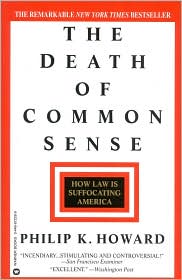
In the social and political domain, back in the 1990’s Philip K. Howard wrote a book called The Death of Common Sense: How Law is Suffocating America in which he detailed example after example of how the overlawyering of regulatory systems in America by an emerging and hyper-aggressive legal class was producing neither restraint on government abuses nor fine-tuned social outcomes but instead created a state of paralyzed rigidity, risk aversion, perverse incentives and general dysfunction; in other words, chaos instead of order.
The Obama-ites in the White House are not “socialists” ( at least not most of them) but there is a great love of liberal-minded technocracy there, and a seemingly boundless self-confidence in the ability of high-minded, upper-middle class, progressive, wonks and lawyers from the “good schools” (or investment houses – in some cases, both) to micromanage not just our lives for us, or even the United States of America but the global economy itself. Sort of a Superempowered Oligarchy of Good Feelings.

The ancient Greeks had a word for that: hubris. More importantly, the Obama-ites are wrong here – adding endless amounts of regulatory complexity is not going to give them the kind of granular control or positive returns that they seek to obtain from the system. Counterintuitively, they should be radically simplifying where and to the degree they safely can instead.

Israel’s Half-Mad Genius of Mil-Theory

Saturday, February 14th, 2009

Just read this profile of Dr. (Gen.) Shimon Naveh, via Soob via Ubiwar.

….Naveh describes his last and perhaps most important military-academic project, OTRI, as a chronicle of failure. “It was a failure of the group and also my personal failure, but in a far deeper sense it was the IDF’s failure. The IDF has not recovered because it doesn’t have the ability, unless it undergoes a revolution.”Naveh, who established OTRI together with Brigadier General (res.) Dov Tamari, draws on imagery from the world of construction to explain the project. “We wanted to create an intermediate level between the master craftsman, the tiling artisan or the electrician, who is the equivalent of the battalion or brigade commander, and the entrepreneur or the strategist, the counterpart of the high commander, who wants to change the world, but lacks knowledge in construction.”Between the two levels, he continues, is the architect/commander-in-chief, whose role is “to enable the system to understand what the problem is, define it and interpret it through engineers.” In the absence of this link, he maintains, armies find themselves unable to implement their strategic planning by tactical means. “Entrepreneurs and master craftsmen cannot communicate,” he says.Already in his first book, “The Operational Art,” published in 2001 and based on his doctoral dissertation, he described the level of the military architect: “The intermediate level is the great invention of the Russians. [The military architects] occupy the middle, and make it possible for the other fields, from politics to the killers, to understand, plan and learn.”
An interesting and to me well constructed analogy by General Naveh that rings true to me from what I know of the Soviet history. Naveh perfectly describes the peculair adaptive requirements forced on the Red Army by the nature of the Soviet political system, especially as it existed under Stalin from the time of the Great Terror forward ( 1936 -1953). Stalin wiped out much of his senior military leadership of the Red Army during the Yezhovschina in 1937 and decimated the junior officer corps to boot, leaving it thoroughly demoralized and rigidly shackled to political comissars who were, like the military commanders, completely paralyzed with fear ( the Red Navy officer corps was basically exterminated en masse).

When Operation Barbarossa commenced in June, 1941, the dramatic Soviet collapse in the face of the Nazi onslaught was due in part to Stalin’s maniacal insistence that Germany was not going to attack and that assertions to the contrary were evidence of “wrecking” and “provocation” – crimes liable to get one immediately shot. Even a high ranking NKVD official, Dekanazov, whom Stalin made ambassador to Berlin, was personally threatened by Stalin for daring to warn the Soviet dictator about Hitler’s imminent attack.

That being said, Stalin quickly realized during the 1941 retreat that he had debilitated his own army by decapitating it and his own judgment as supreme warlord was no substitute at the front lines for what Naveh terms “operational art”. Stalin the entrepreneur-grand strategist needed competent military architects like Zhukov and Rossokovsky to plug the gap with the craftsmen and Stalin not only promoted and protected them, he tolerated their dissent from his own military judgment and sometimes yielded to their concerns. Very much unlike Hitler who could seldom abide criticism or deviation from his general officers or learn from them. Stalin improved as a war leader from interaction with his generals; Hitler did not and if anything grew worse over time – as did the Wehrmacht’s tactical-strategic disconnect.

The above anecdote represents the rich level of depth behind Naveh’s offhand and seemingly disjointed references. There’s a lot of meat there behind the dots Naveh is connecting but the uninitiated will have to be willing to dig deep. I’m cool toward Naveh’s reliance upon French postmodernism but I admire the breadth of his capability as a horizontal thinker and theorist. However, Naveh needs an “architect” of his own to translate for him and make his complex ideas more readily comprehensible to the mainstream. I will wager that few Majors or Lt. Colonels, be they U.S. Army, IDF or Russian, read much Focault these days.

ADDENDUM:

The SWJ had an interview with Dr. Naveh on his theory of Systematic Operational Design in 2007

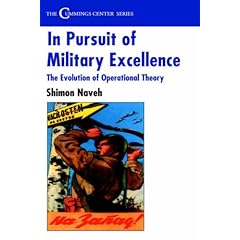
Dr. Naveh’s book is In Pursuit of Military Excellence: The Evolution of Operational Theory (Cummings Center Series)

Joint Force Quarterly (via Findarticle) -“Operational art

Jerusalem Post – “Column One: Halutz’s Stalinist moment

Depth, Breadth and Velocity

Wednesday, August 27th, 2008

I thoroughly enjoyed John Hagel’s post Stupidity and the Internet where he analyzed the implications of the book vs. snippet debate initiated by Nick Carr’s  Atlantic article “Is Google Making Us Stupid?”. Hagel properly broadened the debate away from content format to encompass the social sphere:

But if the concern is about intelligence, thinking and the mind, then isn’t content just one small piece of the puzzle?  Nick and many of the digerati who line up against Nick have one thing in common – they are content junkies.  They consume content voraciously and care deeply about the form that content takes. 

In the heat of debate, they seemed to often lose sight of the fact that most people are not content junkies.  Most people use the Internet as a platform to connect with each other.  Sure, they are exchanging information with each other, but they are doing a lot more than that.  They are learning about each other. They are finding ways to build relationships that expand their understanding of the world and enhance their ability to succeed in their professions and personal lives.

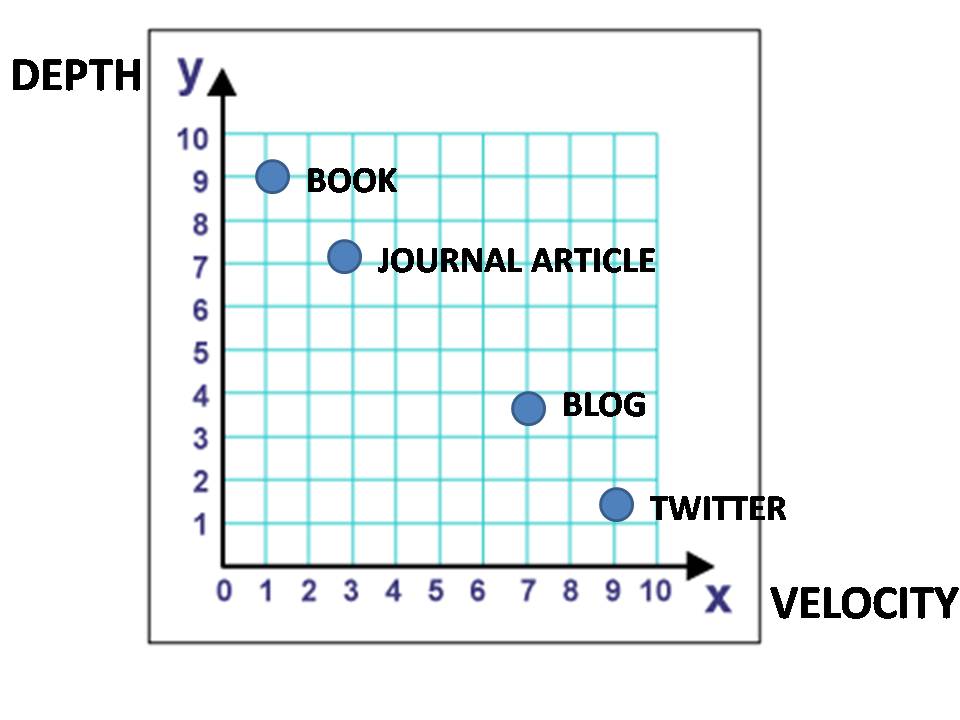
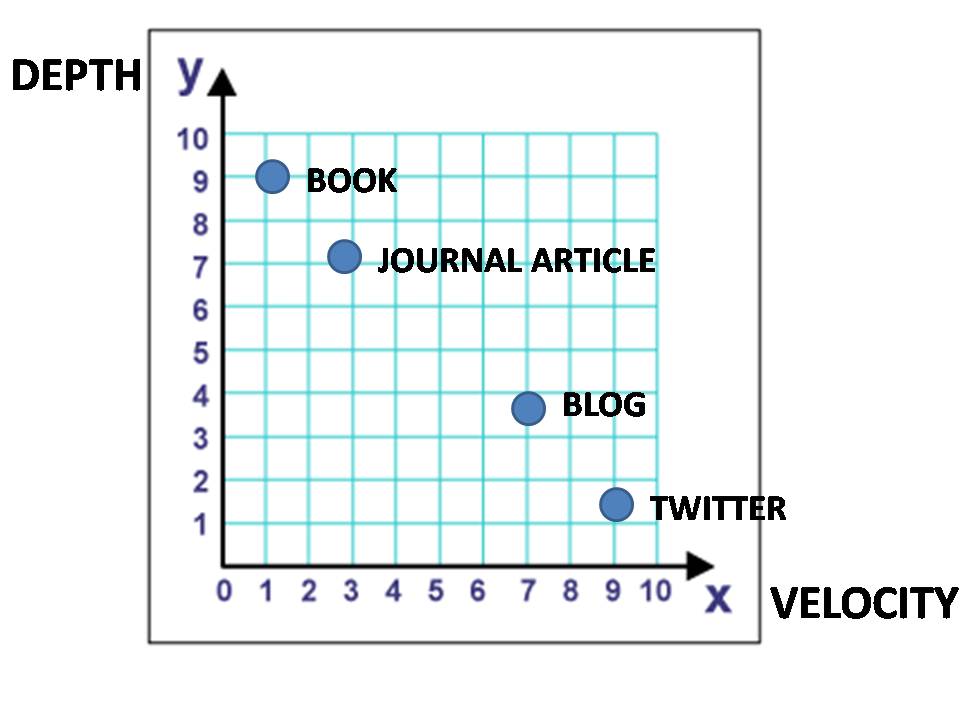
I’m going to back the discussion up a half-step by pointing out that these online relationships are often, initially of a transactional nature. Information is being exchanged and the kind of information used as a “hook” to capture attention may be determinative to the trajectory the social relationship may take and the rate of information exchanged may determine if the social connection can be sustained. To simplify, we are discussing Depth, Breadth and Velocity of information:

graph1.jpg

Books, journal articles, blog posts and Twitter “tweets” ( 140 character microblogging) could have their relative informational and transactional qualities be represented on a simple graph. Books have the greatest potential depth but the least level of timely, qualitatively reciprocal, informational transaction for the author ( primarily gained from the relationship with the editor or a “sounding board” colleague). Peer review journals are next, with a narrow community of experts sanctioning the merit of the article or rejecting it for deficiencies that put the work below or outside the field’s recognized professional standards. Blog posts can potentially generate an enormous volume of feedback, though at the cost of a dramatically inferior “signal to noise ratio“. Microblogging services like Twitter have hyperkinetic transaction rates but unless used strategically ( for example, by Robert Scoble) or within an existing social network, they generate little other than useless noise.

Attention can be attracted by a clever “snippet” – particularly if the concept itself has ambiguity or nuance that would intrigue more people than if it were precisely defined – but the attention will not be held unless the author can sustain the flow of interesting material, something that requires depth of knowledge about a subject.  Even better is to have depth in a subject along with breadth, the ability to think horizontally across many domains to spot emergent patterns, construct powerful analogies and distill a meaningful synthesis. In turn, pulling a willing audience of useful collaborators into a relationship around such intellectual pursuits hinges on first gaining their attention with a comprehensible simplification of complex abstractions and exhibiting a willingness to interact on a reciprocal basis.

It’s not a case here of “Books vs. Google”. Depth, breadth and velocity of information are interdependent and mutually reinforcing.

First Post up at Complex Terrain Laboratory

Monday, June 16th, 2008

Kind of a part “theory”, part “futurism” post as my introduction to CTLab readers:

Visualcy and the Human Terrain

As a result of public education, the rise of mass-media and commercial advertising, Western nations and Japan, some earlier but all by mid-20th century, became relatively homogenized in the processing of information as well as having a dominant vital “consensus” on cultural and political values with postwar Japan probably being the most extreme example. The range between elite and mass opinion naturally narrowed as more citizens shared similar outlooks and the same sources of information, as did the avenues for acceptable dissent. A characteristic of modern society examined at length by thinkers as diverse as Ortega y Gasset, Edward Bernays, Marshall McLuhan and Alvin Toffler.

….Interestingly enough, despite complaints by American conservatives regarding the political bias of news outlets like al-Jazeera and al-Arabiya, these organizations are packaging news in the familiar “Pulitzerian frame” in which mass media have been structuring information for over a century. Effectively, habituating their audience to a Western style (if not content) of thinking and information processing, with all of the advantages and shortcomings in terms of speed and superficiality that we associate with television news broadcasting. This phenomena, along with streaming internet video content like Youtube and – very, very, soon, mass-based Web 2.0 video social networks – will overlay the aforementioned complexity in regard to the range of education and literacy.

Read the whole thing here.

Cherry-Picking from Complexity Digest

Saturday, May 24th, 2008

Forgot about Complexity Digest for a while. Some great stuff there – a sampling:

A theory for the formation of large agrarian empires  by Peter Turchin (PDF)

New Insights Into The Dynamics Of The Brain’s Cortex Science Daily

Natural Security: Ecologist Says Evolution Offers Important Lessons for Security Policy  AAAS

In regard to the last one: the need for consilient thinking is starting to penetrate the bureaucracy – about goddamn time.


Switch to our mobile site