zenpundit.com » nuclear

Archive for the ‘nuclear’ Category

What’s the distance between inside, and within — and politics?

Sunday, January 7th, 2018

[ by Charles Cameron — eerie distances between thus and so, this and that — and Trump, Wolff ]
.

Speaking practically: switching between the delicate details of the North Korean situation, and those of the Iranian situation, each of which involves a potential nuclear adversary and some deterrent balance, and each of which contains the other as a subset — what’s the mental distance between those two mindsets? How fast can a sharp mind switch betweeen them. Or, for that matter, between foreign affairs and domestic politics? Or between dealing with House and Senate? Or between treating with Democrat and Republican?

Is there a zoom at work here, between these difficult distances?

**

I’d been wondering recently about some mental distances that illustrate the difference betweeen qualitative and quantitative realms, subjective and objective realities..

I’ve been asking myself, what’s the distance between inside and within, between x-ray and insight, or sky and heaven?


Wm Blake, Newton (left); Angel (right).

And what scale should we use to peer into such questions? — the compass Blake’s Newton uses to parcel out earth is purely terrestrial, purely rational, and Blake’s own blazing angels would have no place in it. Should we perhaps use Taleb‘s Wittgenstein‘s ruler?

Unless you have confidence in the ruler’s reliability, if you use a ruler to measure a table you may also be using the table to measure the ruler.

Here, the distance between the measurer and the measured is itself in flux.

**

Back to politics.

How do those whose entire lives have been concerned with the largely substantial, ascertainable or verifiable facts of focus groups, polls, votes, election results, majorities, minorities, policies and so forth — with no time for Rilke‘s “angels’ hierarchies” — function when weighing the “mental stability” or “very stable genius” of a President with that same President’s policy with regard to — gasp — Kim Jong-Un?

Who has his own issues of “very stable genius” or “mental stability”?

And who doesn’t even have a semi-reliable chronicler like Wolff to illuminate the swathe he is cutting through ideology, dogma, doctrine, advisors, generals, and.. Juche?

How many minds do we have among the generals, among the punditry, who can roam at all scales of the relevant realms, psychological and political, blatant and nuanced, knowable and profoundly unknown?
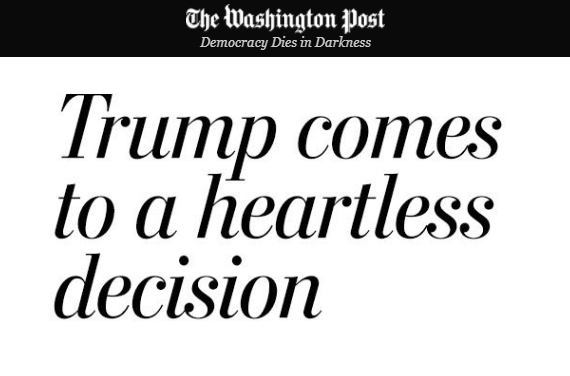
Heartless? What’s heart? Since when did that have anything to do with anything?

Wednesday, September 6th, 2017

[ by Charles Cameron — and to think I thought that little red heart was just an emoticon! ]
.

The Washington Post, supposedly a paper which takes political matters seriously, featured this caption in its email to me today:

Is this heart thing something to be taken seriously? Just on occasion, as with the impact of cancelling DACA on people who were, at least recently, children? Or in matters of economics, too? And the deployment, threat and use of nuclear weapons? In diplomacy?

I mean, the number of situations in which this somewhat vague “heart” entity might be invoked and prioritized is hard to estimate. What was it Pascal said?

The heart has reasons reason knows not of..

That in itself is a somewhat confusing statement. Is it a paradox?

Ah well, I’ll retire to poetry: poets, after all, think themselves the “unacknowledged legislators of the world” — and as one of them legislated not so very long ago:

My heart rouses
          thinking to bring you news
                    of something
that concerns you
          and concerns many men. Look at
                    what passes for the new.
You will not find it there but in
          despised poems.
                    It is difficult
to get the news from poems
          yet men die miserably every day
                    for lack
of what is found there.

What is found there? This heart thing, perhaps? Heart’s the second word in that poetry bit — it could be worth a try.

Truman Trump, and that reminds me, Maude Rumsfeld

Thursday, August 10th, 2017

[ by Charles Cameron — humming along as the world sings ]
.

It’s not as though I’m the one who noticed the Trump Truman correspondence — it’s laid out, with some other worthwhile quotes, in the New Yorker piece, Donald Trump’s Nuclear War Threat:

And it does have something of an apocalyptic ring to it, as does Truman’s remark, which he slipped in like a knife between Hiroshima and Nagasaki.

**

All of which reminds me of two invasions of Iraq, a century apart:

Nothing apocalyptic there — unless you think of Baghdad in the same breath as Babylon — which Saddam likely did.

Two sides of the Saudi coin?

Friday, May 19th, 2017

[ by Charles Cameron — sunni / salafi hope, shia fear, when the us weighs saudi oil against iranian nukes — what say the sufis? ]
.

Context one:

**

Context two:

**

Having said that, returning to the Saudi visit:

Hayder al-Khoei is less than enthused:

Mattis and Kim: mirrors have consequences

Friday, April 21st, 2017

[ by Charles Cameron — the current nuclear standoff, with a coda on silver beech and copper birch ]
.

**

I spend a fair amount of time suggesting that formal characteristics found in events are frequently worth special note, and mirroring is a good example. Here, in Why Mattis versus Kim Jong-Un Will End Badly for Us All, War on tnhe Rocks indicates the potential (and potent) peril of mirroring in the context of our latest Korean adventure:

Inadvertent war in Korea is more likely now than at any point in recent history. Whereas a second Korean war has always been possible, clashing U.S. and North Korean “theories of victory” — beliefs about what it takes to successfully coerce and control escalation — now make it plausible, even probable.

Patterns of bluster and brinkmanship have of course long characterized affairs on the Korean Peninsula. For “Korea watchers,” there’s a perverse comfort in the predictability of a situation that, to the uninitiated, sometimes looks anything but stable.

So on some level, the rhythm of recent saber-rattling between the Trump administration and North Korea recalls the perverse comfort of typical Korea policy. On a recent visit to South Korea, Vice President Mike Pence cited U.S. attacks in Syria and Afghanistan as indications of U.S. resolve against North Korea. This statement followed numerous officials confirming that the administration is contemplating preventive strikes against the North, and a recent policy review on North Korea yielding one overarching imperative: “maximum pressure.” North Korea’s rhetoric and posturing has been no less confrontational and no less familiar. As Pence departed Alaska for South Korea, North Korea attempted a submarine-launched ballistic missile test that failed. Upon news that a U.S. carrier group was headed to its neighborhood, North Korea responded that “a thermonuclear war may break out at any moment” and that it’s “ready to react to any mode of war desired by the U.S.”

These words and deeds themselves are more heated than usual, but unremarkable in the context of all that’s come before. North Korea routinely threatens war, often summoning images of a future mushroom cloud. The United States routinely dispatches aircraft carriers, bombers, and other strategic military assets in hopes of signaling resolve while actually registering little more than displeasure with North Korean behavior. The notion of “maximum pressure,” moreover, only differs from the approach of past U.S. presidents in the ambiguous adjective “maximum.” Pressure is the historical mean of U.S. policy toward North Korea. My concern is not with these observable dynamics to date, but rather with what lies beneath them, and what may be coming soon as a consequence.

It’s getting harder to ignore that the Pentagon, under Secretary Jim Mattis, may have a coercive theory of victory that largely mirrors that of North Korea under Kim Jong-Un. The danger is in the fundamental incompatibility of these disturbingly similar sets of strategic beliefs.

**

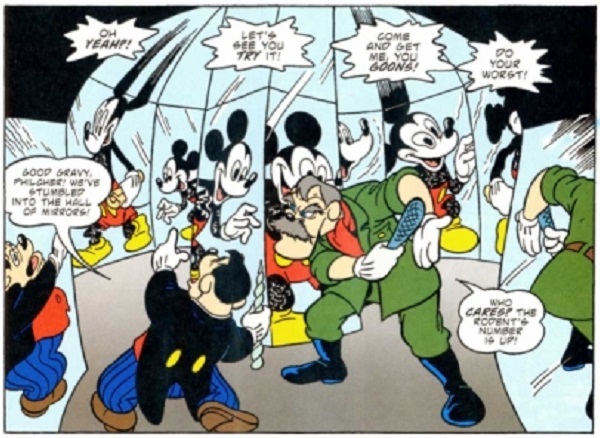
Smoke and the hall of mirrors, a digression:

An excellent place for final confrontations with heroes, the Hall Of Mirrors wins high marks for ease of use. All you have to do is lure your victim inside by dashing in yourself, and then cackle with glee as they find you reflected back not once but a thousand times… When you have had your fun, seal the exits and fill the cramped space with some kind of liquid. Plain water works as well as anything, but why not add food dye for color. Or, for a touch of whimsy, use a sickeningly sweet fruit punch.

Neil Zawacki, How to Be a Villain, in TV Tropes: Hall of Mirrors

**

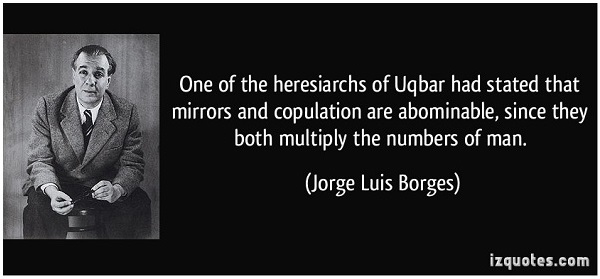
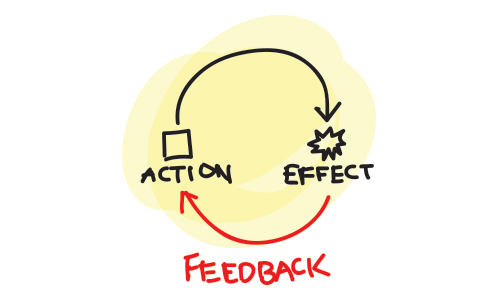
Mirroring sets up an echo chamber — consider the myth of Narcissus** — which is also a sort of ping-pong game and a feedback machine —

and hence a magnifier or an accelerator. It can allm too easily howl out of control, with — in this case — nuclear consequences.

** Narcissus sees his reflection, Echo echos his voice back to him, thus the myth encompasses a parallelism between visual and aural self-perceptions in a wonderful act of inter-media symmetry.

**

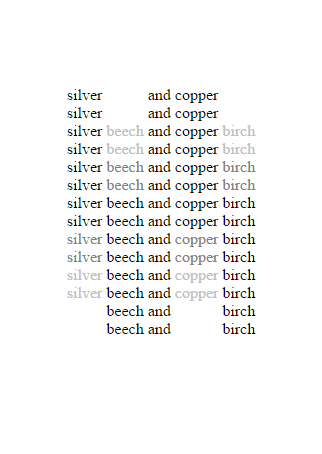
Form is the decorative act of the creative mind, adding to meaning by the use of devices of art in the way the materials of the art are deployed — as when the poet notes (specifically) beech and birch trees in a wood, delighted by the verbal felicity between the two words, or Coppola matches helicopter rotors against the blades of a hotel room fan in the beginning of Apocalypse Now.

And then the delight triples with the addition of a metallic match:

But again, I digress..

**


Switch to our mobile site