zenpundit.com » Glass Bead Game

Archive for the ‘Glass Bead Game’ Category

Pope Francis : Francis Bacon

Monday, March 28th, 2016

[ by Charles Cameron — and a tradition of natural philosophy profound enough to include Francis of Assisi ]
.

It’s a small point, perhaps, but M. Anthony Mills had a piece in The New Atlantis last Fall titled Is Pope Francis Anti-Modern? — which I ran across today because today 3 Quarks Daily posted it — and in it, Mills to my mind makes a false dichotomy between Pope Francis and Francis Bacon.

Thus Mills writes:

Pope Francis’s picture of nature is indebted to Genesis, the Biblical prophets, and the writings of Irenaeus, Aquinas, and Francis of Assisi — and, arguably, Plato and Aristotle — as well as to the twentieth-century theologian Romano Guardini (whose book The End of the Modern World is cited a number of times in the encyclical). But it is not true that doing so puts Pope Francis at odds with modern science. It does pit him against a particular understanding of modern science, bequeathed to us by Francis Bacon and, perhaps more importantly, by the Enlightenment philosophes such as Voltaire who claimed Bacon as the “father of experimental philosophy.” This view of science continues today in the cult of technological progress, which sees every problem as amenable to technocratic solution, no matter the environmental, social, cultural, or spiritual cost. This is what Pope Francis refers to and criticizes as the “technocratic paradigm.”

To the contrary, at the end of his Preface to the Instauratio Magna, which Jerome Ravetz quotes in the final paragraph of his magisterial Scientific knowledge and its social problems, Bacon writes:

Lastly, I would address one general admonition to all; that they consider what are the true ends of knowledge, and that they seek it not either for pleasure of the mind, or for contention, or for superiority to others, or for profit, or fame, or power, or any of these inferior things; but for the benefit and use of life; and that they perfect and govern it in charity. For it was from lust of power that the angels fell, from lust of knowledge that man fell; but of charity there can be no excess, neither did angel or man ever come in danger by it.

And to bring the opposition between their two views into a nutshell, Mills writes of “the Baconian technocratic paradigm, which understands science and technology together as instruments for controlling and exploiting all of creation” — while Bacon is in fact opposed to such control and exploitation, as we see when he attacks certain of his contemporaries for precisely those failings:

For we create worlds, we direct and domineer over nature, we will have it that all things are as in our folly we think they should be, not as seems fittest to the Divine wisdom, or as they are found to be in fact.

**

There are indeed two visions of science at work across history, as Ravetz is at pains to show. Perhaps we can see them best by comparing the two instances in which Mills and Ravetz respectively situate yet another Francis, St Francis of Assisi.

Mills, as we have seen, locates him — along with the current Pope — on the anti-modern, and hence anti-Baconian, side of the ledger:

Pope Francis’s picture of nature is indebted to Genesis, the Biblical prophets, and the writings of Irenaeus, Aquinas, and Francis of Assisi — and, arguably, Plato and Aristotle — as well as to the twentieth-century theologian Romano Guardini

For Ravetz, St Francis is indeed a participant in one of two distinct streams of world exploration — the one he terms a “romantic” philosophy of nature:

Looking back into history, we can find a similarity of doctrine or style, and sometimes a linking tradition, as far back as the Taoists of ancient China, through St. Francis of Assisi, to Paracelsus, William Blake, and Herbert Marcuse.

He continues:

Not every one of these figures would claim to be a natural scientist of any description; but as philosophers, poets or prophets, they must be recognized as participating in and shaping a tradition of a certain perception of nature and its relation to man. Granted all the variety of their messages and styles, certain themes recur. One is the ‘romantic’ striving for immediacy, of contact with the living things themselves rather than with book-learned descriptions. Another is ‘philanthropy’; the quest is not for a private realization, but for the benefit of all men and nature.

And here’s the difference. Francis Bacon, Ravetz finds, stands clearly on this same “romantuc” side of the ledger. For:

As deeply as any of his pietistic, alchemical forerunners, he felt the love of God’s creation, the pity for the sufferings of man, and the striving for innocence, humility, and charity; and he recognized vanity as the deadliest of sins.

**

Let me recapitulate that final paragraph of Ravetz’ book, quoted entirely from Bacon:

Lastly, I would address one general admonition to all; that they consider what are the true ends of knowledge, and that they seek it not either for pleasure of the mind, or for contention, or for superiority to others, or for profit, or fame, or power, or any of these inferior things; but for the benefit and use of life; and that they perfect and govern it in charity. For it was from lust of power that the angels fell, from lust of knowledge that man fell; but of charity there can be no excess, neither did angel or man ever come in danger by it.

This is virtually a monastic ideal of science, one which would be found most suitable in the halls of Hesse’s Castalia, and one well-suited to the Benedict Option as formulated by Rod Dreher.

It is also, and significantly, as Ravetz points out, compatible with the truth concerns of Taoists, poets and theologians…

**

Hermann Hesse, it seems to me, gives a deeper and wider acknowledgment of both streams, bringing their “hard” and “soft” strands together in his history of the Glass Bead Game:

How far back the historian wishes to place the origins and antecedents of the Glass Bead Game is, ultimately, a matter of his personal choice. For like every great idea it has no real beginning; rather, it has always been, at least the idea of it. We find it foreshadowed, as a dim anticipation and hope, in a good many earlier ages. There are hints of it in Pythagoras, for example, and then among Hellenistic Gnostic circles in the late period of classical civilization. We find it equally among the ancient Chinese, then again at the several pinnacles of Arabic-Moorish culture; and the path of its prehistory leads on through Scholasticism and Humanism to the academies of mathematicians of the seventeenth and eighteenth centuries and on to the Romantic philosophies and the runes of Novalis’s hallucinatory visions. This same eternal idea, which for us has been embodied in the Glass Bead Game, has underlain every movement of Mind toward the ideal goal of a universitas litterarum, every Platonic academy, every league of an intellectual elite, every rapprochement between the exact and the more liberal disciplines, every effort toward reconciliation between science and art or science and religion. Men like Abelard, Leibniz, and Hegel unquestionably were familiar with the dream of capturing the universe of the intellect in concentric systems, and pairing the living beauty of thought and art with the magical expressiveness of the exact sciences. In that age in which music and mathematics almost simultaneously attained classical heights, approaches and cross-fertilizations between the two disciplines occurred frequently. And two centuries earlier we find in Nicholas of Cues sentences of the same tenor, such as this: “The mind adapts itself to potentiality in order to measure everything in the mode of potentiality, and to absolute necessity in order to measure everything in the mode of unity and simplicity as God does, and to the necessity of nexus in order to measure everything with respect to its peculiar nature; finally, it adapts itself to determinate potentiality in order to measure everything with respect to its existence. But furthermore the mind also measures symbolically, by comparison, as when it employs numerals and geometric figures and equates other things with them.”

Basta!
Go googled, GBG still to go: 1

Friday, March 18th, 2016

[ by Charles Cameron — games, games, games — & prepping a challenge for AI, the analytic community & CNA ]
.

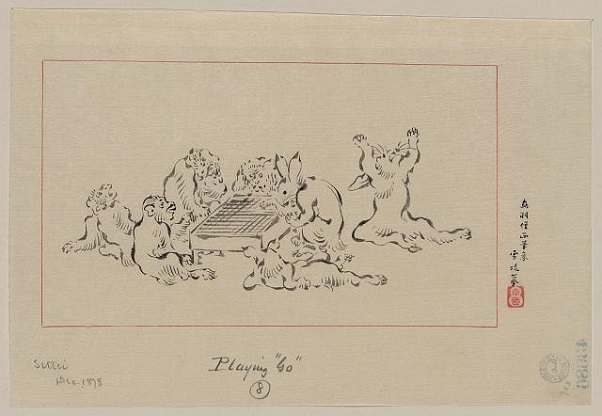
playing go
Playing go, Hasegawa, Settei, 1819-1882, Library of Congress

**

In the past, computers have won such games as Pong and Space Invaders:

Google’s AI system, known as AlphaGo, was developed at DeepMind, the AI research house that Google acquired for $400 million in early 2014. DeepMind specializes in both deep learning and reinforcement learning, technologies that allow machines to learn largely on their own. Previously, founder Demis Hassabis and his team had used these techniques in building systems that could play classic Atari videos games like Pong, Breakout, and Space Invaders. In some cases, these system not only outperformed professional game players. They rendered the games ridiculous by playing them in ways no human ever would or could. Apparently, this is what prompted Google’s Larry Page to buy the company.

Wired, Google’s Go Victory Is Just a Glimpse of How Powerful AI Will Be

I can’t corral all the games they’ve played into a single, simple timeline here, because the most interesting discussion I’ve seen is this clip, which moves rapidly from Backgammon via Draughts and Chess to this last few days’ Go matches:

Jeopardy should dfinitely be included somewhere in there, though:

Facing certain defeat at the hands of a room-size I.B.M. computer on Wednesday evening, Ken Jennings, famous for winning 74 games in a row on the TV quiz show, acknowledged the obvious. “I, for one, welcome our new computer overlords,” he wrote on his video screen, borrowing a line from a “Simpsons” episode.

NYT, Computer Wins on ‘Jeopardy!’: Trivial, It’s Not

What’s up next? It seems that suggestions included Texas Hold’em Poker and the SAT:

Artificial intelligence experts believe computers are now ready to take on more than board games. Some are putting AI through the ringer with two-player no-limit Texas Hold’ Em poker to see how a computer fairs when it plays against an opponent whose cards it can’t see. Others, like Oren Etzioni at the Allen Institute for Artificial Intelligence, are putting AI through standardized testing like the SATs to see if the computers can understand and answer less predictable questions.

LA Times, AlphaGo beats human Go champ for the third straight time, wins best-of-5 contest

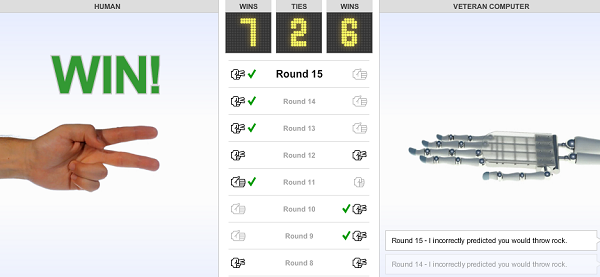
And of course, there’s Rock, Paper, Scissors, which you can still play on the New York Times:

Rock Paper Scissors

**

Now therefore:

In a follow-up post I want to present what in my view is a much tougher game-challenge to AI than any of the above, namely Hermann Hesse‘s Glass Bead Game, which is a major though not entirely defined feature of his Nobel-winning novel, Das Glasperlenspiel, also known in English as The Glass Bead Game or Magister Ludi.

I believe a game such as my own HipBone variant on Hesse’s would not only make a fine challenge for AI, but also be of use in broadening the skillset of the analytic community, and a suitable response also to the question recently raised on PaxSIMS: Which games would you suggest to the US Navy?

As I say, though, this needs to be written up in detail as it applies to each of those three projects — work is in progress, see you soon.

**

Edited to add:

And FWIW, this took my breath away. From The Sadness and Beauty of Watching Google’s AI Play Go:

At first, Fan Hui thought the move was rather odd. But then he saw its beauty.

“It’s not a human move. I’ve never seen a human play this move,” he says. “So beautiful.” It’s a word he keeps repeating. Beautiful. Beautiful. Beautiful.

The move in question was the 37th in the second game of the historic Go match between Lee Sedol, one of the world’s top players, and AlphaGo, an artificially intelligent computing system built by researchers at Google.

Now that’s remarkable, that gives me pause.

Carambolages, huzzah!

Monday, March 14th, 2016

[ by Charles Cameron — a brilliant new exhibition breaks the usual museum rules to provoke prodigious & repeated leaps of imagination ]
.

Carambolages Dominos

**

Cath Styles, whose Sembl games are closely related to my own HipBone variants on Hermann Hesse‘s Glass Bead Game, recently pointed me to an exhibition called Carambolages that opened recently at the Grand Palais, Galleries Nationales, 3, avenue du General Eisenhower, Paris.

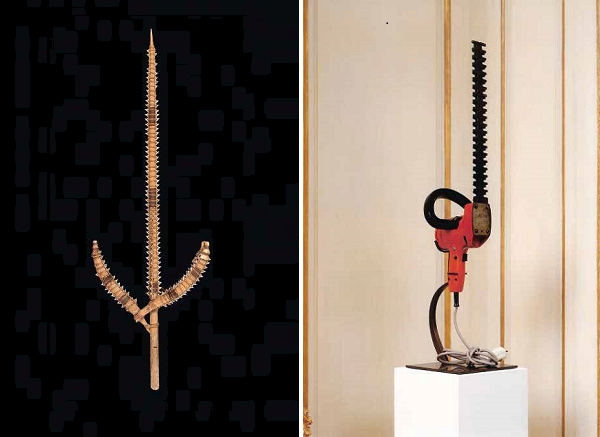
Strolling their website, I was struck by this double image, which in HipBone terms would be called a DoubleQuote, or a Sembl in Cath’s Sembl game:

Carambolages
(left) Sword, Kiribati, Micronesia Islands, Oceania, sd, Paris, Musée du Quai Branly
(right) Bertrand Lavier, Black & Decker, 1998 collection Giuliana and Tommaso Setari

It appears, indeed, that the exhibit in question features a Domino game of Sembls or DoubleQuotes —

Fascinating — and definitely a notable step in the expanding history of bead game variants — which I view, among other things, as an art movement that has yet to be written up as such.

Congratulations, Jean-Hubert Martin! The catalogue will no doubt be as close as I can get physically, but I’m all the way with you in spirit…

Bonne idée, bon chance!

Contrapuntal video, fugal braiding

Friday, March 11th, 2016

[ by Charles Cameron — from Trumpery to Altman’s Nashville ]
.


Tufte’s illustration of the Kathasaritsagara or Ocean of the Streams of Story

**

Wired had a piece titled Never Mind Trump. The Internet Wants to Watch What’s Behind Him a couple of days ago, and it contained a sentence that caught my attention:

Like a Bach fugue, the counterpoint rivaled, and then overtook, the original melody.

**

I’m always interested in non-musical forms of counterpoint, whether we’re talking Glenn Gould‘s radio dramas, Claude Levi-Strauss‘s structure for his Mytholoogiques, Tufte‘s Rushdie‘s Kathasaritsagara, or the various attempts to make Hermann Hesse‘s Glass Bead Game playable. Hesse himself invokes both fugue and counterpoint in the passage in which he describes actual moves in his game about as clearly as anywhere:

A Game, for example, might start from a given astronomical configuration, or from the actual theme of a Bach fugue, or from a sentence out of Leibniz or the Upanishads, and from this theme, depending on the intentions and talents of the player, it could either further explore and elaborate the initial motif or else enrich its expressiveness by allusions to kindred concepts. Beginners learned how to establish parallels, by means of the Game’s symbols, between a piece of classical music and the formula for some law of nature. Experts and Masters of the Game freely wove the initial theme into unlimited combinations. For a long time one school of players favored the technique of stating ide by side, developing in counterpoint, and finally harmoniously ombining two hostile themes or ideas, such as law and freedom, individual and community. In such a Game the goal was to develop both themes or theses with complete equality and impartiality, to
evolve out of thesis and antithesis the purest possible synthesis.

**

I was accordingly interested to read this paragraph, ending as it does with the sentence I quoted above:

The Christie videos were just the latest installment in what might be the defining video format of this election. Call it marginal media, in which background activity overwhelms the intended subject. Most candidates have found themselves inadvertently sidelined at some point. Hillary Clinton was overshadowed by the surreal stylings of “Sticker Kid,” who mugged, jerked, and danced throughout her stump speech. Another short video treated Bernie Sanders’ endorsement of marijuana decriminalization as a preamble to an audience member’s startled reaction. Another Trump rally was undercut when a member of the crowd behind the lectern began reading a copy of Claudia Rankine’s Citizen. The drama unfolded over the course of Trump’s speech, as the reader’s neighbors began to argue with her, then brought their neighbors into the fray. Soon, the tension made it impossible to pay attention to Trump at all. Like a Bach fugue, the counterpoint rivaled, and then overtook, the original melody.

**

We need, it seems to me, to get used to thinking contrapuntally — and accordingly it is instructive to see just how many of the great artists of recent times have employed some measure of contrapuntal thinking in their work. From the same Wired piece:

The frames of Robert Altman’s Nashville are packed with overlapping dialogue and activity—it’s often hard to determine which storyline should dominate—granting his aspiring losers the same weight as the country-music superstars they idolize. Tom Stoppard applied the same lens to Hamlet when he made two lackeys — whose off-stage death was barely remarked upon in Shakespeare’s play — the heroes of his fan-fic spin-off, Rosencrantz and Guildenstern Are Dead.

Okay, I’m off to see Nashville if I can find it..

Encryption, the mind and voice

Monday, February 29th, 2016

[ by Charles Cameron — paging birds and fishes, Chuang Tzu and Wm Blake ]
.

Dwight Furrow, Wine Tasting and Objectivity:

The question is whether flavors are “in the wine” or “in the mind”. On the one hand, there are objectively measurable chemical compounds in wine that reliably affect our taste and olfactory mechanisms—pyrazines cause bell pepper aromas in Cabernet Sauvignon, malic acid explains apple aromas in Chardonnay, tannins cause a puckering response, etc. But we know that human beings differ quite substantially in how they perceive wine flavors. Even trained and experienced wine critics disagree about what they are tasting and how to evaluate wine. This disagreement among experts leads many to claim that wine tasting is therefore purely subjective, just a matter of individual opinion. According to subjectivism, each person’s response is utterly unique and there is no reason to think that when I taste something, someone else ought to taste the same thing. Statements about wine flavor are statements about one’s subjective states, not about the wine. Thus, there are no standards for evaluating wine quality.

**

Is each mind inherently closed to every other, much as the bird’s mind is closed to ours in Blake‘s aphorism —

How do you know but every bird that cuts the airy way, is an immense world of delight, closed by your senses five?

— albeit not always so joyful?

In more contemporary terms — Is there encryption of the mind?

**

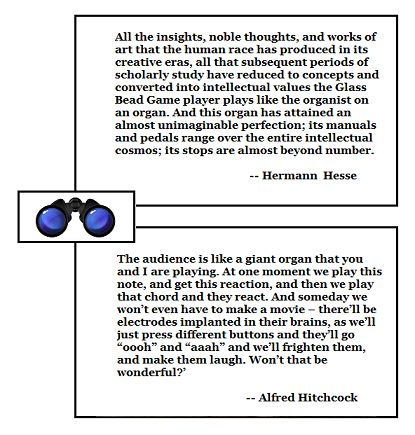
I ask this in light of the DoubleQuote I posted a few days ago comparing Hesse and Hitchcock in terms of their metaphoric uses of “organ” — in, I hasten to add, the Bach sense of the word:

SPEC-Hesse-Hitchcock-organs sm

Here’s what I’m thinking. Hesse’s game influences the mind, as does art, but it is non-invasive; Hitchcock applauds the potential for art to move in a more invasive direction, as if by force rather than by enticement.

“”

Humans — or at least the philosophers and philosopher tagalongs among them — can’t even tell if what one human sees as “red” is what another sees as “red” — let alone what a given Burgundy tastes like on another’s palate.

If this means, more generally, that minds are effectively encrypted by virtue of their differences in wiring acquired with parentage, age and experience, then our communications media -– language, the arts, literature, number — would appear to be the available decryption keys, selectively available to the minds in question.

**

Chuang-Tsu has this tale to tell:

Men claim that Mao-ch’iang and Lady Li were beautiful, but if fish saw them they would dive to the bottom of the stream, if birds saw them they would fly away, and if deer saw them they would break into a run. Of these four, which knows how to fix the standard of beauty for the world?

And this..

Chuang Tzu and Hui Tzu were strolling along the dam of the Hao River when Chuang Tzu said, “See how the minnows come out and dart around where they please! That’s what fish really enjoy!”

Hui Tzu said, “You’re not a fish – how do you know what fish enjoy?”

Chuang Tzu said, “You’re not I, so how do you know I don’t know what fish enjoy?”

Hui Tzu said, “I’m not you, so I certainly don’t know what you know. On the other hand, you’re certainly not a fish – so that still proves you don’t know what fish enjoy!”

Chuang Tzu said, “Let’s go back to your original question, please. You asked me how I know what fish enjoy – so you already knew I knew it when you asked the question. I know it by standing here beside the Hao.”

**

Chuang Tzu said, “You’re not I, so how do you know I don’t know what fish enjoy?”

Blake said, “How do you know but every bird that cuts the airy way, is an immense world of delight, closed by your senses five?”


Switch to our mobile site