Photocommentary: “The Coming Face of Iran”
Tuesday, June 16th, 2009
Ayatollah Wojciech Jaruzelski
Ayatollah Wojciech Jaruzelski
Dave Schuler of the Glittering Eye is involved in a formal debate at Outside the Beltway with Dr. Bernard Finel over the role of the United States in the Mideast. Dr. Finel is arguing for a grand bug-out, or at least a serious reduction in “footprint” and “fingerprint”, and Dave is going to argue the negative.
Here is the introduction by Dave:
Pulling Out: Debating Middle East Disengagement (Intro)
One of my common patterns of thought is to frame any given proposition as a debate proposal, I did so in this specific context, and said as much in the comments to the post. Dr Finel was kind of enough to respond to my comment with enthusiasm, welcoming a debate with me on the subject.
Over the next week or so we’ll be debating the following proposition:
Resolved: that the United States should disengage from the Middle East
Dr. Finel will make the affirmative case; I will provide the negative.
Dr. Finel’s affirmative case will be posted in the next day or so; it will be followed by my cross-examination; I’ll state my negative case; Dr. Finel will cross-examine me; and so on.
Debating is a form seen only occasionally in the blogosphere and I think this is an exciting project. The longer format, extending over multiple posts, will enable us to explore the subject in more detail than is usually found in the hit-and-run blog post. It’s an important topic and, regardless of the immediate situations in Iraq and Afghanistan, is worthy of substantial reflection, rarely seen as a consequence of the poverty of our public discourse which is mainly limited to headlines, op-eds, and sound bites and is often enmeshed in partisan squabbling.
Dr. Finel, who is a senior fellow at the American Security Project, has opened with the following post:
Pulling Out: Debating Middle East Disengagement (Affirmative)
….The second issue is oil. The U.S. presence in the Middle East does serve to reduce some of the risks associated with the Western world’s reliances on Middle Eastern oil. It does not lower the cost necessarily, but it may reduce some potential for volatility in supply. But the cost of this risk mitigation is tremendous. We pay for lowering the supply risk with increased risk of terrorist attacks, greater hostility from the Arab population, and the costs of men and materiel associated with military commitments. Are there other ways to reduce those risks? Of course there are. They include investments in alternative energy, oil exporation at home, better fuel efficiency from cars. Certainly those are costly measures in the short-run, but so is deep involvement in a volatile region. In the long-run, the calculus is easy. Energy independence is a strategic imperative.
This excerpt shortchanges the breadth of Finel’s argument, which you should read in full here.
First, I’d like to commend both gentlemen for making use of the formal debate method. Construction of a reasoned argument in a civil debate is the blogosphere at it’s best. I intend to follow this debate as it evolves.
I know Dave to be a deeply thoughtful, well informed and even tempered commentator. I do not know Dr. Finel, though his c.v. seems impressive to me and he probably has a number of interesting things to say on terrorism policy. As a strategist however, he is not winning me over, though in terms of tactics, he accurately identifies many points of irritation that traditional U.S. policy has for the Arab World. The answer for that irritant is not amputation.
The thesis that regions of the world will move to a better state of polity with an absence of American presence or influence is not “counterintuitive” as Finel suggests – it’s a position lacking in real world evidence. The world’s absolute worst regimes have the least interaction with the United States or with globalization and movements like Islamism have intrinsic drivers, not simple Act-React mechanisms.
Alternate energy sources are a long term – a very long term – solution. In terms of technological application with immediate policy effect, it is the equivalent of Edward Teller’s vision of SDI in 1987. By all means, invest in alternative energy but even throwing $ 100 billion at the problem in fiscal year 2009 is not going to disconnect the United States, much less the West, from oil in 2010 or even 2020. Any reduction in our own oil consumption by the use of alternate energy sources in coming decades will more than be made up by rising Asian demand and the Gulf will increase, rather than decrease, in importance as a geopolitical “choke point”.
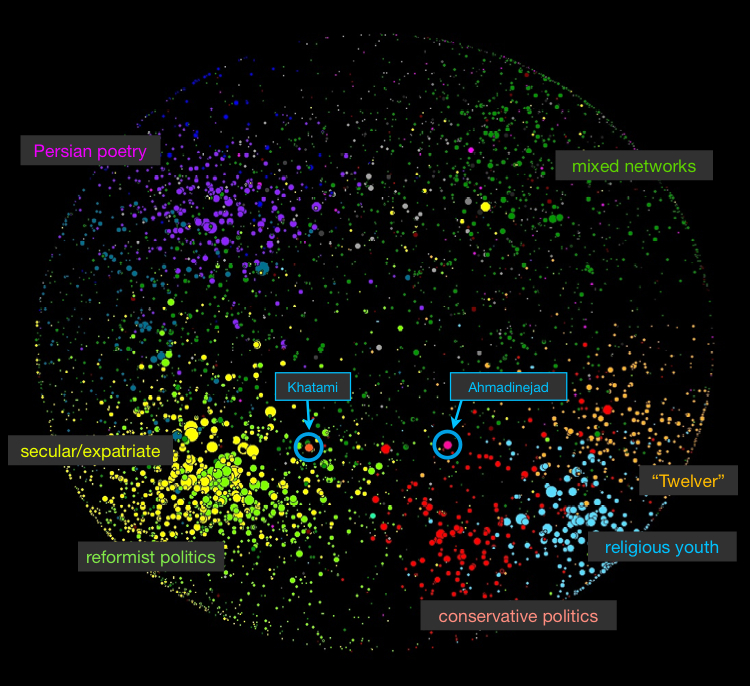
Intelfusion posts on the Harvard study of the Persian blogosphere. Found at Jeffreycarr on Twitter.
(I figured that so long as my margin was temporarily messed up on Explorer from Cameron’s text file – why not go with a big visual? In for a penny, in for a pound! Should be ok on Firefox etc.)
Tom appears to have really rattled somebody’s cage at The White House with his profile of CENTCOM commander Admiral Fallon in Esquire Magazine.
The Man Between War and Peace by Thomas P.M. Barnett
The money quote from the magazine article that probably caused political WWIII:
Last December, when the National Intelligence Estimate downgraded the immediate nuclear threat from Iran, it seemed as if Fallon’s caution was justified. But still, well-placed observers now say that it will come as no surprise if Fallon is relieved of his command before his time is up next spring, maybe as early as this summer, in favor of a commander the White House considers to be more pliable. If that were to happen, it may well mean that the president and vice-president intend to take military action against Iran before the end of this year and don’t want a commander standing in their way.
We will be hearing a lot more about this in the next few days. Before the analysis commences, I’ll add that what Tom wrote for Esquire was not some shoot-from-the-hip, data-free analysis, op-ed, blog post. His profile of Admiral Fallon was deeply sourced and the product of a great deal of firsthand experience, careful research and extensive review to vett it prior to publication. Far more so, I might add, than what Thomas Ricks put up in WaPo in response. 🙂
UPDATE:
I’ve redacted this section as the link was broken and the post has been removed by the author. In the interim, The SWJ BLog has put up an extended post that details the Barnett-Fallon-Ricks story in greater detail as well as Tom’s COIN coments (as well as linking here – thanks Dave!).
Meanwhile, Barnett was quite critical of a recent SWJ Magazine article, The Global Counter Insurgency, by Jonathan Morgenstein & Eric Vickland.
From the article…
Sixty years ago, George Kennan penned his landmark Foreign Affairs article that defined American foreign policy for the next half century. Seminal security policy decisions such as the creation of NATO, the blockade of Cuba and the Berlin airlift were all components of the policy of Containment. Today, a radical Islamic ideology seeks our destruction, yet we lack a unifying doctrine on which to base our foreign policy. Al Qaida and its ideological compatriots represent a worldwide insurgency based on religious extremism. At its core it is a political struggle with political aims and in order to defeat it, we need adapt our means to the nature of the struggle. We are not fighting a war on terrorism. We are fighting a global insurgency against an extremist brand of Islam.
Read the rest here.
Other Blogs Commenting:
Neptunus Lex The Agonist World and Global Politics Blog Winterpatriot Corrente DownWithTyranny Tailrank Kevin Drum Poligazette William Arkin Thinkprogress Newshoggers Outside the Beltway Hullabaloo
The release of the conclusions in the recent NIE (PDF) on Iran’s nuclear program has provoked widespread commentary in the blogosphere. The pure politics of the release is best dealt with elsewhere but here are a few words from some folks with more than nimble typing fingers to back up their analysis:
“The declassified key judgments of the latest NIE on Iran are yet another opportunity to get a glimpse of the inner-workings of the highest levels of the intelligence community. The picture isn’t pretty. The key judgments are notable for many reasons, not the least of which is how they contrast with the last NIE on this same topic. In 2005, with access to an Iranian source’s laptop, the community was confident that Iran was determined to build a nuclear weapon “despite its international obligations and international pressure.” Today it is equally confident that Iran halted its weapons program in 2003 and that it remained suspended for several years”
“I will note that the supposedly secret uranium enrichment program that the administration accused North Korea of, and broke up the Agreed Framework for, was disavowed by the intelligence community earlier this year in much the same way that this NIE disavows the 2005 NIE on Iran. I’ll also note that proving a negative is difficult, and one of the favorite tactics of the right: we say that you’ve got a secret program. Prove to us you don’t.”
“ Dafna Linzer reports in the Washington Post that a crucial bit of information was an intercepted communication by a senior Iranian military official “complaining that the nuclear program had been shuttered.”The intercept – which Linzer notes was one of 1,000 footnotes in a 150 page document – was the final piece in the puzzle, and Linzer reports that the intercepts were briefed to the Bush Administration “beginning in July.”So, that timing would be consistent with Mike McConnell’s reference to “new information collected in late spring that caused a reconsideration of some elements of the assessment.”
Swedish Meatballs Confidential:
“The ‘new’ NIE on Iran’s nuclear weapons program [9-page pdf] — which has been [minor tweaks aside] in the can for nearly a year now — was released this afternoon. It is clear why the Cheney Cabal didn’t want this estimate to see the light of day.”
“ While the NIE clearly shifts the assessment of Iran’s nuclear weapons program, it acknowledges the regime continues to engage in dangerous behavior and comes down firmly on the side of political and economic pressure as an effective means of changing Iranian behavior. According to the NIE, Iran’s decision to halt its nuclear weapons program on the fall of 2003 was “in response to increasing international scrutiny and pressure resulting from exposure of Iran’s previously undeclared nuclear work.” (It was around this time that the U.S. and other governments exposed the A.Q. Kahn network and its international nuclear weapons material black market). The key judgments conclude that “our assessment that the [nuclear weapons] program probably was halted primarily in response to international pressure suggests Iran may be more vulnerable to influence on the issue that we judged previously.”
” The chimera of Iran as deadly menace is a product of Israeli paranoia and debilitating fear of the “other.” This fear saturates Israeli strategic thinking making impossible for them a rational contemplation of the odds against Iranian suicide attacks against Israel. Israel rejects the concept of deterrence of nuclear attack through creation of MAD (mutual assured destruction). I have described their reasoning elsewhere in these pages. Given the awful nature of Jewish history, such overwhelming fear of the return of the final “gollum,” or perhaps Azrael himself is comprehensible.”
“ Iran’s choice is reasonably smart: talk big like Libya, stop short of weapons like Japan, but signal willingness to aggressively defend like Israel. I told you these guys are not stupid.”
I recall, as a lowly grad student, that many of the documents I would have loved to have had my hands on – NIE’s and PDD/NSDD’s referred to in secondary literature – were locked up tight, despite having been issued sometimes decades earlier. It’s rather surreal, from a historian’s perspective, seeing even partial declassification of a just issued NIE. Until recently at least, the USG had still classified documents going back to 1917 ( most likely covering cryptological sources and methods)!
The devil is in the details, to which we are not privy. Traditionally, the NIC process constructing a NIE would have a NIO as point man and emerge as a consensus, with the CIA often being the heavyweight in the interagency wrangling. Supposedly, procedures have changed since the pre-Iraq War days to clarify the degree of certainty in an inherently uncertain scenario. Given the general unwillingness of IC bureaucracies to reconsider even information-sharing habits, how robust were the changes in the analytical methodology ?

Zenpundit is a blog dedicated to exploring the intersections of foreign policy, history, military theory, national security,strategic thinking, futurism, cognition and a number of other esoteric pursuits.
Customized Web Site & Blog Design

