[ by Charles Cameron — I’d infinitely rather play Bach than chess.. ]
.
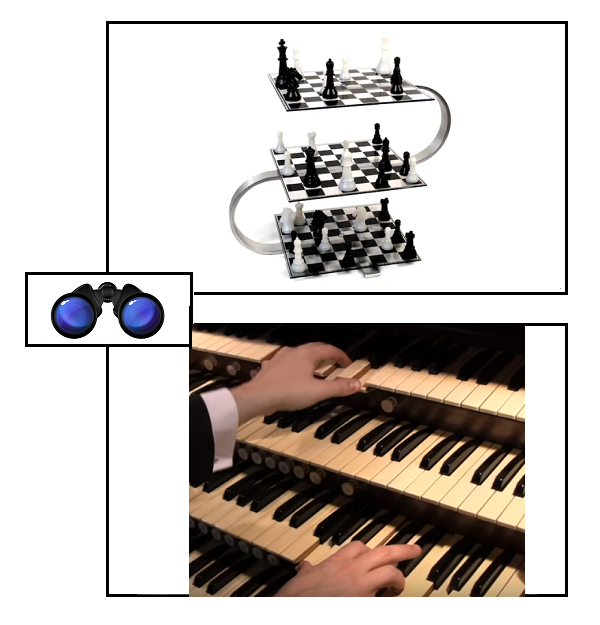
Above, a three-dimensional chess set. When I was up at Oxford, I had a three dimensional tic-tac-toe board, four sheets of plastic stacked vertically, each one drilled four by four, with yellow and red golf pegs to mark moves — it was quite a thrill, especially as an escape from Old Testament studies, but I wouldn’t play it now to save my, well, soul.
Below,Jonathan Scott performs his arrangement of the Finale from Saint-Saens “Organ” Symphony (No. 3) on the 1895 T.C. Lewis organ of Albion Church, Ashton-under-Lyne, UK.
I would, OTOH, give my soul to be able to play the organ — a privilege denied me until I reached Grade 5 in the British system — a grade I gave up on in despair after too mant teachers forcced me to play the detested Alec Rowley‘s exercises — with different fingerings.. Piano, feh, It took me half a lifetimes to realize there is some merit to be found therein.
[ by Charles Cameron — an interdisciplinary meditation on what falls like rain — savor these two at a time, and take your time ]
.
Gary BB Coleman:
Guillaume Apolinnaire:
Prose version, Roger Shattuck:
It’s raining women’s voices as if they had died even in memory
And it’s raining you as well marvellous encounters of my life O little drops
Those rearing clouds begin to neigh a whole universe of auricular cities
Listen if it rains while regret and disdain weep to an ancient music
Listen to the bonds fall off which hold you above and below
**
Clearly drums fall like rain. Hammer blows?
C.B. Cook and gang:
Tangle Eye:
**
Portia, in Merchant of Venice:
The quality of mercy is not strained;
It droppeth as the gentle rain from heaven
Upon the place beneath. It is twice blest;
It blesseth him that gives and him that takes:
Eddie Turner:
**
Like I said, listen to these, two by two —
The second one here, at four hours, will likely outlast you — but do listen to a minute or three..
As my fingers began to manipulate over keys, words began to fall in place on the melody like drops of water falling from the crevice of a rock,” Dorsey later said. He gave the first performance of “Precious Lord” at his church shortly after his wife and baby’s death, and the act of uninhibited spiritual praise was forever changed.
[ by Charles Cameron — have you time to spare for a little beauty? ]
.
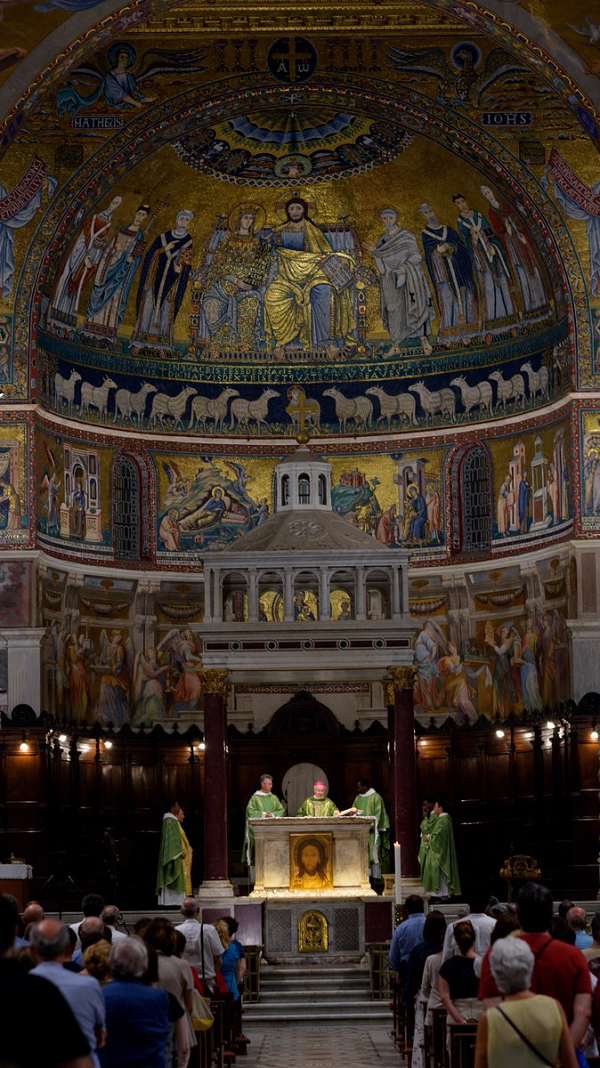
Prof Emily Steiner of the University of Pennsylvania posted this image, which she described as of the “Stunning mosaics in the apse of S. Maria in Trastevere, attributed to Pietro Cavallini (c.1240-1330)”:
Dr Steiner attributed the photo to “the talented @pdecherney” — her colleague at U PEnn, Dr Peter Decherney.
**
When I first saw this image, only the top half was visible on my screen, a fine, and I’m no expert, possibly world renowned, and yes, as Dr Steiner says, stunning mosaic of Christos Pantokrator, Christ the ruler of the universe if I’m not mistaken — and again, I’m no expert, and willing to take instruction.
But stunning, yes. Christ, a mosaic, stunning. Art at the service of praise, beauty as a window on the divine, .
And then, perhaps an hour later, but lapses of time are mended in this realm, I saw the whole image, sized to fit my screen.
**
And thus the bottom half —
— with, brightly lit, even moreso if it were possible than the Christ in mosaic above it is, a small table — an altar, with three priests, and more in the wings, celebrating what looks to be the Eucharist — thought I suppose it might also be Vespers — and again, some expert could say whether the central celebrant is, by his zucchetto or skullcap, a cardinal, bishop, or maybe monsignor.
No matter the celebrant’s rank, he is, as celebrant, at the vanishing point — both the central point of attention photographically, and the point where the priest acts in the person of Christ, in persona Christi, thus himself, his persona, vanishing at the vanishing point.
Do this in memory of me, Christ said to his disciples at the Last Supper before his crucifixion, in words of sacrifice, previsioning his body about to be broken on the cross the next day — and down the centuries priests have broken bread as he did, speaking his words in his place, Take, eat, this is my body.
In the consecration, with these wrds, bread and wine become invisibly the body and blood of Christ, which we may remember, digest and allow to transform us.
It is this which makes the celebration of the Eucharist, in Catholic terms, “the source and summit of the Christian life”.
**
And then, between this focus on the priest celebrant below, and the Christ all-ruling above, there is a mysterious relationship, each reflecting the other as in duet of mirrors — above, below and I invite you to envision, beyond.
Taking us, to switch religious traditions.. into the upper room with that one and self-same Christ —
**
Eucharist: literally, thanksgiving!
May your Sunday bring you cause for such thanksgiving..
[ by Charles Cameron — whether willed by the brain or torn from the heart, the one, same cry for mercy — in chant, by Bach, and by Ray Charles & BB king ]
.
A stranger in my Twitter-stream just tweeted a link to a current Australian report on an opening window for rescue operations for the boys trapped in that cave in norther Thailand, two and a half miles under ground:
[ the video in this tweet is from a continually updated news feed — at time of writing, the rescue op was just beginning ]
Fate may be fate, prayer may or may not influence events — perhaps prayer may only help us, the watching world ouiside that cave, those circumstances, that peril — the urge to pray is no respecter of particular religions, Christians, Buddhists, Atheists, we all may feel the instinct to pray.
The prayer is the most basic cry, as we shall see in three versions: the timeless Gregorian chant, the beauty of the Erbarme Dich from Bach‘s Matthew Passion, and that selfsame song as Ray Charles sings it with BB King.
**
Gregorian chant:
Kyrie XI [ Lord, Have mercy ] from the choir of St Pierre de Solesmes, my favorite haunt when I was seventeen, with the greatest chant scholars and choir in the world:
That floating, swooping melody is characteristic of the chant.
**
Erbarme dich, mein Gott [ “Have mercy Lord, My God, for the sake of my tears” ] by JS Bach
If we lose have mercy, Lord from our conceptual vocabulary, we lose a higher octave of hope, of the necessity of surrender.
Erbarme Dich may be the single sweetest moment in Bach‘s The Matthew Passion, itself arguably the greatest piece of church music ever written — a monumental, gloriously beautiful, grief-stricken work.
**
Pure blues: Sinner’s prayer, Ray Charles and BB King:
If neither Bach nor the chant speak to you, perhaps the blues will — and if all three touch you, how wonderful the variety of expressions of the one prayer:
Lord please have mercy .. have mercy if you please..
Lord have mercy on the boys in the cave — knowing that the rescue task will be arduous, we ask mercy with hope and a readiness to surrender, to greet whatever outcome with our hearts flung open to grief or joy as the case may be.
Zenpundit is a blog dedicated to exploring the intersections of foreign policy, history, military theory, national security,strategic thinking, futurism, cognition and a number of other esoteric pursuits.