My friend Bruce Kesler, who keeps a sharper eye on the fine details of American politics than I do, is dead square right in a recent post at Democracy Project that I reproduce here in full:
Hidden Foreign Contributions Affect US Elections
US election law forbids non-Americans to contribute directly to federal candidates, and qualified donations above $200 are available to public scrutiny. There is a huge loophole – or, more correctly, shroud – over contributions by foreigners to US non-profits, who heavily shape public discussion affecting our elections – and other policies. (There’s, also, some indication that the $200 cut-off for full disclosure of contributions to our campaigns may be another loophole being exploited by some foreigners.)
IRS Form 990 generally requires that non-profits list contributors and their addresses who give $5000 or more. However, non-profits are not required to publicly divulge who they are (with the exception of private foundations and 527’s).
Non-profits include 501(c)(4)’s, which are estimated to spend in 2008 well more than the $424-million that 527’s spent to influence the 2004 elections.
Another area of concern is donations made by foreigners to our universities. Although New York State requires that such contributions be revealed, there is no enforcement and filings are often not made.
In Britain, it is estimated, more funding comes from the MidEast for Islamic Studies departments than from the government.
Ministers labelled Islamic studies a “strategic subject” and said the “effective and accurate teaching” of it in universities could help community cohesion and counter extremism.
Similar concerns have been raised in the US about the influence of MidEast contributors on our universities’ curriculums, and the faculty who influence public discussion. See here and here, for examples.
Former presidents Carter and Clinton have received tens of millions in donations, and more, from foreign sources for their foundations, yet the public knows very little about from whom or how much. Meanwhile, Carter and Clinton take frequent public stands on public policy and candidates for office.
A draft has been released of a revised IRS Form 990. It increases exposure on governance issues, but retains the shroud over contributors to non-profits. At the very least, foreign contributors should be revealed publicly, at least for amounts over the $200 of election laws.
You can send your comments to the IRS during the comment period. It’s as simple as an email to Form990Revision@irs.gov
Bravo to Bruce for highlighting this important but generally unrecognized problem.
One of the ironies of Beltway incumbent preferred campaign finance regulation like the odious McCain-Feingold law is that it manages to combine restrictions of the political activities and free speech rights of American citizens while granting opacity to wealthy foreigners who seek to influence political discourse here through generous donations to foundations, educational organizations, think tanks, universities, presidential libraries and other institutions that shape our intellectual life. It is completely understandable, given the potential impact of American policies on the rest of the world that other states and their sundry notables would seek to make their voice heard here. To a certain extent, when it’s above board public diplomacy and cultural exchanges, it’s even a good thing. What’s unacceptable is that foreign interests can often buy such influence – which is what they are really doing – under the radar or even behind the shield of legal secrecy. If some of our finest universities were people then they would have already had to register as foreign agents a long, long, loooooooong, time ago.
The same might be said of some former presidents. Or of presidential candidates.
The answer here is not to go on a fruitless legal jihad to ban foreign money, which at times does get turned toward humanitarian or genuinely educational purposes but to require radical transparency of our think tanks, universities, charities and other institutions enjoying tax deductible status but are dedicated to indirectly influencing the political process or policy formation. If an American institution or scholar wants to shill for the Wahabbi Lobby by working for a tank on the take from a senior Saudi prince, or accept grants from PLA-affiliated Chinese corporations, Japanese billionaires, mobbed-up Russian “businessmen” or other foreign sources, fine, but a highly visible disclaimer to that fact ought to be mandatory. If Carnegie or AEI or Harvard departments are advising presidential candidates on Mideast policy then contributions emanating from that region are relevant to the discussion.
If accepting the check in public is cause for dismay then there’s a word for what’s really going on:
Graft.
 democracies until common sense and experience can prevail. Time has a different speed in the Senate chamber, one set to a more courtly age and the Senate has killed far more legislation by it’s tempo than by filibusters or votes. Senators, by habit of legislative mind and capacious ego are institutional relics of the deference society that once prevailed in the colonial period and in the antebellum South. Accustomed to relative splendor and the exercise of authority without much in the way of responsibility, senators are better suited to be members of the British high aristocracy of the 18th century – say an Earl or Viscount – than a modern administrator or leader.
 ). In the same period, four Vice-Presidents who were former senators – Richard Nixon, Hubert Humphrey, Walter Mondale and Al Gore – also went down to defeat and the one who managed to win the presidency, Nixon, did so narrowly against Humphrey. Nixon’s campaign skills may have made the grade only through sheer practice, brutally hard work and the bizarre circumstances of a chaotic, three-way contest in 1968.
 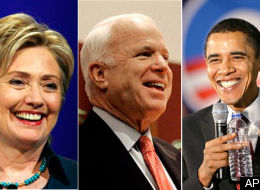 hillbilly to claim the Republican nomination. Senator Clinton, once the presumed nominee, presided over a tone-deaf campaign marred by savage infighting and counterproductively grandstanding antics by former president Bill Clinton. Senator Obama coasted on charisma, eloquence, symbolism and the genius of
  , edited by Dr. Loch K. Johnson and issued by


