zenpundit.com » 2008 » April

Archive for April, 2008

2008: The Year of the Senator

Friday, April 18th, 2008

I’m really surprised that I have not seen or read more about the fact that the major candidates for the presidency are all members of the world’s most exclusive club. Our last presidents to be elected directly from service in the United States Senate were Democrat John F. Kennedy and Republican Warren G. Harding. Neither man’s record as Chief Executive is likely to inspire confidence in the Senate as a training ground for future commanders-in-chief.

The Senate was intended by the Framers of the constitution to be the repository of the Republic’s wisdom – or at least it’s elder statesmen that the states saw fit to send to Washington. A saucer, to cool the hot-tempered passions that periodically engulf democracies until common sense and experience can prevail. Time has a different speed in the Senate chamber, one set to a more courtly age and the Senate has killed far more legislation by it’s tempo than by filibusters or votes.  Senators, by habit of legislative mind and capacious ego are institutional relics of the deference society that once prevailed in the colonial period and in the antebellum South. Accustomed to relative splendor and the exercise of authority without much in the way of responsibility, senators are better suited to be members of the British high aristocracy of the 18th century – say an Earl or Viscount – than a modern administrator or leader.

The managerial incapacity is amply demonstrated by the fact that senators, excepting the aforementioned JFK, invariably run poorly organized, gaffe-prone, presidential campaigns.  In the last half-century, we have seen John Kerry, Bob Dole, George McGovern and Barry Goldwater go down in electoral flames in the general election, two by epic landslides.  Senator Dole has the distinction of losing twice on the national ticket and two other occasions in the primaries, which may be some kind of record ( see Richard Ben Cramer’s fantastic What It Takes: The Way to the White House). In the same period, four Vice-Presidents who were former senators – Richard Nixon, Hubert Humphrey, Walter Mondale and Al Gore – also went down to defeat and the one who managed to win the presidency, Nixon, did so narrowly against Humphrey. Nixon’s campaign skills may have made the grade only through sheer practice, brutally hard work and the bizarre circumstances of a chaotic, three-way contest in 1968. 

In the current contest, Senator McCain prevailed, despite an uneven political record, over a wealthy empty suit and a goofily named hillbilly to claim the Republican nomination. Senator Clinton, once the presumed nominee, presided over a tone-deaf campaign marred by savage infighting and counterproductively grandstanding antics by former president Bill Clinton. Senator Obama coasted on charisma, eloquence, symbolism and the genius of David Axelrod until the Rev. Wright eruption sidetracked his escalating momentum. Obama will go into the general election facing far more intense media scrutiny, under the shadow of an unfolding Illinois scandal involving his former patron, political fixer Antonin “Tony” Rezko, which is likely to engulf other Democratic politicians here, notably Governor Rod Blagojevic.
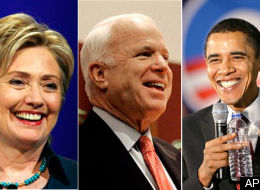
Are any of these candidates ready for prime time ?

At the Risk of being called a Guy who just Links to Cool Articles….

Thursday, April 17th, 2008

Lexington Green sent me this PARAMETERS review essay by Colonel Arthur C. Winn – on the five volume series on Strategic Intelligence [Five Volumes] (Intelligence and the Quest for Security) , edited by Dr. Loch K. Johnson and issued by Praeger Security International.

The five volumes present empirical inquiries, historical views, theoretical frameworks, memoirs, case studies, interviews, legal analyses, comparative essays, and ethical assessments. The authors come fromvarying backgrounds, including academia, intelligence agencies, think tanks, Congress, the State Department, the National Security Council, the legal field, and from seven countries. Each author has different personal experiences andwrites fromhis or her own perspective. The books provide an excellent reference for students of the military, political affairs, foreign policy, or strategic planning. The supporting notes at the end of each chapter are especially helpful and should not be overlooked by the reader.

Lex kidded me about putting this on my Christmas List but it looks to be a “must read” or at least a “must have reference” set for scholars of intelligence, IR, diplomatic or military history. Very DIME oriented format. I’m impressed as this is exactly what I was looking for years ago when I shifted outside of diplomatic and economic history to delve into intelligence and strategic studies.

Maybe a corporate card or institutional account order is a good idea with this one ($ 360 – Ouch!).

A Shot Across the Bow of “Mighty Google”

Wednesday, April 16th, 2008

Interesting.

Triumph of the Will?

Tuesday, April 15th, 2008

An extremely intriguing post by Steve DeAngelis today:

The Importance of Willpower

….Aamodt and Wang assert that personal willpower (the ability to overcome the tension created between desire and common sense) is a zero sum game — use it and you lose it. That is, people who demonstrate willpower in one area have less of it to use in another.

“The brain’s store of willpower is depleted when people control their thoughts, feelings or impulses, or when they modify their behavior in pursuit of goals. Psychologist Roy Baumeister and others have found that people who successfully accomplish one task requiring self-control are less persistent on a second, seemingly unrelated task. In one pioneering study, some people were asked to eat radishes while others received freshly baked chocolate chip cookies before trying to solve an impossible puzzle. The radish-eaters abandoned the puzzle in eight minutes on average, working less than half as long as people who got cookies or those who were excused from eating radishes. Similarly, people who were asked to circle every ‘e’ on a page of text then showed less persistence in watching a video of an unchanging table and wall. Other activities that deplete willpower include resisting food or drink, suppressing emotional responses, restraining aggressive or sexual impulses, taking exams and trying to impress someone. Task persistence is also reduced when people are stressed or tired from exertion or lack of sleep.”

During the Second World War, the United States faced in Nazi Germany and Imperial Japan, enemies whose leadership placed an unusual stock in the advantages of superior will.  While roundly cursed posthumously by his generals at the time, historians now tend to give Hitler considerable credit for preventing a potential disaster in the face of the Red Army counterattack in 1942 with his fanatical insistence that the Wehrmacht stand and fight for every inch of ground, ultimately stabilizing the German lines and permitting a regrouping for further offensives. Noted historian, John Lukacs, has written of Adolf Hitler ” His mind and willpower were extraordinary….”.

Hitler held his regime together to the very end with his word being regarded as law througout the Third Reich, even when Soviet tanks were two hundred meters from his Fuhrerbunker. He dismissed from office his most powerful paladins, Goering and Himmler with a word, even when he was mere hours from his own suicide. The strain of such indomitible determination, in the face of apocalyptic stress, however, made a physical and mental wreck of Der Fuhrer. Hitler’s marked physical degeneration after 1941 was aggravated by the gross quackery of his physician Theodore Morell, an unhealthy lifestyle and injuries sustained in the 1944 bomb plot, but close associates like Speer had noted personality changes in Hitler as early as the latter’s fiftieth birthday when Hitler began to rigidly and monomaniacally focus on the war. Shuffling, beset by Parkinsonian symptoms, frequent rages and chronic insomnia, possibly addicted to stimulant drugs, Hitler’s sickly, grayish appearance often startled high Nazi officials who were granted increasingly rare audiences in Hitler’s final years.

Insurgency and Counterinsurgency

Monday, April 14th, 2008

Two papers:

The excellent Insurgency Research Group points to a paper by Dr. Brynjar Lia, an expert on al Qaida, entitled “Al-Qaida’s Appeal: Understanding its Unique Selling Points” (PDF).

On the other side of the coin ( note: pun intended), blogfriend Charles Cameron sent me a paper by Israeli General Ya’akov Amidror, “Winning Counterinsurgency War: The Israeli Experience“(PDF).

Of course, it can be said that the Israelis have a mixed rep in the COIN community and that counterterrorism against an ideological network (Red Brigades, Baader-Meinhoff Gang, PIJ, al Qaida) is not exactly the same thing as COIN against a broad-based, popular insurgency (Viet Cong, FMLN, Afghan Mujahedin, HAMAS, Iraqi insurgency). Nevertheless, an author with a long career at the intersection of intelligence and military policy.


Switch to our mobile site

