zenpundit.com » 2009 » April

Archive for April, 2009

Building the Antilibrary

Wednesday, April 8th, 2009

Due to a combination of good fortune, review copies sent by publishers and exercising wide-ranging discretion over a budget account at work, I’ve added an eclectic mix of tomes to the ever rising Antilibrary book pile.  Some of these are recommendations from readers left in my comment section last January ( working on improving my traditionally lame following -up skills)

   Alexander II The Last Great Tsar by Edvard Radzinsky

    Engaging the Muslim World  by Juan Cole

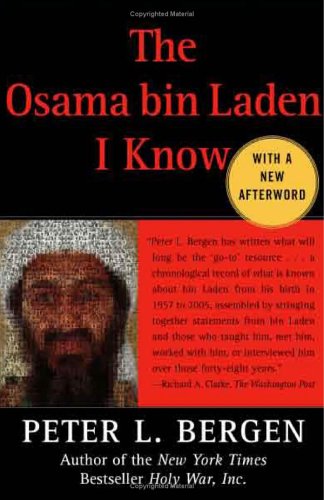
    The Osama bin Laden I Know: An Oral History of al Qaeda’s Leader by Peter Bergen

      The Open Society and Its Enemies, Vol. 1: The Spell of Plato

                          and  The Open Society and Its Enemies, Vol. 2: Hegel and Marx by Karl Popper
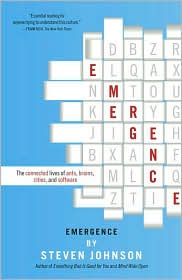
      Emergence: The Connected Lives of Ants, Brains, Cities, and Software

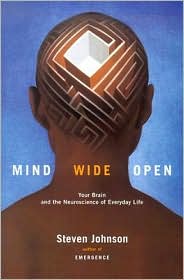
and   Mind Wide Open: Your Brain and the Neuroscience of Everyday Life by Steven Johnson

            How the Mind Works by Steven Pinker

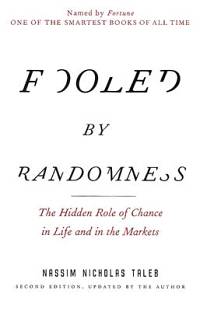
    Fooled by Randomness: The Hidden Role of Chance in Life and in the Markets 

                                 by Nassim Nicholas Taleb

  Real Education: Four Simple Truths for Bringing America’s Schools Back to Reality  

                                by Charles Murray

   Outliers: The Story of Success by Malcolm Gladwell

  Here Comes Everybody: The Power of Organizing Without Organizations 

                                by Clay Shirky

   The Hyperlinked Society: Questioning Connections in the Digital Age 

                                  by Joseph Turow & Lokman Tsui

  Islands in the Clickstream: Reflections on Life in a Virtual World 

                                   by Richard Thieme

Engaging the Muslim World is not long for the Antilibrary, as I have already begun reading it and will review it here soon. Some of these books can be read relatively quickly, a day or two but others, like The two volume The Open Society, I expect will require a greater investment of time and thought. It pays rich dividends though.

Note, Richard Thieme, despite his past as a scholar-clergyman of the Episcopalian Church, is not t be confused with the historicist, fundamentalist, theologian, Colonel R.B. Thieme.

UPDATED!:

Ha! A good one arrived today, courtesy of Columbia University Press:

   The Scientific Way of Warfare: Order and Chaos on the Battlefields of Modernity

                                        by Antoine Bousquet

The First Annual Zenpundit Big Pair of Stones Award

Tuesday, April 7th, 2009

Secretary of Defense Robert Gates.

Rock on Mr. Secretary !

“One day you will come to a fork in the road. And you’re going to have to make a decision about what direction you want to go.” [Boyd] raised his hand and pointed. “If you go that way you can be somebody. You will have to make compromises and you will have to turn your back on your friends. But you will be a member of the club and you will get promoted and you will get good assignments.” Then Boyd raised the other hand and pointed another direction. “Or you can go that way and you can do something–something for your country and for your Air Force and for yourself. If you decide to do some thing, you may not get promoted and you may not get the good assignments and you certainly will not be a favorite of your superiors. But you won’t have to compromise yourself. You will be true to your friends and to yourself. And your work might make a difference.” He paused and stared. “To be somebody or to do something. In life there is often a roll call. That’s when you will have to make a decision. To be or to do? Which way will you go?”

                                                          – Colonel John Boyd

Recommended Reading

Tuesday, April 7th, 2009

Top Billing! SWJ Blog Gates Budget Plan Reshapes Pentagon’s Priorities and DoD Budget Press Briefing

A round up on the biggest proposed structural shift at the Pentagon since Nixon abolished the draft. It’s going to be a bureaucratic-legislative-political battle royal!

Information DisseminationObserving the Pentagon Report on China Military Power

Heh. I have a copy of Soviet Military Power 1990 on the shelf.

Fabius Maximus –  Important, even vital, articles from last week

FM draws on liberal economists deeply concerned with Obama’s economic policy of creeping oligarchy.

J. Bradford DeLongFor the First Time in a Decade, an Administration Is Not Making Our Long Run Fiscal Problems Worse

Brad has become, more or less, the blogospheric champion of Obamanomics.

ERMBThe Rise of Entrepreneurialism

Steve DeAngelis uses The Economist as a foil to discuss leveraging cloud computing and modular innovation as it relates to global patterns of entrepreneurship. 

SoobThe “90% of Mexican cartel guns come from the US” Myth

Not surprised a whit. The MSM is more likely to shoot straight ( pun intended) on global warming or abortion than on guns. I’m also not surprised that El Paso is quiet – it is to Mexican narco-cartelistas what Florida once was to La Cosa Nostra.

Choosing the blog over the dead tree: Tom Barnett’s last newspaper column.

Congratulations to blogfriend Dr. Daniel Nexon of The Duck of Minerva for publication of his new book, The Struggle for Power in Early Modern Europe: Religious Conflict, Dynastic Empires, and International Change.

SEED – The Multiverse Problem

Is an obscure theory in the field of theoretical physics about to collide with the political activism of the Religious Right?

That’s it.

Book Review: The Mind of War

Sunday, April 5th, 2009

The Mind of War: John Boyd and American Security by Dr. Grant T. Hammond

The Mind of War went on to my “must read” list after attending the Boyd 07 Conference at Quantico, where I heard Dr. Frans Osinga deliver a keynote presentation on the theories of Colonel John Boyd, based on Osinga’s exhaustive study of Boyd’s personal papers, which culminated first in a PhD dissertation and then later was published as Science, Strategy and War: The Strategic Theory of John Boyd. Col. Osinga credits Boyd associate Dr. Grant Hammond and The Mind of War with introducing him to the ideas of John Boyd and inspiring him in his own intellectual journey as a student to try to understand and explain Boyd’s strategic theories.

Unlike Osinga or Robert Coram, author of the celebrated biography, Boyd: The Fighter Pilot Who Changed the Art of War, Hammond enjoyed the advantage of having had a personal and intellectual relationship with Col. Boyd, one that Hammond called “Transforming”. This gives Hammond’s shorter biography insights into how Boyd’s mind worked that Coram and Osinga miss (or more properly, could not have known), including  the “perverse glee” Boyd felt in discovering and exploring the Darwinian mismatch between perception and unfolding reality. While Robert Coram wrote about the demanding aspect that collaborators sometimes felt when dealing with the relentlessly autodidactic John Boyd, who could call at any time of the day or night and talk for hours, Hammond was actually on the receiving end of this treatment for six years:

“Let me illustrate by going through my notes of three telephone calls in the space of a single week in november 1995….He went through differences in his work,the portion that dealt with static or fixed data (energy manuverability) and that dealt with potential….He prefers potentialities. He then proceeded to review his latest reading. In rather short order, I was instructed to read Konrad Lorenz’s Behind The Mirror, Ernst Mayer’s The Growth of Biological Thought, Gerard Radnitsky and W.W Bartley’s edited collection entitled Evolutionary Epistemology (focus on particularly on Karl Popper’s essay and that of Donald T. Campbell) and Stuart A. Kauffman’s The Origins of Order.

….From biology to chaos, future defense scenarios to information war, Sun Tzu and Musashi to the Ames Spy Case, genetic algorithms to how one thinks and learns, airbase security and police to the Japanese art of war, evolutionary epistemology and the growth of biological thought – to Boyd, they are all clearly interrelated.” [ 184-186]

Note that Hammond’s description of just three phone calls with John Boyd ran over three pages of text and the above excerpt reveals only a fraction of the concepts and source material discussed. From Hammond’s The Mind of War the reader gains a good appreciation of how Boyd’s analogically oriented, synthesizing, pattern recognizing, fluidly connective mind worked in practice with a personality or character that could make Boyd competitive, confrontational, admirable, brusque, antagonizing or heroic at different turns.

The Mind of War also puts Boyd’s role in the “military reform movement” into greater clarity and sheds more light on Boyd’s retirement years of declining personal health, intellectual epiphanies, and partial rehabilitation with the Air Force brass that continued to nevertheless inflict slights and insults on the rebel who had repeatedly “bucked the system. While The Mind of War is primarily an intellectual biography of John Boyd, the human dimension is far from absent in Hammond’s writing.

For the serious student of modern strategy or aficianados of Col. John Boyd, Grant Hammond’s The Mind of War is a must read book. It forms a necessary bridge between Robert Coram’s classic style, popular, biography and Osinga’s strictly military-academic treatise on Boydian strategic theory. The Mind of War helps the reader better comprehend either book while remaining a great and highly informative work in it’s own right. Strongly recommended.

WIRED for WAR the TED Talk

Sunday, April 5th, 2009

P.W. Singer at TED

Remember to check out the Wired for War Symposium at CTLab Review!

Also check out How to Maintain America’s Strategic Advantage co-authored by my twitteramigo Zach Tumin of Harvard’s Leadership for a Network World (LNW) Program at the John F. Kennedy School of Government.


Switch to our mobile site