zenpundit.com » 2010

Archive for 2010

Book Mini-Reviews to Clear a Boundless Bibliographic Backlog!

Friday, December 10th, 2010

I have too many books that I have read that I would like to review that, realistically, I will never get to post on in conventional fashion. A fair number belong with Summer Series which seems ridiculous as it is two weeks to Christmas! Therefore, brace yourselves, as I commence the first, and hopefully only, Mini-Reviews post:

Play: How It Shapes the Brain, Opens the Imagination, and Invigorates the Soul by Stuart Brown, MD

Dr. Stuart Brown, scientist and psychiatrist, has written a short tome on the nature and cognitive value of play. While there is plenty of child social development information and “pop”self-helpish type chapters, ZP readers wil gravitate to the chapters on play’s vital role in creaivity and innovation ( which are not the same thing), scientific discovery and work. Also of interest are the spectrum of “play personalities” and the “dark side of play”. Not an academic book but a reasonable read on a deceptively complex subject.

The Collapse of Complex Societies by Joseph Tainter

A superb academic book, previously featured and reviewed in the blogosphere by John Robb and Joseph Fouche, The Collapse of Complex Societies embarks upon a critical examination and partial de-bunking of theories that purport to explain the “sudden” fall of great empires, such as Rome or the vanishing of the Mayans. With caveats, Tainter settles on declining marginal returns from increasing societal investment in complexity as a rough proximate cause capable of subsuming a ” significant range of human behavior, and a number of social theories” under it’s rubric. Highly recommended.


The Bin Ladens: An Arabian Family in the American Century by Steve Coll

A biography of the Bin Laden family, this book does not come close to matching the impact or importance of Coll’s previous instant classic, Ghost Wars. There are many interesting trivialities about the divergences between the “religious and the hard Rock Cafe wings” of the Bin Laden families, and intriguing nuggets about political matters such as the 1979 takeover of the Grand Mosque and the connections between the Bin Ladens and elite figures inside the beltway but anyone looking for insight into Osama bin Laden will be disappointed. The most infamous member of Saudi Arabia’s dominant non-royal business clan is a subdued figure in this biography. Coll’s superior skills as a wordsmith and reporter manage to make the book a pleasant page turner.

The Death and Life of the Great American School System: How Testing and Choice Are Undermining Education by Diane Ravitch

Conservative education scholar and historian Diane Ravitch lays out the demise of the movement for high curricular standards in public education that she once championed and it’s transmogrification under NCLB into a punitive system that is slowly imposing an unprecedentedly narrow and dumbed down national curriculum focusing on basic math and reading skills, featuring gamed  test results, highly paid lawyer-consultant insiders and perverse incentives for public and charter schools alike. A depressing but important read.

WikiLeaks: Critical Foreign Dependencies

Thursday, December 9th, 2010

[ by Charles Cameron ]

The most interesting part of the WikiLeaks-posted State Department Request for Information: Critical Foreign Dependencies, it seems to me, is the part that ties in with Zen’s recent post Simplification for Strategic Leverage.

Zen referenced Eric Berlow‘s recent TED talk to the effect that sometimes a complex network can be made effectively simple by reducing it to the graph of nodes and links within one, two or three degrees of the node you care about and wish to influence.

“Simplicity often lies on the other side of complexity”, Dr Berlow says, and “The more you step back, embrace complexity, the better chance you have of finding simple answers, and it’s often different than the simple answer that you started with.”

*

This resonates neatly with a few things I’ve been thinking and talking about for some time now.

1. There’s the need for visualization tools that don’t operate with as many nodes as there are data points in a database like Starlight — I’ve been wanting to reduce the conceptual “load” that analysts or journos face from thousands, sometimes tens of thousands of nodes, to the five, seven, maybe ten or twelve nodes that the human mind can comfortably work with:

What I’m aiming for is a way of presenting the conflicting human feelings and understandings present in a single individual, or regarding a given topic in a small group, in a conceptual map format, with few enough nodes that the human mind can fairly easily see the major parallelisms and disjunctions, as an alternative to the linear format, always driving to its conclusion, that the white paper represents. Not as big as a book, therefore, let alone as vast as an enormous database that requires complex software like Starlight to graphically represent it, and not solely quantitative… but something you could sketch out on a napkin, showing nodes and connections, in a way that would be easily grasped and get some of the human and contextual side of an issue across.

2. There’s the fact that the cause is typically non-obvious from the effect. In the words of Jay Forrester, the father of stocks and flows modeling:

From all normal personal experience, one learns that cause and effect are closely related in time and space. A difficulty or failure of the simple system is observed at once. The cause is obvious and immediately precedes the consequence. But in complex systems, all of these facts become fallacies. Cause and effect are not related in either time or space… the complex system is far more devious and diabolical than merely being different from the simple systems with which we have experience. Though it is truly different, it appears to be the same. In a situation where coincident symptoms appear to be causes, a person acts to dispel the symptoms. But the underlying causes remain. The treatment is either ineffective or actually detrimental. With a high degree of confidence we can say that the intuitive solutions to the problems of complex social systems will be wrong most of the time.

3. There’s the need to map the critical dependencies of the world, which became glaringly obvious to me when we were trying to figure out the likely ripple effects that a major Y2K rollover glitch – or panic – might cause.

Don Beck of the National Values Center / Spiral Dynamics Group captured the possibility nicely when he characterized Y2K as “like a lightening bolt: when it strikes and lights up the sky, we will see the contours of our social systems.” Well, the lightning struck and failed to strike, a team from the Mitre Corporation produced a voluminous report on what the material and social connectivity of the world boded in case of significant Y2K computer failures, we got our first major glimpse of the world weave, and very few of the possible cascading effects actually came to pass.

I still think there was a great deal to be gleaned there — as I’m quoted as saying here, I’m of the opinion that: “a Y2K lessons learned might be a very valuable project, and even more that we could benefit from some sort of grand map of global interdependencies” – and agree with Tom Barnett, who wrote in The Pentagon’s New Map:

Whether Y2K turned out to be nothing or a complete disaster was less important, research-wise, than the thinking we pursued as we tried to imagine – in advance – what a terrible shock to the system would do to the United States and the world in this day and age.

4. That such a mapping will necessarily criss-cross back and forth across the so-called cartesian divide between body & mind (materiel and morale, wars and rumors of wars, banks and panics):

You will find I favor quotes and anecdotes as nodes in my personal style of mapping — which lacks the benefits of quantitative modeling, the precision with which feedback loops can be tracked, but more than compensates in my view, since it includes emotion, human identification, tone of voice.

The grand map I envision skitters across the so-styled “Cartesian divide” between mind and brain. It is not and cannot be limited to the “external” world, it is not and cannot be limited to the quantifiable, it locates powerful tugs on behavior within imagination and powerful tugs on vision within hard, solid fact.

Doubts in the mind and runs on the market may correlate closely across the divide, and we ignore the impacts of hope, fear, anger and insight at our peril.

*

Getting back to the now celebrated WikiLeak, which even al-Qaida has noticed, here’s the bit — it’s really just an aside –that fascinates me:

Although they are important issues, Department is not/not seeking information at this time on second-order effects (e.g., public morale and confidence, and interdependency effects that might cascade from a disruption).

It seems to me that the complex models which Starlight provides, and Eric Berlow pillories, overshoot on one side of the problem – but avoiding all second-order effects?

One cause, one effect, no unintended consequences?

What was it that Dr Berlow just said? “if you focus only on that link, and then you black box the rest, it’s actually less predictable than if you step back, consider the entire system”…

Avoid all second-order effects?

If you ask me, that’s overshooting on the other side.

WikiLeaks: Counterpoint at the State Department?

Wednesday, December 8th, 2010

[ by Charles Cameron ]

[ note: all links are to youtube videos ]

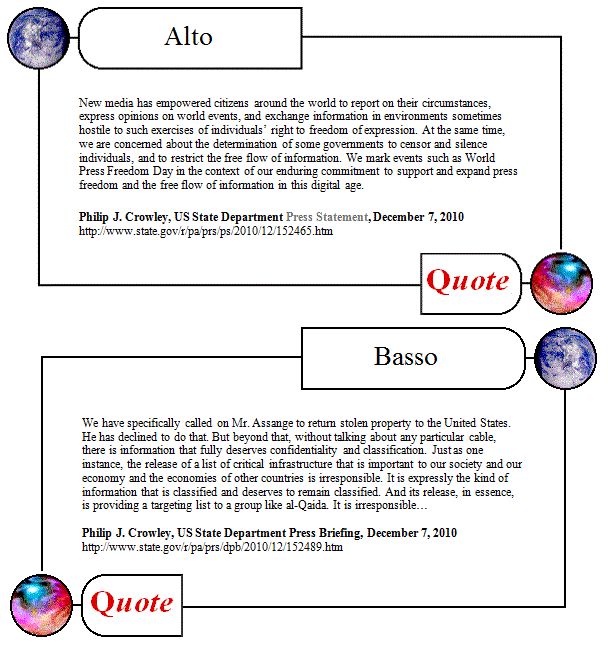
The pianist Glenn Gould is celebrated for his ability to bring the different and at times positively oppositional voices in a fugue by Bach to our attention, so that we follow each one separately while hearing all at the same time as a single whole. What is less known is that he liked to sit at a table in a truck stop and listen to the different conversations at the other tables and booths, mentally braiding their pale or brightly colored threads of human together into an analogous tapestry — one voice harmonizing with or conflicting against another, here a new subject introduced, there an echo of an earlier idea heard in a fresh context, with the murmurings of waitresses punctuated by the kaching! of the cash register, the hydraulic hiss of a door closing — conversation as counterpoint.

Organizations and individual alike, we all have different and at times dissonant voices, and strive to bring them to some kind of resolution. The many stakeholders debating an issue in town halls, blogs or letters to the editor, the many drives within each one of us, idealistic, hopeful, defeated, paralytic, angry, evasive, sluggish, vengeful, curious, alert, defiant, all have voices, all constitute an experience of polyphony, a “music of many voices”, in point counter point.

One of my interests is to find a way to score these many fugues, these musics of meaning.

My DoubleQuotes, then, can be considered as two-part inventions, attempts to show the multiple tracking of the mind — whether of a single individual, as in this case, or of a group, a community, a world divided – so that something of the music begins to be visible, and some of the dissonances can move towards necessary resolution.

*

QUOwikileaks

*

I believe there is unresolved irony between these two statements, made on the same day by Philip J Crowley, the US State Department’s Assistant Secretary, Bureau of Public Affairs – but each has its reasons, and there are arguments to be made for both transparency and opacity, diplomacy and publicity, secrets and revelations.

Between them lies the possibility I think of as a virtual music of ideas.

*

Bach published a series of two-part inventions, BWV 772–801, and wrote of them that he intended to offer them as an honest method

by which the amateurs of the keyboard – especially, however, those desirous of learning – are shown a clear way not only (1) to learn to play cleanly in two parts, but also, after further progress, (2) to handle three obligate parts correctly and well; and along with this not only to obtain good inventions (ideas) but to develop the same well; above all, however, to achieve a cantabile style in playing and at the same time acquire a strong foretaste of composition…

Later comes the Art of Fugue.

Recommended Reading

Wednesday, December 8th, 2010

Top billing! Spengler BOOK REVIEW Reason to pause The Closing of the Muslim Mind: How Intellectual Suicide Created the Modern Islamist Crisis by Robert R ReillyI am not a regular reader of Spengler except when friends draw my attention to him, but this column had a heavy dose of intellectual and cultural history, theology and epistemology. Much food for thought here ( hat tip to the Warlord):

Mainstream Islam rejected Greek-derived philosophy at the turn of the 12th century, when Abu Hamid al-Ghazali established a theology of divine caprice. In the normative Muslim view of things, Allah personally and immediately directs the motion of every molecule by his ineffable and incomprehensible will, according to the al-Ghazali synthesis, directly and without the mediation of natural law. Al-Ghazali abolished intermediate causes, that is, laws of nature, leaving great and small events to the caprice of the absolute tyrant of the universe.In place of Hellenistic reasoning, Islam turned to a literal reading of the Koran. Robert Reilly recounts Islam’s abandonment of Hellenistic reason, and blames it for the subsequent decline of Muslim civilization and the rise of radical Islam….

John P. Sullivan and Sam LoganLos Zetas: Massacres, Assassinations and Infantry Tactics

Two expert and cutting edge thinkers on Mexico’s narco-insurgency: 

In the aftermath of the massacre, the lead investigator and another police officer were reported missing. Car bombs exploded near a police station and a Televisa office; a grenade exploded in a Puerto Vallarta bar; and, the mayor of Hidalgo was assassinated. The Zetas are suspected in those actions, too. Such is the tempo of extreme violence in areas contested by the Zetas: primitive car bombs, grenade attacks, assassinations, and massacres. Tamaulipas, Nuevo León, and Jalisco-states contested by the Zetas-are deluged by the spate of violence.Urban blockades, or narcobloqueos, are a quasi-political tool recently employed by Los Zetas in Monterrey and Reynosa. For example, on August 14, 2010, members of the Zetas blocked off at least 13 major roads in Monterrey, preventing access to the city’s international airport and major highways entering and exiting the northern industrial city. The narcobloqueos were deployed in the aftermath of a shootout between the military and Los Zetas that killed reputed Monterrey Zeta leader “El Sonrics.” Drivers were carjacked and their cars were used to close the roads. These blockades are a “show of force,” a demonstration of the Zetas’ power….

HG’s World –How Will Two Goliaths Meet?

….Today our national creed has become to spread American style democracy around the globe, even to the point of a gun. The results have backfired in several places as nationalistic tendencies led to the election of leaders now bent on confronting our hegemony by inciting disdain for all things American. We should all be reminded of America’s first foray into imperilism cum, “nation building” in 1900, which saw the Philippines racked with a war of resistance that cost thousands of American and Philippine lives and ended in the United States tarnishing it’s image of being the shinning hope for the down-trodden. Ultimately we left behind a country still struggling to make it’s way beyond the grinding poverty that still resides on many of their far flung islands.Many Americans still see the rise of China in Cold War terms. China is continually referred to as Communist or the Chi-Coms who are still bent on changing the world into a collective farm and concrete block apartments of robotic people dressed in  drab Mao jackets and riding bicycles in mass transit to equally drab work assignments. For anyone who has visited China, you will quickly learn that image has joined Chairman Mao in his tomb. Mao jackets along side Russian style fur caps are sold only to tourists by hundreds of vendors, all eager to gain a middle class existence. This is aptly apparent when one considers that just a short thirty years ago, over 65% of the Chinese people lived in extreme poverty on less than $1 per day, but by 2007 it had fallen to 4%. Today, it is even lower, but still far behind our American standard of living. Bottom line, they accomplished this by emulating the best traditions of liberal Capitalism, not Communism. If anything, China is returning to her roots, as the Communist Party assumes the role traditionally held by the Mandarin class who administered policy for the imperial court. We may not like it, but with the growing nationalist pride many Chinese feel, seeing them elect a firebrand who becomes bent on starting wars is not in any one’s best interest at this time. So in the short run it is better to allow them to progress towards a popularly elected representative government at their own pace.

RECOMMENDED VIEWING:

“Soft Power” theorist Joseph Nye on global power shifts

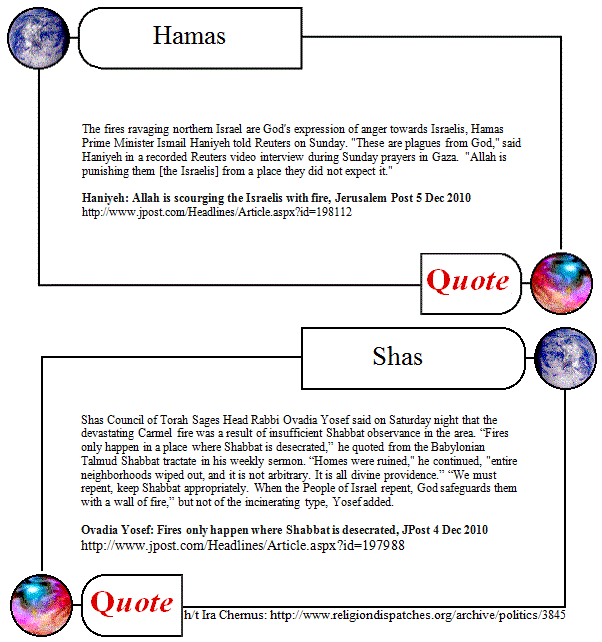
Israeli fires: the blame game

Tuesday, December 7th, 2010

[ by Charles Cameron ]

QUOIsraelFires

If it were me, I’d pray for rain.


Switch to our mobile site