zenpundit.com » 2011 » February

Archive for February, 2011

On the Mythic and the Historic

Thursday, February 3rd, 2011

My amigo Sean Meade ponders:

Notes: The Problem with Sparta

So here are some of the ideas and notes, for posterity.The Problem with Sparta (and Greece)

References
300 (original graphic novel by Frank Miller and better-known movie)
Gates of Fire, Steven Pressfield
The Peloponnesian War, Thucydides
A War Like No Other, Victor Davis Hanson
Sailing the Wine-Dark Sea, Thomas Cahill

The fiction glorifies Sparta while the non-fiction is more critical than laudatory. I was struck by how much the fictional Sparta, in three stories I really love, did not match the history I’d been studying.

Did Pressfield make his story more palatable to his readership by soft-pedaling Helot slavery, radical conservatism and aristocracy, oligarchy and homosexuality and pederasty?

We moderns are very critical of the real, historical Sparta. Insofar as it stands in for Greece in the fiction above, it’s an inaccurate portrayal. To say nothing of all the problems with our view of the Golden Age of Athens…

Ah, the tension between history and myth. 

Admiration for ancient Sparta was imprinted into Western culture because Sparta’s Athenian apologists, including Xenophon but above all Plato, left behind a deep intellectual legacy that includes a romantic idealization of Sparta that contrasts sharply with the criticisms leveled by Thucydides against Athens in The Peloponnesian War. The Melian Dialogue remains a searing indictment against Athens 2,500 years later but no equivalent vignette tells the tale of the Helots living under the reign of terror of the Spartan Krypteia. Plato’s Republic upholds oligarchic authoritarianism inspired by Sparta as utopia while Athenian democracy is remembered partly for the political murder of Socrates and the folly of the expedition to Syracuse. Somehow, ancient Athens lost the historical P.R. war to a rival whose xenophobic, cruel, anti-intellectual and at times, genuinely creepy polis struck other Greeks as alien and disturbing, no matter how much Sparta’s superb prowess at arms might be applauded. 

The fact that the vast majority of the ancient classic texts were lost, or as Dave Schuler likes to note, very selectively preserved and edited – at times, invented – by later peoples with agendas, may account for some of the discrepancy.
DQ Egypt: impact on Israel

Wednesday, February 2nd, 2011

[ by Charles Cameron [hoping Zen’s ISP will be back up shortly] — cross-posted from ChicagoBoyz ]

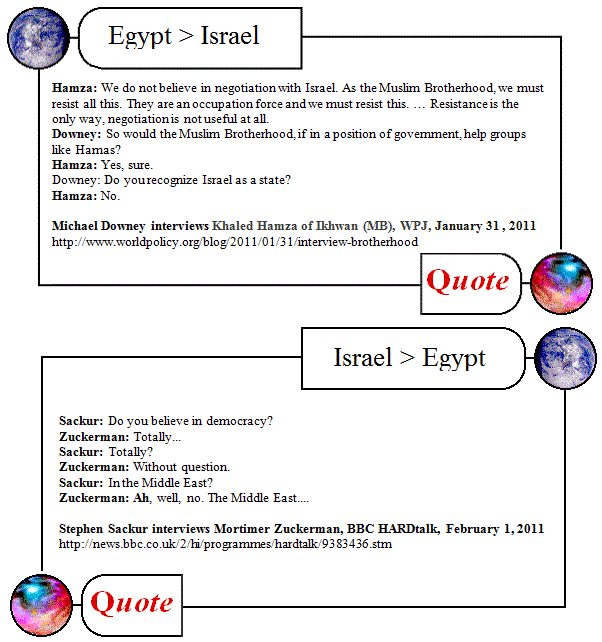
Someone posted an excerpt from an interview with Khaled Hamza, the webmaster of the Muslim Brotherhood, as a comment on an earlier post of mine on ChicagoBoyz, where I also blog, and I was interested enough to track the original interview down, and have presented the key points of the excerpt here in Quote #1.

I am pairing it, in Quote #2, with an excerpt from an interview the BBC recently conducted with Mortimer Zuckerman – because I find the two quotes taken together suggest something of the complexity of the breaking situation in the Middle East.

*

I’d like to float a trial balloon / try a though experiment, if I might. And since I’m more “tail” than “left” or “right wing”, I’ll be posting this in more than one place, and hope to get comments from all sides…

On the face of it, Zuckeman is applying what’s arguably a racist double-standard. He advocates democracy, “totally” and “without question” – but not for the Egyptians, or at least not today or tomorrow.

On the face of it, the Egyptian public seems distinctly unenthused by Mubarak’s regime and will, in a democratic election, presumably vote in a fair number of Muslim Brotherhood representatives – though it’s by no means clear that they would be in the majority, and their present ideology in any case is closer to the processes of electoral politics than those of violent jihad.

So there is reason for Israel to be concerned, and reason for those who support democracy to see some hope for democracy, in the ongoing events in Egypt.

Let me put it this way: Quote #1 illustrates why Zuckerman might make the remarks quoted in Quote #2, while Quote #2 illuminates why Hamza might make the remarks quoted in Quote #1.

*

And here’s the thought experiment — I’d like to come at this from a Maslovian angle.

Maslow’s Hierarchy of Needs

I’d like to suggest that “democracy” is an ideal, or to get away from that word with its somewhat ambiguous political connotations, an activity of the “the better angels of our nature” – and thus, from a Maslovian perspective, an aspect of a group or nation’s “self-actualization” level of interest, whereas “stability” would fall under “safety” or even “physiological”.

If that’s right, Zuckerman is at least arguably articulating a “stability first, eventual democracy would be ideal” position.

Does that “Maslovian” formulation throw any additional light on the situation?

*

The problem with the position I just described is nicely articulated by Mohammad Fadel at the very end of a Foreign Policy post, Can Black Swans lead to a sustainable Arab-Israeli peace? — and it’s only his conclusion I’m quoting here:

Tunisia and Egypt have demonstrated categorically that any peace which relies on the stability of police states is doomed from the outset.

If a butterfly flapping its wings in Brazil can in theory cause a tornado in Texas – heaven alone knows what someone blinking in Cairo or Jerusalem or Washington can do.

Myself, I pray for empathy, which seems a reasonable request, I hope for wisdom, which seems a great deal more chancy — and I long for peace.

In the current environment of hatred and mistrust, that seems entirely beyond the capacity of anyone’s present thinking to achieve.

Moblogging

Wednesday, February 2nd, 2011

The blizzard has knocked out my ISP and I am reduced to using the tiny keys on my droid.

Expect blogging to be light from me, though Charles can carry on, not being buried in snow 🙂

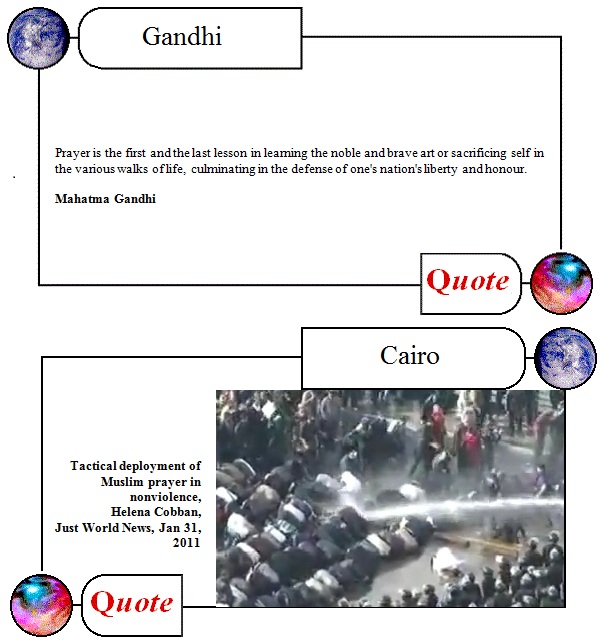
Egypt: prayer vs water cannons

Tuesday, February 1st, 2011

[ by Charles Cameron cross-posted from Brainstormers on the Web ]

For location / background, see Helena Cobban, Tactical deployment of Muslim prayer in nonviolence.

The image is from the middle of this YouTube video — you can see the prayers begin around the 3.25 mark, and the ending is also worth watching, as Cobban notes.

One for Zen and the Boydz

Tuesday, February 1st, 2011

[ by Charles Cameron ]


Switch to our mobile site