zenpundit.com » 2011 » June

Archive for June, 2011

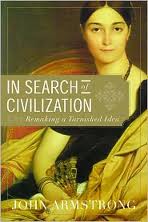
In Search of Civilization, a review

Saturday, June 18th, 2011

 [by J. Scott Shipman]

civilization.jpg

In Search of Civilization, by John Armstrong 

In Search of Civilization is a refreshing and erudite examination of civilization, how it developed in the past, negative present day connotations, and why it remains importance and relevant today. What follows is a detailed overview of Part One, and with any luck, the teaser will be enough to convince you to read this important book. For me, this is a truncated review. Normally, I would provide a 1200-1500 hundred word overview, but like Zen, I’ve been busy and wanted to share what I had with you. This books makes a nice foil for John Gray’s Black Mass, which I read recently but probably will not review.

Also, some books have wonderful finds in the bibliography. Back in the early 80’s I chased footnotes for about two years—and have no memory of what the original book was, but I went from one reference to another. Going forward, I’ll provide the titles from the bibliography that piqued my interest, which may also provide the you a little more insight on the works that influenced the author. Please let me know if this is or is not useful to you.

Part One Civilization as Belonging

Armstrong’s quest to define civilization began as he was reading a bedtime story to his son, and he advances that “with the possible exception of God, civilization is the grandest, most ambitious idea that humanity has devised.” From that introduction, Armstrong makes a compelling case for civilization.  He notes that it is difficult to get one’s mind around the concept since “civilization” touches everything. As a result, he offers that our ideas about “civilization tend to be rather messy and muddled.”

Armstrong goes on to frame civilization as “a way of living,” a level of political and economic development, “the sophisticated pursuit of pleasure,” and finally, “a high level of intellectual and artistic excellence.” Separately each of these, what I’ll call working definitions, made sense. But Armstrong rightly attempts to define, frame, contextualize civilization, not from historical perspective, but rather the philosophical in a way that is relevant to our times.

The actual word “civilization” is, according to Armstrong, not “fashionable” in our globalized world, particularly among those one would expect to be the “defenders.” He offers that civilization carries a “moral implication” whereby one society is somehow better than another, “fully human” or “superior.” And nations often advance the idea that they are better, more civilized, etc. Those defenders (in the arts and humanities) mentioned above have become “wary and negative” with respect to civilization. I’ll call this standard-less ambivalence based primarily on fear. Fear of “what,” you may ask. Fear of offending. Harvey Mansfield in City Journal made an excellent point with respect to political correctness:

“When there is no basis for what we agree to, it becomes mandatory that we agree. The very fragility of change as a principle makes us hold on to it with insistence and tenacity. Having nothing to conform to, we conform to conformism—hence political correctness. Political correctness makes a moral principle of opposing, and excluding, those of us who believe in principles that don’t change.”

Principles are a big part of civilization.A brief review of Samuel P. Huntington’s classic The Clash of Civilizations follows. Armstrong reminds of Huntington’s words: “In coping with an identity crisis, what counts for people are blood and belief, faith and family.” Armstrong recounts Huntington’s view of civilization a sense of “loyalty” and “shared identity.” Armstrong calls this an “organic conception of civilization;” witness the identity politics of the in the aftermath of 9/11 where it seemed the US, for once, stood as one. The phenomena can be found around the world, regardless race, religion, or ethnicity.  If there is a community of people, chances are there will be shared identities, but is this “sharing” civilization?

One of the strongest parts of the book is the emphasis he places on the “quality of relationships.” With the aforementioned “sharing” and “loyalty” Armstrong rightly asks about the quality of individual relationships and the impact on civilization. He compares the loyalty of religious believers to their faith to their loyalty to their civilization. Armstrong believes, and I agree, we share much more in common than one might, on first glance imagine. He says, “The rich achievements of any civilization are not in violent conflict, and in fact are on the same side in a clash between cultivated intelligence and barbarism. The irony is that such barbarism too often goes under the name of loyalty to a civilization.” Armstrong believes that a “true civilization is constituted by high-quality relationships to ideas, objects, and people.” In high quality relationships there is love and Armstrong sees civilization as “the life-support system for high-quality relationships.” Civilization sustains love; I like the implications.

The cultivation of high quality relationships tends to bring out the best in people.  He goes on to discuss the paradox of freedom—as we in the West live in cultural democracies. He asserts that vulgarity is “triumphant” because of our democratic ideals; the majority rules. Freedom comes with great responsibilities, greater responsibilities than living in a coercive state. At the level of the individual we make choices, satisfy appetites. “The civilizing mission is to make what is genuinely good more readily available and to awaken an appetite for it.”

Part Two Civilization as Material Progress, Part Three: Civilization as the Art of Living, Part Four: Civilization as Spiritual Prosperity 

References you may find of interest:

F.R. Leavis, The Great Tradition

C.P. Snow, a lecture “The Two Cultures and the Scientific Revolution

Matthew Arnold, Culture and Anarchy  A free online copy here.

 Kenneth Clark’s BBC television series Civilization

Bernard Berenson, The Florentine Painters of the Renaissance (1896)

T.S. Elliot, an essay called “Tradition and the Individual Talent

Busy….

Friday, June 17th, 2011

With some offline issues. May have time for a short post later today. Normal blogging to resume in a few days….

The Said Symphony: Board and Gameplay

Thursday, June 16th, 2011

[ by Charles Cameron – extended analytic game on Israeli-Palestinian conflict — see Said Symphony: Intro ]
.

All the games of the HipBone family use the juxtaposition of ideas on a game-board to develop a web of associations that is larger and more complexly interwoven than the same ideas gathered in a simple list, didactic argument or sequence.
.

The Said Symphony board:

.
The simplest of these games uses the DoubleQuotes format, with which regular Zenpundit readers will already be familiar (i, ii, iii, iv). More complex games have been played on the Dart and WaterBird boards among others, some light-hearted (Movie Trivia Game), some quite serious (What Sacred Games?).

For quite a while now, I have wanted to play a solo game — something more epic in scale than a two-move DoubleQuote or even a ten-move game on the WaterBird board – that “scored” the symphony that Edward Said intuited, as mentioned in my previous post.
Not so long ago, I found the perfect board…

600px-graph_betweenness_svg.png

Board credit: Claudio Rocchini
.

The HipBone gameplay

.
Here’s how the gameplay works.

Slowly, I am going to “place” one quote (or image) after another on that board.

Each of these quotes or images (or equations, or sound-clips, or even blanks / silences) will be assigned a “position” (circle) on the board, a name or “move title“, some “move content” that features the quote or image and enough associated content to explain it, a series of “links claimed” in which I build bridges to directly adjacent moves already in play, and on occasion a “comment” which will allow me to weave in an overview of how the game is going, some footnotes, whatever seems helpful.

A board position, move title, move content, links claimed and comment, taken together, will comprise a single “move” on the board.

I hope to cover a wide range of issues here, political and religious, riparian and agrarian, Judaic and Christian and Muslim, secular and sacred, local, regional and international, disputed and agreed, in parallel and orthogonal and in opposition, violent and peaceable, ancient and modern and futuristic, social and individual… thesis and antithesis and synthesis, you get the drift.

Let me be clear: wherever the board shows two circles (‘board positions”) directly linked by a line, the ideas (“moves”) assigned to those two circles should have some form of linkage – associative, analogical, metaphorical, metonymic, causal, illustrative, oppositional, paradoxical, biographical, bibliographic… and so forth.

Putting that another way, I shall try to place my moves in such a way that moves joined by lines between them will indeed provoke thought and insight — about the facts on the ground, the myths in the air, the dreams and hopes and dashed hopes, the people…

So that the whole sorry, glorious story will hover behind the board, with pinpoint quotes and details shining through the moves on the board like constellations in the night sky.

Thus it is not the ideas themselves but their relationships – their duels and duets – which form the fabric of this work of architecture, the counterpoint of its music.
.

Playing and following along:

.
I shall play my moves first, one at a time, in the forums my friend Howard Rheingold, web pioneer and author of Smart Mobs, has set up for graduates of his online classes. I may at times make two or three moves there in a day — or wait a week and ponder what my next move should be.

But I don’t want to clutter up ZP every time I made a move, so I shall wait and gather them, and post here on Zenpundit when I have a suitable cluster to offer.

It was Howard‘s gracious invitation for me to introduce my games to his alumni that first nudged me off my perch and got me started playing this game that I have been thinking about for some years now –and Zenpundit is my home on the open web – so this double presentation is natural.

You are most welcome to follow along, comment and kibitz – but let me make two things clear from the outset:

The fact that I “play” a particular person, image, work of art or headline in no way means that I endorse that person or point of view – any more than a novelist or historian quoting Hitler, Churchill, or Stalin necessarily endorses the swastika, Union Jack or hammer and sickle:

Quotation does not imply endorsement or disparagement.

And the fact that I juxtapose two situations, events, anecdotes, quotes, processes or persons in no way means that I equate them – any more than a juxtaposition between the soccer game that kicked off the Football War (El Salvador and Honduras, 1969) and the Fischer-Spassky match that was a minute but focused skirmish in the Cold War (USA vs USSR, 1972) implies that soccer is or somehow equals chess — or is its exact opposite — or provides or implies a moral equivalence between America and Russia:

Linkage does not imply equivalency, moral or otherwise.

There will be symmetries, there will be asymmetries, as you’ll see — and indeed it may well prove that the discrepancies, oppositions and imbalances between two adjacent moves will be as fruitful as any parallelisms.

What I would suggest is that every move, like it or loathe it, should be heard.
.

And briefly, the HipBone Games:

.
The project builds on my previous development of the HipBone family of games, which began as an attempt to make a playable variant of the Glass Bead Game described in Hermann Hesse‘s Nobel winning novel, Magister Ludi.

I recently posted an introductory account of the games on Bryan Alexander‘s New Digital Storytelling blog; game boards are available for download at HipBoards; and the basic games rules and invitation to play are still up at my now ancient HipBone Games website.

I’m happy to take questions in the comments section.
.

Next up:

.
In my next post, I’ll play the opening moves

Pundita on Mexican Insurgency and Hollowing Out America

Wednesday, June 15th, 2011

Blogfriend Pundita turns an eye to Mexico, which is currently entering free fall despite official US policy that the cartels are not an insurgency, and has extensive comments on how the transnationally oriented, strategically inept, elite mismanaging US foreign policy no longer think in terms of a “US foreign policy”. Or perhaps, a “US”:

“Hollowed out” Mexico and hollowed-out USA

….I hate to be the one to break this news to Mark but there can no longer be an American policy on Mexico because there is no longer a United States of America. He doesn’t know this because he doesn’t watch much television news, but a few weeks of watching CNN will clue him that the USA is no more. In its place is a country called The Whole World (aka RIC – Republic of International Community), which for reasons known only to the rascals who run CNN excludes every world region where CNN is not in hot competition with al Jazeera.I myself speak of the “country” of the USA, which I think is what seems to be a box of cookies or a milk carton in the foreground of the above satellite photo of the RIC, only as a matter of convention.

As for FNC (Fox News Channel): currently too busy taking pot-shots at other TV news outlets for initially covering up the Weiner story and otherwise too busy trying to find a Republican who can win the White House to notice that a U.S. government is a memory.

(Memo to FNC: The other TV media were initially quiet about Weiner’s texting problem not because he’s a Leftist but because his wife is Hillary Clinton’s closest aide and they didn’t want to have to tell the American public that the person closest to the U.S. Secretary of State is an American Muslim of Indian-Pakistani heritage who was raised in Saudi Arabia, you nitwits.)So before we try to upgrade U.S. policy on the hollowed-out state of Mexico, as the Narcos book terms it, I say let’s examine how the U.S. got hollowed out.

One more point before I cede the floor to Mark: His summary doesn’t indicate whether the book addresses racism and apartheid in Mexico. I know that Mark is aware of the subject so I think he would have mentioned it, if any of the monographs dealt specifically with racism; frankly I’d be surprised if any did because the topics of Mexican racism and apartheid are taboo in both the USA and Mexico.

Later this week or the next I’ll try to rip myself away from the Afghan War long enough to return to those issues, which I touched on in an earlier post. For now, I’ll just say that I think Mexico’s type of racism is the true “virus” that Dr Bunker talks about….

Good question regarding the effects of racism in Mexico on the evolution of the cartel wars. An important point. I know why employees of USG entities do not raise it; for the same reason they will not use the “i” word – Mexican officials would go ape.

Dr. Bunker reads ZP from time to time and he’s best placed to explain why none of the authors delved into that aspect of narcocultas folk religion or Mexican elite behavior. My recollection is that most of the contributors to Narcos Over the Border were security specialists rather than social historians or sociologists.  Maybe David Ronfeldt, who also has a specialty in Mexican affairs, can also weigh in on this important point.

Hollowing out of the US requires a post of it’s own to consider.

Lieven on Pakistan

Wednesday, June 15th, 2011

Noted foreign policy commentator and academic Anatol Lieven has a new book on Pakistan, and holds forth at length here on the always excellent Conversations With History.

For my part, diplomatic relations with Pakistan amount to our stage managing their elite’s LIC war against us, Afghanistan and India at what our elite perceive as a tolerable level of affront , deceit and violence. And we are doing it as expensively as possible.


Switch to our mobile site