[ by Charles Cameron — surprising infrequency of capital punishment, though mandated in Sharia and Torah ]
.
I’m always struck by formal parallelisms, particularly in matters religious — so when I came across this fascinating reference to the infrequency of capital punishment by stoning in the Ottoman Empire in a book review today (upper panel):
I was immediately reminded of a similar Jewish reluctance to use capital punishment — stoning being one of the four choices — as recorded in Tractate Sanhedrin (lower panel)
And i thought the Dalai Lama (inset) might like it too…
Of course, there’s more detail and nuance to be had in each case, but the parallelism is nevertheless instructive.
[ by Charles “told you so” Cameron — Pew figures for Mahdist expectation, also the Second Coming, Israel, and the potential influence of apocalyptic ideation on foreign policy ]
.
The World’s Muslims: Unity and Diversity, p. 65
.
I am Qualit, not Quant by nature, really much more interested in the workings of the imagination that in the aggregates of poll responses, so it’s a bit like pulling teeth for me to report on a Pew report — but in this case I can legitimately say “I told you so”, which massively outweighs the reluctance I might otherwise feel…
**
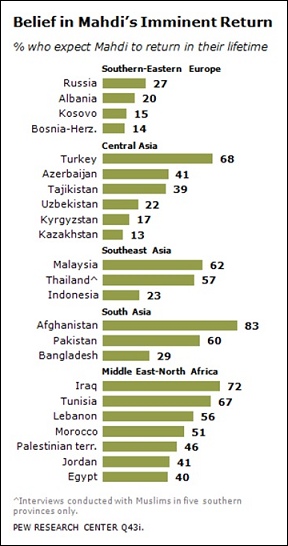
Recently, Pew has been including questions about the expectation of the Mahdi in some of its reports, and even Tim Furnish — who wrote the book on Mahdist movements and has long been saying we neglect them at our peril — even Tim was surprised at how widespread Mahdist expectation is, as reported in their just released The World’s Muslims: Unity and Diversity. In a post aptly titled Don’t Leave a Live (or Occulted) Mahdi Out of Your Calculations, Tim says the report contains “The most notable — indeed, strikingly important — news” in the form of “fascinating — and disturbing — data on belief in the Mahdi’s imminent (in one’s lifetime) return.”
See graphic above.
I recommend you read Tim’s analysis for the full range of his points — I won’t, for instance, be touching on what he says about Turkey — here I am going to select a couple of his key issues, and make just a point or two of my own.
**
Furnish:
Of the 23 countries whose Muslim citizens were polled, nine have majorities which expect the Mahdi in their lifetimes, with the overall average percentage at 41.8% … it is safe to extrapolate this percentage to Islam as a whole; ergo, 42% of 1.6 billion = 672 million Muslims who believe in the Mahdi’s imminent return! This is FAR greater than I had supposed.
Furnish also notes that Iran, the world’s most intensely Shi’ite nation and the one whose President has been speaking openly of Mahdist expectation, is not even included among the 23 countries Pew sampled.
Simply put, we have been blind to a very real phenomenon, and now we have a statistical alarm call to wake us up.
More subtly: there’s a difference between answering yes to the question “do you expect the Coming of X in your lifetime” and being on the edge of your seat, viewing every week as threshhold. Damian Thompson is very good on this in his book, Waiting for the Antichrist, and Stephen O’Leary in Arguing the Apocalypse suggests there’s an optimal “arousal” period — if you believe the Coming is too far away, you won’t be motivated to prepare for it quite yet, and if it’s too close it may be too late for you to do much to spread the word…
So, Pew — next time, ask a question with the opinions “in the next five to ten years” and “in my lifetime” — okay? The distinction is important, and a shift towards the shorter time-span would be highly significant.
**
Furnish again:
Despite the conventional wisdom (repeated even by Pew, in the face of their own data) that Mahdism is primarily the province of Shi`is, note that three of the four countries with the highest percentage expecting the Mahdi are majority-Sunni ones: Afghanistan (83%), Turkey (68%) and Tunisia (67%). This has ramifications, respectively, for: US policy in a country we are currently occupying; the only NATO Muslim-majority nation; and the vanguard state of the “Arab Spring.”
In his Conclusions, Furnish says:
The usual State/Defense departments’ “rational actor” approach to international relations might be quite simply irrelevant, if almost half the world’s Muslims expect the imminent return of their eschatological deliverer.
So there you have it. I discussed the “rational actor” versus Scott Atran‘s “devoted actor” in a recent post. And yes indeed, there are “ramifications for U.S. policy”…
Notably with regard to Afghanistan …
**
Here’s Furnish again:
Afghanistan is so rife with Islamic messianism because the 80% of the population that is Sunni and the 20% that is Shi`i (albeit Sevener/Isma’ili, as well as Twelver) both are in the middle of a war and occupation by a “Christian” power — which tends to ratchet up such expectations …
And again, in his Conclusions:
Afghanistan is a lost cause: over eight in ten of its people expect the Mahdi in their lifetime, and no amount of roads and clinics and girls’ schools built by the infidels will change that.
I don’t want to argue that second point in detail, although I think there’s a great deal more to life that Mahdist expectation for many who would answer “yes” to Pew’s question about expecting the Mahdi in one’s lifetime — see my comment on Damian’s book above. But how can I put it? A background Mahdist expectation can become a passionate involvement in a Mahdist movement if the right trigger comes along.
But what I find most striking here is that Afghanistan should be the country with the strongest Mahdist current out of all those Pew selected. And I’m struck not because Afghanistan has been a battlefield for so much of recent history — indeed, for so much of its history, period. I am struck because, in Al-Qaida’s recruitment narrative, supported by a number of ahadith, Afghanistan as Khorasan is the very locus from which the Mahdi’s victorious army will sweep out to conquer (finally) Jerusalem. And this too I have been posting about, eg in my discussions of Ali Soufan‘s The Black Banners and Syed Saleem Shahzad‘s Inside Al-Qaeda and the Taliban.
So the highest level of Mahdist expectation also happens to be found in an area with a potentially major role to play in an end times scenario…
**
There’s at least one earlier report in which Pew raised the question of Mahdist expectation — this time tied in with both the expectation of the Caliphate, and Christian hope of the Second Coming — their 2010 report Tolerance and Tension: Islam and Christianity in Sub-Saharan Africa.
Here, for instance, we learn:
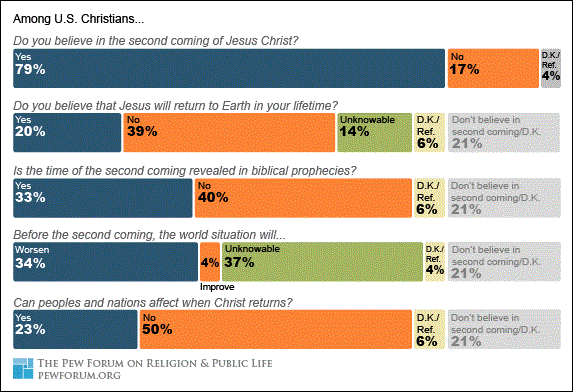
Both Christians and Muslims believe they are living in a time that will undergo momentous religious events. For example, at least half of Christians in every country with large enough samples of Christians to analyze believe that Jesus will return to earth during their lifetime, including nearly seven-in-ten Christians in the Democratic Republic of the Congo (69%).
And at least half of Muslims in 10 of the 15 countries with large enough Muslim populations to analyze say they believe that the caliphate, the golden era of Islamic rule, will be re-established in their lifetime; this belief is most common among respondents in Mozambique (69%). And in 12 of these 15 countries, roughly six-in-ten or more Muslims believe in the return of the Mahdi, the guided one who will initiate the final period before the day of resurrection and judgment, though the survey did not ask respondents whether they expect this to occur during their lifetime.
And here is the relevant data on sub-Saharan Mahdist belief. In Q51 of this poll, Muslims were asked whether they believe “in the return of the Mahdi, the guided one who will initiate the final period before the Day of Resurrection and Judgment? Here’s the table of responses:
Given the “religious fault line” of mixed conflict and amicable coexistence between Christians and Muslims running across Africa from (so to speak) Nigeria to Somalia, with Boko Haram and Al-Shabaab among the less delightful participants, keeping an eye out for signs of Mahdist “semiotic arousal” would be important here, too.
**
And “semiotic arousal” — that reminds me. Richard Landes, who coined the term, has the definitive, encyclopedic book out about all the many forms of apocalyptic, and why they’re important: Heaven on Earth: The Varieties of the Millennial Experience Essential reading, if you ask me, on a hugely neglected and no less critically important subject.
Prophecy has impact, both on public opinion and on believing leaders. Jews with an expectation of the Messianic era, Christians expecting the soon Coming of Christ, and Muslims with Mahdist expectations each have their own apocalyptic scenarios, and in each case those scenarios exert some influence on policies relating to the Middle East and the Israeli-Palestinian situation in particular.
The bottom line?
Scriptural interpretation — and prophetic eschatology in particular — can no longer be assumed to be a quiet backwater topic for rabbinic students, seminarians and future mullahs to study, each in terms of their own tradition. It is now a series of conflicting drivers of current affairs — of war and peace.
….Countries differ in their economic success because of their different institutions, the rules influencing how the economy works, and the incentives that motivate people,” write Acemoglu and Robinson. Extractive institutions, whether feudalism in medieval Europe or the use of schoolchildren to harvest cotton in contemporary Uzbekistan, transfer wealth from the masses to elites. In contrast, inclusive institutions—based on property rights, the rule of law, equal provision of public services, and free economic choices—create incentives for citizens to gain skills, make capital investments, and pursue technological innovation, all of which increase productivity and generate wealth. Economic institutions are themselves the products of political processes, which depend on political institutions. These can also be extractive, if they enable an elite to maintain its dominance over society, or inclusive, if many groups have access to the political process. Poverty is not an accident: “[P]oor countries are poor because those who have power make choices that create poverty.” Therefore, Acemoglu and Robinson argue, it is ultimately politics that matters.
The logic of extractive and inclusive institutions explains why growth is not foreordained. Where a cohesive elite can use its political dominance to get rich at the expense of ordinary people, it has no need for markets and free enterprise, which can create political competitors. In addition, because control of the state can be highly lucrative, infighting among contenders for power produces instability and violence. This vicious circle keeps societies poor. In more fortunate countries, pluralistic political institutions prevent any one group from monopolizing resources for itself, while free markets empower a large class of people with an interest in defending the current system against absolutism. This virtuous circle, which first took form in seventeenth-century England, is the secret to economic growth….
Kay Larson, Where the Heart Beats: John Cage, Zen Buddhism, and the Inner Life of Artists, Penguin, $29.95
.
Dropping silence into a concert turns things upside down: it brings the solo performer or group of performers into the position of audience, makes listeners of them – and makes keener listeners of the audience — perhaps with a touch of unease or self-consciousness, but with an unusual attentiveness, too.
Dropping John Cage‘s piece of silent music into a book right around the beginning… well, it has a similar impact. And that’s what Kay Larson‘s book Where the Heart Beats does, on the page numbered xiii so you’ll know the book hasn’t even started properly yet. Larsen points you, without giving you the URL, to YouTube, where you can find Cage’s most shocking, and thus his most famous piece, 4’33”, performed by the London Symphony at the Barbican, in three movements, all silent as demanded by the composer’s score – with breaks in between the movements for the usual coughing and fidgeting.
And how to say this? During the silence, you could have heard a pin drop? Or you could hear, as Tom Service said on the BBC, the “very distinct high hum” of the Barbican’s electrical system, and the occasional cough too – “you could cut the atmosphere with a knife, and every cough, every tiny noise was absolutely amplified, made into a massive musical event”.
Listen:
You can tell the audience was delighted – self-satisfied perhaps, too? – from the hearty applause, and they had listened, had presumably taken onboard the idea that pauses – silences – are as much a part of music as sounds.
But what if I said that wine was just as much a part of drinking as glasses, and poured wine for my guests with no glasses to contain it?
The thing about John Cage’s 4’33” is that it straddles the line between the emperor having and not having clothes, between group assent and dissent, between “either” and “or” -– if it turns us from self-obsessed self-expressives into attentive listeners, it has reached into us musicically and carried us beyond the limits of music. And if it’s a bunch of boring minutes while an orchestra gets paid to SFU, it’s plain idiotic.
Which means that John Cage composed it right at the tipping point between the stupid and the profound.
I want to express it that way, and not tell you that Cage composes where the mind is fresh and inspiration flows, because it is stupid as well as fresh and profound.
As Hitler might have said, if he’d been asked…
And we haven’t really begun the book yet.
**
There are three stories here:
There’s the rigorous thread of western classical music, from its origins in the mist via Jewish cantillation and Gregorian chant into Polyphony and the Baroque, Classicism proper, Romanticism and the Modern. The music of Cage is the culmination, here, of this theme.
There’s the circling yet nonexistent circle, drawn as it were on glass with an ink brush dipped in water, of Zen, a “rebirth with neither beginning nor end”…
And there’s the world of the contemporary arts, centering in New York, with Cage a leading light.
They comes together when various characters have what Larson calls “life altering moments” — Larson herself, John Cage, Gary Snyder, Allen Ginsberg, Jack Kerouac in the first few pages alone, with the two Suzukis, DT Suzuki and Shunryu Suzuki Roshi and their experiences hovering in the background.
Zen is the pond, the emptiness, the silence, the stillness waiting into which like so many varied pebbles, the themes are character off the book will drop, in which their ripples will intersect…
Or to put that another way: silence, the stillness, is the pond into which Cage’s life and influence is dipped, and music and the arts the shingle on the beach from which the pebbles are dropped.
**
And Cage played in that shingle, sent notes from “prepared piano” and other instruments… formal and informal… skipping across the silence.
Cage not only invited silence into the concert hall, he also theorized it at length. I’d like to quote here a celebrated passage from his book, aptly named Silence: Lectures and Writings:
What happens to a piece of music when it is purposelessly made? What happens, for instance to silence? That is, how does the mind’s perception of it change?… Silence becomes something else — not silence at all, but sounds, the ambient sounds… Where ears are in connection with a mind that has nothing to do, that mind is free to enter into the act of listening, hearing each sound as it is, not as a phenomenon more or less approximating a preconception.
**
Zen is the simplest thing, it’s human nature. It is also the most difficult — it’s what we instinctively shy away from. And it can take all our resources, as those who “sit while going round in circles” well know — to break from the “boredom” of silence into listening, to dip into the sound stream, to hear the stillness.
Somehow, I’m hoping to nudge you into that kind of awareness, so that you can understand from within the taste of silence, the importance of Cage’s life, and of Kay Larson’s book.
Here’s another nudge, from a different angle — the Scottish poet Edwin Morgan‘s poem in homage to one of John Cage’s sayings:
Opening the Cage: 14 Variations on 14 Words “I have nothing to say and I am saying it and that is poetry.” — John Cage
I have to say poetry and is that nothing and am I saying it I am and I have poetry to say and is that nothing saying it I am nothing and I have poetry to say and that is saying it I that am saying poetry have nothing and it is I and to say And I say that I am to have poetry and saying it is nothing I am poetry and nothing and saying it is to say that I have To have nothing is poetry and I am saying that and I say it Poetry is saying I have nothing and I am to say that and it Saying nothing I am poetry and I have to say that and it is It is and I am and I have poetry saying say that to nothing It is saying poetry to nothing and I say I have and am that Poetry is saying I have it and I am nothing and to say that And that nothing is poetry I am saying and I have to say it Saying poetry is nothing and to that I say I am and have it
— Edwin Morgan, The Second Life Edinburgh University Press, 1968
**
In a follow up post on Monday or Tuesday, I shall describe Larson’s book in more conventional terms, and offer you some details from Cage’s intricate life and extraordinary network of friends..
For now, I just want to give you again that taste of silence from which this whole endeavor springs. Here is the pianist David Tudor, for whom the piece was written, playing 4’33”:
Some of you may recall the blogger Kotare a.k.a Peter Hodge, who sometimes commented here and at Chicago Boyz blog. He has been inactive in the strategy-mil blogosphere for several years.
Lexington Green and I have an important issue we need to discuss with Mr. Hodge. The email address he used previously with his blog has not yielded any response.
If anyone is in touch with Peter, please ask him to contact me via this blog.
If anyone has a suggestion regarding where I might contact him, please
contact me via this blog.
Zenpundit is a blog dedicated to exploring the intersections of foreign policy, history, military theory, national security,strategic thinking, futurism, cognition and a number of other esoteric pursuits.