zenpundit.com » 2012

Archive for 2012

On the inforced uniformity of religion

Thursday, July 5th, 2012

[ by Charles Cameron — when religion strongly influences politics — greetings on the Fourth of July ]
.

God and Politics UK


**

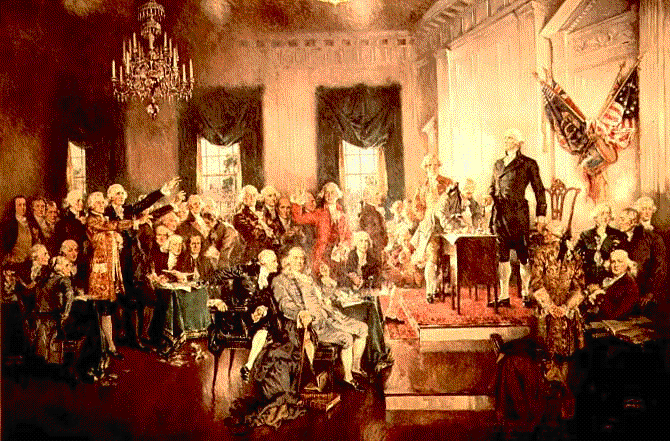
At least in the words of the Library of Congress exhibit, Religion and the Founding of the American Republic, the US we know today was conceived as a “Religious Refuge”:

The religious persecution that drove settlers from Europe to the British North American colonies sprang from the conviction, held by Protestants and Catholics alike, that uniformity of religion must exist in any given society. This conviction rested on the belief that there was one true religion and that it was the duty of the civil authorities to impose it, forcibly if necessary, in the interest of saving the souls of all citizens. Nonconformists could expect no mercy and might be executed as heretics. The dominance of the concept, denounced by Roger Williams as “inforced uniformity of religion,” meant majority religious groups who controlled political power punished dissenters in their midst.

Haven’t we had enough wars of religion? There’s much to be said for that idea.

Happy glorious Fourth to all my American friends!

**

The image above of the Palace of Westminster in London looks quite lovely and tranquil, and some of what people hear when they quiet themselves and listen to the “still, small voice” is of inestimable value, beauty and insight. But it is not always so.

As Roger Williams shrewdly observed:

enforced uniformity, sooner or later, is the greatest occasion of civil war, ravishing consciences, persecution of Christ Jesus in His servants, and of the hypocrisy and destruction of millions of souls

**

United Kingdom Come

You will perhaps understand, therefore, why I am less than enthralled by the idea of a particular opinion within Christianity “declaring the plans of heaven” over my country of origin — as suggested in the graphic immediately above this — or any other country, the United States included, and why I hope that, in Williams’ words:

a permission of the most Paganish, Jewish, Turkish or anti-Christian consciences and worship be granted to all men, in all nations and countries; and they are only to be fought against with that sword which is only, in Soul matters able to conquer, to wit; the sword of the Spirit–the Word of God

I wouldn’t mind seeing that idea take hold in Iran or Saudi, either. Yeah!

Consider:

Let there be no compulsion in religion. Truth has been made clear from error. Whoever rejects false worship and believes in Allah has grasped the most trustworthy handhold that never breaks. And Allah hears and knows all things. — Qur’an, 2: 256

If it had been your Lord’s will, all of the people on Earth would have believed. Would you then compel the people so to have them believe? — Qur’an, 10: 99

**

Besides which, having prayed often enough “Thy kingdom come” myself, I have to say I’m less than enthused to find the publicists of this particular outpouring of faith modifying the phrase to read “United Kingdom Come”.

What is this, the Cup Final?

“We Hold these Truths to be Self-Evident….”

Wednesday, July 4th, 2012

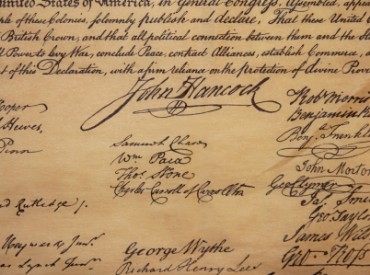
In CONGRESS, July 4, 1776.
 

The unanimous Declaration of the thirteen united States of America,
When in the Course of human events, it becomes necessary for one people to dissolve the political bands which have connected them with another, and to assume among the powers of the earth, the separate and equal station to which the Laws of Nature and of Nature’s God entitle them, a decent respect to the opinions of mankind requires that they should declare the causes which impel them to the separation.

We hold these truths to be self-evident, that all men are created equal, that they are endowed by their Creator with certain unalienable Rights, that among these are Life, Liberty and the pursuit of Happiness.–That to secure these rights, Governments are instituted among Men, deriving their just powers from the consent of the governed, –That whenever any Form of Government becomes destructive of these ends, it is the Right of the People to alter or to abolish it, and to institute new Government, laying its foundation on such principles and organizing its powers in such form, as to them shall seem most likely to effect their Safety and Happiness. Prudence, indeed, will dictate that Governments long established should not be changed for light and transient causes; and accordingly all experience hath shewn, that mankind are more disposed to suffer, while evils are sufferable, than to right themselves by abolishing the forms to which they are accustomed. But when a long train of abuses and usurpations, pursuing invariably the same Object evinces a design to reduce them under absolute Despotism, it is their right, it is their duty, to throw off such Government, and to provide new Guards for their future security.


-Such has been the patient sufferance of these Colonies; and such is now the necessity which constrains them to alter their former Systems of Government. The history of the present King of Great Britain is a history of repeated injuries and usurpations, all having in direct object the establishment of an absolute Tyranny over these States. To prove this, let Facts be submitted to a candid world.

  • He has refused his Assent to Laws, the most wholesome and necessary for the public good.
  • He has forbidden his Governors to pass Laws of immediate and pressing importance, unless suspended in their operation till his Assent should be obtained; and when so suspended, he has utterly neglected to attend to them.
  • He has refused to pass other Laws for the accommodation of large districts of people, unless those people would relinquish the right of Representation in the Legislature, a right inestimable to them and formidable to tyrants only. 
  • He has called together legislative bodies at places unusual, uncomfortable, and distant from the depository of their public Records, for the sole purpose of fatiguing them into compliance with his measures. 
  • He has dissolved Representative Houses repeatedly, for opposing with manly firmness his invasions on the rights of the people.
  • He has refused for a long time, after such dissolutions, to cause others to be elected; whereby the Legislative powers, incapable of Annihilation, have returned to the People at large for their exercise; the State remaining in the mean time exposed to all the dangers of invasion from without, and convulsions within.
  • He has endeavoured to prevent the population of these States; for that purpose obstructing the Laws for Naturalization of Foreigners; refusing to pass others to encourage their migrations hither, and raising the conditions of new Appropriations of Lands.
  • He has obstructed the Administration of Justice, by refusing his Assent to Laws for establishing Judiciary powers.
  • He has made Judges dependent on his Will alone, for the tenure of their offices, and the amount and payment of their salaries.
  • He has erected a multitude of New Offices, and sent hither swarms of Officers to harrass our people, and eat out their substance.
  • He has kept among us, in times of peace, Standing Armies without the Consent of our legislatures.
  • He has affected to render the Military independent of and superior to the Civil power.
  • He has combined with others to subject us to a jurisdiction foreign to our constitution, and unacknowledged by our laws; giving his Assent to their Acts of pretended Legislation:
  • For Quartering large bodies of armed troops among us:
  • For protecting them, by a mock Trial, from punishment for any Murders which they should commit on the Inhabitants of these States:
  • For cutting off our Trade with all parts of the world:
  • For imposing Taxes on us without our Consent: 
  • For depriving us in many cases, of the benefits of Trial by Jury:
  • For transporting us beyond Seas to be tried for pretended offences
  • For abolishing the free System of English Laws in a neighbouring Province, establishing therein an Arbitrary government, and enlarging its Boundaries so as to render it at once an example and fit instrument for introducing the same absolute rule into these Colonies:
  • For taking away our Charters, abolishing our most valuable Laws, and altering fundamentally the Forms of our Governments:
  • For suspending our own Legislatures, and declaring themselves invested with power to legislate for us in all cases whatsoever.
  • He has abdicated Government here, by declaring us out of his Protection and waging War against us.
  • He has plundered our seas, ravaged our Coasts, burnt our towns, and destroyed the lives of our people. 
  • He is at this time transporting large Armies of foreign Mercenaries to compleat the works of death, desolation and tyranny, already begun with circumstances of Cruelty & perfidy scarcely paralleled in the most barbarous ages, and totally unworthy the Head of a civilized nation.
  • He has constrained our fellow Citizens taken Captive on the high Seas to bear Arms against their Country, to become the executioners of their friends and Brethren, or to fall themselves by their Hands. 
  • He has excited domestic insurrections amongst us, and has endeavoured to bring on the inhabitants of our frontiers, the merciless Indian Savages, whose known rule of warfare, is an undistinguished destruction of all ages, sexes and conditions. 

In every stage of these Oppressions We have Petitioned for Redress in the most humble terms: Our repeated Petitions have been answered only by repeated injury. A Prince whose character is thus marked by every act which may define a Tyrant, is unfit to be the ruler of a free people.

Nor have We been wanting in attentions to our Brittish brethren. We have warned them from time to time of attempts by their legislature to extend an unwarrantable jurisdiction over us. We have reminded them of the circumstances of our emigration and settlement here. We have appealed to their native justice and magnanimity, and we have conjured them by the ties of our common kindred to disavow these usurpations, which, would inevitably interrupt our connections and correspondence. They too have been deaf to the voice of justice and of consanguinity. We must, therefore, acquiesce in the necessity, which denounces our Separation, and hold them, as we hold the rest of mankind, Enemies in War, in Peace Friends. 

We, therefore, the Representatives of the united States of America, in General Congress, Assembled, appealing to the Supreme Judge of the world for the rectitude of our intentions, do, in the Name, and by Authority of the good People of these Colonies, solemnly publish and declare, That these United Colonies are, and of Right ought to be Free and Independent States; that they are Absolved from all Allegiance to the British Crown, and that all political connection between them and the State of Great Britain, is and ought to be totally dissolved; and that as Free and Independent States, they have full Power to levy War, conclude Peace, contract Alliances, establish Commerce, and to do all other Acts and Things which Independent States may of right do. And for the support of this Declaration, with a firm reliance on the protection of divine Providence, we mutually pledge to each other our Lives, our Fortunes and our sacred Honor.

Of the sacred, II: trees

Wednesday, July 4th, 2012

[ by Charles Cameron — more on magical worldviews: following hot on the heels of the curative power of saliva, a breathtakingly beautiful tale a wise man told me ]
.

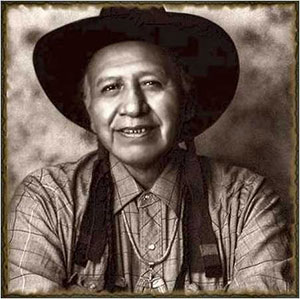
Wallace Black Elk


Look, you may detest saliva, saintly or otherwise, and I’d prefer not to leave you feeling queasy — so let’s follow the saintly saliva trail just a little further, and I think you’ll find it leads to something quite beautiful.

Susan Bayly continues:

Tamil Sufi texts often assert that the founding pir of a particular cult shrine identified his heir and successor by bequeathing him the twig which he used for tooth-cleaning. Such an object would naturally be impregnated with the saint’s saliva and would therefore serve to pass on the pir’s endowment of power and sanctity without involving him in an act of procreation.“ Fakiruddin is portrayed as having received a tooth-brushing twig as a token of spiritual succession from his murshid or preceptor, the Trichy pir Nathar Wali. According to the texts, it is this twig which grew up into the miraculous staff of the Nandi episode. The wooden staff also becomes imbued with the miraculous transforming barakat of the pir. …

Let’s forget saliva, let’s even forget neem-sticks, the organic Indian equivalent of the toothbrush — and consider the miraculous thorn tree that grows at Glastonbury:

After the crucifixion of Jesus lore has it that Joseph of Arimathea (who according to the Bible donated his own tomb for Christ’s interment after the Crucifixion) came to Britain, bearing the Holy Grail — the cup used by Christ at the Last Supper and later by Joseph to catch his blood at the crucifixion.

When Joseph landed on the island of Avalon, he set foot on Wearyall Hill — just below the Tor. Exhausted, he thrust his staff into the ground, and rested. By morning, his staff had taken root — leaving a strange oriental thorn bush – the sacred Glastonbury Thorn.

Lore has it that the thorn would bloom once a year, at Christmas.

**

But virtuous trees, like saintly saliva, can be found in more than one tradition. I had the privilege some while ago of spending a good deal of time in the company of the Lakota shaman, Wallace Black Elk, and would like to offer you one of his stories which I noted down pretty close to his own words.

I should perhaps preface this account by telling you that Wallace once told me he had twelve grandfathers — so the words grandpa and grandma don’t imply lineal descent here as they do in common usage, but function more as a term of respect for one’s elders:

I remember my grandfather, Black Elk. One time when I was very young, he came with my
grandfather Eagle Man to visit my grandmas in the tipi. My mother and my aunt were both young, so they let the old people visit together. “We’re good at cooking, so you just sit down and rest, and visit. We’ll look after the cooking.” And my father went off to take care of the horses, and to haul and chop wood, and left the old people to visit with each other.

That was the way it was. Everybody would eat a big meal, and some of those evenings my grandfathers would sit around telling ghost stories, spirit stories, and I’d listen. And while they were talking, they had a pipe. They would smoke the pipe and talk. So I was maybe seven years old, and I was sitting in the middle between grandma and grandpa, I used to sit there and listen, and watch them smoke the pipe.

My grandpa took the pipe-stem and planted it in the ground. He took a piece of charcoal and lit the fire, sprinkled some tobacco on it, and just puffed a little of that smoke. And that pipe-stem, you know, blossomed. Branches bloomed out of it, leaves bloomed out, and there’s a big red plum there. Red.

So my grandpa took the plum and gave it to his brother, and he ate it, and said: “Washtay, that’s really good.” And then he took the pipe and planted the pipe-stem, did the same thing, and put some tobacco over it, and that pipe-stem…that tree just bloomed, leaves just cropped out all over it, and there was a black cherry hanging there, it was a choke cherry. So my grandpa gave that choke cherry to his brother, and he ate it and blew the pit onto the ground. “Aah, very good.”

My grandmas were watching all this, and one of my grandmas picked up her moccasin and said, “Aaah, want some cherries, do you?” as if my grandpas were doing this to show their powers, and she was telling them, don’t do that! She threw her moccasin on the ground and an owl came up. It hopped around and flew in front of them, and started hooting whu whuwhuu, whu whuu.

My grandfathers looked at one another and said: “Hey, almost like our powers!” And they both started laughing, and that owl jumped down, and puffed itself up, and started hooting. So then my other grandma took her cane, she cried “Heeeeeee!” and threw it on the ground and it came out a rattlesnake. And it wasn’t just kind of a rattlesnake almost: boy, it really was a rattlesnake, and it coiled around the place. Boy, we bailed out.

Then my grandma reached over and took hold of that snake, and she took that cane and grabbed a hold of that owl by the neck, and pulled it back to her, and when it flopped down, when it landed, it was her sister’s moccasin, and she gave her sister her moccasin and put away her cane.

So that was my grandmas and grandpas. They had those powers, they knew that power was there. So I learned then there was a power in that pipe we hold, that the pipe could feed us. And he has been feeding us. There is no starvation, and we needn’t fear. That pipe represents the whole universe, and she can continue to multiply trees and plums and cherries.

That power of the Great Spirit is there, and those creatures can come from that pipe. Grandpa Great Spirit can do these things. From out of nowhere, he can do anything. I realized that.

A white man might think it was a bit of hocus pocus. Like a white man’s magician pulls a poor rabbit out of a hat, or a pigeon. But this is real. A tree comes up, and then it blooms, then it flowers, then it bears fruit. It’s a tree. And we are part of that tree. We absorb that fruit in our system, and we bear children, we bear fruit.

So that is an interpretation of the vision of the Tree of Life. That way my grandpa taught me.

**

Which reminds me (Exodus 7)…

And the LORD spake unto Moses and unto Aaron, saying, When Pharaoh shall speak unto you, saying, Shew a miracle for you: then thou shalt say unto Aaron, Take thy rod, and cast it before Pharaoh, and it shall become a serpent. And Moses and Aaron went in unto Pharaoh, and they did so as the LORD had commanded: and Aaron cast down his rod before Pharaoh, and before his servants, and it became a serpent. Then Pharaoh also called the wise men and the sorcerers: now the magicians of Egypt, they also did in like manner with their enchantments. For they cast down every man his rod, and they became serpents: but Aaron’s rod swallowed up their rods. And he hardened Pharaoh’s heart, that he hearkened not unto them; as the LORD had said.

Of the sacred, I: saliva

Wednesday, July 4th, 2012

[ by Charles Cameron — more on magical worldviews: first the curative power of saliva, Iran, India — then in the follow up, a breathtakingly beautiful tale a wise man told me ]
.

First off, a hat-tip to Shoshank Joshi, because were it not for his tweet, I might not have noticed Muhammad Sahimi’s post, stirred old memories, and written what follows.

The tweet:

Frankly, it was the mention of saliva in a religious context that caught my attentiont.

**

Sahimi’s post only mentions the Ayatollah Khamenei‘s saliva in passing, and is worth reading in its own right:

Some of the praise heaped on Khamenei is borderline blasphemy. But as the Prophet Muhammad said, “A ruler and his rule can survive blasphemy, but not injustice.” And terrible injustice is being done to a great nation and its people on a daily basis by Khamenei’s supporters. As far as the fate of the nation is concerned, the critical question is, Given that Khamenei is surrounded by minions, flatterers, and cronies who compete with each other to praise him lavishly, how realistic a view does he have of what is going on, either domestically or internationally? When his own chief of staff exaggerates and even lies about him, what type of information can he expect to receive? Mohammad Reza Shah Pahlavi was surrounded by the same sort of coterie, and by the time he realized the gravity of the state’s situation in the fall of 1978, it was too late to reform his regime and put it on a democratic path.

**

So, Charles, saliva. WTF?

**

TF is this. Sahimi begins his article, in which mention is made of the sacred qualities attributed to Khamenei’s saliva, with the following observation:

Praising national leaders and elevating them to mythic levels is as old as human civilization. Iran is no exception; indeed, the phenomenon has a very long history in the country, as manifested by the many tales of kings’ bravery, vision, kindness, and generosity that one finds in the Persian literature. This practice continues — the difference is that it is now entering uncharted territory and reaching absurd heights.

**

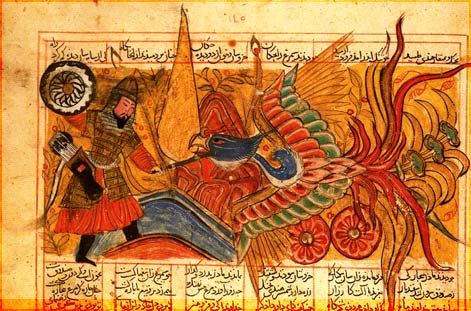
Okay, okay, the Shahnameh.

**

But then Sahimi gives us these two paragraphs:

In addition to producing reactionary clerics to serve Khamenei and his power, Mesbah — as he is commonly known — has been the Supreme Leader’s exaggerator-in-chief. Here are a few examples:

“Ayatollah Khamenei’s saliva can cure diseases.” According to dogma, only a saint can possibly perform such “miracles.”

And I’m sorry — that absolutely isn’t “uncharted waters” — it’s definitely charted.

**

As Sahimi says, in fact, it’s dogma — or, I’d prefer to think, an archetypal feature of pre-scientific religious thought.

Consider this, from Susan Bayly, Saints, Goddesses and Kings: Muslims and Christians in South Indian Society, 1700-1900, (Cambridge South Asian Studies), p. 127:

The explanation for this is that throughout India bodily secretions, especially blood, semen, saliva and human wastes, are thought of as being charged with a form of power and energy which may be both menacing and protective. The god manifests his awesome potency with a great flow of blood; the individual’s wastes and secretions are a source of danger and pollution to others. Lesser beings accept saliva-impregnated leavings from their superiors, and so the Hindu devotee and so the Hindu devotee takes the divine ‘leavings’ or prasatam of the god as a token of fealty and a source of protective and transforming sacred energy.

In south India the pir’s devotees also perceive their lord’s saliva as a medium which carries and transmits his barakat. Here too the disciple seeks out contact with a transforming substance which would otherwise be conceived of as unclean and defiling…

So that’s the sacredness of a saint’s saliva attested to in both Hindu and Sufi traditions — but it was apparently also a part of Christian tradition, as this by turns charming and arresting quotation from the description of Saint Columban in Sean Kelly and Rosemary RogersSaints Preserve Us!: Everything You Need to Know About Every Saint You’ll Ever Need p. 67 attests:

He was known to everyone, and cut a distinctive figure — he shaved the front of his shoulder-length hair into a half-tonsure, squirrels nested in his cowl, and he wandered around brandishing his staff and downing oak trees with his fist While in France, Columban and his monks followed the Irish tradition, often criticized by many as being too severe: a monk who cut his finger badly while reaping had the wound cleaned by Our Saint’s saliva and was ordered back to work.

**

But wait — there’s more… and it’s beautiful.

The best war game is a library of windows

Tuesday, July 3rd, 2012

[ by Charles Cameron — Escher, Borges, simulating the future, wargames, A Pattern Language, Sembl ]
.

MC Escher, Relativity

.
Ridiculous phrase, a library of windows. Unless you think, as I do, of books as windows onto different worlds, in which case it makes a whole lot of sense, and a decent library has more windows onto more profoundly different worlds than any physical room — and here we are getting into the territory of Jorge Luis Borges (links to Library of Babel) and Maurits Escher (image above).

And let me just state for the record that Godel Escher Bach could just as well have been Escher Carroll Borges, and that a comparison between the logics of Escher and Borges is one of the desiderata of our times.

That’s a Sembl move.

**

Let’s expand the concept of window to include the sort of inter-worldview glimpse that Haaretz describes today here:

Last week, in a small beit midrash (study hall) named after Rabbi Meir Kahane in Jerusalem’s Shmuel Hanavi neighborhood, an emergency meeting was convened to discuss instigating freedom of religion and worship on the Temple Mount. It was a closed meeting attended by representatives of the Temple Institute, HaTenu’ah LeChinun HaMikdash (the Movement to Rebuild the Holy Temple) and the Temple Mount Faithful, as well as two representatives of Women for the Mikdash, and others. The activists met to try to understand how they could overcome the authorities, who they believe are plotting against them, and return to the Temple Mount. At this meeting, Haaretz was offered a rare behind-the-scenes glimpse of the most ardent activists in the battle to Judaize the Temple Mount.

**

Here’s the meat of the post, as yet uncooked. Back in 2005, but brought to my attention today by Rex Brynen at Paxsims, is this piece from Strategy Page:

After eight years of effort, and spending over $300 million, the U.S. Army has officially received its new wargame (WARSIM) for training battalion, brigade, division, and as big as you want to get, commanders, and their staffs. Now even the most elaborate commercial wargame would not get $300 million for development, and eight years to create the system. But wargames for professional soldiers have different requirements, and a troublesome Department of Defense bureaucracy to deal with. First, the requirements. Commercial wargames shield the player from all the boring stuff (support functions, especially logistics.) But professional wargames must deal with these support activities, because in a real war, these are the things commanders spend most of their time tending too. …

WARSIM covers a lot of complex activities that a commander must deal with to achieve battlefield success. Besides logistics, there’s intelligence. Trying to figure out what the enemy is up to is, next to logistics, the commanders most time consuming chore.

— which in turn was referenced by Michael Peck writing in a Kotaku piece today titled Why It’s So Hard to Make a Game Out of the 21st Century:

Let’s build a game. Let’s make it a strategy game. We will realistically simulate global politics in the 2030s. Perhaps a sort of Civ or Supreme Ruler 2020-type system.

Where shall we start? How about something easy, like choosing the nations in the game? It’s simple enough to consult an atlas. We’ll start with Britain…but wait! Scotland is on the brink of declaring independence from the United Kingdom. Should Britain be a single power, or should England and Scotland be depicted as a separate nation? What about Belgium splitting into Flemish and Walloon states? And these are old, established European nations. How will states like Syria and Nigeria look in two decades? It was only a bit over 20 years ago that the Soviet Union appeared to be a unshakeable superpower that controlled Eastern Europe and Central Asia.

**

Let’s cook that meat, let’s make a meal of it.

Peck’s piece goes into many other ways in which predictive gaming isn’t terribly productive.

But it left me asking the question, what would I do with a game-sized budget, if my aim was to push military and intelligence towards greater insight.

And my answer would be to embed information in walls. In corridors…

To build windows at sparse and irregular intervals into the internal corridors that connect any given office in the Pentagon or three-letter agency — or my local preference (hush, I know it’s the Glorious Fourth tomorrow) MI-5 and -6 — through which analysts and decision makers can glimpse snippets of information.

Which can then fall into the deep well of memory.

It is deep within that well of half-forgotten knowledge, ST Coleridge tells us, that the “hooks-and-eyes of memory” link one thought with another to build a creative third.

**

A wall, then. I would build a wall embedded with facts and fancies, maps and illustrations, graphs and stats, film clips and news clips, anecdotes and quotes — even, perhaps, tiny alcoves here and there with books free for the taking, music CDs, DVDs of movies, old, new, celebrated, strange…

And I would be constantly shifting and rearranging the “views” from my windows, so that what was seen yesterday would not be what would be seen tomorrow — yet with a powerful index of words, topics, themes, memes, image contents, names of actors, newscasters, authors and so forth, so that what was once seem and dimly recalled could be recaptured.

**

The concept here is pretty much the exact opposite of having a huge black poster proclaiming Creativity Matters!

Don’t get me wrong, creativity does matter (get that poster and others here), but it “works in mysterious ways its wonders to perform” — and the way to entice it is to see things out of the corner of the eye…

The windows I’m looking for, therefore, offer glimpses you wouldn’t necessarily notice if you were deep in thought or conversation, and conversely, wouldn’t see twice and grow so familiarized to that they’d become irrelevant by repetition. They’d be glimpsed in passing, their esthetic would be that of Christopher Alexander’s Zen View, pattern 134 in his brilliant work — the closest we have to a Western I ChingPattern Language:

The idea, then, is to seed the memory with half-conscious concepts, patterns, facts and images, carefully selected and randomly presented — so that those hooks and eyes have the maximum chance of connecting some scrap of curious information with a pressing problem.

Which is how creativity tends to work.

**

That way each corridor becomes a game-board — but it is in the analyst’s focused mind that the game is played and won.

What you’d get, in effect, would be community-wide, ongoing free-form gameplay in complete alignment with the web-based game we’re currently developing at Sembl. Games of this genre will also have powerful application in conflict resolution.

And peace.


Switch to our mobile site