zenpundit.com » 2012

Archive for 2012

The crackling energy of a Sembl move

Sunday, June 10th, 2012

[ by Charles Cameron — cross-posted from Sembl ]
.

image credit The Movie Poster Art Gallery / http://www.rock-explosion.com/catpage2.html


.

1.

I’m always looking around for ways to describe the leap between two ideas (concepts, people, events, things) that occurs when you make a move in a Sembl game. On the game board, the ideas are shown as circles and the links as lines between them.

In the case of the museum version, the “ideas” are objects in the Museum’s collection – but the same principle applies whether we’re talking objects, concepts, events or people: entities of whatever type go in the circles, the lines between them signify the exploration of their resemblances and differences.
.

2.

Okay.

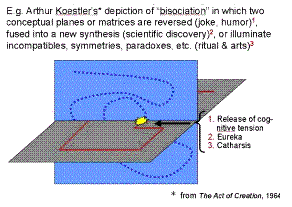
In more technical terms, Arthur Koestler in his classic book about the conceptual structure of creativity, The Act of Creation, diagrammed the intersection of two conceptual frames as representing the place where the joyous aha! of discovery, the gasped ah! of tragedy or the delightful ha! of laughter is generated, and this more recent version of his diagram gets the essence:


.

3.

But wait!

There’s a lot going on here, there’s a distinct leap – think: creative leap, even perhaps leap of faith.

It was the leap between two ideas – electricity and magnetism – that gave Faraday his dynamo, Maxwell his equations, and the modern world almost its whole existence. It was the leap between two ideas – modular forms and elliptic equations – that gave Taniyama his conjecture and Wiles his proof of Fermat‘s Last Theorem.

The leap that intuits similarities, particularly rich similarities between rich concepts in widely separated fields, is the most powerful tool of the thinking mind – and playing Sembl amounts to nothing more or less than a repeated, playful, delightful invitation to make leaps of exactly that kind.

So a Sembl leap of resemblance can be anything from training wheels for creativity to a prize-winning long-jump at the conceptual Olympics.
.

4.

Maria Popova at Brainpickings quotes Steve Jobs:

Creativity is just connecting things.

And she quotes James Webb Young, back in 1939:

Consequently the habit of mind which leads to a search for relationships between facts becomes of the highest importance in the production of ideas.

This isn’t some hidden secret, but it’s not exactly common knowledge either, it’s not something many schools teach — which is why the great anthropologist Gregory Bateson famously told his fellow Regents at the University of California:

Break the pattern which connects the items of learning and you necessarily destroy all quality.

Which is also why Eliot Eisner, Stanford professor and former President of the American Educational Research Association, said of Sembl’s precursor HipBone Games, “the cognitive processes you are interested in developing are critical to a decent education”.
.

5.

And just what does this have to do with Van der Graaf Generators, you might wonder?

There’s a cracking sense of energy discharged when you connect two ideas in a Sembl game move – not unlike the discharge of energy between the spheres of two Van der Graaf Generators picture here:

Imagine the spheres as two ideas in place on a Sembl game board, and the electrical discharge as the excitement of seeing how they mesh together to create that ah!, aha! or ha!

Or watch the whole, ultra-short video from which that image was taken, courtesy of the folks at MIT:

Play as if your life depends on it

Sunday, June 10th, 2012

[ by Charles Cameron — from the Glass Bead Game via the HipBone Games to Sembl ]
.

.
.

Play most assiduously is how Edgar Wind translates the motto of Marsilio Ficino — the man who more or less single-handed, built the Florentine Renaissance: studiossime ludere. Play most studiously.

Play as if your life depends on it.

*

Hermann Hesse crowned his life-work with the great, boring, utterly riveting novel Das Glasperlenspiel, The Glass Bead Game, sometimes better known in the English-speaking world by the (Latin) title, Magister Ludi — which means both school-teacher and Master of the Game.

And game there is: the Glass Bead Game itself, or GBG for short.

The book centers around a game of ideas — a game in which the most profound conceptual systems of all human cultures are brought together in a grand architecture that Hesse calls “the hundred-gated cathedral of Mind”:

A Game, for example, might start from a given astronomical configuration, or from the actual theme of a Bach fugue, or from a sentence out of Leibniz or the Upanishads, and from this theme, depending on the intentions and talents of the player, it could either further explore and elaborate the initial motif or else enrich its expressiveness by allusions to kindred concepts.

Here Hesse mentions astronomical, musical and textual concepts — the game, like the digital world of the internet, allows mathematical, textual, musical and visual elements to be juxtaposed and combined, just as Sven Birkerts described in an interview with Cliff Becker:

There are tremendous opportunities, and we are probably on the brink of the birth of whole new genres of art which will work through electronic systems. These genres will likely be multi-media in ways we can’t imagine. Digitalization, the idea that the same string of digits can bring image, music, or text, is a huge revolution in and of itself. When artists begin to grasp the creative possibilities of works that are neither literary, visual, or musical, but exist using all three forms in a synthetic collage fashion, an enormous artistic boom will occur.

Birkerts was concerned that these “tremendous opportunities” might drown out “the old quiet pastime of reading mere words” — but Hesse’s great game is a contemplative one, in which Hesse proposes:

Every transition from major to minor in a sonata, every transformation of a myth or a religious cult, every classical or artistic formulation was, I realized in that flashing moment, if seen with a truly meditative mind, nothing but a direct route into the interior of the cosmic mystery, where in the alternation between inhaling and exhaling, between heaven and earth, between Yin and Yang, holiness is forever being created.

*

Play…

We play, we play games, we play music… we play wargames… all the world’s a stage, and we are (merely) players.

Consider: Play is what children do to learn, so brilliantly, language, languages, geography, mathematics, history, chess, go, music, politeness, discipline, excess, consequences, moderation… And play is what masters do to express their mastery — Picasso plays, Casals plays, Einstein plays… And the motto of Ficino, mentor to the Florentine Renaissance, is play most assiduously.

*

The Glass Bead Game is a game, then, to compare with the greatest of games — Chess, Go, name your poison — indeed, with the greatest of intellectual endeavors — the Encyclopédie, the gesamtkunstwerk, the long-sought Theory of Everything…

All the insights, noble thoughts, and works of art that the human race has produced in its creative eras, all that subsequent periods of scholarly study have reduced to concepts and converted into intellectual values the Glass Bead Game player plays like the organist on an organ. And this organ has attained an almost unimaginable perfection; its manuals and pedals range over the entire intellectual cosmos; its stops are almost beyond number. Theoretically this instrument is capable of reproducing in the Game the entire intellectual content of the universe.

How can taking that idea and making it playable not be a worthy challenge, in this world that is daily more absorbed in digital play in its arcades and cinemas, on its consoles, tablets, phones, and computers?

*

Just reading the book made me want to play the game, but I like to keep things simple. I needed to be able to play it with a pencil and paper napkin over a cup of coffee — or on an email list or in the online forums that were beginning to spring up while I was figuring out some early boards and rules. I took Hesse’s basic concept of juxtaposing ideas and applied it on simple graph-like boards, on which each circle represents an idea, and each line a resemblance. I called my playable variants the HipBone Games.

More recently, my friend and colleague Cath Styles has been working on the development of iPad and web-playable versions of the games. We call them Sembl, because they explore the resemblances between things, ideas — and at a deeper level, the patterning of the world itself.

But the game remains the same: to juxtapose one thing — an idea, an object, a work of art, song, person or event — with another, in a way that generates the aha! of creativity. And to do that repeatedly, weaving an architecture of related ideas, on our way to weaving Hesse’s cathedral of Mind.

Our world has never been in greater need of creativity and connectivity — our future depends on them — and in the Sembl game, every move you make is a further link in the pattern that connects, every move you make is a creative leap. More on that in my follow up post, The crackling energy of a Sembl move.

Book Review: The Snake Eaters by Owen West

Friday, June 8th, 2012

The Snake Eaters by Owen West 

Owen West, commodities trader, novelist and USMC Major in the Reserves has written a remarkable book in his war story of counterinsurgency in Khalidiya, a decaying rural town in the deadly Anbar province, heartland of Iraq’s Sunni insurgency. A success story for COIN, but also a very cautionary tale of the transformation of the Iraqi Brigade 3-1, from a dispirited, ill-equipped, poorly led unit distrusted and ignored by it’s American “partner” battalion and under siege by a hostile population into a self-confident, elite, combat force, “the Snake-Eaters”, feared by insurgents and respected by townspeople – and of their American advisors of Team Outcast who struggled to broker this transformation.

After reading The Snake-Eaters and reflecting, the book speaks to readers at different levels.

For the casual reader,  West has a narrative with no shortage of colorful characters – the inexperienced jundis, “Hater”, the grim Major Roberson, Colonel Troster, “Captain Bomb”, “Private Crazy”,  the treacherous police chief Shalal, the Superfriends, the beloved Doc Blakley, the indomitible Major Mohammed, Sheikh Abbas, the no-nonsense Huss, “Ogre” McCarthy, the Sadiqiya Sniper and some advisors who were “strange by any measure”.

The chronically undermanned, underesourced handful of  Team Outcast advisors in might resemble a Middle-eastern version of The Magnificent Seven, except that unlike Yul Brynner, Colonel Troster arrived in Khalidiya only to find Calvera and his bandits in control of the town, completely invisible and supported by a community that was implacably hostile:

….To protect a fellow Sunni was the duty of every Khalidiyan. Even if they didn’t love AQI, they were socially connected to and literally enriched by, the local insurgency. In the same way small Texas towns follow their football teams, everybody in Khalidiya knew an active resistance fighter and kept score. The Americans promised security but had brought a hurricane of damage. They passed through Khalidiya in their armored trucks like tourists on glass bottomed boats admiring exotic fish.

The Khalidiya sheikhs, a title loosely used in Anbar for any man with influence, implored the AQI fighters to remain cautious. If they paraded in their black balaclavas too prominently in town, mugging for pictures on al Jazeera, they would draw the attention of Marine headquarters in nearby Fallujah. It was best to inflict some casualties on each American unit that rotated through the area – enough to keep Americans on the defensive but not so many that the Marines would mass their forces and crush the city, as they had done to Fallujah in 2004.

The 3-1 of the New Iraqi Army in Khalidiya bore scant resemblance to a unit of the mighty, Soviet equipped, legions with which Saddam Hussein had daunted his neighbors, held off Iran for ten years of bloody combat or sacked and pillaged Kuwait. Or even the shadow version of Saddam’s Army, decimated by American arms  and hollowed out by a decade of UN sanctions after the Gulf War. West describes the Iraqi soldiers initially as a mendicant mob of ill-fed, untrained, Shia jundis without heavy arms, patrolling as seldom as possible, with beat-up Nissan junkers and a pray and spray shooting reaction to the frequent IED blasts that injured and killed them with regularity.

Like any underdog story, with much suffering and lessons learned counted in the lives of men, the American advisors bond with their Iraqi charges through a herculean effort at non-stop  patrolling of  Khalidiya’s bomb and sniper-ridden streets. Training Iraqis in aggressive tactics while learning Iraqi mores from them, the 3-1 evolves up into the Snake-Eaters, winning over the townspeople of Khalidiya and demoralizing, defeating and driving away the insurgents and gaining the respect of their American mentors. This is the level at which most readers will enjoy and be impressed with The Snake -Eaters.

A second level of reading will be for defense intellectuals, policy wonks, COIN and CT theorists, military historians and other academics. Despite West writing with tactful restraint, avoiding directly criticizing senior brass or national civilian leadership by name, The Snake-Eaters is, in it’s own way, an incredibly damning indictment by virtue of empirical observations of the conditions and restrictions under which Team Outcast labored, driving home the disconnect between leaders, indifferent bureaucrats or FOBbits and the men waging COIN on the ground.  Only in the last chapters, when West himself appears in the narrative, does the author permit himself something approaching real and embittered criticism of the Alice-in-Wonderland myopia that sometimes prevailed during the Iraq War:

“If he does this again, I will end his life! Dhafer threatened. “I will burn his house down!”

It was an empty threat. Every day in Iraq, troops encountered suspected insurgents who had previously been arrested. When I first joined the team, I had read Troster’s after-action report excoriating the “ridiculous evidentiary justice system” that “had no place in a wartime environment”. Most detainees were let go because their crimes could not be proved to the satisfaction of corrupt Iraqi judges, or to US military lawyers. We didn’t have prisoners of war in Iraq, only criminal suspects entitled to many of the same rights as in the States. Most detainees were set free within a few months. The advisors called it “catch and release”.

That’s an excellent of example of policy sabotaging strategy and undoing tactical success for transient to nonexistent political benefits for those in comfortable, clean offices far, far away from the crack of rifle fire and the cries of wounded men.

In his Epilogue, West is even more frank regarding counterinsurgency and respect for his efforts in Khalidiya and in the writing of this book require excerpting it here:

While writing this book over the past four years, I’ve tried to figure out how much influence an advisor team really has on it’s unit., and whether institutional expectations match those limitations. I have again read the field manuals taught in our Army and Marine schools where we train advisors. The manuals have an upbeat, culturally correct tone, suggesting that our soldiers and Marines will succeed as advisors based on their tact and sensitivity. The manuals need drastic revision: they are misleading a generation of advisors.

That the recent conference at Leavenworth on the COIN rewrite has been an insular affair may not bode well for the acceptance of critical, empirically-based, views of COIN being offered by Major West.

The final level of reading is one to which West alludes several times in the text, but one in which I cannot share, is that of the soldier or marine who was “outside the wire”. For those men, there is a poignancy in the stories of the figures portrayed in The Snake Eaters that goes beyond mere words, which West bluntly states comes with a sense of despair at the lack of comprehension in the civilian world. Perhaps these feelings of isolation are also shared by veterans of earlier wars, when they speak of Kasserine Pass, the Bulge,  Chosin or Khe Sanh; or perhaps not, as every war is horrible in it’s own way. But if we cannot understand these shades of grief and meaning that West indicates are harbored in our veterans, the rest of us can at least acknowledge them and respect it.

The Snake-Eaters is an important book that delivers a microcosm of the COIN war in Iraq, gritty and unromanticized, as experienced by jundis, marines, soldiers and Iraqis in sweltering and crumbling Khalidiya. It is a success story but it is where the phrase “winning ugly” comes to mind; dedication and valor, stubborness and cunning, pitted against dolorous bureaucracy and savage insurgency.

Strongly recommended.
The Admirals — a brief review

Thursday, June 7th, 2012

[by J. Scott Shipman]

The Admirals, by Walter R. Borneman

If you have any interest in the lives of the only five-star admirals to serve in the US Navy, this is the book to begin your reading. Mr. Borneman does a masterful job of describing the admirals (LeahyKingNimitz, and Halsey), their lives and contributions to the US victory in WWII. Borneman uses a thematic approach, beginning with short chapters describing the lives of the four subjects and how the admirals came to attend the United States Naval Academy at Annapolis, MD (which they all attended).

Borneman follows with modest chapters on the admirals’ areas of expertise, to include: battleships, submarines, and aircraft carriers. These chapters offer a glimpse into both the strengths and weaknesses of these ships following WWI and how the ships’ roles changed in the years leading up to WWII. Intermixed with the descriptions of the ships, Borneman weaves the admirals into the story illustrating their tastes in ships and their leadership methods.

Borneman follows with a fast-paced story of how these men worked together (and with other big name colleagues like Roosevelt, MacArther, Marshall, and Spruance, to name a few) to achieve victory. From the intricacies of a cogent strategy for the early days of the Pacific, to the conferences between Allied leaders (Roosevelt and Churchill, primarily), to the battles and tactics that shaped the war’s outcome, Borneman’s fine writing presents the admirals, warts and all. As mentioned previously, they were all different, but they were all talented and driven. Borneman quotes retired Vice Admiral Roland N. Smoot, who was in the thick of the Pacific war, speaking after the four had died:

“I’ve tried to analyze the four five-star Admirals that we’ve had in this Navy…You have a man like King—terrifically ‘hew to the line’ hard martinet, stony steely gentleman; the grandfather and really lovable old man Nimitz—the most beloved man I’ve ever know; the complete and utter clown Halsey—a clown but if he said ‘Let’s go to hell together,’ you’d go to hell with him; and then the diplomat Leahy—the open-handed, effluent diplomat Leahy. Four more different men never lived and tehy all got to be five-star admirals, and why?”

Borneman says, “Smoot answered his own question with one word: “leadership.” Smoot continues that each had “the ability to make men admire them one way or the other.” Borneman suggests King got there by “bluster and verve; Nimitz by putting his hand on your shoulder and saying, Let’s get this thing done; Halsey—still the fullback—by rushing through the line in such a way that everyone on the team wanted to go through with him; and Leahy by never letting his own personal feelings, or those of others, interfere with the long-range objectives and best interests of his country.”

If these men sound interesting, it is because they are; the lessons and examples they left behind could use some attention from many of today’s military leaders. The four were smart, tough, and unafraid.

The Admirals is a about 475 pages long, with lots of reference material in the multiple appendixes. Borneman’s writing is so fluid and eloquent, I was able to read in two sittings, and his fine book comes with my strongest recommendation.

Crossposted at tobeortodo.com.

UPDATE: My apologies for a post with so many typos; I was in a hurry, but wanted to get this recommendation out. That said, I’ll try to edit more carefully going forward.

Leah Farrall posts on culling elephants and AQ

Tuesday, June 5th, 2012

[ by Charles Cameron — Abu Yahya al-Libi, targeted killings, impact on terrorism ]
.


.

My (ex, late, respected) father-in-law Donald Atwell-Zoll co-wrote the book on Managing Elephants, so I suppose you could say it’s a matter of family interest. In any case, I thought these were pretty neat opening paras from an LA Times article a while back, with a dateline from S Africa:

Some teenagers are raising hell in the untamed bush here, tormenting the wild animals and giving tourists a terrible fright.

Such rowdiness may sound typical for adolescents, except these delinquents are running amok in one of South Africa’s most popular game reserves. They have killed rhinos. They have charged cars of safari-goers. And to make matters worse, they are elephant-sized — well, to be precise, they are elephants.

That’s the problem, here’s what they figured out:

“There appears to be a discipline problem among the young elephant bulls,” said Douw Grobler, veterinarian at Kruger National Park, where many of the elephants at Pilanesberg once lived. “There is a missing link in the elephant population at Pilanesberg. There is a need for the presence of adult elephant bulls. They act as the disciplinarians.”

Okay, got that? Let’s get down to business.

*

Today my twitterfeed briefly buzzed with speculation that Abu Yahya al-Libi had been targeted and killed in a drone strike. The tweets were pleasantly sprinkled with humor — but when the talk got serious, sometimes enthusiasm got the better of caution.

Daveed Gartenstein-Ross, level-headed as usual, was among those to make it clear that the initial reports — including an anonymous US official confirmation — of al-Libi’s deaths came with no guarantee of accuracy. But he also noted his willingness to rethink his picture of the overall continuing strength of AQ if al-Libi does in fact turn out to have been killed. With, say, confirmation from an official AQ media channel.

Aby Yahya al-Libi is certainly a significant figure in AQ, as Jarret Brachman‘s many posts and Foreign Policy piece on the man attest. His one sentence summary:

If true, a cataclysmic blow to the future of al-Qaida’s General Command.

But it was Leah Farrall who (IMO) got the bigger picture. And in doing so, she was reminded of those young elephants going on the rampage, and the “need for the presence of adult elephant bulls” to calm them down and give them some discipline.

From Leah’s blog entry, Some quick thoughts on reports Abu Yahya al-Libi has been killed, then:

First, I’ll believe it when al Qaeda acknowledges it.

This of course won’t stop the chest beating celebrating his killing.

And if he has in fact been killed, I wonder if those who think this is a victory (and those supporting the strategy of extrajudicial killings more generally) have given ample thought to the fact that he along with others who have been assassinated were actually a moderating force within a far more virulent current that has taken hold in the milieu. And yes, given his teachings I do note a certain irony in this, but sadly, it’s true.

What is coming next is a generation whose ideological positions are more virulent and who owing to the removal of older figures with clout, are less likely to be amenable to restraining their actions. And contrary to popular belief, actions have been restrained. Attacks have thus far been used strategically rather than indiscriminately. Just take a look at AQ’s history and its documents and this is blatantly clear.

Leah continues — I’ve made only a minor cut between paras here —

I’m working on a more detailed, research driven piece on this. But in the meantime, the best way of summing up the consequences of a strategy of killing off leadership instead of using a criminal justice approach lies with what happened in a wildlife sanctuary in South Africa many years ago.

A culling program was implemented to kill off all the older generation elephants owing to overcrowding. Juveniles were spared. However, without the presence of the older elephants they then proceeded to go on rampages, killing other animals and causing such havoc that the rangers thought they’d have to cull them too. Until that is, someone chanced upon the idea of bringing in older elephants from another wildlife park, who ended up bringing the juveniles into line and enforcing discipline, something that had been missing since the cull of the older generation.

Right now you’re probably scoffing at this. Scoff away, because this example has come up time and time again in conversations I’ve had with folks who know this milieu very well because they’ve lived in it. Along with it has been concern expressed for the future, for what will happen when authoritative voices who can restrain the actions of those left and, importantly, those newer folks still seeking to join the cause, no longer exist. When indiscriminate becomes the norm.

So before anyone goes off celebrating another “number” in the death count, it is worthwhile remembering there will be consequences from this short sighted and reactionary path chosen to deal with threat…

*

It’s not hard to find evidence of that “moderating force within a far more virulent current” that Leah mentions.

From West Point’s Combating Terrorism Center alone, we’ve had the recent Letters from Abbottabad: Bin Ladin Sidelined? with bin Laden expressing displeasure at Faisal Shahzad having broken his citizenship oath in attempting to attack the United States, and warning Yemeni leaders against using Americans who have taken the oath in that way.

Even more recently, in her comments on Fadil Harun’s memoirs, Beware of Imitators: Al-Qa`ida through the Lens of its Confidential Secretary, Nelly Lahoud discusses what she calls “a jus in bello-like framework devised by [AQ’s] Legal Committee”, noting:

The spirit driving Harun’s manuscript is the desire to produce a corrective history of al-Qa`ida distinguishing it from jihadi groups acting in its name. He believed that unlike al-Qa`ida, many jihadi groups have deviated from the true path of jihad. In his opinion they lack a sound ideological worldview and many of their operations, particularly those which involved resorting to “tatarrus” (i.e., the use of non-combatants as human shields), are in breach of what he deems to be “lawful jihad.” He therefore decided “to write about al-Qa`ida… to make clear to everyone the sincerity and uprightness of its path with respect to jihad and other religious, worldly and political issues.”

and further:

it is evident that Harun’s sentiments were not isolated. The internal communication between a number of well-known al-Qa`ida figures [gathered at Abbottabad and recently released to CTC] indicate that they too were alarmed by the conduct of regional jihadi groups and their indiscriminate attacks against civilians. Bin Ladin in particular was distressed by their conduct and, like Harun, was dismayed by their irresponsible understanding of “tatarrus,” which led to the unnecessary deaths of civilians and tainted the reputation of the jihadis.

So there you have it: the older bull elephants don’t like the undisciplined ways of the youngsters…

And what do we do? We cull the ones who are calling for restraint…

*

How does Leah conclude her analysis? You’ll remember she said, “there will be consequences from this short sighted and reactionary path”? Here are her almost-final words — and whether you agree fully with her analysis or not, they are words to be considered seriously by those rethinking strategy and making policy decisions:

These consequences will not play out in areas where extrajudicial killings take place, but in indiscriminate attacks in capital cities in the west. I wonder then how those who advocate the current policy plan to deal with this and the implications it will pose for the social contract.


Switch to our mobile site