zenpundit.com » 2013

Archive for 2013

Flags, shrouds, martyrs and the Fallen

Saturday, August 17th, 2013

[ by Charles Cameron — burial flags, shrouds on the unknown, and the black banner seen from a new angle ]
.

I feel grief.

**

We are, by now, all too well aware of the cost of war in lives. Sometimes those lives are of unknown souls, perhaps belligerents, perhaps partisans, perhaps peace-makers, perhaps simple souls caught in the cross-fire…

Caitlin Fit Gerald has a suitable memorial for those recently dead in Egypt, which I won’t reproduce here because I would make her already scaled-down images even smaller and less impressive if I did — click through to The Dead, When The Dying Is Done, then click again to see the images at better scale.

**

Sometimes the dead are our foes.

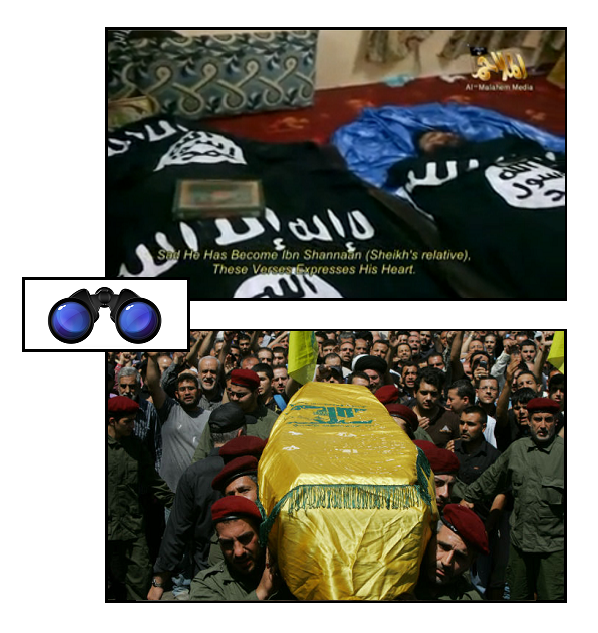
What interests me particularly on this occasion is seeing the Sunni Islamist black banner in what is for me a new context — draped like the Shi’ite flag of Islamist Hezballah on the martyrs of their faith.

**

It raises for me another question: Hezbollah and the Salafi jihadists alike term their dead “martyrs”. We honor ours no less, wrapping them in symbols of that greater cause for which they gave their lives — “country” — and call them “patriots” to distinguish their cause, and “heroes” to salute their courage.

Yet they gave their lives. To indicate and honor this, we call them “the Fallen” — and perhaps in its quiet way it is enough.

Cairene woman caught in the cross-fire

Saturday, August 17th, 2013

[ by Charles Cameron — without comment ]
.

**

Sources:

  • Joshua Hersh
  • Photo of woman in Cairo, Amr Agamwi
  • On understanding Hijra

    Friday, August 16th, 2013

    [ by Charles Cameron — the lure of exile, of hijra, in the context of western jihadists going abroad ]
    .

    Whereas the Prophet’s first visionary reception of the Quran dates to 609-610 CE, and the Prophet himself was born some 40 years earlier, the Islamic reckoning of time (AH, Anno Hegirae) begins with his hijra or migration from Mecca, his home, to Medina — an event of huge Islamic consequence, with echoes in our own times.

    One of the questions I have been pondering recently has to do with those echoes. I have been asking myself how strong a part in the decisions of westerners to migrate to Syria and elsewhere to participate in jihad might be played by the concept of hijra — either in the minds of recruits, or in the rhetoric of recruiters.

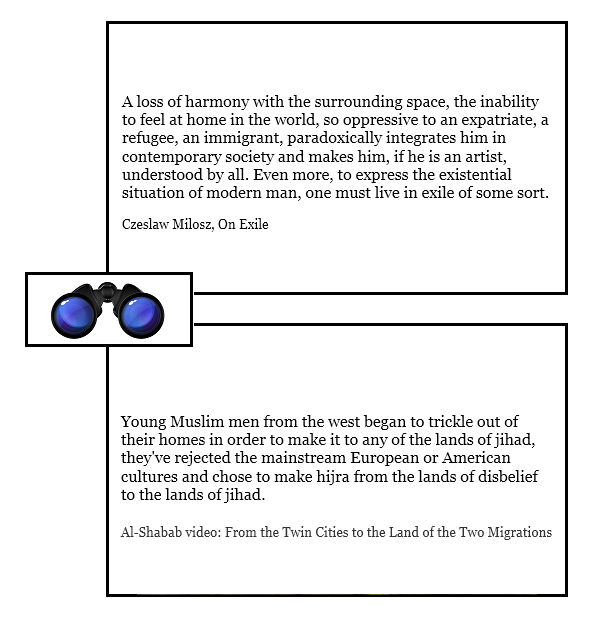
    When I came across the quote from Czeslaw Milosz (above, upper panel), I recognized that I had stumbled upon the expression of a secular equivalent of that yearning — and thus perhaps an opening into our own deeper understanding of hijra (lower panel) — a sacralization and hence an intensification of the same yearning.

    **

    It is therefore instructive to note conversely that Thomas Hegghammer, in his paper Should I Stay or Should I Go? Explaining Variation in Western Jihadists’ Choice between Domestic and Foreign Fighting, p 7, quotes Anwar al-Awlaki as advising a correspondent:

    [Hearing] that you intend on making hijrah [emigration], I immediately wanted to contact you to tell you that my advice to you was to remainin your current position.

    Here, strategic rationalism attempts to prevail over romantic yearning…

    **

    Sources:

  • Czeslaw Milosz, On Exile, quoted in Paris Review
  • Al-Shabab video: The Path to Paradise: from the Twin Cities to the Land of the Two Migrations, at 08.23-08.36
  • Creativity and Ennui

    Friday, August 16th, 2013

    [Mark Safranski a.k.a. “zen“]

    Creativity is a subject that has  interested me, going back to the days long, long ago when I was an art student. Creativity is only mildly correlated with IQ, but like “intelligence”, the deeper you delve into the study of  creativity and creative thinking the more “creativity” looks like a multifaceted, multidimensional and diverse set of capacities, habits and circumstances than it does a single, universal, characteristic or ability.

    Creativity has been studied from a neuroscientific, psychological, evolutionary,  behavioral, economic and social perspective but what of creativity”s opposite?  What about Ennui?

    From a cognitive perspective, the two may be flip sides of the same coin, note the correlation between highly   creative  people and incidence of depression. It may also be a sign of overuse of certain brain functions, like adrenal exhaustion from an excess of physical and mental stress over a long period of time. Creativity, being in “the flow” is intoxicating but it usually involves peak exertion which accumulates weariness. Exemplary performance in one area can also come at the expense of penalties in another area.

    Or perhaps ennui is the natural, cyclical ebb and flow between generative conceptual fertility and barrenness, the brain preparing itself for the next creative “surge” to come?

    When are you creative and when are you not?

    AQ Conference Call, 2: what a difference a week makes

    Thursday, August 15th, 2013

    [ by Charles Cameron — all the AQ leaders teleported into this one cave for their annual conference, see, and spoke to reporters as they were leaving for “near” and “far” – no wardrobe malfunctions, though ]
    .

    Following up on my post, AQ Conference Call, 1

    .

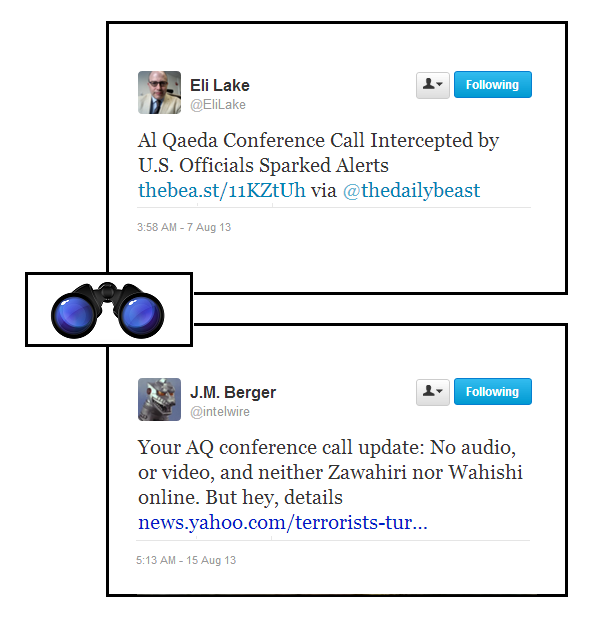
    When Eli Lake and Josh Rogin broke the story it was huge, wardrobe-malfunction huge, although AQ doesn’t really do wardrobe malfunctions the way we do at the Superbowl:

    It wasn’t just any terrorist message that triggered U.S. terror alerts and embassy closures—but a conference call of more than 20 far-flung al Qaeda operatives, Eli Lake and Josh Rogin report.

    Okay, conference call, I’ve been on some of those. Phones, right?

    Ah — Skype, maybe, or Google+?

    Nope.

    Semantic? Okay… but anyway, “The crucial intercept that prompted the U.S. government to close embassies in 22 countries was a conference call between al Qaeda’s senior leaders and representatives of several of the group’s affiliates throughout the region” — right?

    Um, no.

    Here’s the more recent piece by Lara Jakes and Adam Goldman for AP to which JM Berger’s quote (lower panel, above) was pointing:

    Al-Qaida fighters have been using secretive chat rooms and encrypted Internet message boards for planning and coordinating attacks — including the threatened if vague plot that U.S. officials say closed 19 diplomatic posts across Africa and the Middle East for more than a week.

    It’s highly unlikely that al-Qaida’s top leader, Ayman al-Zawahri, or his chief lieutenant in Yemen, Nasser al-Wahishi, were personally part of the Internet chatter or, given the intense manhunt for both by U.S. spy agencies, that they ever go online or pick up the phone to discuss terror plots, experts say.

    More specifically:

    A U.S. intelligence official said the unspecified threat was discussed in an online forum joined by so many jihadist groups that it included a representative from Boko Haram, the Nigerian insurgency that has loose and informal ties to al-Qaida. Two other intelligence officials characterized the threat as more of an alert to get ready to launch potential attacks than a discussion of specific targets.

    One of the officials said the threat began with a message from al-Wahishi, head of the Yemen-based al-Qaida in the Arabian Peninsula, to al-Zawahri, who replaced Osama bin Laden as the core al-Qaida leader. The message essentially sought out al-Zawahri’s blessing to launch attacks. Al-Zawahri, in turn, sent out a response that was shared on the secretive online jihadi forum.

    So the jihadis have a web-forum, and messages from Zawahiri get quoted there?

    A stunning new development!

    **

    DoubleTweet Sources:

  • Eli Lake
  • JM Berger
  • Articles pointed to:

  • Eli Lake
  • JM Berger
  • **

    Edited to add:

    FYI, there’s an extended treatment of the whole affair by Ken Silverstein now up at Harper’s, Anatomy of an Al Qaeda “Conference Call” — h/t Joshua Foust.


    Switch to our mobile site