zenpundit.com » 2013

Archive for 2013

Clausewitz and Center of Gravity

Wednesday, July 3rd, 2013

At Small Wars Journal a provocative essay by Col. Dale C. Eikmeier:

Give Carl von Clausewitz and the Center of Gravity a Divorce

….Because we love Carl von Clausewitz and the center of gravity concept, we need to grant them a divorce- for our sake.  We tried for years to make it work, but it’s time to face reality, together they are just too abstract and confusing for us to embrace.

 The center of gravity concept, a mainstay of the US military “operational art” since 1986[1], has never fully satisfied doctrine’s intent.   According to Dr. Alex Ryan, a former School of Advanced Military Studies instructor, the concept is, “so abstract to be meaningless”[2]  Now if a ‘mainstay’ is so ‘abstract’ that subject matter experts declare it ‘meaningless’ we have a doctrinal problem.  The genesis of this problem is a doctrinal foundation built on dubious authorship and editing, underdeveloped theory, imprecise metaphors, and flawed translations. [3]  This Clausewitzian foundation, which was never very solid, is now collapsing under the weight of 21st century warfare.  For this reason it’s time to end our reliance on Clausewitz’s On War as the authority on the center of gravity concept.

….Crack Four.  Another problem is flawed translations.  Clausewitz never used the term “center of gravity”, or in German, “Gravitationspunkt”, he used the word schwerpunkt, which means weight of focus or point of effort which is different from center of gravity, hubs or sources of power. [9]   But it is easy to understand how an English translator when picturing this point of effort could think of a center of gravity which further illustrates the danger of metaphors.  Milan Vigo in Joint Operational Warfare Theory and Practice provides a detailed analysis of the evolution of schwerpunkt from focus of effort to center of gravity which is summarized below:[10]

  1. Schwerpunkt – main weight or focus or one’s efforts.
  2. Mid 19th century, schwerpunkt is associated with an enemy’s capital as the point of focus. Germans and Austrians used the word schwerpunktlinie to mean a line of main weight or effort that links one’s base of operations to the enemy’s capital. This is where the schwerpunkt as ‘the target’ understanding comes from.
  3. Late 19th century it comes to mean a section of the front where the bulk of one’s forces are employed to reach a decision. Schwerpunkt is now the ‘arrow’ not the target.  This is a subtle shift from the point of focus on a target, to the arrow or what is focused.  Count Alfred von Schlieffen and German military practice used the ‘arrow’ understanding up to WW II.
  4. Colonel J.J. Graham’s 1874 English language translation of On War  mistranslated Schwerpunkt as “center of gravity”[11]
  5. Post World War I German military progressively adds a new meaning using schwerpunkt to mean the focus of planning efforts.  This is a natural evolution of the late 19th century hybrid of ‘the arrow’ and the ‘target’ understandings.
  6. The Bundeswehr (German Army) now uses the English term “center of gravity” while the Austrian Army uses the German term “Gravitationspunkt” which translates to “center of gravity”. 

Hence, English translators took Clausewitz’s “schwerpunkt”, ‘the target or point of focus’ meaning mistranslated it into center of gravity which morphed into the source of power or ‘the arrow’ meaning. 

I’m not understanding Eikmeier’s hostility to the employment of metaphor as a device for learning as it is a conceptual bridge for understanding without which human society would not have made much progress.  Yes, metaphors can be misunderstood or abused but so can just about everything else. Most important ideas were either understood by or are most easily explained by metaphor and analogy.

“Center of gravity” in Clausewitzian theory is often misunderstood by non-experts or incorrectly identified in the enemy in practice in the midst of a war, but the same can be said of many other valuable concepts. Ask people to explain “gravity” itself and see how precisely scientific an explanation you receive, but that hardly means we should abandon the concept.

Regarding translation from On War, Eikmeier may have a more valid point but I am not qualified to assess it. I have a fair grasp of the political-historical context but not the linguistic and cultural nuances of early 19th century German language expression. Maybe Seydlitz89 will care to weigh in here?
On Time and timeframes

Monday, July 1st, 2013

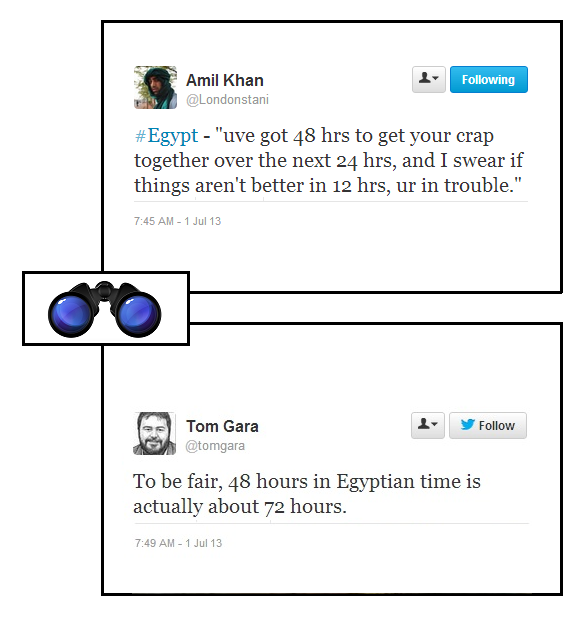
[ by Charles Cameron — 48 hours, Egyptian time, can mean many things, also DoD foresight, next 48 hrs ]
.

We seem to have at least four “times” here, ranking from 12 to 72 hours — or zero to 72 if you take the Army’s announcement itself as a sort of starting pistol — and they’re operating, obviously enough, under different frames. The army likes nicely rounded numbers like “48 hrs”, PERT chart thinking gives you the least time available in which to take the first step towards a desired aim, here “12 hours” — and “24 hours” is the latest target time for serious, visible progress to avert “worst case” response preparations. Or something along those lines.

And “72 hours”? That may be Egyptian elastic time, and thus roughly comparable to Lakota time

The Lakota view of time was simple. “Time was never a specific minute, but rather spaces of time,like early morning, just afternoon or just before midnight. The real meaning of time could be summed up by the phrase “nake nula waunyelo” loosely translated it means:

“I am ready for whatever, any place, any time, always prepared”.

When work needed to be done, people were prepared to work late inthe fields or stay up until 3 am to finish goods to be sold at market.When no work needed to be done, they didn’t work.

The irony is in the next comment:

Policy makers saw an opportunity to improve things by installing awestern time ethic and a respect for the clock.

I don’t know Egypt — but I have spent time “on Lakota time” and don’t wear a watch or carry a phone these days… The piece I drew those quotes from, Lessons from the Lakota: Time lessons for today’s managers, may or may not be useful advice for managers, but its overview-with-graphic of different time systems is worth a quick look. Anthropologists would be able to tell you more about individual cultures, but my point is that differing timeframes are among the major features of different worldviews, and we need to have a decent sense of them when we interface with them.

So “72 hours” may be an instance of relaxed but purposive time, okay? Which wouldn’t necessarily fit well with starched and pressed military time.

**

And here’s the blockbuster:

According to the Congressional Budget Office’s Analysis of DoD’s Future Years Defense Program from 2013, military foresight time runs five years ahead, while USG foresight time runs to 2030 at least:

In most years, the Department of Defense (DoD) provides a five-year plan, called the Future Years Defense Program (FYDP), associated with the budget that it submits to the Congress. Because decisions made in the near term can have consequences for the defense budget well beyond that period, the Congressional Budget Office (CBO) regularly examines DoD’s FYDP and projects its budgetary impact over several decades. For this analysis, CBO used the FYDP provided to the Congress in March 2012, which covers fiscal years 2013 to 2017; CBO’s projections span the years 2013 to 2030.

That’s confidence of a kind… but consider this:

I know, I know — whatever happens in Egypt “momentarily” may turn out to be no more than an eddy briefly interrupting a larger time-flow in the “mid-term” — a phenomenon I’d like to map nicely with some river graphics one of these days.

**

But time? What was it St Augustine said of it?

What, then, is time? If no one asks me, I know what it is. If I wish to explain it to him who asks me, I do not know.

More Books and Bookshelf Musings

Sunday, June 30th, 2013


Mussolini’s Italy:Life under the Fascist Dictatorship by by R. J. B. Bosworth 

Seeing Like a State by James C. Scott

Been busy writing a book review and a long and serious post, so here is something more lighthearted and tangible in the meantime.

Having recently purchased the Bosworth bio of Mussolini, I went back and bought his history of Italian Fascism. While doing that, I came across Scott’s Seeing Like a State, which had either been highly recommended in a discussion over at Chicago Boyz blog or perhaps in an email by one of the Chicago Boyz themselves ( maybe Lex will help me out here).

However, a long discussion by my amigo Adam Elkus on Facebook about his emerging organizational system for his books coupled with an hour long search to try and find a book I needed to cite in the review I was writing have made me realize something: I no longer have any organization to my books.

Sure, there’s still a semblance of a core – a Soviet/Russian bookcase, an antique/antiquarian bookcase for collectible editions 80-130+ years old, three shelves of strategy and war, two and half on Nazi Germany, two on Richard Nixon, an “Ummah” shelf on Islam, al Qaida, Central Asia and the Mideast but after that it starts getting messy. Once methodically organized, diplomatic history and diplo memoirs are spread across two rooms, four bookcases and three packing boxes in the garage; the Vietnam War is on two shelves in two different bookcases plus a half dozen or books so shelved at work; ancient history and classical philosophy have metastasized to occupy parts of three shelves in two different rooms; American history, European history, Japan and China,  sociology, general science, politics, biographies, neuroscience, intelligence community, economics are everywhere and anywhere. Your guess is probably almost as good as mine.

And then there are book piles randomly stacked horizontally on top of shelved books and bookcases or stacked by my computer desk or on/under/next to my nightstand. I no longer recall what books I have loaned out or to whom vice given away as gifts.

Bibliomania….A Gentle Madness …..


Pie Jesus, dona eis requiem

Sunday, June 30th, 2013

[ by Charles Cameron — of Ozymandias, as Shelley’s story-teller friend reminds us, all that remains are “vast and trunkless legs of stone” ]
.

I am very fond of the long view, in which each of us becomes (physical) dust and enters (mental) oblivion — not necessarily in that order — see Shelley, Osymandias, best read by the wonderful Eleanor Bron

I take the video below, with its scenes both of a young girl playing a tribute of flowers to the fallen of 9/11 and of Osama bin Laden, set to Fauré‘s plangent and beautiful Pie Jesus, dona eis requiemBlessed Jesus, grant them peace — as truly comprehensible only in that long view, where oblivion meets forgiveness…
.


.

**

The notes accompanying the video tell us:

Uploaded on May 4, 2011
Pie Jesu (from Requiem by Gabriel Fauré)

Words : Tommaso da Celano (1200 – 1265)
Music : Gabriel Fauré (1845 – 1924)

Conductor : Michel Corboz
Soprano : Alain Clement
Organ: Philippe Corboz
Berne Symphony Orchestra

Recording on May 1972, in Casino de Berne, Switzerland

Verse :

Pie Jesu Domine (Merciful Jesus) ,
dona eis requiem (grant them rest) ,
sempiternam requiem (grant them everlasting rest) .

Notes:

1) The War in Afghanistan (1979 – 1989)

was a conflict involving the Soviet Union and her puppet against the indigenous Afghan Mujahideen and foreign “Arab–Afghan” volunteers. The mujahideen found military and financial support from a variety of sources particularly Saudi Arabia and the United States.

2) September 11 Attack

The September 11 attacks were a series of coordinated suicide attacks by al-Qaeda led by “Osama bin Laden” upon the United States on September 11, 2001. Nearly 3,000 victims include 343 firefighters and 60 police officers died in the attacks.

The United States responded to the attacks, invaded Afghanistan. This war is not over yet.

3) Osama bin Laden (1957 – 2011)

Osama bin Laden was born in Riyadh, Saudi Arabia. On 1979 he joined the Afghan Mujahideen as a volunteer. After withdrawn USSR, he founded “al-Qaeda” in the war-devastated land and took the decisive action on September 11 2001. U.S. President Barack Obama announced that he had been killed by US armed forces on May 2 2011.

Fauré’s Requiem is one of the classic works of sacred choral music, and Michel Corboz deservedly one of the pre-eminent conductors of that repertoire.

This video, as you may have guessed, comes from the same source as the other examples of strange pairings of music and visuals which I discussed recently in Taylor Swift, Sara Mingardo, JS Bach and a quiet WTF, and I hope brings closure to that piece.

**

I tracked down the picture of the young girl. it is titled:

Cazzandra Peterson leaves flowers at Ground Zero in memory of father William Peterson during the 7th annual 9/11 memorial ceremony September 11, 2008 in New York City.

Family and friends of the victims, heads of government and others gathered at the annual ceremony to remember the attacks that killed more than 2,700 people with the destruction of the World Trade Center on September 11, 2001.

(September 10, 2008 – Source: PETER FOLEY/Getty Images North America)

**

Pie Jesus, dona eis requiem.

Videos, the counter-nasheed and some dancing girls

Sunday, June 30th, 2013

[ by Charles Cameron — further notes from the frayed edges of what’s significant ]
.

Okay, you all know I’m interested in the graphics of terrorism and their symbolism, and only a day or two ago I posted Of dualities, contradictions and the nonduality on the two into one phenomenon — well, here’s an addendum:

**

The upper image, showing the Jabha al-Nusra logo — Sunni, left — alongside the Hezbollah insignia — Shi’a, right — morphs into the single image in the lower panel, thereby resolving the sectarian conflict in Syria by filmic means.

The video from which these two shots were taken, alas, was the work product of the US Government, as part of an effort of outreach by the little-known Digital Outreach Team at the State Department, who at the time of writing appear to have 193 videos uploaded.

The BBC notes:

According to the Associated Press news agency, the 50-member Digital Outreach Team tweets, posts Facebook updates and uploads video to YouTube in Arabic, Punjabi, Somali and Urdu, in a bid to counter the radical jihadist message. It seems it’s even had exchanges with terror suspects such as US-born militant Omar Hammami, a former member of Somalia’s al-Shabab.

The two images above were taken from a video titled Secret meeting between Hassan Nasrallah and al-Zawahiri, but the Beeb’s article focused on what it termed a “spoof Al-Qaeda video”, which I’ll call Pharaoh Ayman speaks to the dancing girls for want of a better name:

The team’s al-Zawahiri spoof opens with a notice that “fizzy drinks should be consumed while watching this production” – a twist on the usual message at the beginning of al-Qaeda videos saying “it is not permitted to add music to this production … Taking the classic preaching-to-camera format, the three-minute clip features a voiceover in which the Egyptian-born militant repeatedly bungles his speech by saying things like: “The butchers, ahem, sorry, I mean the mujahideen”. In the video – issued by the US State Department’s Digital Outreach Team – al-Zawahiri is backed by punkah-wallahs. The clip then cuts to a shot, as though from behind the speaker, to reveal a troupe of dancers performing in front of him.”

But see for yourselves, punkah-wallas and all:

For your further Sundance consideration, and from the same studios, you might also like the lowest and slowest nasheed ever recorded.

**

Speaking of graphics — coming up on ZP when I have had a chance to read a little more of El Difraoui, reviews of:

  • Beifuss and Bellini, Branding Terror
  • Abdelasiem El Difraoui, Al-Qaida par l’image. La prophétie du martyre

  • Switch to our mobile site