zenpundit.com » 2013

Archive for 2013

Talk about interlocking nightmares…

Friday, February 8th, 2013

[ by Charles Cameron — when the world doesn’t divide quite so nicely into us and them ]
.

Artist credit: Toby Hazel, for link see below
Nah, not nightmarish, dreamlike abstract Interlocking Figures

**

Today, let’s talk about interlocking nightmares…

Consider the tugs and tensions in this article by Iranian-Israeli Middle East analyst Meir Javedanfar, which appeared in Al Monitor about a week ago titled Iran, Israel and Their Red Lines Over Syria. I’ll just quote you the tail end of the piece:

Syria’s WMD stockpile falling into the hands of al-Qaeda is a red line which Iran and its adversaries in Syria must draw together, and make sure that Al Qaeda does not cross that.

If al-Qaeda does persistently try and the only other viable option to avoid this scenario is to transfer Syria’s WMD to Iran, than the West may have no option but to accept. That is an infinitely better scenario than al-Qaeda getting its hands on such a weapons. Al-Qaeda is a suicidal non-state actor with nothing to lose by using such weapons, however the opposite is true about Iran. As unpleasant as it may be, this is one scenario which the West should not draw a red line around.

**

Insights?

** ** **

Image source:

Toby Hazel, Interlocking Figures

Don’t ask me — I’m a Qualit!

Friday, February 8th, 2013

[ by Charles Cameron — Christmas pudding UK circa 1950, math, banks, and moral authority ]
.


.

As I recall, the plum pudding served in our family on Christmas day was not only rich in raisins, sultanas, currants and candied peel, it not only had brandy poured over it and a flame swiftly set to it, it was not only served with brandy butter…

It also had, somewhere within it, a silver coin — I understand these were originally related to coins of healing and the Royal Touch — and one of us, my sister and I, would be the one to find it in our slice. So equality of opportunity was important, both of us wanted to have an equal chance at winning the coveted prize.

Or perhaps I should say, equantity? Because believe me, the quality in each and every slice was just fine.

All this by way of saying that yes, I understand that quantity has its uses.

**

In Recipe for Disaster: The Formula That Killed Wall Street a while back, Felix Salmon proposed the upper (and more colorful) of the two equations below, suggesting that it was the root cause of the financial failure of 2008:

Comes now Chris Arnade blogging on Scientific American for the defense, claiming that The Real—and Simple—Equation That Killed Wall Street was the lower of the two equations (the one in black on white).

**

Arnade writes of Salmon’s Wired article:

It was not the first piece that made this type of argument, but it was the most aggressive. Since then it has been a common theme in the media that mathematics, especially obscure advanced mathematics, is largely responsible for the catastrophe that doomed the world to the last five years of recession and slow growth.

This theme plays on the fallacy that danger always comes from complexity. It’s a fabrication that obscures the real causes, that makes it easier to say, “Hey, it wasn’t my fault, I was blinded by science.”

The reality is much simpler and less sexy. Wall Street killed itself in a time-honored fashion: Cheap money, excessive borrowing, and greed. And yes, there is an equation one can point to and blame. This equation, however, requires nothing more than middle school algebra to understand and is taught to every new Wall Street employee. It is leveraged return.

What is leveraged return? It’s the return on assets using borrowed money.

I am depicted as the fellow with glasses and a squint, squeezed in between the two equations. When I recover from my discombobulation, I will push my glasses up high on my brow and say, Don’t ask me — I’m a Qualit!

**

And now we Anglicans have a new Archbishop who, well, as the Guardian puts it, Archbishop of Canterbury accuses banks of hypocrisy over bonuses:

Two months ago HSBC was also fined a record £1.2bn over allegations of money laundering for Mexican drug barons. Regulators said HSBC had allowed at least $881m of drugs money through its accounts.

Taking evidence from HSBC’s two top bosses – its chief executive, Stuart Gulliver, and chairman, Douglas Flint – the archbishop said: “I’m increasingly baffled at the discussion we are having. What is it essentially about bankers that means they need skin in the game [bonuses]? We don’t give skin in the game to civil servants, to surgeons, to teachers.

“There’s a whole range of people who don’t have that. It seems to me that you are putting huge effort into a values-based organisation and yet at the end of the day, particularly for your most senior staff who are most important as regards setting values and culture, you seem to be saying the only way you can motivate them to any significant extent is with cash.”

The bankers, who said they wanted to turn HSBC into a bank of “courageous integrity”, insisted it was necessary to pay bonuses because they provided incentives that could be clawed back if mistakes were later uncovered.

Don’t you love it? Courageous integrity!

**

As Rochefoucauld said:

Hypocrisy is the homage vice pays to virtue.

It seems it is a small price to pay, quantitatively speaking — a rounding error. From a qualitative perspective however, it is a Faustian price — as Wikipedia (following Britannica) has it, it is:

a situation in which an ambitious person surrenders moral integrity in order to achieve power and success

Ooh — it’s a question of having or surrendering moral integrity about one’s own claim to integrity! A self-referential paradox if ever I saw one…

Christianity (since we’ve just been quoting an Archbishop) sets the matter sub specie aeternitatis in Mark 7.6:

He answered and said unto them, Well hath Esaias prophesied of you hypocrites, as it is written, This people honoureth me with their lips, but their heart is far from me.

A small price, or the ultimate? Quant? or Qualit? The choice is always ours.

**

So you see why I’d rather be a Qualit than a Quant.

But even so, finding that silver coin in my Christmas pudding was pretty special, from a quantish point of view. The brandy butter, more qualitish IMO, was even better.

** ** **

Sources for header:

Qualit logo
Quant logo

Sources for SPECS:

Wired‘s equation
SciAm‘s equation

“Sin, Death, and Hell have set their Marks on Him”

Tuesday, February 5th, 2013

King Richard III 

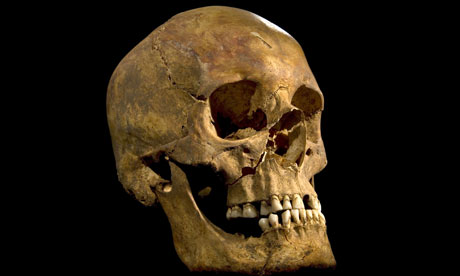
The bones of Richard III, Shakespeare’s greatest villain and the last King of England to be killed in battle have been discovered and identified by DNA testing:

….There were cheers when Richard Buckley, lead archaeologist on the hunt for the king’s body, finally announced that the university team was convinced “beyond reasonable doubt” that it had found the last Plantagenet king, bent by scoliosis of the spine, and twisted further to fit into a hastily dug hole in Grey Friars church, which was slightly too small to hold his body.

But by then it was clear the evidence was overwhelming, as the scientists who carried out the DNA tests, those who created the computer-imaging technology to peer on to and into the bones in raking detail, the genealogists who found a distant descendant with matching DNA, and the academics who scoured contemporary texts for accounts of the king’s death and burial, outlined their findings.

….Richard died at Bosworth on 22 August 1485, the last English king to fall in battle, and the researchers revealed how for the first time. There was an audible intake of breath as a slide came up showing the base of his skull sliced off by one terrible blow, believed to be from a halberd, a fearsome medieval battle weapon with a razor-sharp iron axe blade weighing about two kilos, mounted on a wooden pole, which was swung at Richard at very close range. The blade probably penetrated several centimetres into his brain and, said the human bones expert Jo Appleby, he would have been unconscious at once and dead almost as soon.

The skull of Richard III

Injuries to the skeleton appear to confirm contemporary accounts that the king died in battle. Photograph: AFP/Getty Images

The injury appears to confirm contemporary accounts that he died in close combat in the thick of the battle and unhorsed – as in the great despairing cry Shakespeare gives him: “A horse! A horse! My kingdom for a horse!” 

Richard III, usurper and probable regicide of his nephew the boy King, was the last truly medieval King of England. Had Richard lived to rule, his reign would have been characterized by the same bloody uprisings and civil strife that marked the War of the Roses. England was fortunate in his successor who had bested him in battle, Henry Tudor who became King Henry VII was an energetic and far seeing monarch who restored a war-wracked and bankrupt England to peace and fiscal health and set the foundations of the modern United Kingdom and the future world-spanning British Empire. It was Henry who started the Royal Navy and curtailed the ability of the nobility to wage war as they pleased with large private armies, by taxing them for each man at arms, thus ending bastard feudalism ; recalcitrant rebels were executed and justices of the peace established in every shire to enforce the law of the realm rather than the corrupt whims of manorial courts.

Richard III has his devoted fans as well his detractors. Except for his impatient ruthlessness, Richard probably was little worse, morally speaking, than his fellow medieval monarchs in an age when brutality and the rule of the strong was the norm.  However, unlike the brilliant Henry, Richard would have done little to improve the situation and might have made life in England more savagely violent.

America the Home of the Brave?

Sunday, February 3rd, 2013

An excellent op-ed in the Washington Post by Small Wars Journal editor and author of War, Welfare and Democracy,  Peter J. Munson 

An America Cramped by Defensiveness by Peter J. Munson 

….Since I returned home, a darkness has grown in me as both I and our nation have failed to live up to the sacrifices of these young men and women. I had no expectation of “victory” in Afghanistan or Iraq, whatever that would mean. Nor did I expect some epiphany of strategic insight or remorse from the nation’s brain trust.

I just found that I could not square the negativity, pettiness and paranoia in the discourse of our country’s elders with the nobility and dedication of the men and women I had seen and served with in Afghanistan.

Over time, as I listened to the squabbling, I realized that about the only thing Americans agree on these days is gratitude bordering on reverence for our military. It troubled me that the sum total of consensus in our discourse is deference toward the defenders of our nation.

Eventually, it dawned on me that the focus on defense was the root of our problem.

After the Sept. 11, 2001, attacks, the United States sent its military off to war and fretted about post-traumatic stress disorder — but paid little attention to the fact that America itself was traumatized. Americans became angry and withdrawn. We are fearful and paranoid because after a strike on our nation we chose to focus on defense rather than the resilience and vitality that made America great. In our defensive mind-set, we bristle at every change in a world undergoing an epochal transformation.

We have little reason to be so negative. Certainly the rest of the world is gaining on us, but this represents the success of explicit U.S. policies. After World War II, the United States sought to create a world of economic interdependence and prosperity, hoping to banish the malaise that helped precipitate a global conflict. The prospect of rapid growth in the developing world was not viewed as a threat but rather offered the promise of robust markets for American goods and ingenuity. We were confident and focused on the positive tasks of expanding our economy rather than fearing change…..

If you go back and look at news coverage of September 11, you will be struck by the calmness of ordinary citizens in New York in the face of carnage, their lack of panic and firm determination to help. The bravery and sacrifice of firefighters, EMT and police, the dogged resolution of rescue workers digging for victims, the sheer heroism of the passengers of  United Airlines Flight 93 who, led by Todd Beamer, stopped the al Qaida hijackers from ramming another plane into another skyscraper or perhaps the Capitol Building.

All of the security theater, the attacks on liberty, the surveillance state machinations, creeping normalization of government thuggery, bureaucratization, centralization and paternalism that have since been justified in the name of 9/11 were not needed on that day nor wanted by the overwhelming mass of American citizens afterwards.  It was wanted by our “leaders” – who were largely irrelevant to events on September, 11 – because it conformed to their worldview and overweening personal need for “control” of a democratic citizenry they would prefer to be less autonomous and more passive, docile, compliant and disengaged.

We need to revive the American spirit and the first steps are rolling back much of the illiberalism of the past decade.

Recruitment, poetry and tears

Thursday, January 31st, 2013

[ by Charles Cameron — Hegghammer on testing and trusting as precursors to AQ recuitment ]
.

I’ve been having trouble finding any of the anasheed Ibn Siqilli was posting on his site, many of which have been taken down — but this one, found in a comment of his on Leah Farrall‘s site, has somehow survived:

Craftsmanship in search of emotion, in service to the jihad.

Thomas Hegghammer has a fascinating article out titled The recruiter’s dilemma: Signalling and rebel recruitment tactics from which I’ll only tease you with the bits of special interest to me, viz those that speak to religion (roughly, scripture and ritual), and culture (narrative, music and poetry).

**

First, matters clearly involving religious piety and its expressions:

At the same time, personal piety at the time of recruitment was certainly a necessary condition for joining. Failure to observe any of the basic rituals or engaging in sinful behaviour – by skipping prayers, smoking, or watching Hollywood films – would have constituted a very negative sign. Moreover, even at the far end of the piety spectrum there were small signs that distinguished the extremely pious from the very pious. These signs were not in material objects such as clothes, but rather in body language and habits. QAP martyrdom biographies would highlight the piety of some but not of others, which suggests some variation. Judging from texts and videos, the behaviours that were appreciated included reading the Qur’an at every available spare moment, weeping while reciting the Qur’an, frequent minor pilgrimages (umra) to Mecca, efforts to acquire religious knowledge, etc. However, to observe these signs, recruiters needed to already be in direct contact with the recruit.

Piety, however, was not enough. Recruiters would also need to see signs of ideological commitment of a more political nature, in particular approval of violent activism.

Particularly interesting to me here is the sentence, These signs were not in material objects such as clothes, but rather in body language and habits.

**

And then, culture…

To find out whether a person had really been abroad for jihad, recruiters would solicit signs of jihad experience, either by engaging the recruit in conversation, or if in a larger group, steer the conversation toward the topic of foreign jihad fronts. They would presumably look for displays of three types of knowledge, the combination of which would be very hard to acquire for a person who had not been to any of the major battlefronts.

The first was knowledge of people, places and events specific to the conflict in which the recruit claimed to have taken part. [ more … ]

The second type of distinctive knowledge was weapons expertise. [ more … ]

The third type was familiarity with ‘jihad culture’, a set of peculiar practices and artistic expressions that emerged in the Arab Afghan community in the 1980s and developed in subsequent jihad fronts. One important component was anashid, battle hymns sung a capella during training and socializing. A similar component was poetry. Arab fighters in Afghanistan, Bosnia and Chechnya would continuously compose new poems and recite them in the camps. Veterans would be familiar with at least part of this material and would share it during social gatherings in the kingdom. Yet another aspect of jihad culture was the telling of war stories from the time of the Prophet Muhammad and his immediate successors. While some of these stories were part of the basic religious education of most Saudis, it required extra effort to learn many or all of them, and to be able to cite them verbatim, as custom required. In the training camps and the trenches, such stories were told all the time (Nasiri, 2006), so jihad veterans typically knew many more such stories than the average Saudi.

Of course, non-veterans could acquire some of this knowledge if they wanted to, but to mimic jihad experience, impostors would need to emit large and consistent clusters of correct signs – a considerable challenge.

I’m reminded of Abdullah Azzam‘s book The signs of Ar-Rahmaan in the Jihad of Afghanistan, which I quoted in an earlier post Of war and miracle: the poetics, spirituality and narratives of jihad.

**

Here’s how bad we are at learning the local mores of the various war zones we keep dropping in on, in the words of FPRI’s Adam Garfinkle, in Mali: Understanding the Chessboard, posted recently:

As the article says, when the Tuareg rebellion in Mali gained steam after the denouement of the Libya caper, greatly stimulated by the return of heavily armed Tuareg brethren from that fight, these three Tuareg commanders defected to the rebels, bringing soldiers, vehicles, ammunition and more to the anti-government side. Anyone who was surprised by this is at the very least a terminal ignoramus. And anyone in the U.S. military who failed to understand the ethnic composition of the country’s politico-military cleavages, such that he let U.S. Special Forces training be lavished on Tuareg commanders, was clearly insufficiently trained to do his job. And believe me, that’s about as nice a way to put that as I can summon.

How do things like this (still) happen, after what we should have learned from years of dealing with Iraqis and Afghans and others on their home turf? I happen to know someone who teaches in the U.S. military education system, and this person happens to be a field-experienced Harvard Ph.D. in anthropology. This person tries very hard to clear away the thick fog created by the innocent Enlightenment universalism that pervades the American mind—the toxic fog that tries to convince us that all people, everywhere, are basically the same, have the same value hierarchies, the same habits of moral and tactical judgment, and mean the same things by roughly comparable translated words.

Now imagine how good we’d be at infiltration, getting the anasheed, poetry and stories right…


Switch to our mobile site