zenpundit.com » 2013 » September

Archive for September, 2013

Recommended Reading

Friday, September 20th, 2013

Top Billing!!!  Pundita’s series “From Economic Collective to Police State”

Part I. From Economic Collective to Police State: Once Americans ceded control over their financial affairs they lost control of everything else, Part II. The Guardians of the Economy make their move: Part 2 of From Economic Collective to Police State, Part III. From Tofu to the Police State, Part IV Modern U.S. lawmaking and the original police state: Part 4 of “From Economic Collective to Police State”

….Mao famously said that all power comes from the point of a gun. Not in a republic it doesn’t. All power comes from the peoples’ control of their monetary wealth. Here wealth simply means an abundance — what money earners have left over after meeting all their expenses including taxes. Whoever controls this wealth rules because while taxation provides representation, only the crushing authority of wealth — how the people decide to spend, save, borrow, and invest their abundance of money — imposes the discipline on government that insures taxation produces honest and adequate representation.

So here is the bottom line about whether the United States will continue to exist as a republic: Just as there’s never been any such thing as a long lived monarch who doesn’t control his wealth, a “rule of the people” can’t last long unless the people control their wealth.

This control works out in practice to the people controlling their banking system. And by “people” I don’t mean “the government of the people.” I mean “the depositors.” I’ll expand on all this later but for any reader who thinks it can’t be that simple — tragically, it is that simple. The clearest indicator of where an independent nation stands on the freedom-oppression index is the state of its banking system, although the indicator is usually viewed, wrongly, as an effect and not a primary cause. But then how many American high school and college graduates have you met who know anything about  banking?

The bottom line was overlooked by political parties in the USA. Instead of focusing on the critical issue for a rule of the people, the parties encouraged voters to engage in distracting arguments about taxation and the size of government. All the while Americans ceded more and more control of their financial affairs by cooperating with fiscal and monetary policies designed to stave off another Great Depression.

For example, if the President appealed to the public to spend for the sake of the economy, Americans dutifully spent, even if this meant going into debt. If the Federal Reserve enacted policy that slashed the amount of interest banks paid depositors — policy meant to stimulate greater public spending and investment in the stock market — Americans who depended on income from the interest grumbled but didn’t picket the Fed or chain themselves to bank doors in protest.

In short, there was no need for a draconian regulatory regime or what people consider a police state because Americans were so cooperative with policies that eroded their control of their wealth. Then the Great Recession of 2008 struck. After that, everything changed. Many Americans ceased being cooperative. This alarmed the Guardians of the Economy.

I think Pundita has been reading John Robb….

Seydlitz89 –   President Putin’s Letter to the American People Regarding the Syrian Crisis 

….Along with Putin’s UN/international law argument he weaves the current situation in Syria and the greater Middle East. The conclusion a reader draws from this description is that overt US military involvement not only faces strong international opposition, but is difficult to see as being in the US national interest or even strategically coherent in terms of the forces our military actions would support. The implication is that this aggressive Syrian policy operates counter to the strategic narrative of the Global War on Terror which has dominated US foreign policy for over a decade.

….This specific crisis is then placed within the larger context of the US foreign policy emphasis on the use of force which has proved “ineffective and pointless”. Not only that, this proclivity has had the opposite effect on nuclear proliferation, since “if you have the bomb, no one will touch you”. So with this context in mind, Putin is inviting the US to “return to the past of civilized diplomatic and political settlement”, a past which the US was fundamental in building and maintaining.

….First, this is an appeal from Russia to the US to start acting once again as a great power. What we see today in US Syrian policy is a policy of strategic incoherence, of a power acting not in it’s own interests but in those of other powers which attempt to utilize US military force for their own ends. We have degenerated in terms of strategic effect to the point where the US acts as a “tool” of other powers. In the case of a US attack on Syria, the interested powers include Saudi Arabia, Turkey and Israel.

War on the Rocks(Peter Munson)THIS IS NOT THE DIPLOMACY YOU’RE LOOKING FOR and (John Collins)NATIONAL SECURITY CAREER CHOICES and (Frank Hoffman)IT’S TIME TO THINK ABOUT  STRATEGY 

Choices are hard.

In a recent op-ed on the Strategic Choices Management Review (SCMR), I challenged those who expected more definitive choices in the review (or those I suspect want to avoid definitive choices).  The SCMR was really about establishing a framework for choices that the next QDR must actually make and explain.  It’s a two-step process, and I thought that review had set the stage for what will I think prove to be a critically important Pentagon effort for the remainder of this year.  We clearly need to match our aspirations more coherently with the resources we will be allotted.

Otherwise, we will remain “strategically insolvent” as my colleague at NDU, Professor Mike Mazarr, has argued in The Washington Quarterly. To improve our solvency, we will have to make some tradeoffs and come to appreciate risk better. 

SWJ Blog –José Mujica and Uruguay’s “Robin Hood Guerrillas”  and How to Improve U.S. National Security Strategies 

Eeben Barlow –THOUGHTS ON FRAGILE AND FAILED STATES Part 2 

Aeon Magazine – (David Barash) Is there a war instinct?  

The Scholar’s Stage – Independence and Rights

Ribbonfarm –The Exercise of Authoritah

Dave Maxwell –U.S., Republic of Korea and Allies Should Prepare for Eventual Collapse of North Korean Government 

Kings of War -(Jill Sargent) You Can’t Shoot Rioters* 

Michigan War Studies ReviewBetween Flesh and Steel: A History of Military Medicine from the Middle Ages to the War in Afghanistan 

That’s it


Photographic enantiodromia at the Zaynab shrine?

Friday, September 20th, 2013

[ by Charles Cameron — in recognition that Photoshop is a weapon that can turn enemies into friends, at least within Photoshop! ]
.

How to describe this? It’s a DoubleQuote in Two Tweets from Phillip Smyth in which [Almost] the Same Photo of a Guy with an Israeli Rifle Poses on Both Sides of the Conflict around the Sayyida Zaynab Shrine in Southern Damascus:

So the guy in the original photo does a bit of an enantiondromia thanks to Photoshop…

**

For some in depth reading:

  • On the Shia side of things, see Phillip Smyth‘s Hizballah Cavalcade posts at Jihadology.
  • For the same on the Sunni side, see Aymenn Al-Tamimi‘s Musings of an Iraqi Brasenostril series, also on Jihadology.
  • And for both and all else, well, there’s always Aaron Zelin‘s Jihadology itself!
  • Most intriguing game-theoretic comment of the year thus far

    Friday, September 20th, 2013

    [ by Charles Cameron — at the intersection of zero-sum and non-zero sum games ]
    .

    And the hands-down winner is — opening today’s Washington Post to the op-ed page — President Hassan Rouhani of Iran, who says:

    The world has changed. International politics is no longer a zero-sum game but a multi-dimensional arena where cooperation and competition often occur simultaneously. Gone is the age of blood feuds. World leaders are expected to lead in turning threats into opportunities.

    I think he’s right, though I’ll leave the question of whether he means it TBD — but if he does, that’s a.. that’s a.. that’s a Major Game Changer — and verra interesting in any case:

  • What’s the non-zero-sum strategy when there may be one or more zero-sum players in the game?
  • **

    For your further edification, here’s what a genuine game-changer, in both literal and metaphoric sense of the phrase, looks like:
    .


    .

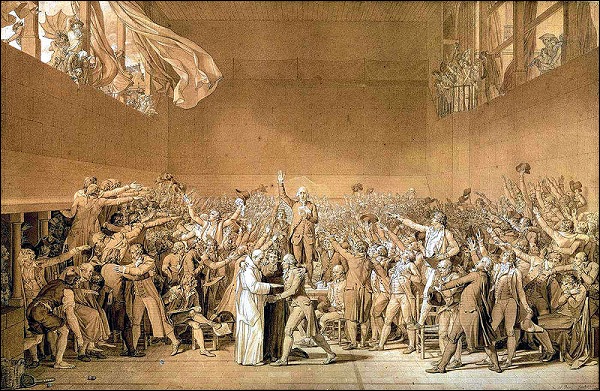
    The court is a tennis court, the game in play is revolutionary politics, the event is the Tennis Court Oath, where the members of the National Assembly gathered to swear “not to separate, and to reassemble wherever circumstances require, until the constitution of the kingdom is established” — the drawing is by Jacques-Louis David.

    Pope Francis and the artists who move him

    Thursday, September 19th, 2013

    [ by Charles Cameron — Dostoevsky, Hopkins, Caravaggio, Mozart, Bach, Fellini, Cervantes — that’s who! ]
    .

    For context and contrast, first read this:

    Pope Francis decided at the last minute not to attend a Beethoven concert last evening, Fox News and others reported. Fox News comments, “Unlike his predecessor Benedict, who was well-known as a music lover, Francis has shown scant interest in music, liturgical or otherwise.” The concert, an event long planned for the Year of Faith, included Beethoven’s 9th symphony with choir and orchestra.

    Pope Francis supposedly said “I am not a Renaissance prince who listens to music instead of working,” Vatican Insider first reported, later softening its report to preserve the general sense without quoting the pope directly.

    — then this, from the first extended interview of Pope Francis, which has just been released.

    While I’m sure plenty of others will mull over other aspects of what he has to say for himself, I’m taking my own insights into his character from the artists in whose work he finds inspiration:

    I have really loved a diverse array of authors. I love very much Dostoevsky and Hölderlin. I remember Hölderlin for that poem written for the birthday of his grandmother that is very beautiful and was spiritually very enriching for me. The poem ends with the verse, ‘May the man hold fast to what the child has promised.’ I was also impressed because I loved my grandmother Rosa, and in that poem Hölderlin compares his grandmother to the Virgin Mary, who gave birth to Jesus, the friend of the earth who did not consider anybody a foreigner.

    I have read The Betrothed, by Alessandro Manzoni, three times, and I have it now on my table because I want to read it again. Manzoni gave me so much. When I was a child, my grandmother taught me by heart the beginning of The Betrothed: ‘That branch of Lake Como that turns off to the south between two unbroken chains of mountains….’ I also liked Gerard Manley Hopkins very much.

    Among the great painters, I admire Caravaggio; his paintings speak to me. But also Chagall, with his ‘White Crucifixion.’ Among musicians I love Mozart, of course. The ‘Et incarnatus est’ from his Mass in C minor is matchless; it lifts you to God! I love Mozart performed by Clara Haskil. Mozart fulfils me. But I cannot think about his music; I have to listen to it. I like listening to Beethoven, but in a Promethean way, and the most Promethean interpreter for me is Furtwängler. And then Bach’s Passions. The piece by Bach that I love so much is the ‘Erbarme Dich,’ the tears of Peter in the ‘St. Matthew Passion.’ Sublime. Then, at a different level, not intimate in the same way, I love Wagner. I like to listen to him, but not all the time. The performance of Wagner’s ‘Ring’ by Furtwängler at La Scala in Milan in 1950 is for me the best. But also the ‘Parsifal’ by Knappertsbusch in 1962.

    We should also talk about the cinema. ‘La Strada,’ by Fellini, is the movie that perhaps I loved the most. I identify with this movie, in which there is an implicit reference to St. Francis. I also believe that I watched all of the Italian movies with Anna Magnani and Aldo Fabrizi when I was between 10 and 12 years old. Another film that I loved is ‘Rome, Open City.’ I owe my film culture especially to my parents who used to take us to the movies quite often.

    Anyway, in general I love tragic artists, especially classical ones. There is a nice definition that Cervantes puts on the lips of the bachelor Carrasco to praise the story of Don Quixote: ‘Children have it in their hands, young people read it, adults understand it, the elderly praise it.’ For me this can be a good definition of the classics.

    **

    Mozart, Et incarnatus est:

    Mozart, played by Clara Haskil:

    Bach, Erbarme dich, from the Matthew Passion:

    Fellini, La Strada, innocence:

    Fellini, La Strada, despair:

    No wonder, then, that he loves the poetry of his fellow Jesuit, the poet Gerard Manley Hopkins:

    No worst, there is none. Pitched past pitch of grief,
    More pangs will, schooled at forepangs, wilder wring.
    Comforter, where, where is your comforting?
    Mary, mother of us, where is your relief?
    My cries heave, herds-long; huddle in a main, a chief
    Woe, wórld-sorrow; on an áge-old anvil wince and sing —
    Then lull, then leave off. Fury had shrieked ‘No ling-
    ering! Let me be fell: force I must be brief.”‘

    O the mind, mind has mountains; cliffs of fall
    Frightful, sheer, no-man-fathomed. Hold them cheap
    May who ne’er hung there. Nor does long our small
    Durance deal with that steep or deep. Here! creep,
    Wretch, under a comfort serves in a whirlwind: all
    Life death does end and each day dies with sleep.

    — nor the works of Caravaggio, whose rap sheet was impressive to say the least:

    Arriving in Rome in 1595 at the age of 25, the hot-headed painter’s police dossier — hand-written in Latin and vernacular Italian and bound in great volumes that were stored in the archives until now — makes Caravaggio come across as almost compulsive in his lawlessness. For instance, the man was weapon-obsessed, sporting a sword, dagger, and pistol at various times. He was twice thrown in the clink for carrying arms without a permit, and known for beating strangers in late-night fights and pelting police with rocks.

    The documents add fresh color to well-known parts of the Caravaggio legend. Regarding the 1606 brawl during which the artist killed one Ranuccio Tommassoni, leading the artist to flee Rome and causing Pope Paul V to issue a death warrant, the documents reveal that the fight was over a gambling debt, and not a woman, as some accounts have suggested.

    It is all the more appropriate, then, to close this post with Caravaggio’s own meditation on the martyrdom by crucifixion of the first Pope, St Peter, whose chair Francis now holds:

    _______________________________________________________________________________

    .

    h/t Damian Thompson, who tweeted “I never thought I’d hear a Pope rave about Haskil’s Mozart, Furtwängler’s Beethoven and Knappertsbusch’s legendary 62 Parsifal.”

    Unrenormalizable

    Thursday, September 19th, 2013

    [ by Charles Cameron — a quick quantum DoubleQuote in music and jewel — humor, edutainment ]
    .

    Nibbling at the tasseled fringes of science is as close as I get, but these two otherwise unrelated pieces caught my eye…

    **

    My first entry:
    .


    .

    Pretty cool, pretty popular — and my second?
    ,


    .

    Read all about it: A Jewel at the Heart of Quantum Physics

    **

    A little video music, a little digital art, a little physics — what’s not to like?

    And my title, Unrenormalizable? In physics, so I’m told, “Unrenormalizable theories contain infinitely many free parameters”. I’m no theory, but I suspect I’m unrenormalizable too.


    Switch to our mobile site