zenpundit.com » 2015 » March

Archive for March, 2015

New Article: There Are No Tea Leaves to Read About the Mosul Plan

Friday, March 13th, 2015

[by Mark Safranski, a.k.a. “zen”]

There Are No Tea Leaves to Read About the “Mosul Plan”

I have a new piece up at War on the Rocks ( which, by the way, is doing an important Indiegogo fundraising drive):

THERE ARE NO TEA LEAVES TO READ ABOUT THE “MOSUL PLAN” 

A mostly forgotten Arab adversary of American influence in the Mideast, the late Egyptian dictator Gamal Abdel Nasser, once said “The genius of you Americans is that you make no clear-cut stupid moves, only complicated stupid moves which make us wonder at the possibility that there may be something to them we are missing.”

The Obama administration appears determined to live up to Nasser’s estimation of our strategic acumen.

The latest evidence for this proposition would be the ill-fated affair of the administration’s former battle plan to retake the Iraqi city of Mosul from the butchers of the Islamic State in Iraq and the Levant (ISIL). Problems began at the inception when the anonymous but official Central Command (CENTCOM) briefer revealed a plethora of sensitive operational details to reporters, a move described by journalists in their stories as “odd,” “very unusual,” “rare.” The stories provoked a firestorm of criticism from members of Congress, the Iraqis, and within the Pentagon itself which predictably led the administration’s numerous admirers in the media to mobilize andtake up a defensive crouch, speculating as to the clever hidden motives for releasing the plan. [….]

Read the rest here.

The dust-up over the Mosul Plan is, in my view, symptomatic of dysfunctional organizational problems, especially with the senior White Hose staff and NSC.  The latter of which is now of enormous size, estimated 400-500 people, depending how you count various civil service employees and military personnel on “loan” from their agencies and departments ( a “mini-State Department”, in the words of one member of the natsec community).

By contrast, Brent Scowcroft helped the collapse of the USSR to a soft landing and managed the Gulf War with an NSC of about 50.

DoubleFlag in Tikrit

Wednesday, March 11th, 2015

[ by Charles Cameron — more exectly, flag / stone — but a DoubleLogo either way ]
.

**

I like this because of the twinning of logos in the image, a sort of DoubleQuote in the Wild, and also because of the parallelism of opposites it proposes in the wording of its text portion — Shia militia vs Sunni IS.

Grurray asked me whether it was the Hezbollah flag, and I made my guess but asked Phillip Smyth, who covers Shia militias in Iraq on Aaron Zelin‘s Jihadology.net at Hizballah Cavalcade. He replied:

**

For further details on Shiite militias, see Phillip’s…

Sunday surprise addendum: Magritte and Montparnasse

Monday, March 9th, 2015

[ by Charles Cameron — Lawrence Weschler in the same NYorker issue as Fredric Dannen ]
.

In the same issue of the New Yorker as Fredric Dannen‘s piece on the Green Dragons referenced in my earlier post, as it happens, and indeed printed on the same pages, is one of Lawrence Weschler‘s brilliant Convergences — his term for what I call DoubleQuotes.

I’ve composed my own version out of the same two images, here:

Magritte Montparnasse

**

William Routt, in his The Madness of Cinema and Thinking Images, has this to say:

Writing under the heading “Convergences” in The New Yorker of November 16th, 1992, Lawrence Weschler explains that a train photographed dangling alongside a brick building “overshot the Gare Montparnasse, in Paris, on October 22, 1895”. What he cannot explain, and what he only points to in the way I have pointed to the coincidence between Lindsay and Deleuze, is the coincidence between this photograph and René Magritte’s well-known 1938 painting of an engine coming out of a fireplace (which is called “Time Transfixed”). The photo hallucinates the painting and the painting the photo. Their connection is delirious.

Delirious or delicious, I couldn’t let the occasion of my discussing that New Yorker issue pass without praising Weschler’s eye for the telling matcvh of images.

Image sources:

  • Rene Magritte, Time Transfixed, 1938
  • Levy & fils, Train wreck at Montparnasse Station
  • Sunday Surprise: dark beauty in green & red with dragons

    Monday, March 9th, 2015

    [ by Charles Cameron — the color of green cards, the color of blood ]
    .

    I was watching Revenge of the Green Dragons, since Scorsese produced, and had very little idea of what I was going to see — the film is an amalgam of Hong Kong action flick and New York City crime thriller, based on a New Yorker aticle about Chinatown gangs in the 1980s and 90s — but the opening titles were run under a brief voice-over account of Ellis Island, and included this shot of some early “green cards” —
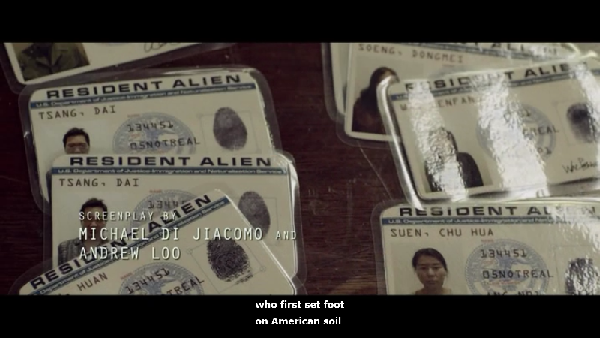
    Green Dragons 01

    followed by this one of Mahjong tiles, definitively green, and roughly equivalent to cards in western gameplay —
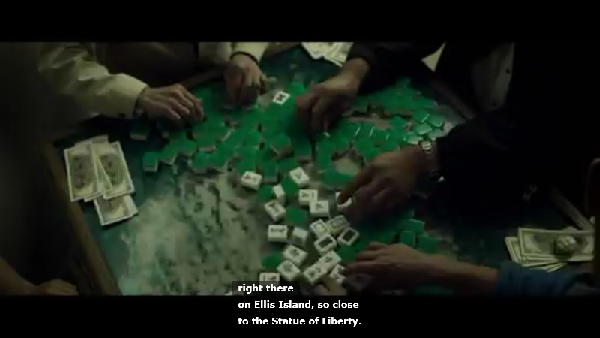
    Green Dragons 02

    and this, showing the same tiles face-up —
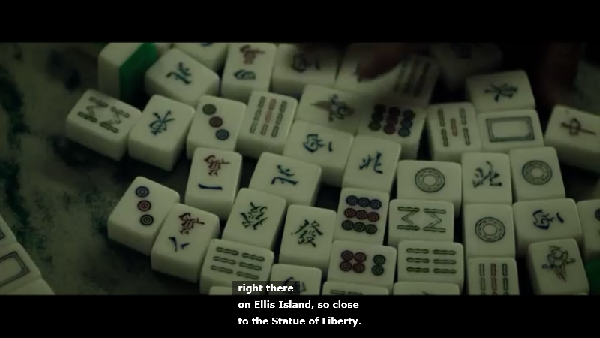
    Green Dragons 03

    by which point, the greenness, cardness and gameness had my full attention, and at which point I went back and started putting together a series of screencaps, like this one, showing a different but related form of green —
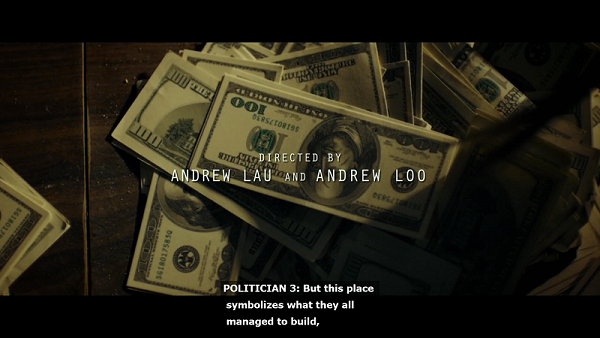
    Green Dragons 04

    with a switch to red, green’s complementary color, and the violent theme of the movie —
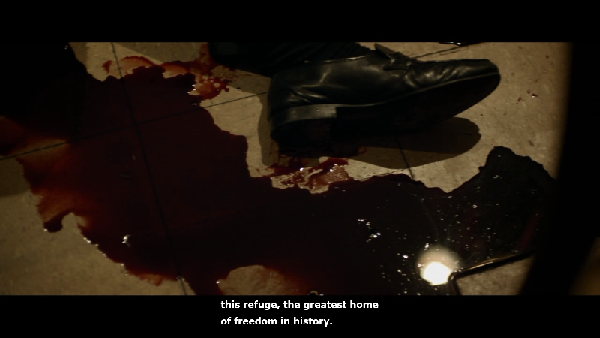
    Green Dragons 05

    and finally, the film’s title, in red against green.
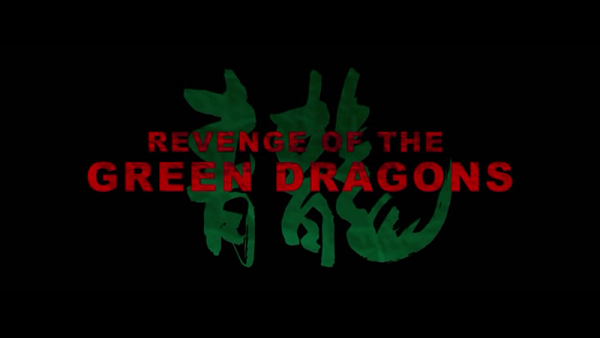
    Green Dragons 06

    I was beginning to like this film.

    **

    I thought of calling this post “Entertaining the heart’s eye” because it’s the emotions that respond to this sort of (formal) care in detail — the film maker is fully conscious of such things, but the viewer’s mind’s eye is preoccupied with narrative (content) and barely notices them. That’s skillful means, that’s the artistry of the medium, that’s how we’re subliminally engaged and move, that’s how it’s done.

    And if narrative is of any interest, as I suggested recently it should be, in terms of trategy, then “how it’s done” — with an emphasis on form rather than content — is key.

    Okay, I had my six screencaps and the tale I’ve just told, and I thought that would be enough, tgether they would make a fine Sunday surprise for ZP. And i thoughy, maybe I can sit back and watch the rest of the film without having to constantly stop and start for screencaps, always a somewhat tedious process.

    **

    But then, as the film proper got under way, there was this shot of —
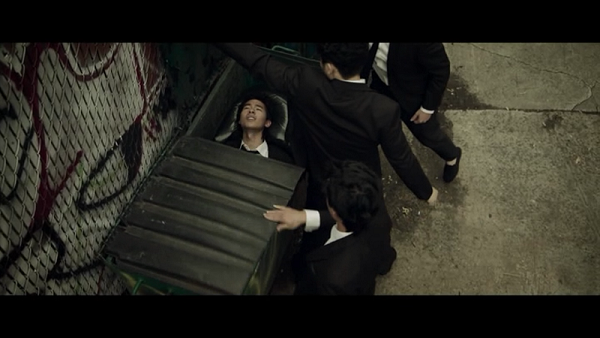
    Green Dragons 7

    a deceased gangster in the dumpster, for all the world as if it was in one of those viewing coffins used for more warmly appreciated mobsters —
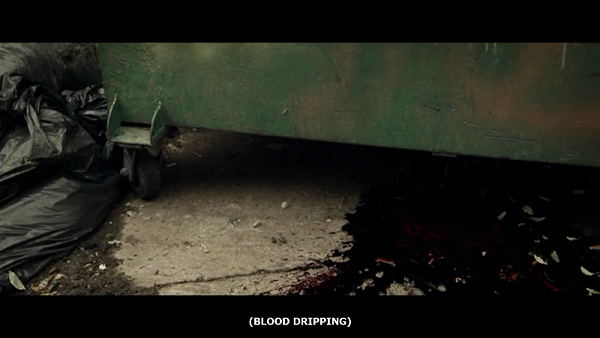
    Green Dragons 8

    but again featuring the film’s characteristic coloring, green, oozing the dark, dark red of blood.

    **

    I was enjoying the film a great deal now, and sat back an allowed myself to move through it as, what, “the speed of film”? But I was in for another shock. There’s a narrative within the narrative, you see, a story told by one brother to the other — and as with all such matrioshka “plays within a play” it is the key to the whole. The elder brother explains to his younger sibling the nature of reality, of strength:

    When I was six, my father took me far into the forest and left me there. Without food, without water. First two days, I cry and I cry. Then, I started to understand the beauty of forest. How big it was. How small I was.

    Soon I come to road, truck take me home. Neither father or mother say anything to me. Not a word.

    I loved them even more after that, because they show me how strong I can be.

    **

    That tale is what the movie is all about, and it is told in forest green.
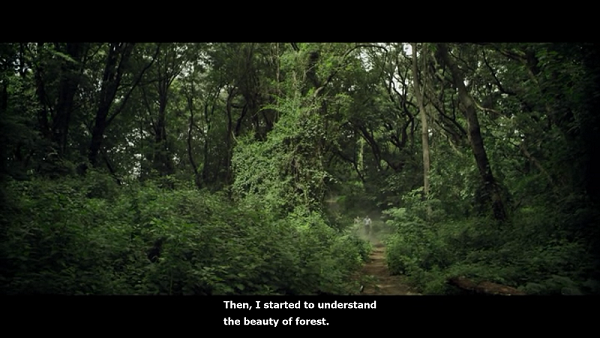
    Green Dragons 9

    The city is left behind, and in otherworldly green Steven tells Sonny this tale as an act of brotherly love —
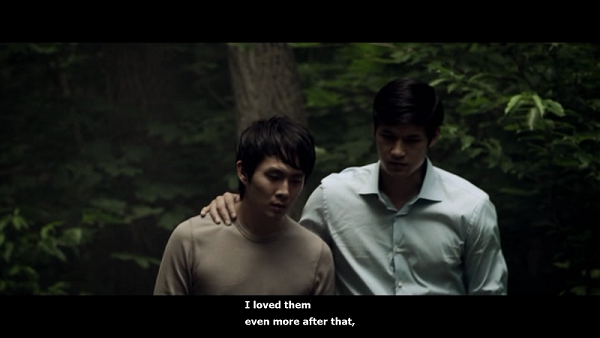
    Green Dragons 10

    as they are approaching the glade where Sonny’s love, Tina

    Green Dragons 11

    before Sonny’s horrified and furious eyes — and strictly according to gang logic —
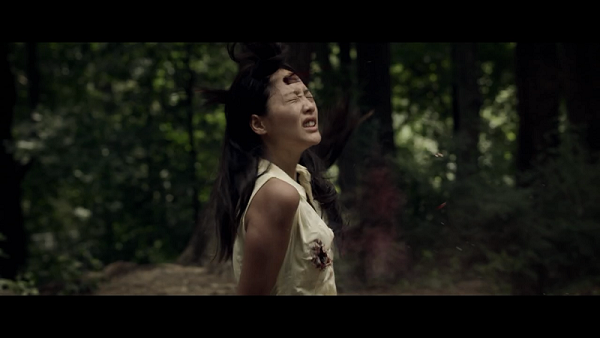
    Green Dragons 12

    is to be executed, spilling that dark red once again into the green.

    **

    I have left out the “story” and given you the “geometry” here — see my recent post on the geometry of the Narcissus / Echo myth.

    Fredric Dannen wrote the New Yorker article on which the film was based, published in 1992. It doesn’t contain the film’s “story within the story” — but it does mention the “forest” —

    They circled around for a while and came across a dirt road. The road ran along the bottom of a ravine and cut through dense woods — an ideal spot for an execution.

    And there’s a flash of brilliant red, too — the real-life Tina’s relatives had placed a red handkerchief in one of her pockets before her cremation:

    According to Chinese custom, if a murder victim is iven something red to wear, the color will “stick to” the killer and he will be caught.

    **

    Read the New Yorker piece, see the film, and keep your eyes peeled for the red in the green.

    Via the keen eye of Caitlin Fitz Gerald

    Saturday, March 7th, 2015

    [ by Charles Cameron — a stunning “DoubleQuote in the Wild” ]
    .

    Caitlin‘s a colleague and digital friend, and I must confess I personally have very little to do with superheroes of any variety, but this DQ of Caitlin’s both captivated and shocked me — captivated me as a DoubleQuote in the Wild (its form), and shocked me with the gendered contrast it records (its content):

    Consider my mind blown, as we used to say.


    Switch to our mobile site