zenpundit.com » 2015 » March

Archive for March, 2015

Variations on the Blue Screen of Death

Saturday, March 7th, 2015

[ by Charles Cameron — where would we be without our digital devices, minds & memories? ]
.

Two converging thoughts, the first from John Robb at Global Guerrillas:

Over the weekend, ISIS threatened the life of Jack Dorsey, a co-founder and Chairman of Twitter. Why? Twitter, at the urging of the US government, has been shutting down the accounts of ISIS supporters for months. So, ISIS supporters responded by making a threat with a nifty graphic:

IS warns Dorsey the Twitter CEO Robb GG

We told you from the beginning it’s not your war, but you didn’t get it and kept closing our accounts on Twitter, but we always come back. But when our lions come and take your breath, you will never come back to life

The CEO as an Objective of War

Unfortunately for the suits in Silicon Valley, ISIS isn’t as much of a pushover as al Qaeda was. They have mass and
momentum and they are smart enough to understand the role of the Internet in this struggle. Additionally, they have lots of experience coercing CEOs. They did it quite a bit of it during the war in Iraq (and it worked).

Regardless, the targeted killing of a well known tech executive in sunny California by ISIS jihadis does appear impossible to imagine. Few places are more remote from each other, and not just geographically. Silicon Valley is a hyperconnected, financially mainlined zone striving for a tech nirvana. ISIS is a disconnected autonomous zone striving to return to the 7th Century. However, that’s probably a bad assumption. Charlie Hebdo showed the world that terrorism is evolving and corporate targeting on global scale is now on the agenda. This means an attack on a tech CEO isn’t just possible, but probable. Worse, once an attack on a senior tech executive happens, future threats will be instantly credible and highly coercive..

If that occurs, we are going to find out very quickly that the corporation, and particularly tech companies, are particularly bad organizations for warfare. One reason is that they are too centralized. In particular, the institution of the CEO is a grave weakness (a systempunkt in global guerrilla lingo). The CEO’s centrality to the corporate network makes him/her a single point of failure for the entire organization. Another is that executives in most of the western world are very soft targets. Easy to find (Google and Google maps), easy to isolate, and easy to kill…

**

And the second from Marc Lindemann, When the Screens Go Dark: Rethinking Our Dependence on Digital Systems, from Small Wars Journal:

In a threat environment where even the most useful digital system may be knocked out of the fight, there needs to be a back-to-basics approach that will enable units to continue to fight effectively in the absence of their digital systems and digital guidance from higher headquarters. Every commander should be able to shut off the TOC’s power, slipping the digital leash, and have confidence that his or her unit can continue to function. Junior leaders and staff sections should be able to anticipate the problems inherent in digital-system failure and know what to do without a major disruption in TOC operations. ADRP 6-0’s non-digital solutions – “establishing trust, creating shared understanding, or providing a clear intent using mission orders” – are significant. More significant, however, and more measurable is the degree of Soldiers’ basic proficiency in their warfighting tasks.

Conclusion

Although this paper does not and cannot advocate the abandonment of the U.S. Army’s existing digital systems, the U.S Army’s dependence on digital systems is very much on its leaders’ minds today. These systems have repeatedly demonstrated the potential to make the U.S. Army a much more efficient and lethal fighting force. Before his retirement, however, GEN Robert W. Cone, then Commanding General, U.S. Army Training and Doctrine Command, gave digital systems an ultimatum: “Why do we want this piece of technology? If it does not dramatically improve training ef?ciency, we need the strength to walk away.” Right now, the military is poised to increase digital training requirements in pursuit of inter-service operations, multinational activities, and the expansion of the network to include all Soldiers and vehicles. Leaders at every level must understand their dependence on digital systems, successfully manage their units’ use of these systems, and promote decentralized initiative in support of clearly defined and mutually understood tactical goals. In the end, Soldiers must have tactical knowledge that transcends anything displayed on a computer monitor. Soldiers, not our digital systems, are what will win our future conflicts. When the screens go dark, the mission must go on.

Well, the military details are way beyond me, though they presumably make sense to other SWJ and ZP readers — but the idea that the net, or large domains within it, may suddenly go dark (or blue, as the saying goes) is one that should give each one of us, dependent as we are on digital media for our communications and memories, considerable plause.

**

It was my friend Peter Rothman — currently editor of H+ Magazine — who wrote the now celebrated digital haiku a few years back:

Windows NT crashed.
I am the Blue Screen of Death.
No one hears your screams
OODA’s Revenge

Saturday, March 7th, 2015

[ by Charles Cameron — when being up to the minute is no longer enough – Berger, Boko and IS ]
.

JM Berger, as I’ve noted many time before and am far from alone in noting, is one of our very best analysts, and someone with a remarkable finger on the pulse of terror. They say the world is speeding up around us — a dubious position philosophically, perhaps, but one that many of us can’t help thinking is somehow correct, even if the phrasing could use some refinement.

Even JM, it seems, can’t blink without one thing becoming another. A few minutes ago, he tweeted:

— followed, I believe it was 26 seconds later, by this:

**

Also worth noting, while we’re on the topic of our most astute analysts:

**

JM Berger and Aaron Zelin — if it was Friday, I’d say, as I have before, #FF Follow Them!

But it’s Saturday, alas, and I’m too late.

How passionate was Red team’s eschatology?

Saturday, March 7th, 2015

[ by Charles Cameron — wondering how close we are to deep recognition of the millenarian nature of IS ]
.

I sense a “change of direction” coming in discussions of terrorism — and IS / Daesh specifically — in the wake of Dempsey‘s declaration “This is an organization that has an apocalyptic, end-of-days strategic vision”, Graeme Wood‘s Atlantic article, What ISIS Really Wants, and Jessica Stern and JM Berger‘s forthcoming book, ISIS: The State of Terror — and once the Stern / Berger book is out in a week or so, I’ll be posting about that change as I see it, and as it affects my writing here on Zenpundit.

In the meantime…

**

The Atlantic Council posted (above) the video of their recent discussion of last month’s war game in which “Eed Team” representing IS / Daesh took on “Blue Team” representing the US. I wasn’t at either that event or the war game itself — the second in their series — but while I was waiting for the feed to be permanently uploaded, I found time to read an account of the first game in the series in October 2014, and ran across this paragraph:

Despite its profound interest in waging holy war against Blue and the enormous symbolism of such a campaign, Red members agreed that it would be prudent to delay the launching of spectacular terrorist attacks against the US homeland. Attacking the United States on its own soil now would bring considerable symbolic and material advantages, but it would also come at the high risk of unleashing the fury of the most powerful military on earth. Washington’s most likely response, Red assumed, would be to escalate militarily and deploy US ground troops to completely root out Red. And once Blue goes “all in,” according to Red, it would most likely be the beginning of the end for Red (that does not mean, however, that Red would not put up a fight and incur heavy losses on Blue before its elimination).

Who were these Red members, and what was their level of understanding of IS / Daesh’s end times thinking, as manifested in the various issues of Dabiq magazine — and recently, since that first war game, noted by Wood in his Atlantic article?

**

The thing is, Dabiq makes it very clear that IS, by reason of its eschatology, both desires US involvement and envisions that its own caliphal troops will be severely reduced in numbers before God grants them the final victory. This is in accord with one of IS / Daesh’s favorite hadiths, quoted more than once in Dabiq:

The Last Hour would not come until the Romans would land at al-A’maq or in Dabiq. An army consisting of the best (soldiers) of the people of the earth at that time will come from Medina (to counteract them). When they will arrange themselves in ranks, the Romans would say: Do not stand between us and those (Muslims) who took prisoners from amongst us. Let us fight with them; and the Muslims would say: Nay, by Allah, we would never get aside from you and from our brethren that you may fight them. They will then fight and a third (part) of the army would run away, whom Allah will never forgive. A third (part of the army). which would be constituted of excellent martyrs in Allah’s eye, would be killed ani the third who would never be put to trial would win and they would be conquerors of Constantinople.

Did anyone on the Red Team quote that hadith in either game?

I ask, because I’m wondering — in terms of that “change of direction” I mentioned above — whether discussion of the apocalyptic driver has reached “critical mass” yet.

The road to Samarra

Friday, March 6th, 2015

[ by Charles Cameron — parroting Somerset Maugham in the context of suicide ops ]
.

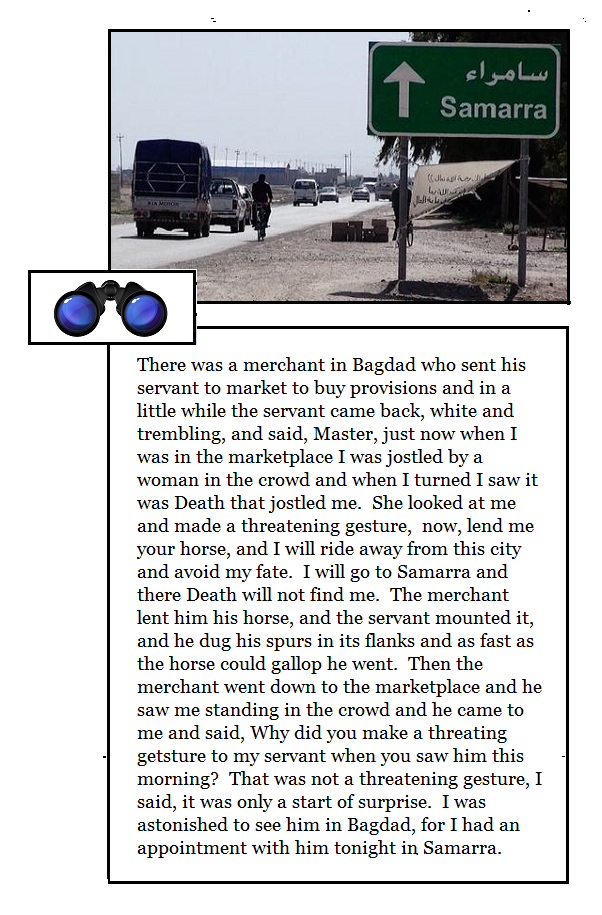
SPEC-Samarra1

The story [lower panel] is Somerset Maugham‘s version of the tale..

**

No news from Samarra since Feb 28th, when Radio Free Europe reported:

IS Militants Attack Samarra

Militants from the radical group Islamic State (IS) have launched an attack on the northern Iraq city of Samarra, where security forces and Shi’ite militia groups have been assembling ahead of an anticipated offensive against IS positions.

Suicide bombers detonated their explosives-laden vehicles in the northern part of Samarra early February 28 and a man in a Humvee also packed with explosives blew up his vehicle in the southern part of the city.

Those who actually volunteer for these suicide missions, however, will find their path to Death in Samarra way more direct.

In Brief: Azzam illustrates Levi-Strauss on Mythologiques

Friday, March 6th, 2015

[ by Charles Cameron — the geometry of two miracle stories from Abdullah Azzam ]
.

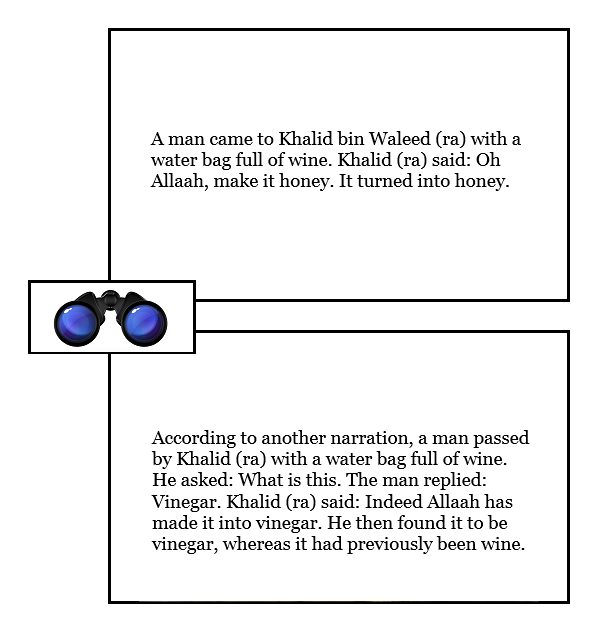
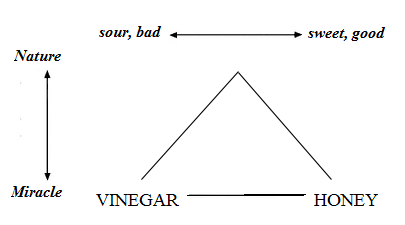
SPEC DQ Azzam honey & vinegar

These two tales are taken from Abdullah Azzam, Signs of ar-Rahman in the Jihad of Afghanistan.

**

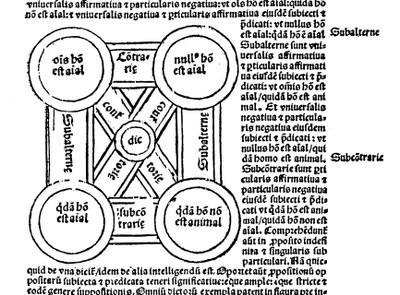
Binary oppositions seem to be basic to the human thought process, and this simple, elegant observation has in turn given rise to a number of interesting philosopphical explorations, some of which are expressed perhaps most powerully in diagrams. I am thinking here of the medieval square of opposition — as in this diagram taken from Georg Reisch, Margarita Phylosophica tractans de omni genere scibili, Basel 1517:

square_of_opposition SEMBL

Algirdas Greimas developed his semiotic square from this medieval diagram —

greimas_semiotic_square

— and defines his square as the “visual representation of the logical articulation of any category”. In his “Towards a Theory of Modalities”, Greimas writes:

the terms manifestation vs. immanence .. can be compared profitably with the categories surface vs. deep in linguistics, manifest vs. latent in psychoanalysis, phenomenal vs. noumenal in philosophy, etc.

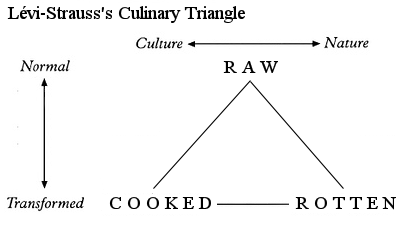
Then there’s Levi-Strauss and his triangle, essentially a variant on the same idea, applied by LS in his magnificent 4-volume Mythologiques to a wide range of myths — here’s the basic triangle for the first volume, The Raw and the Cooked:

LS culinary_triangle

**

What Reisch, Greimas and Levi-Strauss are all doing lies in its own distinct area of “visual thinking” at the confluence of logic, algebra, geometry and conceptual graphs — the same area my own DoubleQuotes and the HipBone and Sembl games are found in.

When people think about narrative — and it is or should be as hot a topic in strategy and counterterrorism as it is in myth, story-telling, film and their various related forms of criticism — they tend to think linearly, from beginning to end, noting the emotional expansions and contractions, the narrative shifts, the crescendos before the climax and its resolution.

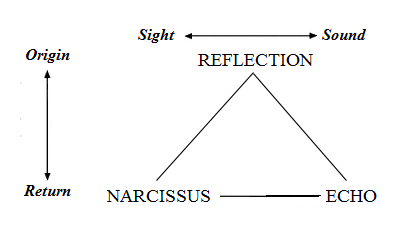
My own style of thinking leans more to the atemporal or synchronic, which in turn is closer to the logical-algebraic-geometric-graphical mode of visual expression. Thus, for me, the “myth of Narcissus” is not a story-line but a geometry, a narrative formulation of the concept of reflection, or “bouncing back”. To adapt the Levi-Strauss triangle to the Narcissus narrative, then, we have:

Reflection triangle

while the two Azzam miracle tales in my DoubleQuote at the top of this post give us:

Azzam triangle

This in turn can become a square if we allow the four coordinates to be wine (intoxicant, bad), water (sobriety, good), vinegar (sour, bad) and honey (sweet, good). We notice here that water (sobriety, good) is the fourth which hovers unmentioned over the twin tales, just as Jung argued the dogma of the Assumption of the Virgin into heaven was the “fourth” which “completed” — nb, this is from a psychological perspective — the celestial Trinity of Father, Son, and Holy Spirit.

It remains for Jalaluddin Rumi to transcend the duality of the halal (sobriety) and the haram (intoxication) in his praise of his master, Shams of Tabriz:

In Shams al-Din-i Tabrizi you will discover a heart which is at once intoxicated and very sober.

**

In what sense or senses are Azzam’s two tales two, and in what sense are they one and the same?

Sources & suggested further readings include:

  • The Raw and the Cooked: Mythologiques, Volume 1
  • Anthropology for Beginners
  • Structure, Sign, and Play in the Discourse of the Human Sciences
  • The Dual and the Real
  • Semiotics for Beginners
  • Semiotics and Language
  • Visual Memory (handbags!)
  • Punctualization: Law and Greimas
  • Square of Opposition
  • Visualizing knowledge
  • Signs of Ar-Rahman
  • Mystical Poems of Rumi

  • Switch to our mobile site