zenpundit.com » 2016

Archive for 2016

Thucydides Roundtable, Book I: Knowing Thyself and Knowing the Enemy

Friday, October 21st, 2016

[by Marc Opper]

The decision to go to war is one with which political leaders have grappled from time immemorial. An integral part of that decision involves an assessment of the political, economic, and military parameters by and belligerents of both themselves and their rivals. In Book I of The Peloponnesian War, Thucydides provides two speeches, one each by the leaders of Sparta and Athens, that reflect what was probably the consensus view of each side in the period immediately prior to the war [1]. In this post I use these speeches as a means to consider how political leaders perceive the world around them and draw on some examples temporally and geographically far-removed from Greece to illustrate the importance of ideology in shaping the decision to go to war and decisions on the strategies belligerents adopt in their pursuit of their goals.

Following the outbreak and conclusion of hostilities between Athens and Corinth over the latter’s colony Corcyra (1:24-1:54) and a series of conflicts between Sparta’s allies and Athens, the Spartans held an assembly of the Peloponnesian League at which they discussed the possibility of going to war with Athens. After speeches from both the Corinthians and the Athenians, the Spartan king Achidamus delivers a speech in which he does not foreclose the possibility of conflict, but emphasizes the importance of undertaking comprehensive preparations for a conflict against

…a people who live in a distant land, who have also an extraordinary familiarity with the sea, and who are in the highest state of preparation in every other department; with wealth private and public, with ships, and horses, and hoplites, and a population such as no one other Hellenic place can equal, and lastly a large number of tributary allies. (1:80:3)

He asserts the importance of monetary resources and states that

war is a matter not so much of arms as of money, which makes arms of use. And this is more than ever true in a struggle between a continental and a maritime power. First, then, let us provide money, and not allow ourselves to be carried away by the talk of our allies before we have done so: as we shall have the largest share of responsibility for the consequences be they good or bad, we have also a right to a tranquil inquiry respecting them

He strikes a remarkably humble tone when he states that

In practice we always base our preparations against an enemy on the assumption that his plans are good; indeed, it is right to rest our hopes not on a belief in his blunders, but on the soundness of our provisions. Nor ought we to believe that there is much difference between man and man, but to think that the superiority lies with him who is reared in the severest school. (1:84:4)

The Spartans acknowledge their inferiority in resources and manpower in comparison to Athens, but believe those deficiencies can be overcome through adequate preparation.

The Athenian king, Pericles, is more verbose in his assessment of Athens and Sparta and far more confident than Achidamus:

As to the war and the resources of either party, a detailed comparison will not show you the inferiority of Athens. Personally engaged in the cultivation of their land, without funds either private or public, the Peloponnesians are also without experience in long wars across sea, from the strict limit which poverty imposes on their attacks upon each other. Powers of this description are quite incapable of often manning a fleet or often sending out an army: they cannot afford the absence from their homes, the expenditure from their own funds; and besides, they have not command of the sea. Capital, it must be remembered, maintains a war more than forced contributions. Farmers are a class of men that are always more ready to serve in person than in purse. Confident that the former will survive the dangers, they are by no means so sure that the latter will not be prematurely exhausted, especially if the war last longer than they expect, which it very likely will. In a single battle the Peloponnesians and their allies may be able to defy all Hellas, but they are incapacitated from carrying on a war against a power different in character from their own, by the want of the single council-chamber requisite to prompt and vigorous action, and the substitution of a diet composed of various races, in which every state possesses an equal vote, and each presses its own ends, a condition of things which generally results in no action at all. The great wish of some is to avenge themselves on some particular enemy, the great wish of others to save their own pocket. Slow in assembling, they devote a very small fraction of the time to the consideration of any public object, most of it to the prosecution of their own objects. Meanwhile each fancies that no harm will come of his neglect, that it is the business of somebody else to look after this or that for him; and so, by the same notion being entertained by all separately, the common cause imperceptibly decays. (1:141:2-7)

The contrast between Achidamus and Pericles is stark because while the latter takes a more comprehensive view of the strengths and weaknesses of his side while the former dwells on the strengths alone. I wish to draw on an example relevant to my own work to show what how these different styles of analysis worked elsewhere.

Mao Zedong is rightly credited as being one of the most effective insurgents in modern history. The ability of the Chinese Communist Party (CCP) to withstand assaults from the Japanese military in Northern and Central China during the Second World War (1937-1945) and its subsequent victory over the Chinese Nationalists (Kuomintang, KMT) demonstrated the wisdom of Mao’s strategic and political approach to revolutionary guerrilla warfare. The CCP’s post-1937 successes were in stark contrast to its complete defeat in Southern China, where between 1927 and 1934 it led an insurgency against the KMT.

The CCP’s failure in Southern China was a product of the overconfidence of the CCP’s leadership in its political and strategic position vis-à-vis the KMT. The CCP saw rural Chinese society as consisting of five socio-economic classes: (1) landlords, (2) rich peasants, (3) middle peasants, (4) poor peasants, and (5) rural laborers. Poor peasants were the numerical majority in the countryside and the CCP-established regime in Southern China, called the Chinese Soviet Republic, was established on a foundation of poor peasants and rural laborers. The CCP leadership believed that their allies in the countryside far outnumbered their enemies and that the force of their numbers and their zeal for revolution would be sufficient overcome the resistance of the KMT.

In 1925, Mao surveyed the fabric of Chinese society and asked: “Who are our enemies? Who are our friends?”

All those in league with imperialism – the warlords, the bureaucrats, the comprador class, and the reactionary intellectual class, that is, the so-called big bourgeoisie in China – are our enemies, our true enemies. All the petty bourgeoisie, the semiproletariat, and the proletariat are our friends, our true friends. As for the vacillating middle bourgeoisie, its right wing must be considered our enemy; even if it is not yet our enemy, it will soon become so. Its left wing may be considered as our friend – but not as our true friend, and we must be constantly on our guard against it. How many are our true friends? There are 395 million of them. How many are our true enemies? There are one million of them. How many are there of these people in the middle who may either be our friends or our enemies? There are four million of them. Even if we consider these four million as enemies, this only adds up to a bloc of barely five million, and a sneeze from the 395 million would certainly suffice to blow them down. [2]

Though Mao’s own positions evolved considerably after this early analysis, those of his peers (and those who were in charge of the CCP at the time) did not [3]. The course of the revolution in Southern China ultimately proved the CCP wrong. The CCP’s myopic focus on the advantages of its own position and its unwillingness to countenance its potential and actual weaknesses drove it to double-down on strategies that were counterproductive to its cause. Its focus on poor peasants alienated both the rural middle class and rural elites, two crucial groups who eventually defected to the KMT when the CCP’s military was defeated.

The CCP’s military defeat was a product of similarly myopic thinking. Militarily, the CCP initially combined a number of tactics pioneered by Mao Zedong: (1) “strengthening the defenses and clearing the fields” (jianbi qingye); evacuating civilians from areas within striking distance of KMT forces, removing any food or livestock of which the KMT could make use, and destroying infrastructure critical to the KMT war effort such as roads and bridges. It then (2) lured the enemy into areas under its control (youdi shenru), but did not initially engage. Instead, it waited for them to disperse and then overpowered smaller units and attacked KMT reinforcements. After Mao was removed from his post by his political rivals within the CCP, the Red Army adopted conventional tactics, concentrating its forces and sending them into pitched battles of attrition against conventional KMT forces. The results were catastrophic and eventually sent the CCP on a 9,000 kilometer retreat known as the Long March.

After Mao took control of the CCP, he undertook a comprehensive reform of Party policy [4]. The philosophical foundation of Mao’s approach to both military and political policy is “On Practice,” a 1937 essay in which Mao states in no uncertain terms that

Marxists hold that man’s social practice alone is the criterion of the truth of his knowledge of the external world…If a man wants to succeed in his work, that is, to achieve the anticipated results, he must bring his ideas into correspondence with the laws of the objective external world; if they do not correspond, he will fail in his practice. After he fails, he draws his lessons, corrects his ideas to make them correspond to the laws of the external world, and can thus turn failure into success; this is what is meant by ‘failure is the mother of success’ and ‘a fall into the pit, a gain in your wit.’ [5]

Mao’s statements may seem like common sense, but Mao did more than enumerate a dialectical relationship between theory and practice; he institutionalized them in the CCP and the Red Army. As a result, generals and commanders could utilize the tactics that best fit the situation they faced and administrators could formulate policy that both adhered to the spirit of the CCP’s United Front policies and conformed to local conditions [6]. At the CCP center, Mao and his colleagues emphasized the importance of formulating policy based on a comprehensive and realistic analysis of the CCP’s political and military programs. The rejection of dogmatism at the center was mirrored at the local level, ensuring that sober analysis rather than blind faith guided the implementation of policy.

Fellow contributor Cheryl Rofer highlighted the stark disjunction between the perceptions of American policymakers in the run-up to the Iraq War and the reality of the war and occupation on the ground and the perception of Russian policymakers prior to their intervention in Syria and the reality on the ground. The verdict has yet to be written on the latter, but analyses of the US’s intervention in Iraq have rightfully condemned the US’s complete lack of proper planning. Optimistic assessments by men like Paul Wolfowitz and Dick Cheney (both quoted by Cheryl in her post) are illustrative of an approach to strategic analysis that overestimates advantages and minimizes potential problems. While that may not guarantee ultimate defeat in a war, it is certainly not a recipe for success.


References:

[1] In his introduction to The Landmark Thucydides, Victor Hanson notes the tension between “contrivance (‘to make the speakers say what was in my opinion demanded of them’) and historical exactitude (‘adhering as closely as possible to the general sense of what they really said’)” in the speeches Thucydides includes in The Peloponnesian War. Accepting that the contents may not be verbatim transcripts of what the orators said, Thucydides includes the speeches to which I refer in this post as a means to illustrate, among other things, the beliefs and preferences of the main actors in the Peloponnesian War. Thucydides. The Landmark Thucydides: A Comprehensive Guide to the Peloponnesian War. Edited by Richard Crawley. New York: Free Press, 1996, pg. xv-xvi, xxii-xxiii.

[2] Mao Zedong. 1925. “Analysis of the Classes in Chinese Society.” In Stuart R. Schram and Nancy J. Hodes, eds. Mao’s Road to Power: Revolutionary Writings, 1912-1949: Volume II: National Revolution and Social Revolution, December 1920-June 1927. Armonk, NY: M.E. Sharpe, 1994. Pg. 249.

[3] This period in Chinese history is best covered by Womack, Brantly. The Foundations of Mao Zedong’s Political Thought, 1917-1935. Honolulu: University Press of Hawaii, 1982. See also Rue, John E. Mao Tse-Tung in Opposition, 1927-1935. Stanford, Calif.: Stanford University Press, 1966. Huang, Philip C. C. “Mao Tse-Tung and the Middle Peasants, 1925-1928.” Modern China 1, no. 3 (1975): 271–96.

[4] The best account of Mao’s rise to power after the Soviet period is Gao Hua ??. Hong taiyang shi zenyang shengqi de: Yan’an zhengfeng yundong de lailong qumai [How the Red Sun Rose: A History of the Yan’an Rectification Movement]. Hong Kong: Chinese University Press, 2000.

[5] Mao Zedong. 1937. “On Practice.” In Selected Works of Mao Tse-Tung, Vol. 1. Peking: Foreign Language Press, 1961. Pg. 296.

[6] For a general discussion of the United Front, see Van Slyke, Lyman P. Enemies and Friends: The United Front in Chinese Communist History. Stanford, Calif.: Stanford University Press, 1967. For a discussion of the United Front in practice during the Second World War in Northern China, see Selden, Mark. China in Revolution: The Yenan Way Revisited. Armonk, NY: M.E. Sharpe, 1995.
Thucydides Roundtable, Book I: It Would Be A Great War

Thursday, October 20th, 2016

[by Cheryl Rofer]

soldiers-marching-through-epsom


My approach to Thucydides, or any other ancient book, is almost diametrically opposite to Tanner Greer’s. It is indeed fascinating to contemplate how people thought in another time, the differences from today’s thinking, to put oneself in the mind of another. I try to do all those things from time to time, but my emphasis is often different.

After suffering through the archaic language of Julius Caesar and Macbeth in high school, I made an agreement with my English teacher: I would not read Hamlet, and he would give me a D for that report period. It seemed fair enough to me. Fighting through the language made it impossible for me to see anything else Shakespeare offered, when there were books I could read and enjoy that contained as much wisdom.

There are reasons to read the classics: to be on the same page with others who have incorporated them into their thinking, and to learn the lessons of difference that Greer describes and the lessons of similarity that I will concentrate on. I have not read Thucydides before, so my essays will be first impressions, overlaid with what I’ve read about Thucydides from more current authors. And yes, I will pluck out themes that still resonate today.

***

Greer mentions a fact that I could not shake as I read through Book One: that these were very small groups of men compared to what we think of as war in today’s world, although there may be comparisons to the ongoing war in Ukraine’s Donbas, and perhaps to some of the wars in Africa. Possibly all the factions in Syria. Another fact is that deliberations and execution of wars were by men alone, in a society that viewed women as not terribly different from slaves.

But some things remain the same. Victor Davis Hanson points to one, from Thucydides’s opening words:

…it would be a great war, and more worthy of relation than any that had preceded it.

Hanson points out that

the Peloponnesian War was a twenty-seven-year nightmare that wrecked Greece.

Great, of course, does not carry positive connotations only. It can mean more than large, enormous, as in the European name for World War I, the Great War, which is perhaps Thucydides’s meaning.

For a historian, both meanings can apply. Thucydides hit the academic jackpot, still being read almost 2500 years after he wrote. Others, too, can benefit from a war: Vendors of war materiel, those who can attach their political programs to the war, and thrill seekers.

There is also the difference between perception and reality. It is easy to consider a war great in the positive sense, engaging, bringing fame and honor, uplifting, before it starts. We will put the wrongdoers in their place. Our technological capabilities, our vigor and bravery, our strategies cannot but prevail.

From Pericles’s speech beginning at 1.141.432.1:

As to the war and the resources of either party, a detailed comparison will not show you the inferiority of Athens. Personally engaged in the cultivation of their land, without funds either private or public, the Peloponnesians are also without experience in long wars across sea, from the strict limit which poverty imposes on their attacks on each other. Powers of this description are quite incapable of often manning a fleet or often sending out an army: they cannot afford the absence from their homes, the expenditure from their own funds; and besides, they have not command of the sea.

….

Did not our fathers resist the Persians not only with resources far different from ours, but even when those resources had been abandoned; and more by wisdom than by fortune, more by daring than by strength, did not they beat off the barbarian and advance their affairs to the present height? We must not fall behind them, but must resist our enemies in any way and in every way, and attempt to hand down our power to our posterity unimpared.

This has an all too familiar ring. Analytical psychologists call it motivated reasoning: adducing the favorable evidence while leaving out the unfavorable. But war is uncertain and contains surprises. Pericles recognizes this uncertainty at the beginning of this speech and brushes it aside:

For sometimes the course of things is as arbitrary as the plans of man; indeed this is why we usually blame chance for whatever does not happen as we expected.

World War I was welcomed by many Europeans as a way to regain a lost virility and vigor. Enthusiasm for it was shared by the governments, the young men who would die, and their sweethearts.

Ernst Jünger in Storm of Steel: “We had come from lecture halls, school desks and factory workbenches, and over the brief weeks of training, we had bonded together into one large and enthusiastic group. Grown up in an age of security, we shared a yearning for danger, for the experience of the extraordinary. We were enraptured by war.”

General Friederich von Bernhardi, Prussian general and military historian, bestselling author: War is “a biological necessity,” “the natural law, upon which all the laws of Nature rest, the law of the struggle for existence.”

The reality of that war and the war after shocked people out of a public love for war, but the inclination remains.

Paul Wolfowitz anticipated an easy victory in Iraq in 2003:

There has been a good deal of comment — some of it quite outlandish — about what our postwar requirements might be in Iraq. Some of the higher end predictions we have been hearing recently, such as the notion that it will take several hundred thousand U.S. troops to provide stability in post-Saddam Iraq, are wildly off the mark. It is hard to conceive that it would take more forces to provide stability in post-Saddam Iraq than it would take to conduct the war itself and to secure the surrender of Saddam’s security forces and his army — hard to imagine. (House Budget Committee testimony on Iraq February 27, 2003)

There’s a lot of money to pay for this. It doesn’t have to be U.S. taxpayer money. We are dealing with a country that can really finance its own reconstruction, and relatively soon. (Congressional Testimony, March 27, 2003)

Similarly, Vice President Dick Cheney:

The read we get on the people of Iraq is there is no question but what they want to get rid of Saddam Hussein and they will welcome as liberators the United States when we come to do that. (Meet The Press with Tim Russert, March 16, 2003)

[In response to “We have not been greeted as liberators.”] “Well, I think we have by most Iraqis. I think the majority of Iraqis are thankful for the fact that the United States is there, that we came and we took down the Saddam Hussein government. (Meet The Press with Tim Russert, September 14, 2003)

More recently, Vladimir Putin put the Russian military into Syria for the few months he believed it would take to help Bashar al-Assad take control back. That was a year ago. The Duma just voted to keep a military presence in Syria for the indefinite future. In between, there were a couple of attempts to end that presence, both unsuccessful. One may imagine assurances from the generals in the summer of 2015 that sounded very much like Pericles’s. Or Putin’s confidence that the Russian-speakers of the Donbas would welcome the chance to associate with the mother country.

There are many more examples. The impassioned pleas that if only the United States would intervene more forcefully in Syria – specifics unknown – also represents this faith in war as the answer.

Before the fighting starts, an honest analysis may even favor one’s own side. Often both sides are willing to wage war, as Thucydides documents, which should give pause to analysts. Motivated reasoning plays its part. Ignoring the many openings for what Pericles sells short as “chance” also helps provide an optimistic analysis. War seems like a way to bring about a decisive ending to an unfortunate situation. It provides a testing ground for manhood and national pride.

It would be a great war.


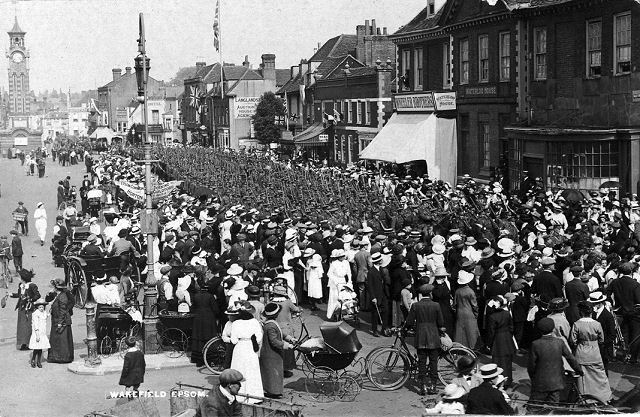
Photo: Soldiers marching through Epsom, UK, during World War I.

Hinnary, or: Google Image Search, meet Hillary Clinton

Thursday, October 20th, 2016

[ by Charles Cameron — artificial intelligence at the intersection of religion and politics ]
.

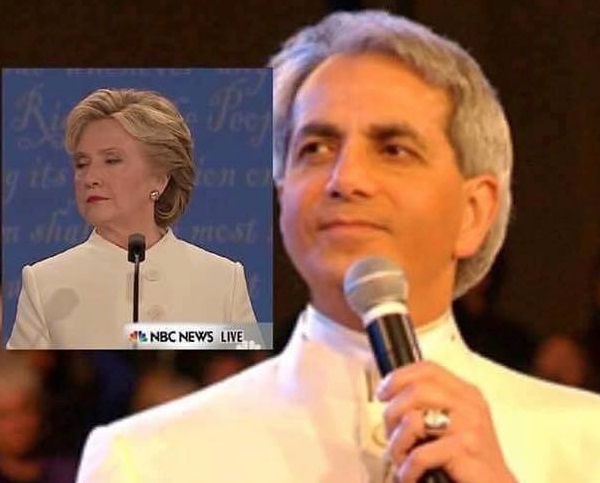
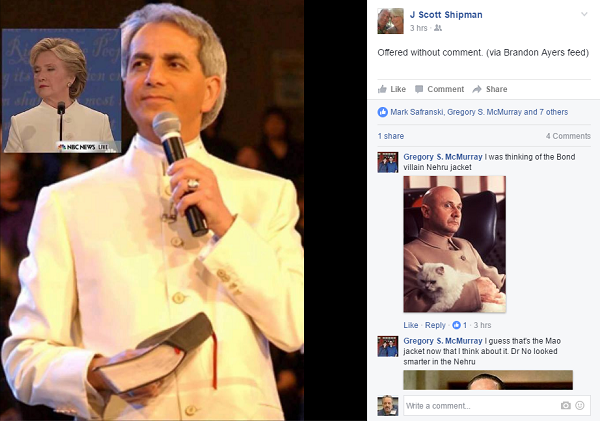
Our own J Scott Shipman posted what I term a DoubleQuote on Facebook this morning, offering a juxtaposition of politician Hillary Clinton and preacher Benny Hinn:

scotts-dq

I’ve enlarged it and cropped it lengthwise to give you a proper appreciation of the comparison.

hinnary-clinton

**

Okay, I thought, Scott’s doing an informal DoubleQuote, let me see if I can find the two images and rework them into one of my regular DoubleQuote formats. Only it wasn’t that easy. The only versions of the Hinn photo I could find were too small for my format, and the Hillary image wasn’t a photo but a screencap from a video — I could find a similar screencap from another TV channel, but not the exact one Scott had found.

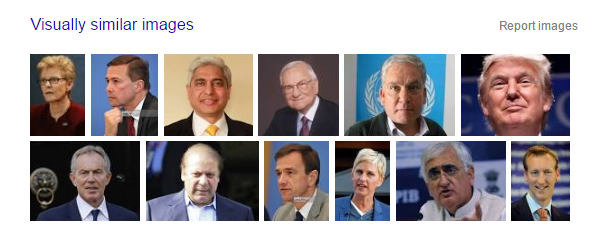
As you’ve seen above, I finally settled for cropping and enlarging the image Scott had provided — but along the way I ran across another instance of the intelligence of artifice — in this case, Google Image Search’s recognition technology:

google-image-search-meet-hillary-clinton

Ah — but spokesperson for what or whom?

**

I’m relieved to say that while Google is in general a brilliant, cutting-edge, genius of a search engine, it’s clearly not following the current Presidential race with any enthusiasm.

You see that lady? She’s one of the candidates, and she was on several TV channels and online streaming sites just last night.

There’s another candidate, who probably looks pretty much the same to you:

similar

I don’t think my telling you all this will make you more artificially intelligent — but it might make you a little better informed about current affairs.

DoubleQuoting Blake on Guinea and Sun

Thursday, October 20th, 2016

[ by Charles Cameron — an appendix to The importance of Albrecht Dürer ]
.

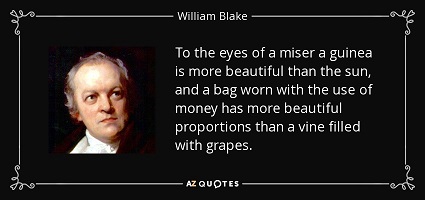
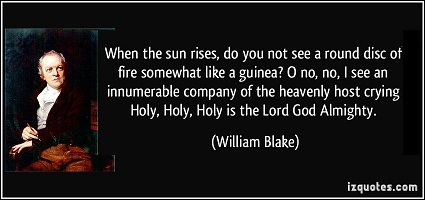
On two separate occasions Blake compares a guinea (a coin worth one pound and one shilling) and the sun:

blaketo-the-eyes-of-a-miser

In the quote above, we see things as they appear “to the eyes of a miser”, while in that below, we see them through the eyes of the Poet:

blake-when-the-sun-rises

Blake continues that second quote, by saying “I question not my Corporeal or Vegetative Eye any more than I would Question a Window concerning a Sight: I look thro it & not with it.” Hence my distinguishing between “as they appear” in the miser’s eyes and “through” the poet’s eyes..

**

The two quotes, taken together, freshly demonstrate the gulf between the two views so forcefully expressed in the second — the topic of my earlier post, The importance of Albrecht Dürer

The importance of Albrecht Dürer in grokking ISIS

Thursday, October 20th, 2016

[ by Charles Cameron — because the world of the jihadists resembles Dürer’s more than it does our own? ]
.

It’s extraordinary the insight that an appreciative acquaintance with Albrecht Dürer provides, in attempting to understand ISIS not just theoretically but imaginatively, and thus viscerally.

Under the title ISIL Boasts: America will go down to defeat in the Streets of Mosul Juan Cole blogs [emphasis mine]:

AFP is reporting that a news agency linked to Daesh (ISIS, ISIL), “A`maq,” is carrying a video of a Daesh fighter who swears that he and his colleagues will inflict a decisive defeat on the US in Iraq, as the guerrillas spread through the streets of the city. He addresses the camera saying, “As for you, America, we promise you that which our honored elders promised you, God bless them, such as Abu Mus`ab (al-Zarqawi) and Abu `Umar and Abu Hamza [etc.].”

The threats don’t make any sense. The US does not have infantry combat troops at the front lines, and is mainly intervening with fighter jets and bombers. If you are a small guerrilla group, you really cannot match that firepower. There is no obvious way in which Daesh could inflict harm on the US in Mosul.

How about a non-obvious way?

**

For the apocalyptic true believers of ISIS, these verses (ayat, which also refers to “signs”) from the Qur’an ring true today:

When thou saidst to the believers, ‘Is it not enough for you that your Lord should reinforce you with three thousand angels sent down upon you? Yea; if you are patient and godfearing, and the foe come against you instantly, your Lord will reinforce you with five thousand swooping angels.’

Qur’an 3.124-25

We may have lost sight of the angels, and for that matter the dragon, the horsemen, the “woman clothed with the sun, and the moon under her feet, and upon her head a crown of twelve stars” and the “Lamb which is in the midst of the throne” — in our western mostly post-Christian tradition, but John of Patmos and Albrecht Durer saw them, in what we now think of as “the sky”, familiarly known in their days as “the heavens”.

But is that our clarity or our blindness?

**

If we are to understand ISIS, we need an analytic framework which doesn’t automatically exclude angels from its purview — as I argued somewhat more broadly in my essay The Dark Sacred: The Significance of Sacramental Analysis in Robert Bunker‘s Blood Sacrifices [Kindle, $3.99].

We are dealing with a subset of that culture wherein poetry is as highly valued as it is lowly valued in our own — as Shahab Ahmad tells us in What is Islam, “the poetical discourses of Muslim societies” are “the form of speech regarded as the highest register of human self-expression and social communication.”

And we are easily blind to such things. Thomas Hegghammer, in his Paul Wilkinson Memorial Lecture at the University of St. Andrews, Why Terrorists Weep: The Socio-Cultural Practices of Jihadi Militants, writes:

It took me a long time to even notice these things. I’ve studied jihadi groups for almost fifteen years, and for the first ten, I was addressing standard questions, like, how did group A evolve, what has ideologue B written, who joins movement C, etc. The thing is, when you study one type of group for a while, you take certain things for granted. I knew that these groups were weeping and reading poetry, but it didn’t really register – it was background noise to me, stuff I needed to shove aside to get to the hard information about people and events.

Hegghammer goes on to comment that “soft” activities — he names weeping, reading and reciting poetry, dreaming — “pose a big social science puzzle, in that they defy expectations of utility-maximising behaviour.”

We tend to the “utility-maximizing” end of a philosophical spectrum (running, as per my example above, from “heaven” to “sky”) but they do not.

Oh, no. They do not.

**

To understand the poetics of jihad, and thus the passions it arouses, we must first glimpse the visionary faculty that is implicit in our own so easily disregarded poetry.

Thus William Blake, in his A Vision of the Last Judgment:

“What,” it will be Questioned, “When the Sun rises, do you not see a round Disk of fire somewhat like a Guinea?” O no no, I see an Innumerable company of the Heavenly host crying “Holy Holy Holy is the Lord God Almighty.” I question not my Corporeal or Vegetative Eye any more than I would Question a Window concerning a Sight: I look thro it & not with it.


Switch to our mobile site