zenpundit.com » 2016

Archive for 2016

Loading up for Survival, Church and State

Tuesday, August 30th, 2016

[ by Charles Cameron — Merkel’s under attack for recommending Germans keep a two-week supply of food ]
.

Mormon faithful are exhorted by the First Presidency of their Church in a pamphlet titled All is safely gathered in “to prepare for adversity in life by having a basic supply of food and water and some money in savings.” Specific recommendations follow:

THREE-MONTH SUPPLY

Build a small supply of food that is part of your normal, daily diet. One way to do this is to purchase a few extra items each week to build a one-week supply of food. Then you can gradually increase your supply until it is sufficient for three months. These items should be rotated regularly to avoid spoilage.

DRINKING WATER

Store drinking water for circumstances in which the water supply may be polluted or disrupted. If water comes directly from a good, pretreated source then no additional purification is needed; otherwise, pretreat water before use. Store water in sturdy, leak-proof, breakage-resistant containers. Consider using plastic bottles commonly used for
juices and soda. Keep water containers away from heat sources and direct sunlight.

FINANCIAL RESERVE

Establish a financial reserve by saving a little money each week and gradually increasing it to a reasonable amount (see All Is Safely Gathered In: Family Finances guide).

LONGER-TERM SUPPLY

For longer-term needs, and where permitted, gradually build a supply of food that will last a long time and that you can use to stay alive, such as wheat, white rice, and beans. These items can last 30 years or more when properly packaged and stored in a cool, dry place. A portion of these items may be rotated in your three-month supply.

That’s a pretty comprehensive survival plan, and while it allows for those who are just starting to prepare themselves to begin incrementally, it’s first real target is three months’ preparedness and longer-term vision extends out to thirty years.

Note that the motivation here is to live in accordance with the divine will as it may be applicable to human circumstance.

**

Compare that with what the secular state of Germany is currently proposing. Deutsche Welle, under the heading What emergency supplies do you need? reports the following:

Germany’s government is mulling a plan requiring citizens to stock up on food and supplies in case of a natural disaster or armed attack. So what should you have in your pantry? Here’s our comprehensive checklist.

The stockpile plan outlined in the government’s “Concept for Civil Defense” paper obligates Germans to store 10 days’ worth of food and five days’ worth of drinking water. The idea is for people to have enough supplies – including cash and medicine – on hand to get them through an emergency situation before government assistance kicks in.

The level of preparedness proposed in the paper hasn’t been seen since the end of the Cold War. The strategy was originally commissioned by a parliamentary committee in 2012, but its release now comes amid a raft of new security measures and heightened terror concerns. Still, its contents aren’t new – German authorities have long urged households to store two weeks’ worth of emergency supplies.

The Federal Office for Civil Protection and Disaster Assistance, for example, has published a checklist online with recommended supplies for a 14-day period. The most important thing on the list is water – 28 liters per person for a fortnight, or around two liters per day. People can survive a few weeks without food, but only four days without liquid.

The Ministry of Food even has an online “calculator” to help you work out what kind of food – and how much – to stock up on. It recommends 4.9 kilograms of cereal-based products like rice, bread and noodles per person per fortnight. It also suggests 5.6kg of veggies, 3.7kg each of milk products and fruit and nuts, and 2.1kg of fish and meat. All food should be able to last without refrigeration.

The government also advises keeping a medicine cabinet stocked with supplies in case it’s not possible to get to a hospital. That means, among other things, a first aid kit, the necessary personal prescription drugs, cold medicine, painkillers, anti-diarrhea and nausea medicine, electrolytes, a thermometer and disinfectant.

Here the anticipated survival time is two weeks, or fourteen days.

**

I don’t know what the prophets, seers, and revelators of the First Presidency have been shown, what ISIS may be plotting, what German intelligence suspects, nor what the future has in mind for us. I do know that Matthew 6.34 counsels:

Take therefore no thought for the morrow: for the morrow shall take thought for the things of itself. Sufficient unto the day is the evil thereof.

and that this is generally considered sufficient precaution for the lilies of the field, but that readers of John Robb may well find it insufficiently flexible — if taken literally — to survive encounters with a succession of inbound black swans. And as is often the case with scripture, preparedness too has its place, as indicated by the “kingdom” parable of the wise and foolish virgins of Matthew 25.1-13.

I note here that the spiritual claims of the Church of Jesus Christ of Latter-day Saints affords the First Presidency the opportunity to call for far more extensive planning than the German Chancellor can ask of her citizens without considerable brouhaha.

Hence:

Three months (minimally) to two weeks (suggested) is the recommended preparedness ratio between the (Mormon) Church and (German) State.

Whence does authority derive?

A Plethora of New(ish) Books I.

Monday, August 29th, 2016

[Mark Safranski / “zen“]

Image result for goddess of the market  Image result for a gentle madness  Image result for small wars and faraway places burleigh

Image result for warfare in antiquity delbruck    Image result for on killing  Image result for Gulag applebaum  Image result for muqqadimah   Image result for denial klehr haynes  Image result for the restoration of rome Image result for excellent sheep

Goddess of the Market by Jennifer Burns
A Gentle Madness by Nicholas A. Basbanes
Small Wars, Faraway Places by Michael Burleigh
Warfare in Antiquity by Hans Delbruck
The Libertarian Mind by David Boaz
On Killing by LTC. Dave Grossman
Gulag: A History by Anne Applebaum
The Muqaddimah by Ibn Khaldun
In Denial: Historians, Communism & Espionage by John Earl Hynes and Harvey Klehr
The Restoration of Rome by Peter Heather
Excellent Sheep by William Deresiewicz

Nothing makes me happier than buying a new batch of books. So I did. In a large enough number to require two separate posts.

A Gentle Madness intrigued me, naturally enough, when I caught it years ago on the old C-Span Booknotes program, the book jacket mirrors the look of the old, fine press, book cover. Some of the authors, Burleigh, Boaz, Haynes and Klehr have written works I have enjoyed and already have on my shelf ( I used to be on a listserv with the last authors years ago in the pre-blogging era. Careful and smart scholars they were). On Killing is widely cited and remains controversial in military academic circles and two of the other books are classics.

I’m not reading any of these books at present. My time is currently occupied by with The Landmark Thucydides in preparation for the upcoming Thucydides Roundtable in October and also with Coming Apart by libertarian intellectual and gadfly Charles Murray (seemed appropriate given the election cycle).

What are you reading?

McCants explains the Saudis, Quantico rebukes them

Friday, August 26th, 2016

[ by Charles Cameron — Saudi-sourced jihadism, the FBI, Baader-Meinhof — hey, it’s all about terrosism ]
.

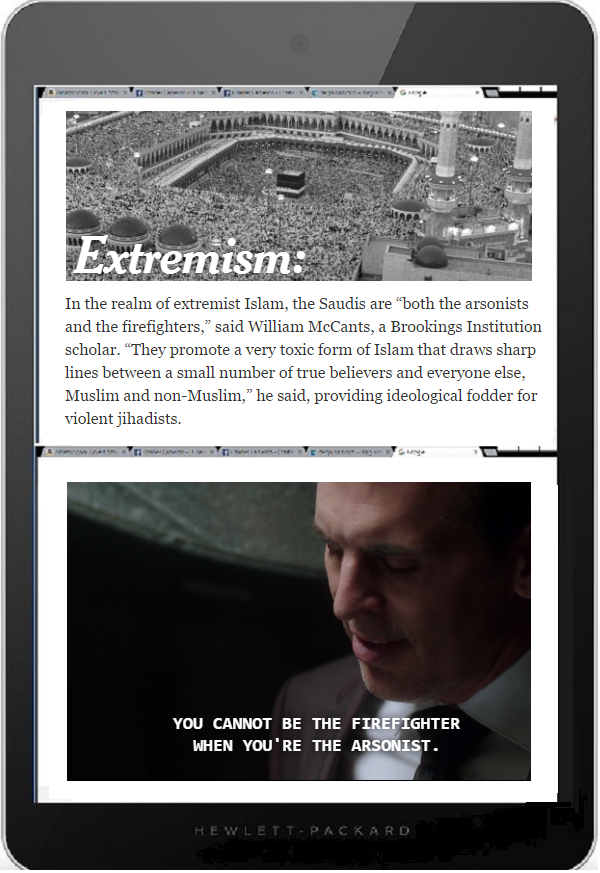
Will McCants explains [upper panel, below] how the Saudis are and are not promoting terrorism —

Tablet DQ 600 arsonist

— while a screen-cap from episode 9 in the first season of Quantico explains just why such an approach is logically bound to be defective.

**

Oh well, not to worry. It’s just another example of the illusion colloquially known as the Baader-Meinhof phenomenon. I wouldn’t want to go all irrational on you, so I’ll let RationalWiki explain:

The frequency illusion (also known as the Baader-Meinhof phenomenon) is the phenomenon in which people who just learn or notice something start seeing it everywhere.

Except that — well, there it is again — Baader-Meinhof — it’s all terrorism!

The positively Abrahamic game of Chess

Tuesday, August 23rd, 2016

[ by Charles Cameron — interfaith rivalry on the checkered board ]
.

Many of you will be familiar with the Christian and Muslim playing chess in this illustration from El Libro de los Juegos or Book of Games of Alfonso X of Castile:

— but let’s not forget that Andalusia was also home to learned Jews, including the great Maimonides. In this illustration to the same work, we see a match-up between Muslim and Jew:

Announcing: The Thucydides Roundtable

Tuesday, August 23rd, 2016

[by T. Greer]

There was once a time when the first thing I would do in the morning was rush to the computer so that I might check the comment threads of the five to ten blogs I followed on national security and strategic theory. It was the golden era of the old Strategy Sphere: a time when the debates swirling around the internet had real intellectual heft and all arguments were conducted with a fierce sense of urgency. I have written about era—what it was like to be a participant in its debates, and what caused that old community to slowly fall apart—before. That retrospective ended on a sad note, questioning whether or not the spirit of those days could ever be recaptured.

I think it might just be possible.

One of the most compelling forums for discussion in those days were the statecraft roundtables. The idea behind all the roundtables was to gather together a diverse group of strategy and history focused bloggers to read and discuss a classic in the field. We would read the book chapter by chapter, each participant chronicling their reaction to the author’s—and each other’s—arguments as we read. Part long distance book club, part public forum, every roundtable was a cocktail of different ideas and perspectives that anyone would learn from, be they newcomers to the strategy scene, practitioners in the field, or well credentialed experts dwelling in think tanks and ivory towers.

Last week the editors of the Clausewitz Roundtable—held eight years ago on Chicago Boyz—published an edited version of the roundtable tour through Carl von Clausewitz’s On War. It can be purchased for $3 on Amazon. For its price it’s a fine little read, both for the insights each author brings to On War and its theories, but also because it gives you a peek into what the blogosphere once was—and what it once again might be. The wide ranging discussions of politics, history, war, and power had in the comment threads of that roundtable are exactly the kind of thing that deserve to return to blogosphere.

And so it will be.

I am proud to announce the upcoming Thucydides Roundtable, to be hosted at the group blog Zenpundit in October 2016.

Thucydides is a man of firsts. He has been called the father of realism, the first “theorist of war” in the Western tradition, the inventor of political science and international relations, the first man to ever attempt an objective and evidence based history of the world he lived in, and many other things besides. In the two thousand years since they were first written, his words have been used and abused by historians, poets, social scientists, and statesmen from one side of the Earth to the other. His chronicle of the thirty year war waged between his native Athens and her rival Sparta has just about everything in it. I really do mean everything. No great or enduring theme of the human experience is left untouched—war and international order of course make their appearance, but so do meditations on statesmanship, bargaining, courage, partisanship, justice, ethics, ambition, greed, honor, religion, culture, history, and so much more. His History of the Peloponnesian War is not just the story of a quarrel between Athenians and Lacedaemonians in the 5th century BC. It is a story about all of mankind.

Or at least this is what Thucydides hoped it would be.

I invite you to discover for yourself if Thucydides’ ambition was realized by reading his work with us. We will officially kick off the roundtable discussion at Zenpundit in mid-October. In the weeks to come we will publish the full list of official participants as well as the Roundtable’s official rules of engagement. Until then, I encourage you to go out and purchase the Landmark Thucydides to get a head start on the reading. It’s a big book, but one well worth reading.

In the meantime, add Zenpundit to your feeds or like our Thucydides Roundtable Facebook page to stay updated on the roundtable’s schedule and progress.

[Cross-posted from The Scholar’s Stage]


Switch to our mobile site