zenpundit.com » 2016

Archive for 2016

Brexit: gunpowder, treason and plot?

Saturday, June 25th, 2016

[ by Charles Cameron — conspiracies in the lead up to Jo Cox’s death and the Brexit referendum ]
.

Amil Khan, aka Londonstani, is a London-based journalist and author of The Long Struggle: The Muslim Worlds Western Problem. If I recall correctly, he was roommate for a while with Andrew Exum, aka Abu Muqawama, and a frequent contributor to Exum’s Abu Muqawama blog.

**

Here are three tweets I found that answer Londonstani‘s question — two conspiracy theories and a conspirator with motive:

and:

and by way of motive:

**

See also:

  • Washington Post, Pencil or pen? An unusual conspiracy theory grips Brexit vote.
  • Veterans Today, BREXIT victory shocks NWO – were “conspiracy theories” responsible?
  • Qur’an 8.30: And Allah is the best of plotters.

    Who am I? I am my motto!

    Saturday, June 25th, 2016

    [ by Charles Cameron — a curious similarity between the courtroom appearances of the Orlando and Jo Cox killers ]
    .

    The Orlando killer’s court appearance is featured in the upper panel below, the appearance of Jo Cox MP’s killer in the lower panel:

    I am my motto DQ

    Sources:

  • WSVN, Orlando shooter’s partial 911 transcript
  • Reuters, Jo Cox murder suspect says name
  • **

    It is generally true that one’s name stands for one’s entire identity — which in my own case would include my personalities as a father, friend, poet, blogger, game designer, analyst of apocalyptic, lover of the beloved. To give an ideological response — a motto — repeatedly, when asked one’s name would indicate an uncanny degree of single-mindedness, of focus, of purpose.

    Scott Atran‘s work, eg his paper, Devoted actors sacrifice for close comrades and sacred cause, would be of interest here:

    Studies across cultures suggest that the strongest forms of primary group identity are bounded by sacred values, often in the form of religious beliefs or transcendental ideologies, which leads some groups to prevail because of nonrational commitment from at least some of its members to actions that drive success independent — or all out of proportion — from expected rational outcomes. For such “devoted actors,” rightness of in-group cause often leads to intractable conflicts with out-groups that become immune to the give-and-take common to “business-like” negotiations.

    Thus, our interviews with United States officials familiar with Abu Bakr al-Baghdadi (now self-proclaimed “Caliph” of the Islamic State) and his close circle, including General Douglas Stone, who commanded Camp Bucca where they were held, suggests absolutely committed “purists,” completely devoted to their idea of Sharia and the Caliphate, and willing to do anything for it, to use violence to instill blood lust among their followers and terror among enemies, who were no match for them. Unconditional commitment to comrades, in conjunction with their sacred cause, may be what allows low-power groups to endure and often prevail against materially stronger foes: since World War II, revolutionary and insurgent groups (e.g., the Islamic State) have beaten armies with up to an order-of-magnitude more firepower and manpower because of devotion to comrade and cause rather than typical reward structures, like pay and promotion (e.g., Iraq’s army).

    All of which ties in with what I was saying four days ago in Firefights, breath, & meditation about “tightly focused” vs “wide-angled” awareness.

    Apocalpyse, not!

    Friday, June 24th, 2016

    [ by Charles Cameron — in using the word apocalyptic to describe mundane (or zombied) disturbances such as Brexit, we lose sight of the beauty and mystery it conceals & reveals ]
    .

    In fact, not so much as a whiff of fresh napalm in the morning.

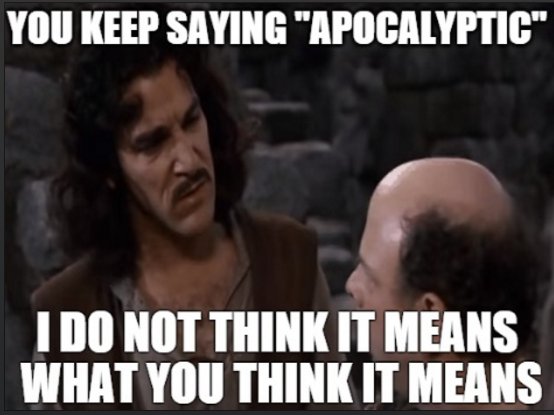
    Tim Furnish has been on a mini-crusade recently against the misuse of the word apocalypse, tweeting examples along with this meme-image:

    Furnish Apocalypse N0

    **

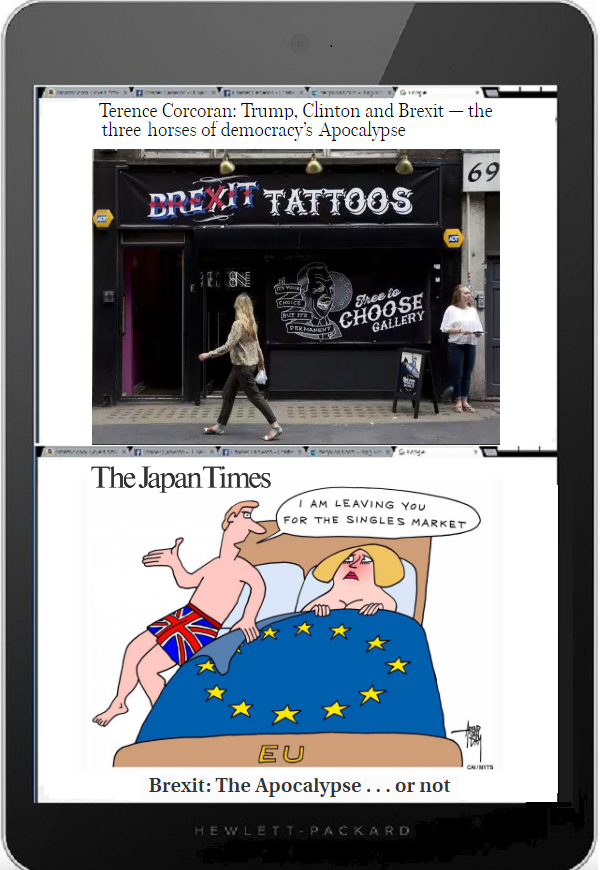
    Here are two examples of the genre. which Tim featured last night because each comments on Brexit in apocalyptic terms:

    Apocalypse No

    Sources:

  • Financial Post, Trump, Clinton and Brexit — the three horses of democracy’s Apocalypse
  • Japan Times, Brexit: The Apocalypse … or not
  • **

    Tim is right.

    The word apocalypse properly refers the vision John, the seer of Patmos, had, tearing away of the veil which so often hides the divine glory from mortal eyes: the Greek word apokalypsis is appropriately translated revelation, and the first verse of the book called The Apocalypse by Catholics and The Revelation of John in the King James Version runs as follows:

    The Revelation of Jesus Christ, which God gave unto him, to shew unto his servants things which must shortly come to pass; and he sent and signified it by his angel unto his servant John.

    **

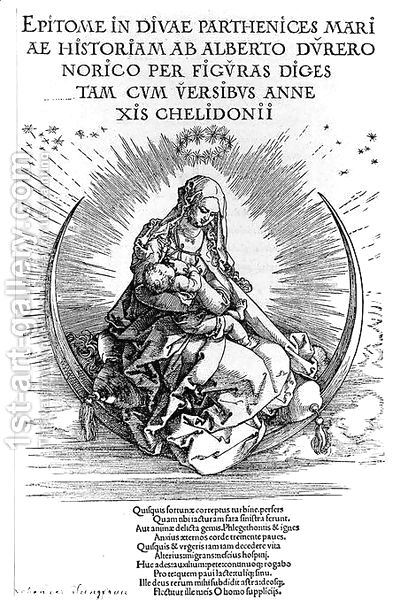
    Consider the beauty — and the otherworldiness — of this image from Albrecht Durer. illustrating the “woman clothed with the sun, and the moon under her feet, and upon her head a crown of twelve stars” of Revelation 12.1

    :Virgin-Sitting-In-Crescent-Moon

    **

    The imagery of this final book of the Bible does not show us the usual world of our senses, but a realm of great symbolic beauty, far beyond the reach of unaided eye or camera — as the great literary critic Northrop Frye notes, when he calls the book “a fairy tale about a damsel in distress, a hero killing dragons, a wicked witch, and a wonderful city glittering with jewels” in his Anatomy of Criticism, p 108.

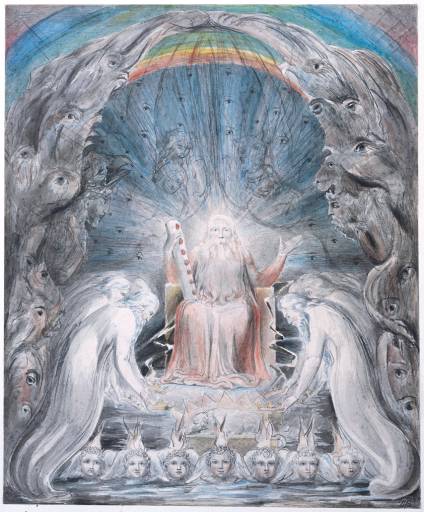
    Like the works of the English visionary William Blake, Revelation is more poetic than literal, visionary in the best sense — and it is hardly surprising that Blake is among its foremost illustrators:

    The_Four_and_Twenty_Elders_(William_Blake)
    Blake, Four and Twenty Elders Casting their Crowns before the Divine Throne, The Tate Gallery

    Brexit simply cannot match the darkness of Revelation’s Babylon in its final throes, nor the “new heaven and new earth” that succeed it — “for the first heaven and the first earth had passed away”.

    Echoing Ginsberg?

    Thursday, June 23rd, 2016

    [ by Charles Cameron — the Holland Tunnel arrest and the beat poet’s Howl — a note on semiotics ]
    .

    160621-holland-tunnel-truck-embed
    A Dodge SUV registered to Higher Ground Tactical sits in the Port Authority impound yard near the Holland Tunnel in Jersey City on June 21, 2016. Photo: Chad Rachman/New York Post

    The SUV is somewhat eye-catching, to be sure, and the photo presumably good for clicks — but is using the image also a sort of dog-whistle, for or against those who decorate such vehicles, train with such guns, etc? I certainly posted it here to add color to the page.. and to raise such questions.

    **

    So there was an arrest outside the Holland Tunnel, and reports variously claimed Group Caught With Weapons In Holland Tunnel Claimed To Be On Vigilante Mission and No link to terrorism is suspected, also Man Stopped in Gun-Laden Truck Was on ‘Mission to Help Other Families’ After Daughter’s Drug Death, Friend Says. Different strokes for different folks?

    Here’s a brief rundown:

    Heavily armed and angry about the heroin epidemic, the owner of an Upper Milford gun range who said he was on his way to rescue a teenage girl in New York City was stopped by police Tuesday at the Holland Tunnel.

    John Cramsey, 50, of Zionsville was one of three people in a truck decorated with anti-drug dealer and pro-gun logos and banners from his business, Higher Ground Tactical.

    Around 7:40 a.m., Port Authority police stopped Cramsey’s truck on the New Jersey side of the tunnel after spotting a cracked windshield.

    Police found weapons in the vehicle — five pistols, an AR-15 rifle and a 12-gauge shotgun — as well as marijuana and a marijuana pipe, according to a news release from the Port Authority of New York and New Jersey. Authorities also found body armor and knives.

    **

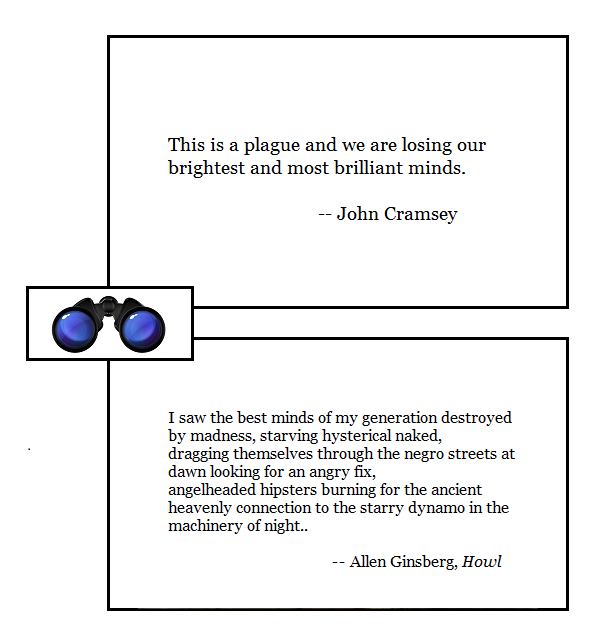
    Here’s what caught my attention, and what it reminded me of:

    John Cramsey DQ Ginsberg Howl

    Ginsberg and an anti-drug crusader?

    These details are of interest to those who track and analyze “signs” — likewise the two place names, Emmaus and Zionsville, both of them Biblical, likewise the name Higher Ground Tactical, with “higher ground” having both metaphorical (moral) and military meanings — and likewise the vivid imagery of the SUV itself, with its decals & detailing.

    We speak with our gestures and the imagery we use, not just with the plain literal sense of our words.

    **

    DoubleQuote Sources:

  • The Morning Call, Emmaus area gun range owner stopped at Holland Tunnel
  • Allen Ginsberg, Howl
  • Prof Pogge teaches ethics at Yale, but does he shave himself?

    Wednesday, June 22nd, 2016

    [ by Charles Cameron — Pogge’s ethics, Russell’s barber paradox, and self-reference ]
    .

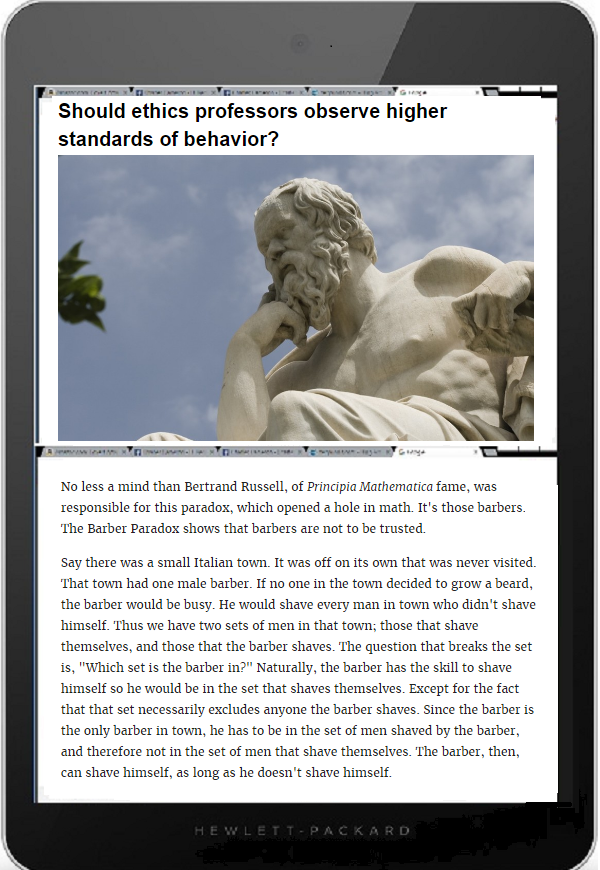
    It’s that old ouroboros [1, 2, 3, 4] rearing its ugly head again, with its tail firmly between its teeth:

    DQ 600 ethicists & barbers

    **

    The riddle, koan or potential paradox posed in the upper panel alludes to the matter of Yale’s professor Thomas Pogge, a noted ethicist, and some unbecoming behavior of which he has been accused — but as professor Judith Stark writing at Conversation suggests, there’s further interest beyond the case of Pogge and his accusers.

    Responding to the question posed by the title of her own piece, Should ethics professors observe higher standards of behavior?, she writes:

    This is an enduring dilemma in the area of ethics and one that has recently come to light with charges of unethical behavior brought against a prominent philosopher, Professor Thomas Pogge of Yale University. Pogge has been accused of manipulating younger women in his field into sexual relationships, a charge he has strenuously denied.

    Without making any judgment on the case itself, this situation raises larger questions about how the behavior of the experts in ethics is to be reviewed and evaluated.

    Profession and practice are, in their own way, like word and act — or are they?

    **

    In the lower panel, I’ve placed a discussion of Bertrand Russell‘s “barber” paradox that in Russell’s view partially but not fully resembles his paradox of the “class of all classes that are not members of themselves” — the question there being whether this class is a member of itself or not. I’m not in a position to argue such matters with Russell, so I’ll just say that he views both the “classes” and “barber” paradoxes as (different but similar) seeming knots which, when you pull on their loose ends, disentangle themselves, pop!:

    Russell writes of the “barber” paradox that it is a variant on the “classes” paradox in which “the contradiction is not very difficult to solve.” The “classes” paradox is harder, he says, but he finally dismisses it as “nonsense, i.e., that no class either is or is not a member of itself, and that it is not even true to say that, because the whole form of words is just a noise without meaning.”

    Or as Wm. Shakespeare might have said, “a tale told by an idiot, full of sound and fury, signifying nothing” — to which Witty Wittgenstein might have quipped, “Whereof one cannot speak, thereof one must be silent” — which, alas, has the air of a tautology, with the entire Tractatus thereby eating its own tail..

    **

    What do you think? Is the entire question of ethicists behaving ethically or unethically moot? a koan? does it eat its own tail? does it just melt into thin air, and leave not a rack behind?

    Sources:

  • Judith Stark, Should ethics professors observe higher standards of behavior?
  • Esther Inglis-Arkell, The Barber Paradox Shook the Foundations of Math
  • Bertrand Russell, Logic and Knowledge: Essays, 1901-1950

  • Switch to our mobile site