zenpundit.com » 2016 » July

Archive for July, 2016

A trumpet voice above Trump’s

Monday, July 25th, 2016

[ by Charles Cameron — for those wishing for discourse above the political fray ]
.

Yesterday, Sunday, I was going to post a “Sunday surprise” about a voice that transcends that of Donald Trump — the voice of Alison Balsom, trumpeter extraordinaire. But my thread linking Balsom and Trump was a slender one — Trump and trumpet — and I thought better of it, and deleted my reliminary notes for that post.

Today, though, I read Humera Afridi‘s Dance of Ecstasy: Bridging the Secular, Sacred, and Profane, and found therein:

Amjad Sabri, an eminent Pakistani qawwal -— a Sufi devotional musician in the tradition of world-renowned Nusrat Fateh Ali Khan, and son of the famous singer Ghulam Fareed Sabri of the Sabri Brothers — had been shot dead in his car in Karachi ten days earlier by the Pakistani Taliban. He’d been praising the Prophet Muhammad (pbuh) and his noble family a little too much for the Taliban’s liking. And so they had their way with him. In a nation inured to violence, Sabri’s death, nevertheless, struck at the communal soul of Pakistan. ..

Thousands of Pakistanis came out on the streets, united in grief, to protest Sabri’s death. Sabri was a child of Pakistan’s own soil. He belonged to a venerable, centuries-old musical dynasty. His spiritual attunement and the muscular faculty of his voice transported people to ecstasy, raising mere mortals above the denseness of an earthly, mired existence, above differences of class and wealth into a celebration of the Divine. Sabri’s music was a glorification. And it belonged to a distinct tradition of South Asian music, a legacy irrefutably inherent in the DNA of Pakistan, twinned to the devotional practice of Islam and its syncretic cultural roots in the region. Invoking a transcendent joy, Sabri’s qawwali created a milieu of harmony—completely antithetical to the Taliban’s backward, beclouded ideology of hate which thrives on sowing seeds of discord.

**

It’s that second paragraph I’m interested in, because it says so exactly what I was trying to get at in my deleted post about Alison Balsom: that “mere mortals” can be lifted, lofted “above the denseness of an earthly, mired existence, above differences of class and wealth into a celebration of the Divine”.

Here’s a taste of Amjad Sabri, for those who appreciate the Sufi tradition and the haunting ecstasies of the Qawwals:

**

And here’s Balsom, whose trumpet voice likewise lifts us, for those with ears more attuned to the western classical tradition:

*

— and best of all, though I’ve posted it here before:

Nesting Buddhas and insubstantiality

Monday, July 25th, 2016

[ by Charles Cameron — from the Buddha’s Diamond Sutra via matrioshka dolls and koans to Sun Tzu and Wittgenstein ]
.

From Karl Brunnhölzl, The Heart Sutra Will Change You Forever, in today’s Lion’s Roar:

Besides being a meditation manual, we could also say that the Heart Sutra is like a big koan. But it is not just one koan, it is like those Russian dolls: there is one big doll on the outside and then there is a smaller one inside that first one, and there are many more smaller ones in each following one.

After reading that, I wasn’t exactly expecting to find illustrations of Buddhas in the form of Matryoshka dolls on Google, but in fact there are quite a few variants on the theme. Here’s one, original source unknown:

matryoshka_buddha

Buddhism actually has a doctrine of the Trikaya or three bodies of Buddha, as described in the dictionarily dry words of the Britannica:

Trikaya, (Sanskrit: “three bodies”), in Mah?y?na Buddhism, the concept of the three bodies, or modes of being, of the Buddha: the dharmakaya (body of essence), the unmanifested mode, and the supreme state of absolute knowledge; the sambhogakaya (body of enjoyment), the heavenly mode; and the nirmanakaya (body of transformation), the earthly mode, the Buddha as he appeared on earth or manifested himself in an earthly bodhisattva, an earthly king, a painting, or a natural object, such as a lotus.

— and point you to a deeper reading as set forth by Shunryu Suzuki Roshi, whose understanding far surpasses anything I could muster.

I don’t. however, believe these three bodies are “nested” quite the way the Russian dolls are..

**

Now let’s get down to business. In the same article, Brunnhölzl writes:

Many people have complained about the Prajnaparamita Sutras because they also trash all the hallmarks of Buddhism itself, such as the four noble truths, the Buddhist path, and nirvana. These sutras not only say that our ordinary thoughts, emotions, and perceptions are invalid and that they do not really exist as they seem to, but that the same goes for all the concepts and frameworks of philosophical schools—non- Buddhist schools, Buddhist schools, and even the Mahayana, the tradition to which the Prajnaparamita Sutras belong.

That’s by normal western standards, is pretty strong philosophical meat. But Brunnhölzl continues, asking:

Is there any other spiritual tradition that says, “Everything that we teach, just forget about it”?

**

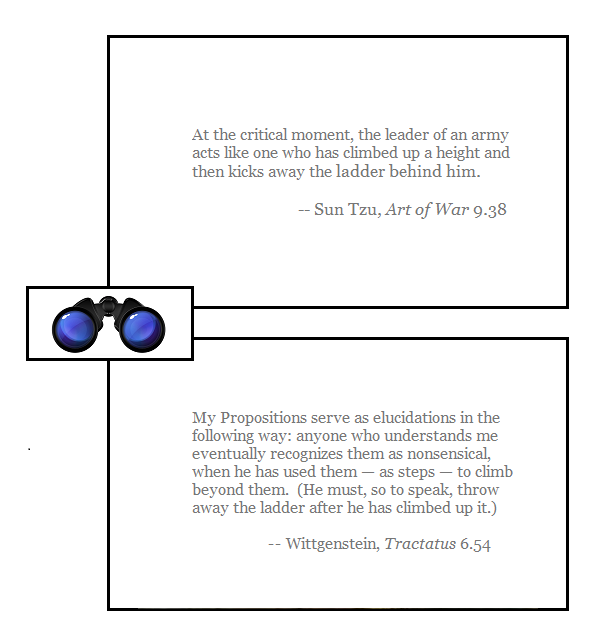
I sense a slight “my path is edgier than yours” tinge to that question, so I didn’t treat it as rhetorical, I pondered it — and in my googling ran across this rather neat pair of DoubleQuotes, which had been put together by Noah Greenstein in a blog-post titled Wittgenstein and Sun Tzu (on throwing the ladder away):

DQ Sun Tzu Wittgenstein ladders

and which I’ve presented here using one of my own DoubleQuotes formats.

**

It should be noted, however, that the Sun Tzu translation quoted here is the 1910 Leonard Giles version, that the text with a little more context reads:

At the critical moment, the leader of an army acts like one who has climbed up a height and then kicks away the ladder behind him. He carries his men deep into hostile territory before he shows his hand. He burns his boats and breaks his cooking-pots..

and that Giles‘ own comment on “the leader of an army acts like one who has climbed up a height and then kicks away the ladder behind him” reads:

literally, “releases the spring” (see V. § 15), that is, takes some decisive step which makes it impossible for the army to return—like # Hsiang Yü, who sunk his ships after crossing a river.

Sun Tzu as quoted here, then, is not in fact a great match for Wittgenstein — but Wittgenstein, who can indeed be said to have “thrown away” his own early philosophy as outlined in the Tractatus before acquiring the new one outlined in his Philosophical Investigations, comes far closer in spirit to the Diamond Sutra as discussed above.

**

Did I say the Heartv Sutra was “pretty strong meat”? I did. Perhaps this excerpt from Brunnhölzl’ piece will bring the point home:

There are accounts in several of the larger Prajnaparamita Sutras about people being present in the audience who had already attained certain advanced levels of spiritual development or insight that liberated them from samsaric existence and suffering. These people, who are called “arhats” in Buddhism, were listening to the Buddha speaking about emptiness and then had different reactions. Some thought, “This is crazy, let’s go” and left. Others stayed, but some of them had heart attacks, vomited blood, and died. It seems they didn’t leave in time. These arhats were so shocked by what they were hearing that they died on the spot. That’s why somebody suggested to me that we could call the Heart Sutra the Heart Attack Sutra.

Now that’s serious philosophy.

**

Okay, this has been an early morning meander, sufficient to drive away both fatigue and insomnia. On with the insubstantial day..

Sunday surprise: Pokemon Go Go Go

Sunday, July 24th, 2016

[ by Charles Cameron — for Adam Elkus, John Robb & JM Berger among others ]
.

Three tweets:

*

*

**

I find that last one pretty interesting, and would like to juxtapose it with a para from Michael Moore‘s piece — almost certainly the only piece of his writings I’ve actually downloaded onto my hard drive — Five Reasons Why Donald Trump Will Win:

The fire alarm that should be going off [CC: for Hillary supporters] is that while the average Bernie backer will drag him/herself to the polls that day to somewhat reluctantly vote for Hillary, it will be what’s called a “depressed vote” – meaning the voter doesn’t bring five people to vote with her. He doesn’t volunteer 10 hours in the month leading up to the election. She never talks in an excited voice when asked why she’s voting for Hillary. A depressed voter. Because, when you’re young, you have zero tolerance for phonies and BS. Returning to the Clinton/Bush era for them is like suddenly having to pay for music, or using MySpace or carrying around one of those big-ass portable phones. They’re not going to vote for Trump; some will vote third party, but many will just stay home. Hillary Clinton is going to have to do something to give them a reason to support her — and picking a moderate, bland-o, middle of the road old white guy as her running mate is not the kind of edgy move that tells millenials that their vote is important to Hillary. Having two women on the ticket – that was an exciting idea. But then Hillary got scared and has decided to play it safe. This is just one example of how she is killing the youth vote.

Department of unintended consequences and black swans:

Who’d have thought a Japoanese telephone-based game might have an influence on the demographics of democracy in the US of A?

Zengi can be Zangi and Zinki, among others

Sunday, July 24th, 2016

[ by Charles Cameron — besides horror at the beheading, there’s an analytic note that needs to be heard ]
.

abdullah issa 600
Abdullah Issa fighting, and wounded — soon to be savagely beheaded

The ferocity of the beheading has been blurred out in most versions of the video, though ZeroCensorship is still showing it, and YouTube has a version that stops short of the beheading but appears to record Abdullah’s final wish — to be shot, not slaughtered.

That devastating final wish goes way beyond Shakespeare‘s “to be or not to be, that is the question” — it may well be the most terrfying depiction of a choice made at death-point that I have ever heard.

**

I commented recently to a post by Ehsani2 titled The Boy Beheaded by Zinki Fighters, Abdullah Tayseer, Who Was He? on Dr. Joshus LandisSyria Comment blog, noting that the piece used the names Zanki and Zinki without commenting on the difference between them, and asking for clarification. I’d like to thank Dr Landis for a graciously email in response, and am happy to note today that my concern regarding the discrepant names used in the article is not without cause — as Kyle Orton just made clear in his own post on his Syrian Intifada blog, A Rebel Crime and Western Lessons in Syria:

One of the first complications with al-Zengi is the sheer variety of ways to transliterate the group’s name. Nooradeen can be Nooridin, Noorideen, and Noor/Nur al-Din/Deen; Zengi can be Zangi and Zinki, among others. Harakat means “movement,” though sometimes the organization is referred to as kataib (brigade) instead. Nooradeen refers to the twelfth-century Seljuk atabeg of the Zengid dynasty, whose life’s project was the reunification of the Islamic community.

No wonder I was confused.

**

My point, as so often, cuts against the grain of the conversation on Ehsani2’s post, which is largely about the horrible event itself and the group that performed it, one time support from the US included, and not the ways in which lack of languahger skills can cause confusion where clarity would be preferable — and that’s fair enough. My point, hiwever, is the linguistic one, and I think it’s important in a way that’s perhaps better suited to discussion here than on Dr Landis’ blog.

My plea is for analysts with special knowledge of places, groups or languages to bear in mind when writing, that there will be some in their interested audiences who may not share those specialities but are still worth reaching — and in particular that non-specialists, while inherently weak in local detail, may nevertheless contribute significant insights from outside linguistic or area-specialist silos, precisely by virtue of not being in the echo-chambers that such forms of specialism themselves tend to erect.

Zen has from the beginning of this blog stressed the mutual virtues of what he terms “horizontal” and “vertical” modes of knowledge — see his series:

  • Understanding Cognition: part I: Benefits of horizontal thinking
  • Understanding Cognition: part II: Benefits of vertical thinking to horizontal thinkers
  • Understanding Cognition: part III: Horizontal and vertical thinking and the origin of insight
  • I came to my own interest in that topic by being a primarily analogical and only secondarily linear thinker, by hearing Murray Gell-Mann at CalTech speak on the importance of generalist “bridge-makers” who perceive analogical links between otherwise unrelated disciplines, and by my twenty- to thirty-year effort to devised a playable form of the great analogical game loosely described in Hermann Hesse’s brillian (nobel-winning) novel, The Glass Bead Game.

    In prepping a proposal — as yet unfinished — for DARPA or IARPA last year, I formulate my basic message as a sort of motto, thus:

    Out of the box, out of the silo, out of the discipline, out of the agency, out of the explicit known into the “unknowing” — where the future takes shape…

    I could — and in the finished proposal will, God-willing — go far further on this topic, describing the ways in which complexity is far better modeled for us humans by analogical than by linear thinking, by cross-disciplinary than by silo’d thinking, by visual rather than verbal thinking, by human scale (7, plus or minus 2 datapoints) visualization than by big-data viz, and so forth. But let’s make it simple:

    Quirky thinking has a better chance at creative insight than routine thinking, individual contrarian passion than in-group agreement.

    Okay?

    **

    Thanks again to Dr Landis, and back to business..

    Benghazi, the election, and a look in the mirror

    Saturday, July 23rd, 2016

    [ by Charles Cameron — the current score seems to be bipolar 1, bipartisan 0 ]
    .

    You may believe:

    You may believe:


    Switch to our mobile site