zenpundit.com » 2017

Archive for 2017

Muslim does not equal Terrorist

Friday, April 21st, 2017

[ by Charles Cameron — witting or unwitting, there’s a blatant inability to make this simple distinction ]
.

The sane alternative:


Sheikh Ahmadou Bamba and His Holiness the Dalai
Lama are two role models for our century.

**

There’s an interesting conflation of Islam and Terrorism in a post titled 2 Faces of Islam: Why All Muslims Benefit from Terrorism from Freedom Outpost:

While many Muslims are just as horrified by terrorism as the rest of us are, all Muslims nevertheless benefit from Islam. This is because both peaceful and violent Muslims tend to share two important goals: (1) the conversion of non-Muslims to Islam, and (2) the silencing of critics of Islam. Since terrorism helps achieve these goals, all Muslims benefit from Islam.

This would make sense — I’m not saying I’d agree with it, merely that it would have a logical form to it that wouldn’t make me go cross-eyed — if it read [note: this paragraph edited in light of comment below]:

While many Muslims are just as horrified by terrorism as the rest of us are, all Muslims nevertheless benefit from terrorism. This is because both peaceful and violent Muslims tend to share two important goals: (1) the conversion of non-Muslims to Islam, and (2) the silencing of critics of Islam. Since terrorism helps achieve these goals, all Muslims benefit from terrorism.

But no: under a caption that tells us 2 Faces of Islam: Why All Muslims Benefit from Terrorism, it twice states all Muslims nevertheless benefit from Islam.

The conflation is evident, Islam and Terrorism are interchangeable in the writer’s mind, and that interoperability is liable to find an echo in — or seep diasastrously into — the reader’s mind, too.

**

The actual relation between Islam and contemporary Islamist terrorism is neither “Islam is a religion of no terrorism (aka peace)” nor “Islam is a religion of terrorism (aka war)”. To get at a couple of the major nuances here, the Meccan Cantos and the Medinan cantos of the Quran suggest very different readings of what the religion was originally all about, and how it adapted to violent hostility; and in terms of contemporary Islam, not all Muslims are Salafist, and not all Salafists are jihadist fighters, but some of them most definitely and ruthlessly are.

In addition, Islam needs to be considered both scripturally — the usual western critique — and culturally, by which I mean how Islamic belief plays out in cultural practice across time and space — a far subtler matter. SH Nasr‘s The Study Quran is a prime guide to the former, and Shahab Ahmed‘s What Is Islam?
The Importance of Being Islamic the towering work to digest in understanding the latter.

A useful corrective to the “Islam is a religion of war” perspective can be found in the lives and works of two proniment Muslim proponents and practitioners of nonviolence, Sheikh Amadou Bamba, founder of the Muridiyya or Mourides, and Badshah Khan, Gandhi‘s Muslim friend.

For context around the Mourides, and in constrast with the Wahhabis of the Levanty, see Why are there so few Islamists in West Africa? A dialogue between Shadi Hamid and Andrew Lebovich.

The inability to distinguish Muslim from Terrorist, and the violence that follows it, can truly be described as Islamophobia.

**

Image:

  • Sheikh Aly N’Daw, Choice, Liberty and Love: Consciousness in Action
  • Guest Post: Impressions of Easter 2017, Rural Russia

    Wednesday, April 19th, 2017

    [ by Mark Osiecki — posted by Charles Cameron ]
    .

    I found this semi-private post by my friend Mark Osiecki quite wonderfully written, insightful as to mood in rural Russia, and deeply moving.

    In my mind, the arches formed where religion and science meet are among the loftiest in the “hundred gated cathedral of kind” that Hermann Hesse wrote of in his novel Magister Ludi, aka The Glass Bead Game, and this post, with its arch between engineering and eucharist, strikes me as a fine example of the possibilities. With Mark’s permission, I’m reposting it here.

    **

    Feodor and I.

    Nearly identical in age, we arrived essentially simultaneously into this existence, but within parallel universes…his The Cold War Soviet, mine The Cold War United States. But we laboured professionally within a common belief system…his sect, nuclear physics and reactor-powered plants, mine mechanical engineering and heavy industrial process. Despite our governments’ endeavoring to differentiate their brands of benevolent service to us, we moved in remarkably similar worlds.

    The Engineering, after all, is united in its own universal mysticism.

    Therein reside incantations…rich in their use of sigmas, alphas, rhos, thetas… symbology universally recognized by all trained congregants. On our respective sides of this planet, we would re-contrive those classical formulae with ritualistic rigor, condense the results into icon-like drawings and present them to sage masters who would ask us “Will this work? Can persons walk under or past this without peril? Is this for the greater good?” We were trained to curtly answer “yes”, of course, confident in our interpretation of The Commandments as bestowed by a Euclid, a Newton, an Euler, a Moore, an Ohm perhaps. Sadly, though, we plied this belief system with the knowledge that it had all too often been deployed not in fact for the greater good but rather to release the great unseen forces hidden within those incantations into enormous, physically destructive effects, eventually bringing grievous harm and agonizing death to many.

    But we, we rationalized, incantated for some greater utility. After all, the greater people somehow desired and benefited from the results of our labours. And thus, we and those consuming the products of our work were able to sense no complicity in the release of such destruction.

    *

    The Supreme Soviet, one day, stopped.

    The Engineering continued despite that passage, but The Orthodoxy – a disallowed belief system – somehow immediately re-emerged adjacent to The Engineering despite the Soviet’s travails over many generations to erase all sentimentality for it. One day soon thereafter, it occurred to Feodor that his inclination towards incantation and application of Commandments could be deployed via The Orthodoxy, also towards the greater good. Thus, he abruptly refocused his faith towards a new set of Unseeable Phenomena, got educated in it, and got to work.

    So now, this Easter’s eve in a tiny rural chapel bounded only by hovels and two cemeteries, my friend Feodor is working. It’s 3:30am on what began as a blustery Saturday night, and we are gathered in the middle of nowhere. Two hundred or so consumers of his work have assembled before him in a space where a certificate next to the front door declares its legal capacity of 60. Half of the congregants – people of my generation or older – had come to this belief system after the collapse of the Supreme Soviet un-disallowed it. The rest, mostly younger, were born into it. Now, we here are compressed together, so tightly that we are slightly deforming each other. Every time the person in back of me waves her right arm in signing The Cross – once every thirty seconds or so over several hours – she caresses that image onto my back. My pelvis is in warm, intimate contact with the back of the person in front of me. Were the man next to me attempt to reach in his pocket, I would feel every nuance of that movement, as though his wriggling fingers were en route to one of mine.

    Group confessions were jointly said earlier this evening, but this compacted mass of believers is not static. Folks come and go. Most will stay for the entire five-hour fete, with an overflow crowd cresting just about now. A cantor announces that if anyone missed the earlier confession, they may step forward and Feodor will somehow work them in during the balance of the service. If you have ever studied fluid dynamics and observed images or videos of how temperature difference diffuses through a dense medium, you would recognize a similar visual phenomenon here. The contrite shimmy their way forward but you don’t actually see them. Rather, you see the reactions of those already-confessed souls parting to make way for them…a glance over a shoulder, a twist of a torso, a fluttering open of normally closed eyes.

    The service, despite its playing out in a language I struggle to grasp, is at least structurally familiar to me. Readings from testaments are performed, a consecration is rendered, praises are sung. A cleansing remorse is conveyed and then sensed as accepted. I take refuge in that familiarity. As the night passes to morning, a subtle crescendo of hopefulness builds within… this certain, family-given sense of being, communicated via a belief couched in the unbelievable.

    **

    Thanks you, Mark.

    From Brooklyn to Birmingham, a contemplative stroll

    Wednesday, April 19th, 2017

    [ by Charles Cameron — unity in the face of difference, radiance in the face of rage ]
    .

    This little pilgrimage began when I saw this tweet, reteeted by The Bridge initiative:

    A Taoist, and from Brooklyn — okay!

    **

    I went off to track down Jackie Summers from Brooklyn, and behold, checking his FB feed I run across this, from a few days back:

    which sends me to this deliciously quiet and unassuming TV news report from, yes, New Zealand if I’m not mistaken:

    [ would that all the world’s newscasters showed such restraint ]

    **

    That newscast in turn let me to this tweet from a British MP:

    And this even more glorious photo of Saffyah Khan‘s face, taken from the Guardian’s report, Protest photos: the power of one woman against the world:

    **

    From that Guardian article:

    Shows of strength and defiance aren’t in short supply at your average protest – demonstrating, by its nature, requires a level of commitment that weeds out the bystanders, the unimpressively apathetic. But what is it that makes the money shot? The protest photo that goes viral? Well, for one, women. Or, more accurately, one woman. Often a striking, beautiful-looking woman. But mostly, a woman who looks like a badass without seeming to do anything much that is dramatic at all.

    For anyone trying to work out the Venn diagram of iconic protest imagery, three tropes will immediately jump to the fore: the quiet dignity of said woman; the battle-hungry paraphernalia of male authority (your shields and batons and chunky uniforms); and the dramatic flip of power that clash presents.

    **

    Pretty much all of the above — the Taoist, the Hassidim, the Muslim lady with child, the radiant protester Saffiyah Khan, Jess Phillips MP — have gone viral, in a world that thirsts for such things.

    Deep bows to them all!

    Running — the pragmatic and the ecstatic

    Wednesday, April 19th, 2017

    [ by Charles Cameron — .. a runner moves between prose and poetry, mere winning and the runner’s high ]
    .

    The pragmatic:

    The ecstatic:

    **

    The pragmatic tells you what most running is like: the ecstatic tells you how you feel when you hit “runner’s high — here’s one athlete’s description of winning, where winning itself becomes the least interesting aspect of the race:

    The starter gave us instructions, and the gun went off. I ran a few steps into a dimension I didn’t know existed.

    Suddenly I seemed to be up in the rafters of the arena, looking down at my race far below. I could see the black framework of the high catwalks vaguely around me, the cables, the great spotlights, the blazing brilliance of the tiny track so far beneath me, and myself running in the midst of the others in my race that was on both with me and without me.

    And in the total silence of this incredible vantage point, a voice said tome clearly, in a kindlysort of way, “Well, Grace, thisis what you always wanted.”

    And then I was back down in my race again, winning it, setting a new U.S. record. Afterward, exuberant, curious, and a little wistful, I asked some friends who were there, “Didn’t anyone clap or cheer or anything?” I didn’t remember hearing the crowd at all.

    “Sure they did! Everyone was yelling and screaming. Didn’t you hear them?”

    No. I hadn’t heard anything. Except the voice. I don’t even remember anything about the race itself except for what I saw from up there.

    That’s Grace Butcher, from Garth Battista, The Runner’s High: Illumination and Ecstasy in Motion. And the “high” doesn’t have to include an out-of-body experience, though I had that myself one day when I was very young. It’s just a matter of transcendance, of what the Buddhists would call “gone beyond” without further specifying..

    Life as poetry.

    From maps to graphs and back, from life to death and eternity?

    Wednesday, April 19th, 2017

    [ by Charles Cameron — graphs and networks, life and death, quality and quantity of life, personal mortality, the (implictly immortal) trinity ].
    .

    I was struck by these items, verbal and visual, in Numberphile‘s YouTube video, The Four Color Map Theorem. The speaker introduces a simple, four color map:

    Then indicates:

    I’ve turned that map into a network:

    The question, can this map be colored using four colors, or better? is the same question as saying, can this network be colored using four colors, or better?

    There are things we can learn now about maps, by studying networks instead. .. By studying networks, we can study all the different kind of maps. Now, all maps make networks, but not all networks make valid maps.

    Given that my HipBone game boards are graphs — my games as played are conceptual graphs — I’m always on the lookout for easily digested gobbits of graph theory to see if they’re applicable to my games, or to put that another way, whether they can startle me into any new insights.

  • At least some HipBone games could be played on maps..
  • **

    One could thus view maps of the various sectarian interests in play in the Levant / Shams — theologies onto geographic areas, Alevi, Twelver, Salafi, Salafi-jihadist, Yezidi, Druze, Christian etc — as conceptual maps analogous to conceptual graphs.

    And these conceptual maps are important in terms of strategy.

    Different graphs could be obtained by articulating the linkages between different sects and ethnicities, eg Turkomen with Turks, Alevi and Ismaili with Twelver Shiism, and Shia with Sunni vs (eg) Christian.. and switching back and forth between map and grapoh might then prove suggestive, instructive..

    **

    Once started on Numberphile’s math-curious videos it can be hard to stop.. Here’s a surprise from the third such video I chased thids afternoon, the one on The Feigenbaum Constant:

    Life and Death can be mathematized!

    I think that diagram — if it can be believed — answers the vexed issue of quality and quantity, and possibly also the hard problem in consciousness.

    **

    I naturally attempted to place myself on the implicit timeline between Life and Death on that diagram. I’m reasonably far along (minor stroke, check, triple bypass, check, on dialysis, check, etc), and, shall we say, somewhat aware of my mortality.

    Someone get me a slide-rule, I’d like to calculate the precise.. unh, on second thoughts, maybe not.

    **

    The only happily viable move from here — I believe — is to infinity, so let’s go.

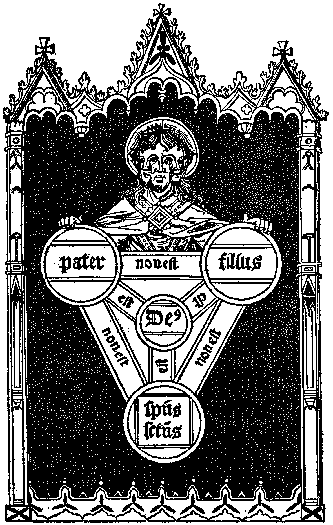
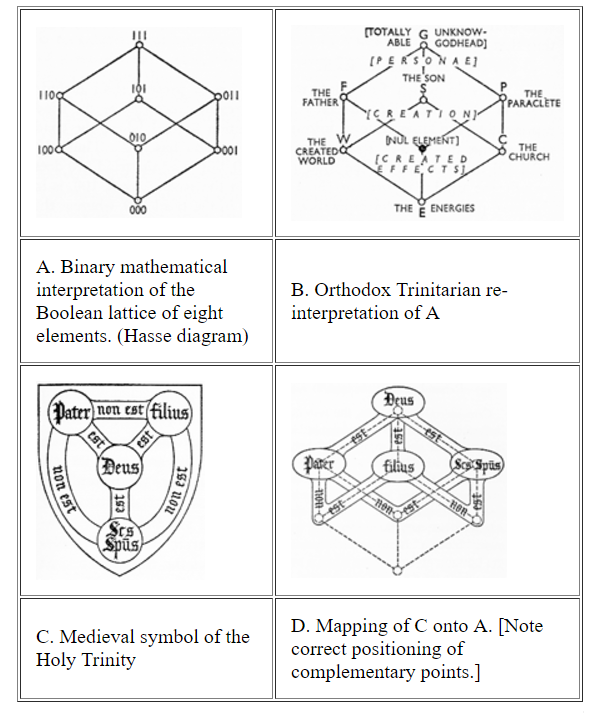
    My games, I’d suggest, make a contribution to graph theory. Specifically, to that branch of graph theory in which Margaret Masterman was a pioneer, is the area of conceptual graphs, which I meantioned above. Indeed, the (theo)logical icon Masterman explored with her Benedictine Abbess friend as described in Theism as a Scientific Hypothesis (part 1), Theoria to Theory Vol 1, 3rd Quarter, April 1967, pp 240-46:

    visiting it in Boolean terms:

    is none other than the graph used as an exemplar of the map-graph correlation in the Numberphile video, second illustration at the top of this post.

    **

    In the Trinitarian version of this graph, however, two kinds of “edge” or linkage are required: for the links between individual Persons (“non est”) and the links between Persons and Godhead (“est”).

    And the same is true, interestingly enough, with even more types of linkage, in Oronce Fine‘s (entirely secular?) map of the elements:

    **

    And that’s enough thinking for one day, perhaps. We shall see..


    Switch to our mobile site