[ by Charles Cameron — two cases of unreal real estate, Moscow & Washington ]
.
Putin:
Sater arranged Ivanka to go to Moscow in '06. "I arranged for Ivanka to sit in Putin's private chair at his desk and office in the Kremlin." https://t.co/j1zZ7n9Awt
[ by Charles Cameron — continuing in the pesky socratic tradition ]
.
**
Here’s the possible parallelism, d’you dare say it’s a moral equivalence, are the scales even close to equal, or isn’t that the moral point anyway?
Just a few years after the destruction of European Jewry, the soldier wonders, have we now become oppressors? Have the Arabs now been sent into exile?
Here’s the whole paragraph:
In 1949, Yizhar Smilansky, a young Israeli veteran, national legislator, and novelist writing under the pen name S. Yizhar, published “Khirbet Khizeh,” a novella about the destruction of a lightly fictionalized Palestinian village near Ashkelon, some thirty miles south of Tel Aviv. Writing from the point of view of a disillusioned Israeli soldier, Yizhar describes the Army’s capture of the village and the expulsion of its remaining inhabitants. The time is 1948, the moment of Israel’s independence and its subsequent victory over five invading Arab armies that had hoped to erase the fledgling Jewish state from the map. It would be forty years before the New Historians—Benny Morris, Avi Shlaim, and Simha Flapan among them—marshalled the nerve and the documentary evidence required to shatter the myth that hundreds of thousands of Palestinian Arabs had all voluntarily “abandoned” their cities and villages. Yizhar was there to bear witness in real time. He wrote from personal experience; he had been an intelligence officer in the war. In “Khirbet Khizeh,” Yizhar’s protagonist is sickened as he comes across an Arab woman who watches as her home is levelled: “She had suddenly understood, it seemed, that it wasn’t just about waiting under the sycamore tree to hear what the Jews wanted and then to go home, but that her home and her world had come to a full stop, and everything had turned dark and was collapsing; suddenly she had grasped something inconceivable, terrible, incredible, standing directly before her, real and cruel, body to body, and there was no going back.” Just a few years after the destruction of European Jewry, the soldier wonders, have we now become oppressors? Have the Arabs now been sent into exile? And why can’t I bring myself to protest? “Khirbet Khizeh” eventually became part of the Israeli public-school curriculum.
With any luck, I’ll report back at some point. It seems to me that a love of the individual Palestinian should nest within a love of the State of Israel as the circles in the tai chih symbol rest within the swirls of the opposite colors. But what a charged topic!
[ by Charles Cameron — from a half-million-strong march to the hug of a victim’s father and an imam, Barcelona and Spain repond to terror with nobility and grace ]
.
Marchers, on Saturday, displayed signs and banners with various slogans. Some read, “No to Islamophobia,” “The best response: Peace,” and “I’m not afraid.”
The march:
A makeshift shrine to those killed in the attack:
A monarch visits the survivors of terror:
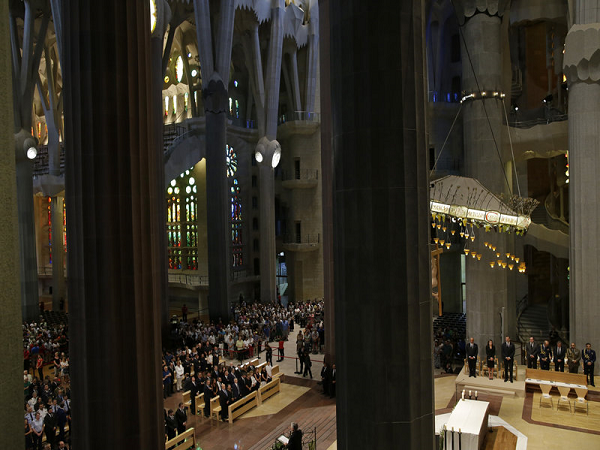
NPR reports on the celebration of Mass in La Sagrada Familia, Barcelona:
Spain’s King Felipe and Queen Letizia and other dignitaries attend a solemn Mass at Barcelona’s Sagrada Familia Basilica on Sunday for the victims of the terror attacks that killed 14 people and wounded over 120 in Barcelona, Spain.
**
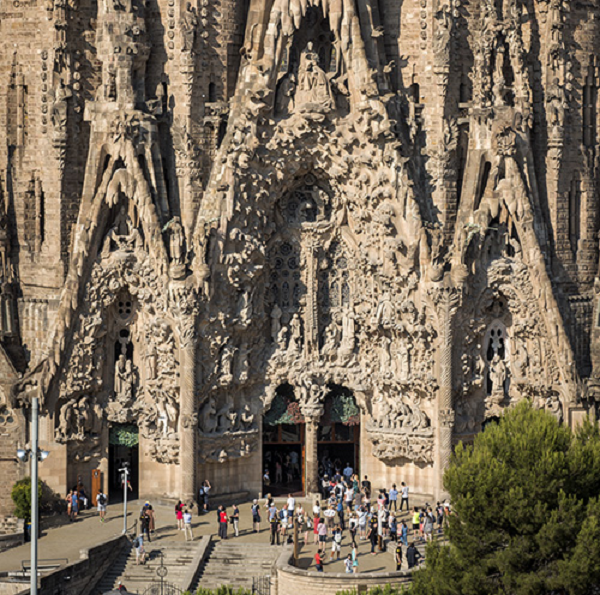
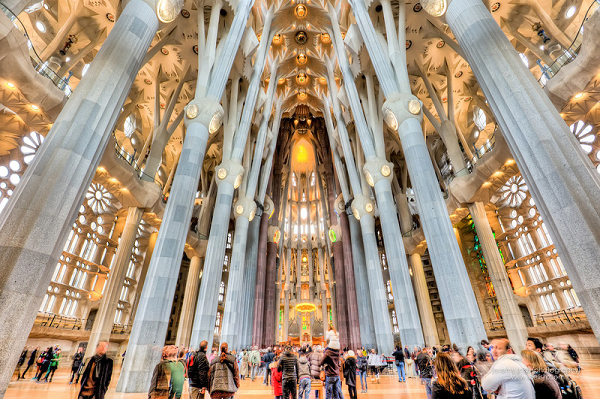
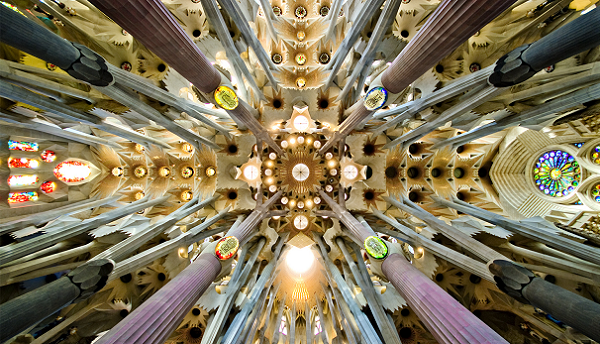
We remember the sacred magnificence of the ritual setting, Antonio Gaudi‘s Basilica of the Sagrada Familia in Barcelona, in which this Mass was offered:
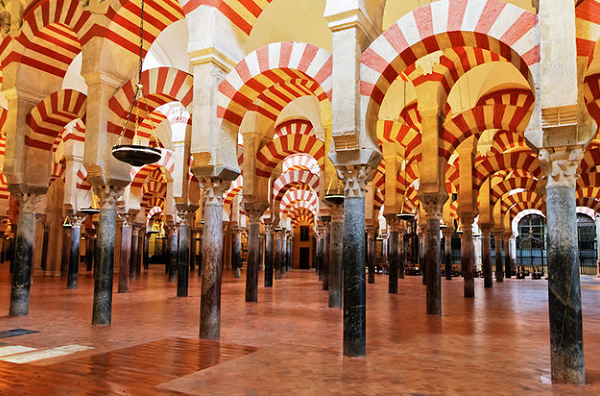
And Spain’s considerable Moorish history, exemplified by the Mezquita of Cordoba:
**
We witness the profound gesture of the father of the youngest victim, as reported by Daily Sabah, Europe:
The father of the youngest victim of last week’s tragic terror attacks in Cambrils and Barcelona hugged a local imam in an emotional protest against terror and Islamophobia.
Xavier Martinez, who lost his three-year-old son Xavi in the attack on Las Ramblas avenue, embraced Spanish imam Driss Salym in the town of Rubi, near Barcelona on Friday. The video of the two hugging, defiantly showing unity and compassion, was widely shared on social media.
Here is the BBC’s video:
**
Oof, the imam’s tears at the end of that clip.
Many cities have shown their resilience when attacked, and we are proud of them: Barcelona best of all.
Zenpundit is a blog dedicated to exploring the intersections of foreign policy, history, military theory, national security,strategic thinking, futurism, cognition and a number of other esoteric pursuits.