zenpundit.com

New Book: The Guns at Last Light

June 2nd, 2013

The Guns at Last Light: The War in Western Europe, 1944-1945 by Rick Atkinson 

Just received a review copy courtesy of Callie  Oettinger and Henry Holt and Company.

I have not read the first two books in Atkinson’s well-regarded Liberation Trilogy, but Guns at Last Light is a deeply researched work with over two hundred pages of end notes and selected bibliography, which feature a very substantial amount of primary source material. The campaign maps are richly detailed and photographs are ample.  The author has aimed to satisfy academic critics, military history buffs and popular audience alike.

In vol. III Atkinson is telling the story of WWII from D-Day to the aftermath of Hitler’s suicide in defeated Berlin to overcome the savage but futile resistance of the Germans:

Although the National Redoubt in the Alps was a brown pipe dream, makeshift bastions here and there stoked SHAEF’s fear of a Germany bent on self-immolation. In Aschaffenberg, Bradley reported that ” women and children lined the rooftops to pelt our troops with hand grenades” while wounded veterans hobbled from their hospital beds into the firing line. In Heilbronn, on the Neckar River, already smashed by years of bombing, German officers shot down Hitler Youth detachments when they broke under American mortar fire 

An anecdote that is the same spirit of what can be read in Ian Kershaw’s The End. The Third Reich was ruled to the last by fanatical Nazi bitter-enders who kept the war going long past the point of any hope of a moderate defeat, much less a victory.

Looks like a good read.

The easy way or the hard way?

June 1st, 2013

[ by Charles Cameron — thinking more in terms of challenge than of threat, and skipping via Chicago Law, Everest, and Handel’s Messiah to a Venn diagram of the workings of conscience ]
.

Well, I don’t always read the Chicago Law Review cover to cover, or even at all to be honest — but I confess I did like this opening paragraph from George Loewenstein† & Ted O’Donoghue†† (love those daggers after your names, guys):

If you ever have the misfortune to be interrogated, and the experience resembles its depiction in movies, it is likely that your interrogator will inform you that “we can do this the easy way or the hard way.” The interrogator is telling you, with an economy of words, that you are going to spill the beans; the only question is whether you will also get tortured — which is the hard way. In this Essay, we argue that much consumption follows a similar pattern, except that the torturer is oneself.

**

Here’s the easy vs hard contrast I was thinking about as I googled my way to the Law Review — as you’ll see, it has nothing to do with interrogation:

**

So, a little background. Jason Burke has been covering Everest for The Guardian lately, since it has been almost exactly sixty years since Hillary and Tenzing were the first to “conquer” the highest peak on earth — and one of his reports caught my eye — Everest may have ladder installed to ease congestion on Hillary Step:

It was the final obstacle, the 40 feet of technical climbing up a near vertical rock face that pushed Sir Edmund Hillary to the limit. Once climbed, the way to the summit of Mount Everest lay open.

Now, almost exactly 60 years after the New Zealander and his rope-mate, Sherpa Tenzing Norgay, stood on the highest point in the planet, a new plan has been mooted to install a ladder on the famous Hillary Step, as the crucial pitch at nearly 29,000ft has been known since it was first ascended. The aim is to ease congestion.

That’s what the upper panel, above, is all about — and I think it contrasts nicely with the bottom panel, which shows a rurp. Should you need one, you can obtain your own Black Diamond rurp here.

**

Rurps are awesome. Here are two descriptions of them, both taken from the mountaineering literature, and neither one of them focusing in too closely on the poetry of the name…

Steve Rope, Camp 4: Recollections of a Yosemite Rockclimber, p. 107:

Chouinard’s “rurp” was obviously something special. An acronym for “realized ultimate reality piton,” this ludicrously small fragment of heat-treated steel opened our eyes to untold possibilities.

and Chris Jones, Climbing in North America, p. 273:

It was about the size of a postage stamp. The business end was the thickness of a knife blade and penetrated only a quarter-inch into the rock. With several of these Realized Ultimate Reality Pitons, or rurps, Chouinard and Frost made the crux pitch on Kat Pinnacle (A4). It was the most difficult aid climb in North America.

Chouinard named this postage-stamp-sized thing the realized ultimate reality piton (RURP) because if you willingly and literally hang your life on that quarter-inch of steel, you’re liable to realize, well, ultimate reality.

Zen — yours for $15 and exemplary courage.

**

Here’s my question: should we make the hard way easier?

When is that a kindness, and when is it foolish?

**

In its own way, of course, a rurp is an assist — it makes the hard way a tad easier for the serious climber.

As indeed would the proposed “ladder” on Everest: here’s why it might be not-such-a-bad idea:

This year, 520 climbers have reached the summit of Everest. On 19 May, around 150 climbed the last 3,000ft of the peak from Camp IV within hours of each other, causing lengthy delays as mountaineers queued to descend or ascend harder sections.

“Most of the traffic jams are at the Hillary Step because only one person can go up or down. If you have people waiting two, three or even four hours that means lots of exposure [to risk]. To make the climbing easier, that would be wrong. But this is a safety feature,” said Sherpa…

Besides, the idea is to set it up as a one-way street…

Frits Vrijlandt, the president of the International Mountaineering and Climbing Federation (UIAA), said the ladder could be a solution to the increasing numbers of climbers on the mountain.

“It’s for the way down, so it won’t change the climb,” Vrijlandt told the Guardian.

Ah, but then there’s human nature to consider:

It is unlikely, however, that tired ascending climbers close to their ultimate goal will spurn such an obvious aid at such an altitude.

Bah!

**

Shouldn’t we just level the top off, as Handel and Isaiah 4.4 suggest, and as we’re doing in the Appalachians?

A little mountaintop removal mining, a helipad, and voilà — even I could make it to the summit!

**

But to return to Loewenstein† & O’Donoghue†† — their paper’s full title was “We Can Do This the Easy Way or the Hard Way”: Negative Emotions, Self-Regulation, and the Law — how can a theologian such as myself resist a diagram such as this?

Update on America 3.0 Book Events – Bennett and Lotus

May 31st, 2013

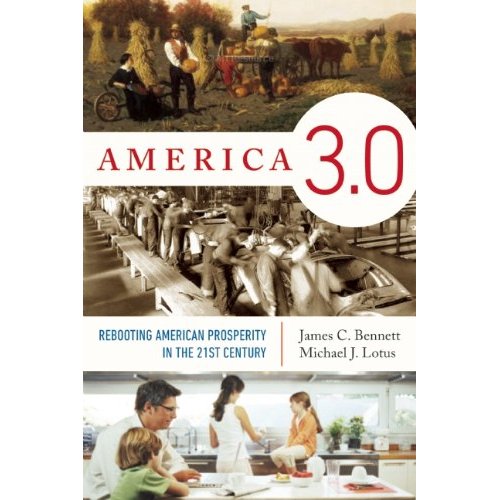
America 3.0 

From Chicago Boyz:

America 3.0: Mike Lotus on The Bob Dutko Show

Mike Lotus will be on the Bob Dutko radio show tomorrow, May 31, 2013 at 12:40 p.m. EST. Bob hosts Detroit’s #1 Christian Talk Radio Show on WMUZS 103.5 FM.

Please listen in if you can!

Many thanks to the Bob Dutko Show for having me on.

This weekend we will post an updated list of upcoming appearances by Jim Bennett, Mike Lotus, and occasionally both of us together, talking about America 3.0.

Thanks to The Takeaway, the The Armstrong & Getty Show, and The Janet Mefferd show for interviewing Jim Bennett — all yesterday. It was a Bennett Threefer! 

And Author Appearances:

Upcoming appearances for Jim Bennett and Mike Lotus discussing America 3.0

Tuesday, May 28, 2013
Lou Dobbs Tonight (James and Michael)
We will be on about 7:45 p.m. EST.

Wednesday, May 29, 2013
Armstrong & Getty (James)
11:15 am EST

Wednesday, May 29, 2013 
Janet Mefferd Show (James)
3:30 pm EST

Friday, May 31, 2013 
Bob Dutko Show (Michael)
1:40 pm EST

Tuesday, June 4, 2013
Talk to Adam Smith Society, Booth School of Business (Michael)
Noon

Thursday, June 6, 2013
Mornings with Nick Reed (Michael)

Saturday, June 7, 2013
Marc Bernier Show (James & Michael)
4:25 pm EST

Monday, June 17, 2013
Western Conservative Summit, “Envisioning America 3.0” (James)

And their maiden TV appearance with Lou Dobbs:

Various body parts for various body parts

May 31st, 2013

[ by Charles Cameron — mostly about a fascinating quote from Martin Luther King ]
.


.

Let’s start with the Code of Hammurabi, 196-97:

If a man put out the eye of another man, his eye shall be put out. If he break another man’s bone, his bone shall be broken.

A few days ago, I found I was feeling mildly exercised by one Dan Hodges writing in the Telegraph:

Indeed, “An eye for an eye, a tooth for a tooth,” quoted by one of Lee Rigby’s suspected killers, comes from the Bible, not the Koran.

Hodges was quoting Michael Adebolajo, who had said on camera:

The only reason we have killed this man today is because Muslims are dying daily by British soldiers. And this British soldier is one. It is an eye for an eye and a tooth for a tooth. By Allah, we swear by the almighty Allah we will never stop fighting you until you leave us alone.

**

It is true that Deuteronomy 19.21 reads:

And thine eye shall not pity; but life shall go for life, eye for eye, tooth for tooth, hand for hand, foot for foot.

and Exodus 21.23-25:

And if any mischief follow, then thou shalt give life for life, Eye for eye, tooth for tooth, hand for hand, foot for foot, Burning for burning, wound for wound, stripe for stripe.

— but its is clear that Adebolajo — who was brought up devoutly Christian in Nigeria, converted (“reverted”) to Islam, and now references suras of the Qur’an using their Arabic names — would also be aware of Sura Al-Ma’ida (5) 45:

And therein We prescribed for them: ‘A life for a life, an eye for an eye, a nose for a nose, an ear for an ear, a tooth for a tooth, and for wounds retaliation’; but whosoever forgoes it as a freewill offering, that shall be for him an expiation.

**

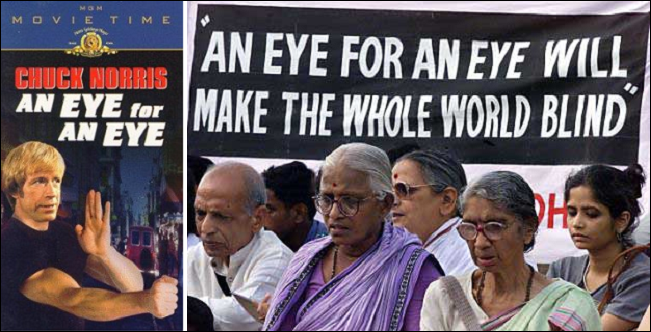
The quote “An eye for an eye makes the whole world blind” is often attributed to Mohandas Gandhi, but I checked with Quote Investigator and found it was originally used by one Louis Fischer to paraphrase Gandhi’s teaching, although the Gandhi family apparently think it sounds authentic. But what interested me most was that a form of the same phrase can safely be attributed to Martin Luther King, who is quote in Stride Toward Freedom: The Montgomery Story, p 208, as saying:

Violence as a way of achieving racial justice is both impractical and immoral. It is impractical because it is a descending spiral ending in destruction of all. The law of an eye for an eye leaves everyone blind. It is immoral because it seeks to annihilate the opponent rather than win his understanding; it seeks to annihilate rather than to convert. Violence is immoral because it thrives on hatred rather than love. It destroys community and makes brotherhood impossible. It leaves society in monologue rather than dialogue. Violence ends by defeating itself. It creates bitterness in the survivors and brutality in the destroyers.

That’s quite a paragraph.

**

Of note, besides the parallel structure with which King addresses violence as both impractical and immoral, are two matters I have often pointed to here on Zenpundit:

Self-reference:

Violence ends by defeating itself.

and polyphony:

It leaves society in monologue rather than dialogue.

**

Gandhi’s position seems to come close to that presented in Matthew 5. 38-48 — in which Christ clearly countermands the lex talionis as promulgated in Exodus and Deuteronomy:

Ye have heard that it hath been said, An eye for an eye, and a tooth for a tooth: But I say unto you, That ye resist not evil: but whosoever shall smite thee on thy right cheek, turn to him the other also. And if any man will sue thee at the law, and take away thy coat, let him have thy cloke also. And whosoever shall compel thee to go a mile, go with him twain. Give to him that asketh thee, and from him that would borrow of thee turn not thou away.

Ye have heard that it hath been said, Thou shalt love thy neighbour, and hate thine enemy. But I say unto you, Love your enemies, bless them that curse you, do good to them that hate you, and pray for them which despitefully use you, and persecute you; That ye may be the children of your Father which is in heaven: for he maketh his sun to rise on the evil and on the good, and sendeth rain on the just and on the unjust. For if ye love them which love you, what reward have ye? do not even the publicans the same? And if ye salute your brethren only, what do ye more than others? do not even the publicans so? Be ye therefore perfect, even as your Father which is in heaven is perfect.

And. for that matter, to The Richmond Declaration of Faith of 1887, as quoted today by my friend, Friend Marshall Massey:

We feel bound explicitly to avow our unshaken persuasion that all war is utterly incompatible with the plain precepts of our divine Lord and Law-giver, and the whole spirit of His Gospel, and that no plea of necessity or policy, however urgent or peculiar, can avail to release either individuals or nations from the paramount allegiance which they owe to Him who hath said, ‘Love your enemies.’ (Matt 5:44, Luke 6:27)

**

How — without denigrating those who are of either the Deuteronomic or the Gandhian persuasion — does one nudge the world-system gently away from justice and towards mercy, away from revenge and towards reconciliation, away from war and towards peace? Towards a new and more viable homeostasis?

Of images and likenesses

May 30th, 2013

[ by Charles Cameron — a storm in a tea-kettle, various resemblances to Hitler, how Pudovkin perceived and practiced montage, what happened when the talkies came along, and four faces of Christ ]
.

It begins with something as innocent ad a tea kettle:

Does this otherwise innocuous tea kettle resemble Hitler? Does it look enough like Hitler to merit JC Penney withdrawing it from sale?

**

Let’s take a look at a couple of other “resemblances to Hitler”:

Who most resembles Hitler — Chaplin, or Stalin?

On the face of it, that’s an easy question. If I were to just ask you the question “who is most like Hitler” in words, you might very well say Stalin, or Pol Pot perhaps — or, I suppose, if you were very focused on World War II and the Axis leaders, Mussolini.

And if I asked you “who looks most like Hitler?” you might well say Charlie Chaplin — but you’d be “thinking visually” in terms of appearances, rather than “verbally” in terms of meanings.

So there are at least two different ways someone can resemble Hitler — in terms of appearance, and in terms of behavior.

**

We don’t notice our own noses most of the time, even though they’re within our field of vision — and it’s a bit like that with likeness. We don’t have a grammar of resemblance, and that’s part of what I want to explore here, in drawing your attention to these two ways (at least) in which we can think of someone resembling Hitler.

Placing two pictures side by side — Charlie Chaplin and Hitler, Hitler and Joseph Stalin — gets us to think a bit about the parallelisms and oppositions. And that’s a large part of what my DoubleQuotes format is good for. I am interested in what the mind does with juxtapositions, and I’m interested in getting us able to hold two contrasting thoughts in mind at the same time. As F Scott Fitzgerald said:

The test of a first-rate intelligence is the ability to hold two opposed ideas in mind at the same time and still retain the ability to function.

I’m in two minds as to whether he’s right, of course.

**

So montage. So the beginnings of Russian cinema, and the great directors of the silent era in film, Vsevolod Pudovkin and Sergei Eisenstein.

Pudovkin wrote quite a bit about montage, about what he called relational editing, telling us:

editing is not merely a method of the junction of separate scenes or pieces, but is a method that controls the “psychological guidance” of the spectator.

He talked about five modes of editing, getting close to the foundations of a grammar of resemblance of the kind I mentioned above — contrast, paralleliem, symbolism, simultaneity and leit-motif. He said, for instance:

Suppose it be our task to tell of the miserable situation of a starving man; the story will impress the more vividly if associated with mention of the senseless gluttony of a well-to-do man.

and went on:

it is possible not only to relate the starving sequence to the gluttony sequence, but also to relate separate scenes and even separate shots of the scenes to one another, thus, as it were, forcing the spectator to compare the two actions all the time, one strengthening the other.

Under the heading of Symbolism, he noted:

In the final scenes of the film Strike the shooting down of workmen is punctuated by shots of the slaughter of a bull in a stockyard. The scenarist, as it were, desires to say: just as a butcher fells a bull with the swing of a pole-axe, so, cruelly and in cold blood, were shot down the workers.

I don’t suppose I’m alone in thinking here of the ending of Coppola‘s Apocalypse Now — and I doubt Coppola would have been unaware of the tribute he was paying to one of the early masters of cinematography, either. And what doe Pudovkin say about the symbolic editing together of the shooting of workmen punctuated by the slaughter of a bull?

This method is especially interesting because, by means of editing, it introduces an abstract concept into the consciousness of the spectator without use of a title.

**

All this, of course, during the silent era. And when the talkies begin…

After the advent of the talking pictures, Eisenstein, Pudovkin, Alexandrov and Vertov issue a statement, attempting to salvage the emotional impact of montage which is in danger of being capsized by the oh so new and glittery charm of verbals — of people talking:

Only a contrapuntal use of sound in relation to the visual montage piece will afford a new potentiality of montage development and perfection.

The first experimental work with sound must be directed along the line of its distinct nonsynchronization with the visual images. And only such an attack will give the necessary palpability which will later lead to the creation- of an orchestral counterpoint of visual and aural images

You see what’s going on here? Eisenstein, Pudovkin, Vertov want the mind to be working on two tracks of ideation at once — a visual track, full of emotional impact, and a verbal track, in counterpoint to the visual.

They want us to be able “to hold two opposed ideas in mind at the same time” — not in synchrony but in counterpoint.

So this business of juxtaposition, of contrapuntal thinking, goes quite deep, and it’s my contention that it’s a skill we need both to develop and to understand — hence my interest in building a grammar of resemblance, of rhyme, of fugue, of graphic match, of equation.

**

One final example. If the “likeness of Hitler” example confronted us with the “nature of likeness” as between facial resemblance and similarities of behavior, this next instance will deal more with “evidence of likeness”:

Here’s the question: are these “real” likenesses?

**

The two likenesses above are both of interest as possible “likenesses of Christ” — the top one taken from the Shroud of Turin, the lower one allegedly photographed in the snow, perhaps in China. The image on the Shroud might be a sort of “photographic negative” of the actual face of man a crucified two thousand years ago — and scientific techniques may or may not offer us evidence as to that likelihood. The other image — supposedly of the face of the same Christ, this time seen and recognized by a photographer in shadows on snow — how does one check the provenance of an image like that?

We don’t have a photographic record of what Christ looked like to compare our own images with — unless the Shroud turns out to offer us just that — so it’s likely we’re back at the distinction first drawn by theologians over a century ago, between “the Jesus of History” and “the Christ of Faith”.

Consider the two images below, neither one perhaps what a camera might have seen if a photographer could time-travel back two thousand years, but each suited to the people for whom it was produced — in China, in Africa:

The Christs these two images evoke come from a different mode of seeing to the images captured in biometric scans and on ID cards — yet they are well-suited for devotion and inspiration…


Switch to our mobile site