zenpundit.com

A Sustainable National Security Posture?

May 22nd, 2013

[ by Charles Cameron — and what about climate change, Mike Mazarr? ]
.

Is there even a Cheney-esque one-percent possibility that 97% of climate scientists (NASA’s estimate) are right?
.


.

**

I just opened up Michael Mazarr‘s NDU Strategy Study Group report, Discriminate Power: A Strategy for a Sustainable National Security Posture. It’s quite far from my usual apocalyptic and more generally religious interests, but he and I once co-led a Y2K scenario role-playing game at the Center for Strategic and International Studies, so I have a friendly interest in what he’s up to.

What interested me next, though, was the overview to their report that Mazarr and company present in their Introduction. Their purview:

In the coming decade, the constraints on U.S. foreign and defense policy — fiscal, social, Geopolitical — are likely to intensify. At the same time, the security environment is evolving in ways that pose a more diverse array of risks, threats and opportunities. While foreign threats have dominated national security planning in the past, for example, future wars may more typically involve nontraditional foes and means threatening the homeland. This will change how we perceive and provide for national security, even as we confront new constraints.

This paper summarizes the work of a study group chartered to assess strategy under austerity for the next ten years. A core conclusion was that the United States is buying systems, forces and capabilities increasingly mismatched to the challenges, threats, and opportunities of the emerging environment. Military power, for example, cannot resolve many of the most complex and pressing challenges we confront — and yet our investments in national security remain vastly over-weighted to military instruments. The most likely threats to the U.S. homeland will come from nontraditional challenges such as biological pathogens, terrorism, cyber, and financial instruments, and yet resources for these issues remain minimal compared to traditional military instruments. At the same time, on our current trajectory, we will end up with a national security establishment dominated by salaries, health care, retirement costs, and a handful of staggeringly expensive major weapons systems. We are spending more and more to get less and less, in terms of relevant tools and influence.

There’s some ambiguity in here. There’s a segue from “foreign threats” to “future wars” without so much as a hiccup — but the actual threats our National Security strategy will need to address are presented as “nontraditional challenges such as biological pathogens, terrorism, cyber, and financial instruments”.

That’s a far broader array than “future wars” to be sure — but maybe still within the ambit of “foreign threats”. What I’m interested in, in the present context, however, is climate change. And unless my .pdf search function is deceiving me, I can find no mention of either “climate” or “warming” in the entire report.

**

Compare these Remarks by Tom Donilon, National Security Advisor to the President At the Launch of Columbia University’s Center on Global Energy Policy from a month ago:

The national security impacts of climate change stem from the increasingly severe environmental impacts it is having on countries and people around the world. Last year, the lower 48 U.S. states endured the warmest year on record. At one point, two-thirds of the contiguous United States was in a state of drought, and almost 10 million acres of the West were charred from wildfires. And while no single weather event can be directly attributed to climate change, we know that climate change is fueling more frequent extreme weather events. Last year alone, we endured 11 weather-related disasters that inflicted a $1 billion or more in damages – including Hurricane Sandy.

Internationally, we have seen the same: the first twelve years of this century are all among the fourteen warmest years on record.

Or the White House’s National Security Strategy of 2010:

Climate Change: The danger from climate change is real, urgent, and severe. The change wrought by a warming planet will lead to new conflicts over refugees and resources; new suffering from drought and famine; catastrophic natural disasters; and the degradation of land across the globe. The United States will therefore confront climate change based upon clear guidance from the science, and in cooperation with all nations — for there is no effective solution to climate change that does not depend upon all nations taking responsibility for their own actions and for the planet we will leave behind.

And given what WSJ SWJ calls the Obama administration’s strategic shift to the East — what about Navy Admiral Samuel J. Locklear III?

America’s top military officer in charge of monitoring hostile actions by North Korea, escalating tensions between China and Japan, and a spike in computer attacks traced to China provides an unexpected answer when asked what is the biggest long-term security threat in the Pacific region: climate change.

Harvard’s 2012 Climate Extremes: Recent Trends with Implications for National Security report?

Or the Council for Foreign Relations report, Climate Change and National Security: An Agenda for Action — from 2007?

**

I know, the CIA has (quietly) closed its Center on Climate Change and National Security, although as the NYT’s Green blog told us:

Todd Ebitz, a C.I.A. spokesman, said that the agency would continue to monitor the security and humanitarian challenges posed by climate change as part of its focus on economic security, but not in a stand-alone office.

But if you’re still interested, take a look at The Center for Climate & Security’s page On the Record: Climate Change as a Security Risk According to U.S. Administration Officials.

Their list is far more comprehensive than mine.

Okay. I know Mazarr’s report will have been written to fulfill certain criteria, specified or unspecified, and I’m not the one who set them — but isn’t climate change a part of the context that would need to be addressed, if “how we perceive and provide for national security, even as we confront new constraints” is the topic under discussion?
Great question!

May 21st, 2013

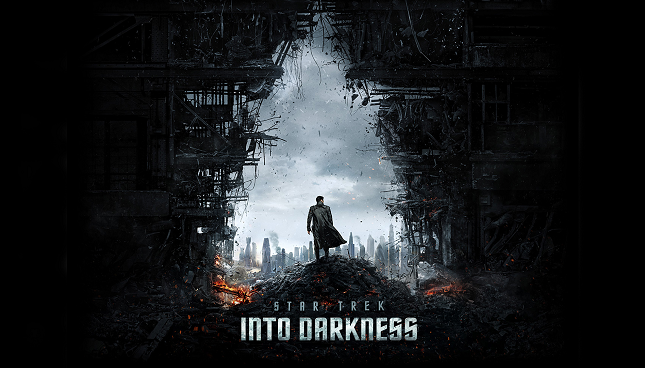
[ by Charles Cameron — from Paradise Regained: Overcoming Terrorism in Star Trek Into Darkness ]
.


.

Matt Ford, guest-blogging at Grand Blog Tarkin [includes spoilers] asks:

How many young Americans learned Arabic and Pashto or studied counterterrorism and international relations because nineteen men flew three planes into a building and one into the ground, killing thousands?

Great question!

And how many in the UK after 9/11? — and after 7/7?

**

Also worth reading [and also includes spoilers]:

Amy Davidson, Is “Star Trek into Darkness” a drone allegory?

Mind map usage example: John Boyd Papers Index

May 21st, 2013

[by Lynn C. Rees, with points from John Boyd]

Earlier this year, Scott kindly shared a PDF index of the John Boyd Papers (see tail end of PDF here). While PDFs are good for preserving document layout, they’re poor at storing clean text data. Since I wanted the index in a spreadsheet to facilitate searching and sorting, this was a issue. Data extraction into machine readable formats remains painful. Data extraction from PDFs remains even more painful: the priority of PDFs is prettiness for the human eye not prettiness for the machine.

Fortunately, pdftotext can extract the text data to plain text. But, even then, the John Boyd index text was misaligned and out of order due to its formatting in the original document. It also needed to be broken down into useful chunks that could be mapped to spreadsheet cells. I decided to use Freeplane to reformat the text into a form appropriate for piping into a spreadsheet since it has elements of asynchronous text editing.

I don’t know if a true asynchronous text editor exists. I’m not sure I know what one would look like. But I have some notion of what it isn’t. Most text editors and word processors are good at sequential editing of text. They only sort of approach asynchronous text editing where text is moved around and reordered freely without copy and pasting. Asynchronous text editing was what I wanted and Freeplane kind of does it.

I pasted the plain text into Freeplane and started breaking it down. Progress was slow. A lot of awkward and time-consuming cutting and pasting was required and this  was annoying. I had to create additional text manipulation tools for Freeplane. Then things moved along nicely.

Due to intervening time constraints, the Boyd Papers index hasn’t made it to spreadsheet form yet. However, it is broken down in Freeplane. Though mind maps are most commonly used as a brainstorming tool, they are also useful for rearranging existing text data in a hierarchy. Since the John Boyd index mind map is a useful example of this, here’s what’s done so far:

  • the index as an image (5.9 MB in size, require some magnification within the browser)
  • original Freeplane mindmap (536.7 KB in size) 

Wicked problems, mind mapping, and IBIS

May 21st, 2013

[by Lynn C. Rees, after a reminder by Charles Cameron]

Wikipedia defines a mind map as:

…a diagram used to visually outline information. A mind map is often created around a single word or text, placed in the center, to which associated ideas, words and concepts are added. Major categories radiate from a central node, and lesser categories are sub-branches of larger branches. Categories can represent words, ideas, tasks, or other items related to a central key word or idea.

Using visuals to represent and explore issues has long interested me. The primary tool I use now is Freeplane, a software application for drawing mind maps. While many mind mapping applications are available, I use Freeplane because:

  1. it’s free/open source software (FOSS)
  2. it’s trivial for me to customize and extend its core features with my own software

A central and popular conceit of FOSS is Linus’ Strongly Worded Suggestion Law:

“given enough eyeballs, all bugs are shallow”; or more formally: “Given a large enough beta-tester and co-developer base, almost every problem will be characterized quickly and the fix will be obvious to someone”

This conceit, over-hyped for most FOSS projects, is true in narrower cases. Since I use a few obscure Freeplane features, I’ve encountered a few obscure Freeplane bugs. Since Freeplane’s source is freely and publicly available and I’m a software engineer, I fixed some of those bugs myself. Some bugs I merely reported for Freeplane’s developers to fix. Some bugs I fixed but the fix hasn’t been merged into the main program.

This isn’t a significant issue. Since it is FOSS, I can take Freeplane’s source code, apply my fixes and customizations to it, and run my own version of the software which, under the terms of the GNU General Public License, I also make publicly available. Hoping to benefit from Linus’ Law myself, I’ve released source for some of my custom Freeplane add-ons for the Freeplane user community to use.

An add-on I released today is a first attempt to represent and explore a not infrequent topic here at Zenpundit: wicked problems.

Horst Rittel, who first devised the concept, ascribed ten characteristics to wicked problems:

  1. There is no definitive formulation of a wicked problem.
  2. Wicked problems have no stopping rule.
  3. Solutions to wicked problems are not true-or-false, but better or worse.
  4. There is no immediate and no ultimate test of a solution to a wicked problem.
  5. Every solution to a wicked problem is a “one-shot operation”; because there is no opportunity to learn by trial-and-error, every attempt counts significantly.
  6. Wicked problems do not have an enumerable (or an exhaustively describable) set of potential solutions, nor is there a well-described set of permissible operations that may be incorporated into the plan.
  7. Every wicked problem is essentially unique.
  8. Every wicked problem can be considered to be a symptom of another problem.
  9. The existence of a discrepancy representing a wicked problem can be explained in numerous ways. The choice of explanation determines the nature of the problem’s resolution.
  10. The planner has no right to be wrong (planners are liable for the consequences of the actions they generate).


Rittel’s own solution for solving wicked problems was the Issue-Based Information System (IBIS). IBIS involves four elements:

  • questions
  • ideas
  • pros
  • cons

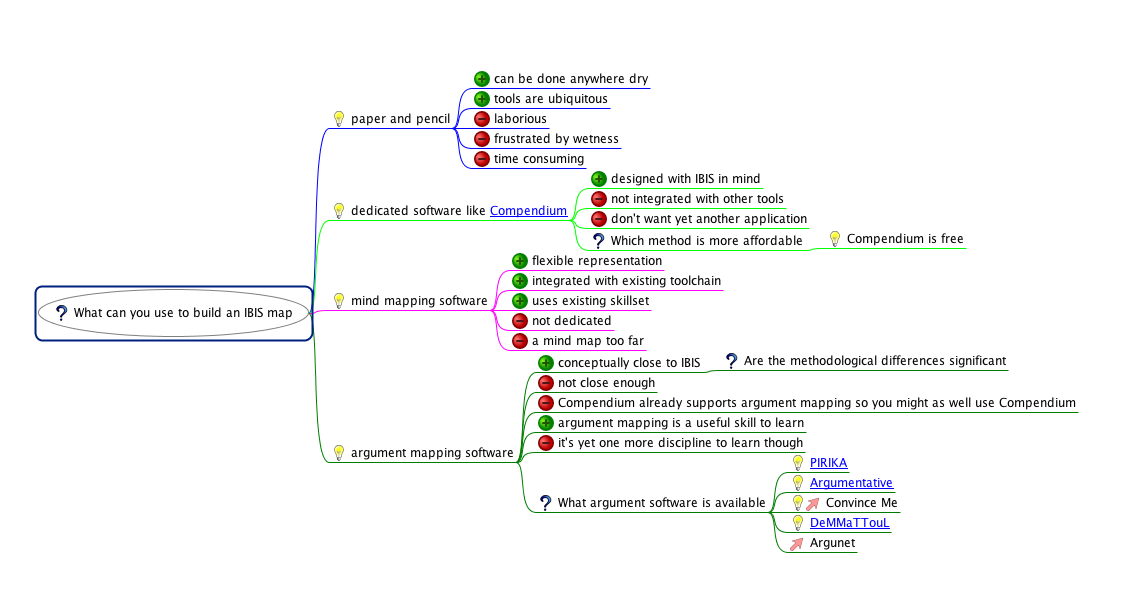
An IBIS map starts with one root question (simplified here for posting efficiency):

First step

First step

A question can be responded to with an idea.

Step two

Step two

Within IBIS, an idea is:

  1. a potential answer or solution to a question
  2. a trigger for further questions


Pros and cons can only respond to ideas.

Step three

Step three

Further questions can also respond to ideas, pros, and cons.

Step four

Step four

Following these few rules, Rittel argued that even wicked problems could be mapped. While IBIS can be used for individual visualization of wicked problems. Rittel designed it for a group. Used with other methodologies like dialogue mapping, Rittel figured a shared map could help establish shared understanding, facilitating distributed problem solving.

Rittel may be correct. I don’t know. While other structured analysis approaches exist, many of them suffer from too much representational granularity. Too much fine parsing tends to lead to inevitable ontological crisis.

For my own efforts, IBIS has a nice balance between too little structure and too much. This new Freeplane add-on facilitates use of IBIS within my existing toolchain.

Some ZP readers may find it interesting to experiment with. It requires Freeplane, available as a free download for Windows, MacOS X, and Linux. The initial version of the add-on, FreeIBIS 0.1.0, is available as a free download here. If Freeplane is installed, all you should have to do is double click it to have it install. Commands are accessed under the Tools  freeIBIS menu within Freeplane.

I use the keyboard for mind mapping so I assigned the four IBIS functions to these keyboard shortcut combinations on MacOS X:

  • ? for question
  • > for idea
  • = for pro
  •  for con

It may use the Control key instead of  under Windows. I don’t know. I don’t run Windows.

Fortunately, Freeplane has a convenient point and click way to reassign keyboard shortcuts under Tools → Select hot keys.

I am exploring further ways to integrate visualization techniques like Freeplane and IBIS with other structured techniques like ACH. Hopefully we’ll see more emerge in this area going forward.

New Book: America 3.0 is Now Launched!

May 21st, 2013

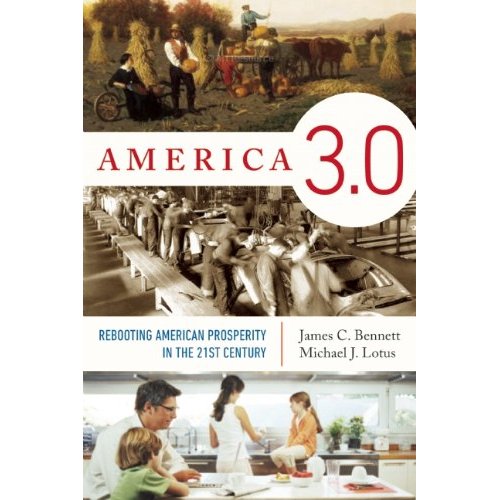
America 3.0: Rebooting American Prosperity in the 21st Century – why America’s Best Days are Yet to Come by James C. Bennett and Michael Lotus

I am confident that this deeply researched and thoughtfully argued book  is going to make a big political splash, especially in conservative circles – and has already garnered a strong endorsement from Michael Barone, Jonah Goldberg, John O’Sullivan and this review from  Glenn Reynolds in USA Today :

Future’s so bright we have to wear shades: Column 

….But serious as these problems are, they’re all short-term things. So while at the moment a lot of our political leaders may be wearing sunglasses so as not to be recognized, there’s a pretty good argument that, over the longer time, our future’s so bright that we have to wear shades.

That’s the thesis of a new book, America 3.0: Rebooting American Prosperity In The 21st Century.The book’s authors, James Bennett and Michael Lotus, argue that things seem rough because we’re in a period of transition, like those after the Civil War and during the New Deal era. Such transitions are necessarily bumpy, but once they’re navigated the country comes back stronger than ever.

America 1.0, in their analysis, was the America of small farmers, Yankee ingenuity, and almost nonexistent national government that prevailed for the first hundred years or so of our nation’s existence. The hallmarks were self-reliance, localism, and free markets.

At the end of the 19th century and the beginning of the 20th, people were getting unhappy. The country was in its fastest-ever period of economic growth, but the wealth was unevenly distributed and the economy was volatile. This led to calls for what became America 2.0: an America based on centralization, technocratic/bureaucratic oversight, and economies of scale. This took off in the Depression and hit its peak in the 1950s and 1960s, when people saw Big Government and Big Corporations as promising safety and stability. You didn’t have to be afraid: There were Top Men on the job, and there were Big Institutions like the FHA, General Motors, and Social Security to serve as shock absorbers against the vicissitudes of fate.

It worked for a while. But in time, the Top Men looked more like those bureaucrats at the end of Raiders Of The Lost Ark, and the Big Institutions . . . well, they’re mostly bankrupt, or close to it. “Bigger is better” doesn’t seem so true anymore.

To me, the leitmotif for the current decade is supplied by Stein’s Law, coined by economist Herb Stein: “Something that can’t go on forever, won’t.” There are a lot of things that can’t go on forever, and, soon enough, they won’t. Chief among them are too-big-to-fail businesses and too-big-to-succeed government.

But as Bennett and Lotus note, the problems of America 2.0 are all soluble, and, in what they call America 3.0, they will be solved. The solutions will be as different from America 2.0 as America 2.0 was from America 1.0. We’ll see a focus on smaller government, nimbler organization, and living within our means — because, frankly, we’ll have no choice. Something that can’t go on forever, won’t. If America 2.0 was a fit for the world of giant steel mills and monolithic corporations, America 3.0 will be fit for the world of consumer choice and Internet speed.

Every so often, a “political” book comes around that has the potential to be a “game changer” in public debate. Bennett and Lotus have not limited themselves to describing or diagnosing America’s ills – instead, they present solutions in a historical framework that stresses the continuity and adaptive resilience of the American idea. If America”s “City on a Hill” today looks too much like post-industrial Detroit they point to the coming renewal; if the Hand of the State is heavy and it’s Eye lately is dangerously creepy, they point to a reinvigorated private sector and robust civil society; if the future for the young looks bleak,  Bennett and Lotus explain why this generation and the next will conquer the world.

Bennett and Lotus bring to the table something Americans have not heard nearly enough from the Right – a positive vision of an American future that works for everyone and a strategy to make it happen.

But don’t take my word for it.

The authors will be guests Tuesday evening on Lou Dobb’s Tonight and you can hear them firsthand and find out why they believe “America’s best days are yet to come


Switch to our mobile site