zenpundit.com

Sisyphus on the treadmill of memes

May 9th, 2013

[ by Charles Cameron — Khorasan, black banners, the Ghazwa-e-Hind — when will the updating ever stop? ]
.
**

It looks as though I first realized that “the black banners of Khorasan” was a meme I should be “eyes out” for was in July 2007, when John Robb pointed us to a piece by Syed Saleem Shahzad on events at the Red Mosque

For the al-Qaeda leadership sitting in the tribal areas, the situation is fast evolving into the promised battle of Khorasan. This includes parts of Iran, Pakistan, Afghanistan and Tajikistan from where the Prophet Mohammed promised the “end of time” battle would start.

That reference to Khorasan in turn led me back to a slightly earlier Washington Post piece where the Khorasan / black banners motif was clearly set forth, along with a pointed comment from Andrew Black, co-founder of Thistle Intelligence Group:

The battles today, like those against the Soviet occupiers, are also fought with religious verve. The Taliban and al-Qaida fight under a black flag connoting the participation of Islam’s prophet in their battle for Khorasan, the ancient name for the region centered around Afghanistan.

Khorasan increasingly features in the militants’ videos and the name was taped to the leg of a suicide bomber who killed 24 people in Pakistan’s Northwest Province this spring.

“One should not underestimate the theological importance of Khorasan to aspiring mujahedeen; particularly those who are only able to initially view the conflict through the Internet,” said Black.

Hamid Gul was in Shahzad’s piece too, talking about the Red Mosque and the Red Fort — and here, too, I likely made my first acquaintance with the motif of the Ghazwa-e-Hind, symbolized by the wish to plant Pakistan’s flag on Delhi’s Red Fort:

It is a pity that our army was preparing youths to seize Lal Qala [the Red Fort of Delhi] and they ended up seizing the Lal Masjid,” Gul said.

Both these memes have been around longer than I have, but back then they didn’t seem to be attracting much attention in the west.

Now they’re cropping up all over — and I’m (to switch metaphors in mid-stream) paddling hard to keep up.

**

The black flags are alive and well this week, as shown in this video of the graduation of a new batch of the Free Army fighters in Syria:

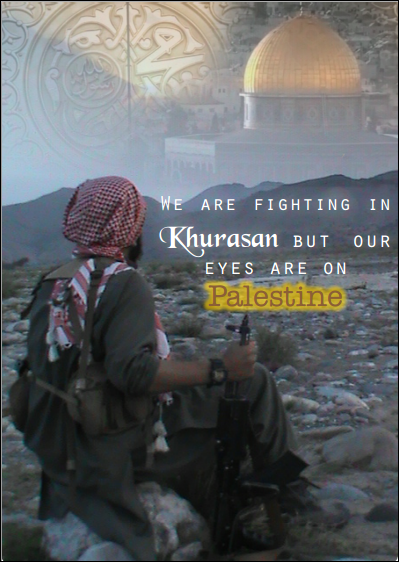
Khorasan too, as seen in the image from the new magazine Azan at the top of this post — but where does Azan itself come from?

B Raman writes:

It is not yet clear who has started “Azan”. One suspect is the Tehrik-e-Taliban Pakistan (TTP), which is the Pakistani Taliban. The other suspect is Al Qaeda headquarters in the South Waziristan area of Pakistan.

I’m interested in this question, because Azan had an overview of the various fronts of contemporary jihad, and an image that invokes both Khorasan and Jerusalem isn’t exactly “local” in focus. And that brings me to that other meme of interest here — the Ghazwa-e-Hind — which as I pointed out recently ius also mentioned in Azan, though not a huge focus there.

But if Azan is indeed a TTP product, then this info from Mr Orange:
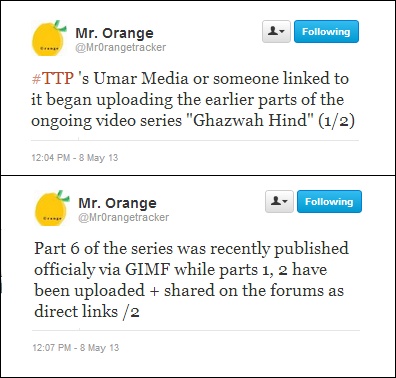
would indicate they find the Ghazwa of more than passing interest…

Water and people

May 9th, 2013

[ by Charles Cameron — and then of course there are animals and plants, too, and wildfires, and the Grand Canyon ]
.

Just a couple of things to think about:

Sources:

  • More than half of the world’s population lives inside this circle

    Even more mindblowing: said circle is mostly water.

  • All of the World’s Water

    Spheres showing:
    (1) All water (sphere over western U.S., 860 miles in diameter)
    (2) Fresh liquid water in the ground, lakes, swamps, and rivers (sphere over Kentucky, 169.5 miles in diameter), and
    (3) Fresh-water lakes and rivers (sphere over Georgia, 34.9 miles in diameter).

  • In the lower panel, the “all water” sphere is obvious, the “fresh liquid” sphere is visible, but the “freshwater lakes and rivers” — did you even notice it?

    **

    Some paras I wrote for John Petersen while at The Arlington Institute around the turn of the millennium:

    Water is our most precious resource. Our bodies are largely made of it; we thirst for it, and die when it is withheld more rapidly than we die for lack of food; and our food itself — whether animal or plant — also relies on it for nourishment and survival. Not surprisingly, water features in religious scripture and poetic mythology as among the highest symbols of purity and blessing: the Psalmist declares “There is a river, the streams whereof shall make glad the city of God” (Psalms 46: 4), Jesus in the New Testament speaks of his own teachings as “a well of water springing up into everlasting life” (John 4:14), while Allah declares in the Koran, “We made from water every living thing” (Al-Anbiyáa 30). For Lao-tzu in the Tao te ching, it is the analog of wisdom: “In the world there is nothing more submissive and weak than water,” he writes, “yet for attacking that which is hard and strong nothing can surpass it.”

    We consume water in ever increasing amounts, while polluting it as though its very purity was a reproach to us – and simultaneously beginning to recognize that this most precious of resources is just that – a limited, physical resource that we are squandering. Such significant indicators of hydrologic activity as , salinity, sea levels, snowmelt, glacial melt, and rainfall are not merely changing but accelerating their rates of change. We are fast running our of fresh water to drink and to irrigate our crops. And when World Bank vice president Ismail Serageldin declared in 1995 that “The wars of the next century will be over water”, he was giving advanced notice of a looming problem which we overlook at our peril.

    If I could slip a couple of quotes into the water supply

    May 9th, 2013

    [ by Charles Cameron — pretty much just thinking out loud about mental processes ]
    .

    The thing is, changing minds is a delicate business, pushing too hard can be counter-productive, and all the more so when the conclusion you want to bring about is clean contrary to the ethos of those you would far rather see thinking — and acting — very differently.

    **

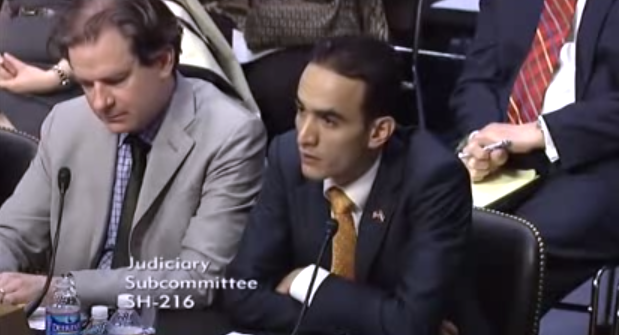
    My first example doesn’t actually need to be dropped into the water supply, it’s there already, in the public discourse. It is taken from Farea Al-Muslimi‘s testimony on Drone Wars: The Constitutional and Counterterrorism Implications of Targeted Killing, April 23, 2013:

    Had the United States built a school or hospital, it would have instantly changed the lives of my fellow villagers for the better and been the most effective counterterrorism tool. Instead of first experiencing America through a school or a hospital, most people in Wessab first experienced America through the terror of a drone strike. What radicals had previously failed to achieve in my village, one drone strike accomplished in an instant: there is now an intense anger and growing hatred of America.

    If that can quietly penetrate thinking in Washington DC, it might alert us to our tendency to act with thought only for direct consequences, never for unanticipated second and second plus order effects…

    And diminish hatred. And thereby also diminish radicalization and recruitment.

    **

    Knowing what words might best counteract pro-jihadist sentiments among potential recruits for purposes of CVE is a far trickier business, and I don’t think it’s my job or the job of government to attempt to influence anyone’s religious belief directly — as I said above, it all too easily backfires.

    Nevertheless, I think that getting a clear picture of how the jihadist mind typically works is a useful exercise, and I’ve suggested before now that accepting the concept of jihad as individual obligation — fard ‘ayn — marks a decisive turning point. That’s why Abd al-Salam Faraj made it a “sixth pillar” of Islam and the centerpiece of his tract The Neglected Duty — see also this article on Faraj in Islamopedia.

    Having said that, these words of bin Laden to Sheikh `Atiyya should at the very least give pause to any who have, like Faisal Shahzad, obtained US citizenship under oath:

    You have perhaps followed the media trial of brother Faisal Shahzad, may God release him, during which the brother was asked to explain his attack [against the United States] in view of having taken an oath [not to harm it] when he was awarded his American citizenship. He responded that he lied [when he took the oath]. It does not escape you [Shaykh `Atiyya] that [Shahzad’s lie] amounts to betrayal (ghadr) and does not fall under permissible lying to [evade] the enemy [during times of war]…please request from our Pakistani Taliban brothers to redress this matter…also draw their attention to the fact that brother Faisal Shahzad appeared in a photograph alongside Commander Mahsud. I would like to verify whether Mahsud knew that when a person acquires an American citizenship, this involves taking an oath, swearing not to harm America. If he is unaware of this matter, he should be informed of it. Unless this matter is addressed, its negative consequences are known to you. [We must therefore act swiftly] to remove the suspicion that jihadis violate their oath and engage in ghadr.

    That’s from Letters from Abbottabad: Bin Ladin Sidelined? by Nelly Lahoud et al, Harmony Program, the Combating Terrorism Center at West Point, 3 May 2012, p. 36.

    For convenience — and here you see the compulsive editor in me helplessly at work — I’d leave out the names and bracketed explanatory phrases, and give the essence of his remarks thus:

    When a person acquires an American citizenship, this involves taking an oath, swearing not to harm America. … The brother was asked to explain his attack in view of having taken an oath when he was awarded his American citizenship. He responded that he lied. It does not escape you that amounts to betrayal (ghadr) and does not fall under permissible lying to the enemy …

    **

    Obviously, that single quote doesn’t accomplish total de-radicalization — but what it might do is give some wannabes pause for further reflection, And as JM Berger has pointed out recently:

    there are hundreds of thousands to millions of people in the world who are radicalized, and only a handful take up violence

    My point here is that if bin Laden himself counseled forms of restraint which young jihadi wannabes acted in ignorance of — how much more would an aspirant need to exercise caution, knowing that divine sanction depends on an accurate theological understanding of what is halal and what haram?

    Because once an individual becomes convinced that jihad is an individual obligation, the fear of being an irhabi terrorist rather than a mujahid fi sabil Allah is about the only restraint left — and that theological distinction, which at the moment of death separates Jannah from Jahannam, paradise from hell, is way above the wannabee’s theological level of competence.

    Something that bears thinking about, no?

    Paging John Arquilla & David Ronfeldt

    May 9th, 2013

    [ by Charles Cameron — on the West Coast ]
    .

    Sources:

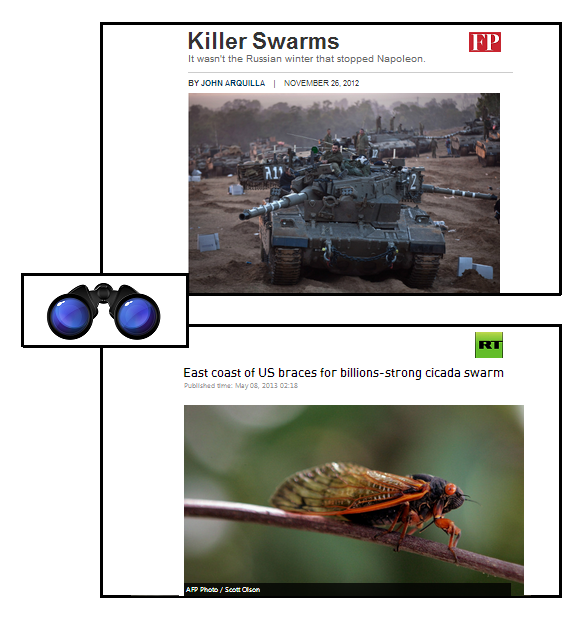
  • John Arquilla, Killer Swarms
  • RT, East coast of US braces for billions-strong cicada swarm
  • **

    Exodus 10. 3-6:

    And Moses and Aaron came in unto Pharaoh, and said unto him, Thus saith the Lord God of the Hebrews, How long wilt thou refuse to humble thyself before me? let my people go, that they may serve me. Else, if thou refuse to let my people go, behold, to morrow will I bring the locusts into thy coast: And they shall cover the face of the earth, that one cannot be able to see the earth: and they shall eat the residue of that which is escaped, which remaineth unto you from the hail, and shall eat every tree which groweth for you out of the field: And they shall fill thy houses, and the houses of all thy servants, and the houses of all the Egyptians; which neither thy fathers, nor thy fathers’ fathers have seen, since the day that they were upon the earth unto this day.

    Qur’an, 7. 133:

    So We let loose upon them the flood and the locusts, the lice and the frogs, the blood, distinct signs; but they waxed proud and were a sinful people.

    And the Eastern seaboard of the US is way more sinful than the ill-reputed West?

    **

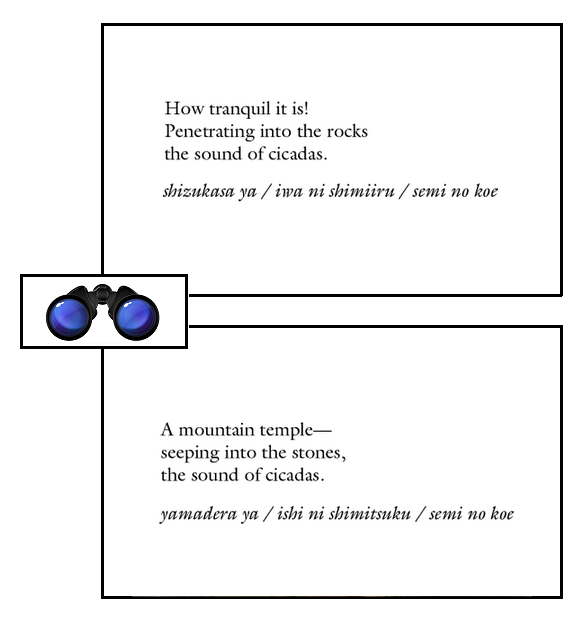
    For a different view, we turn to Basho. Here are the earlier and later forms of one of his poems:

    Source:

  • Eleanor Kerkham, ed., Matsuo Bashô’s Poetic Spaces: Exploring Haikai Intersections
  • A Brief Note on the Benghazi Hearings

    May 9th, 2013

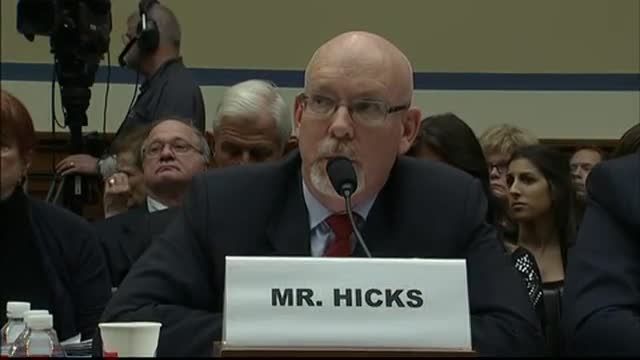
    There is legitimate room for debate if there could have been an effective military reaction to the attack in Libya by al Qaida terrorists that killed Ambassador Stevens and other US personnel.  One was apparently never seriously entertained  by senior White House, State Department and Pentagon officials. I think there ought to have been an effort to move heaven and earth and far, far greater willingness to inflict massive casualties on an attacking Libyan mob than existed, but in fairness to the Obama administration, a seat-of-the-pants, unsupported, undermanned response could also have been a replay of Blackhawk Down or Desert One. It’s a tough judgment call for any President.

    That’s not why the Obama administration is in trouble today.

    Poorly supported security and inept decision making by the State Department in Libya was likewise, disappointing but politically survivable and sadly, unsurprising.. We have seen similar bungling before and after 9/11 by most of our major national security departments and agencies at one time or another. It is a bipartisan phenomenon, albeit one we take far too lightly.

    No, as damning testimony today made clear, the Obama administration is in trouble because their poor but not remarkably so handling of Benghazi was shielded by a ridiculous lie told entirely for partisan gain and to protect the overrated reputations and overweening egos of various administration bigwigs, most notably the former Secretary of State, Hillary Clinton.

    Is there anyone today – anyone at all – who still believes that Benghazi occurred because of an obscure crackpot’s video on youtube?

    Had the administration manfully said “This attack is a terrible tragedy and we dropped the ball but you can believe we won’t make a similar mistake tracking down the people who did this and make them pay” most Americans would have accepted that. No, not rabid partisan Republicans, but most Americans would have wanted to back the President, any President, in the wake of such terrorism which is directed, in the last analysis, at all of us.

    They did not – and much of the rest of their reaction indicates that the real concern at State and the White House was and still is with the temerity of their political opponents in daring to demand they account for their actions as if we lived in a Republic or something.

    In American politics, it is the self-inflicted wounds that fester and turn gangrenous


    Switch to our mobile site