zenpundit.com

A second comment on Hegghammer & Lacroix

April 28th, 2013

[ by Charles Cameron — because the Bene Gesserit understand the power of Mahdism and jihad ]
.

Further reading:

  • Frank Herbert, Appendix II: The Religion of Dune
  • Peter Tarchin, The ‘Dune Hypothesis’
  • Peter Tarchin, Psychohistory and Cliodynamics
  • Peter Tarchin, Science on Screen: DUNE
  • Peter Tarchin, How to Overthrow an Empire – and Replace It with Your Own
  • Ibn Khaldun, The Muqaddimah: An Introduction to History
  • Doris Lessing, Canopus in Argos: Archives
  • **

    As T Greer, friend of this blog, notes in a comment to that last Tarchin post, his explorations would fit in nicely with the work at Grand Blog Tarkin

    A Question for Hegghammer & Lacroix

    April 28th, 2013

    [ by Charles Cameron — a single word in a very small book, and the world that hangs in the balance ]
    .

    I’ve just read Hegghammer & Lacroix on The Meccan Rebellion. At 78 pages and 5.3 x 8.3 inches, it’s a tiny book in hardback and quite a delight to hold — the electricity in my city block went out for a while the other day, and I took pleasure in reading it out under the sun — and it contains, in essence, the two authors’ paper, Rejectionist Islamism in Saudi Arabia (Int. J. Middle East Stud. 39 (2007), 103–122) and a companion piece by Lacroix titled Between Revolution and Apoliticism: Nasir al-Din al-Albanai and his Impact on the Shaping of Contemporary Salafism.

    Blog posts tend to present a point of view – whether to preach to the choir, promote it to unbelievers, stir up trouble, or simply add detail or a fresh angle to an existing narrative. Seldom do they ask questions.

    My own instincts — in line with Madhyamaka as I briefly encountered it in the teachings of Elizabeth Mattis-Namgyel — lead me to leave some kinds of questions open: I use my DoubleQuotes format to set the juices flowing, by providing nudges to thought rather than outright statements – but on this occasion I have a question to ask, and as it’s too long for Twitter I’ll post it here.

    **

    Here’s my question. Juhayman al-Utaybi believed one of his companions, Muhammad al-Qahtani, was the Mahdi, the awaited Coming One of Islam — and that, in our authors’ words, “consecrating him [al-Qahtani] in Mecca on the turn of the hijra century” would ”precipitate the end of the world”.

    In my view, a great deal rests on that simple word, “precipitate”. Would “usher in” do as well? Or “mark the beginning of” perhaps? Or is the idea of forcing the hand of God present, as it is in Reuven Paz’ phrase, “hot-wiring the apocalypse”?

    There’s a lot riding on that issue: whether or not it is possible to force the hand of God, to accelerate destiny, to hasten apocalypse.

    **

    Okay, let’s go light-footed into this issue. In The Question in the DC Comics universe, we have a character described thus:

    During service in Vietnam Jeremiah Hatch got insane, he began to hear the voice that urged him to do the will of the Lord by serving the Devil. He thought that his mission was “to hasten the corruption, to nurture the foulness until the almighty has no choice but to rain down fire and brimstone and overthrow the cities and the plain and all the inhabitants of cities and all that grows on the ground…”

    **

    Hastening the apocalypse — it’s an idea you can find in the world of DC Comics, but it was Israeli analyst Dr Reuven Paz who presented it to us in canonical “national security” form in his paper, Hot-wiring the Apocalypse, where his actual words are:

    The Jihadi and nationalist insurgency in Iraq, which feeds the motivations and enthusiasm of growing number of Islamist youth to search for Jihad, look for the “culture of death and sacrifice,” and self-radicalize themselves, is another factor in the growing sense of Jihadi pride, which also hotwires the sense of the apocalypse.

    That’s a faily imprecise form of words (‘The sense of apocalypse”) from a careful scholar, and Paz applies the concept in a specifically Sunni context. This, however, doesn’t prevent a popular Christian writer such as Joel Rosenberg from applying the same idea to the Shi’ite rulers of Iran:

    Only when we understand the eschatology currently driving Iranian foreign policy, can we truly begin to understand how dangerous the regime in Tehran is. Only then can we fully appreciate how events like the revolution underway in Egypt only encourages Twelvers like Khamenei to take still further provocative and perilous actions to hasten the coming of the Twelfth Imam.

    So the idea is afloat that both Sunni jihadists in Iraq and the Shi’ite state of Iran ay be about the “hastening” business.

    **

    Blog-friend Dr. Timothy Furnish, as I’ve noted here before, rebuts the application of Paz’ concept by Rosenberg, Glenn Beck and others to the situation in Iran, saying of it:

    It posits that there is a strain of Islamic eschatological thought which hopes to force Allah’s hand in sending the Mahdi, as it were, via sparking a major conflagration (nuclear, or otherwise) with the West (either the U.S. or Israel). This may be true of some of the Sunni jihadits with an apocalyptic bent, but there is very little evidence that such an idea is operative in the upper echelons of the Islamic Republic of Iran. The ayatollahs may be cut-throat, anti-Israeli and anti-American-but they are not stupid. They know full well that any nuclear attack on Israel of the U.S. would be met with a crushing retaliation. (Besides, what good would it do for the Mahdi to come and establish his global caliphate over smoking radioactive ruins?)”

    **

    And if I might ask a follow-up question — is the first of the Juhayman Letters, which is devoted to the theme of the coming of the Mahdi, available in English?

    Two tales from the outsider jihad

    April 28th, 2013

    [ by Charles Cameron — wanna know the very latest on those black banners from Khorasan? ]
    .

    Here’s the scene that greeted four British recruits to the jihad on their arrival at a training camp in Pakistan in August 2011:

    This wasn’t like the training camps of propaganda videos, with the black flag of al-Qaeda flying free in the wind. There were no racks of weapons waiting for recruits. And all the trainers had left for the religious festival of Eid.

    They came home to the UK, where their families “berated” them, they were arrested, tried, found guilty and sentenced to 40 month terms in prison.

    With jihad, as with so much else, you can’t always count on truth in advertising.

    **

    And then there’s Omar Hammami.

    Even Rusty Shackleford from My Pet Jawa — “a weblog comparing Muslims to Jawas and containing criticism and satire of Islamic traditions and beliefs” — can’t help but like Omar Hammami, aka Abu Mansoor Al-Amriki, the American jihadist from Alabama who, as Wired puts it, “shoots the breeze” on Twitter “with the people whose job it is to study and even hunt people like him.” He does it with verve, even when ridiculing al-Shabab, the group he was put on the the FBI’s Most Wanted Terrorist List with a $5 million bounty for joining:

    Shackleford commented, “I’ve actually become kinda fond of the guy — if that’s possible”.

    Al-Shabab, however, appears to dislike him enough to have tried to assassinate him a couple of days ago, following up their failure with a major attack, results as yet unknown.

    With jihad in foreign lands, apparently, you can’t even trust your fellow mujahidin to treat you better than your avowed enemies.

    Hysteria about Afghan schoolgirl hysteria

    April 28th, 2013

    [ by Charles Cameron — Reuters publishes scary stuff, should have checked their facts with WHO epidemiologists first ]
    .

    Last time, it was the Jerusalem syndrome — this time it’s mass hysteria, not poison.

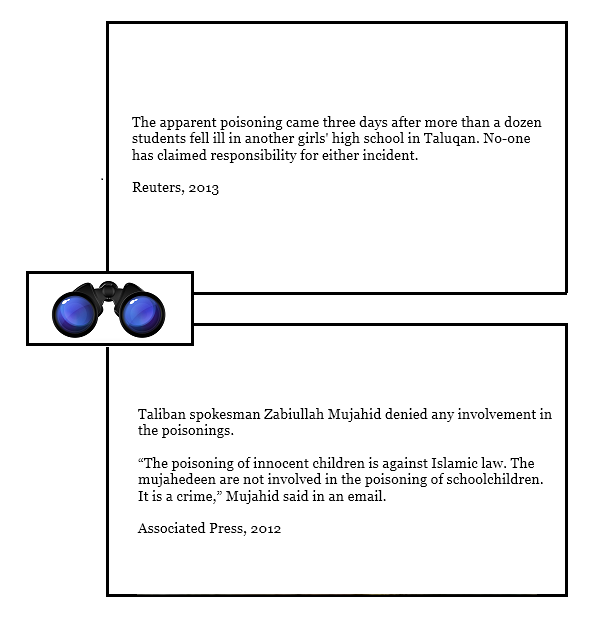
    The Reuters article, Afghan girls’ school feared hit by poison gas by Folad Hamdard (upper frame, above) was posted on April 21, 2013, just one week ago.

    Its key paragraphs in terms of etiology and blame are these:

    As many as 74 schoolgirls in Afghanistan’s far north fell sick after smelling gas and were being examined for possible poisoning, local officials said on Sunday.

    While instances of poisoning are sometimes later found to be false alarms, there have been numerous substantiated cases of mass poisonings of schoolgirls by elements of Afghanistan’s ultra-conservative society that are opposed to female education.

    and:

    Between May and June last year there were four poisoning attacks on a girls’ school in Takhar, prompting local officials to order principals to stay in school until late and staff to search the grounds for suspicious objects and to test the water for contaminants.

    Takhar has been a hotbed of militancy and criminal activity since 2009, with groups such as the Taliban and the Islamic Movement of Uzbekistan active.

    One wonders: Does Reuters employ fact checkers?

    **

    One wonders because…

    An Editorial Note on the 2012 article Mass Psychogenic illness in Afghanistan (lower frame, above) in the WHO’s Weekly Epidemiological Monitor (Vol 5 # 22, 27 May) reads in part:

    This is the fourth year where episodes of suspected mass poisoning of school girls is reported from Afghanistan. Like in the previous years the events are triggered off with one girl developing symptoms of headache, weakness, dizziness, nausea and fainting. Often these outbreaks were believed to be the work of political elements in the country who oppose girls education. Reports of stench smells preceding the appearance of symptoms have given credit to the theory of mass poisoning (chemical/bioterrorism). However, investigations into the causes of these outbreaks have yielded no such evidence so far. In the last four years over 1634 cases from 22 schools have been treated for Mass Psychogenic Illness (MPI) in Afghanistan. There are no related deaths reported.

    Reuters is read by a whole lot more people than some WHO epidemiological weekly, eh?

    **

    Luckily, the NY Times at least posted a blog post by Matthieu Aikins writing from Kabul, The ‘Poisoned’ Girls of Afghanistan, by way of alerting us to the WHO report:

    I’m willing to bet that there was no poison.

    Over the past few years, thousands of girls have fallen victim to waves of alleged poisonings in Afghan schools. The government, media and education activists have blamed the Taliban, and the police in a number of provinces have produced the “guilty” parties, with some of them confessing on national television.

    But last July when I investigated the subject for Newsweek, I discovered never-released reports showing that the United Nations, the World Health Organization and NATO’s International Security Assistance Force had investigated the incidents for years and had never found, despite extensive laboratory tests, any evidence of toxins or poisoning — a fact that may explain ISAF’s conspicuous silence on the issue.

    I’m glad that’s been cleared up.

    **

    Here’s another DoubleQuote for you:

    Of course, the Taliban spokesman was addressing a 2012 outbreak of the same hysteria story, and the “no claim of responsibility” report is from one of this year’s versions.

    But why would anyone claim responsibility in any case, if the actual cause is mass hysteria rather than poisoning? There’s history to these things — they didn’t begin in Afghanistan:

    The cases the Afghanistan incidents most resemble are the Tanganyika laughter epidemic of 1962, in which hundreds of people, mostly schoolgirls, were overcome by fits of mirthless, extended laughter, in what is now known as Tanzania, and the West Bank fainting epidemic of 1983.

    The similarities between the heavily studied epidemic in the occupied West Bank and Afghanistan are particularly striking. Both places are in a state of conflict, where political violence is a fact of life, and both have powerful local rumor mills. The incidents follow a similar pattern: First a single report of a bad smell, then a small number of girls come down with symptoms, then it spreads. Local media fueled the rumors and the incidents spread in Afghanistan, just as they did in Israel and Palestine.

    Albert Hefez, Israel’s lead psychiatric investigator of the incident, wrote in his 1985 study “The Role of the Press and the Medical Community in the epidemic of ‘Mysterious Gas Poisoning’ in the Jordan West Bank” that Israeli newspaper reports of “poisoning” at the start of the epidemic added fuel to the flames. A front page article in Haaretz on March 28, 1983 even claimed that Israeli military investigators had found traces of nerve gas and quoted “army sources” as saying they suspected Palestinian militants were poisoning their own people in order to blame Israel and provoke an uprising. Palestinian leaders followed up with accusations that Israel had poisoned them in an attempt to drive them from the West Bank.

    And such things don’t only happen “abroad” — as detailed in that same NYT blog post I quoted above:

    The phenomenon of groups of people falling ill for psychological, rather than physical, reasons is not unknown, nor is it limited to Afghanistan. Moreover, the typical victims are school-age girls. In late 2011, when a group of girls in Le Roy, New York, fell victim to a mysterious twitching illness, medical authorities eventually concluded it was psychogenic.

    Red lines and the credibility arms race

    April 26th, 2013

    [The views and opinions expressed here are solely the responsibility of Lynn C. Rees. They may not necessarily reflect the official views or opinions of Zenpundit] 

    To deter, Barack Obama has publicly drawn a red line between tolerable and intolerable. We now watch to see and (perhaps) learn if open signaling of red lines has deterrent effect.

    Open red lines intended to stave off the intolerable without ending in blows are as ancient as territorial instinct. Red frequents coloration of animals who’ve evolved warning signals embedded in their anatomy. Lines, though marked more by scent or suggested by signal, are also abundant among Man and nature.

    “Bear”, my brother’s late Shar-Pei, vociferously defended my brother’s chain-linked fence line. All his toing and froing facing down suspicious pedestrians even wore a second line into the front lawn that paralleled the fence. His vigorous bark emerged from wolven ancestors to draw lines red in tooth and claw in wolven mind so it didn’t come to lines red in tooth and claw in wolven reality. 

    But, if bluffs are called and barks prove to have more volume than bite, a red line will prove only as substantial as the bite and fight beyond it. If warning is not credibly conveyed and things fall apart, nothing may remain except bite and fight.

    Bear’s bark proved a poor red line. While it sounded loud and formidable, when you opened the front gate and entered the yard, Bear would casually mosey up, sniff you, and promptly return to the barking line. Shar Peis are renowned for even-tempers. Bred as guard dogs in China, they often had to be brutalized or drugged into fight and bite. Bear was neither brutalized nor drugged so he lacked credible fierceness.

    There is no certain calculus in drawing red lines. My calculus teacher wisely taught that variables have only one invariable certainty: they tend to vary. Man is not only variable, he is contrary. His contrariness not only votes present, it votes with real impact. If it were otherwise, you’d have a sort of Clausewitzian “red line by algebra: tally up one side of a red line in one column and tally the other side in another column. Then, when clearly displayed in public, those on either side would be forced to agree on how substantial the red line was and openly acknowledge its deterrent psychology.

    Politics, the division of power, varies most in the intensity in which its division of power escalates confrontation toward violence. Some political contestants’ escalation is too hot. Others’ escalation is too cold. For others, their escalation will be just right. Some draw red lines and aggressively escalate political intensity based on broken red line theory: one small crack in your red line, like someone publicly urinating on it, means the entire red line will be stripped down to its bare chassis overnight if small infractions aren’t predictably and promptly punished. Others use them to draw folks along, perhaps as bait, perhaps as stalling tactics, while they do something else somewhere else. Some red lines are implicitly understood by all as being for entertainment purposes only.

    Unfortunately, we’re armed with only a few rules of thumb to guide us in drawing and escalating red lining, most centered on creating intrinsic credibility:

    • …every power ought to be commensurate with its object…
    • …the means ought to be proportioned to the end…
    • …there ought to be no limitation of a power destined to effect a purpose, which is itself incapable of limitation…
    • A government ought to contain in itself every power requisite to the full accomplishment of the objects committed to its care, and to the complete execution of the trusts for which it is responsible, free from every other control but a regard to the public good and to the sense of the people.
    • As the duties of superintending the national defense and of securing the public peace against foreign or domestic violence involve a provision for casualties and dangers to which no possible limits can be assigned, the power of making that provision ought to know no other bounds than the exigencies of the nation and the resources of the community.
    • As revenue is the essential engine by which the means of answering the national exigencies must be procured, the power of procuring that article in its full extent must necessarily be comprehended in that of providing for those exigencies.
    Beyond that, it’s a matter of converting intrinsic credibility into fully mobilizable and then field-deployable credibility. Angelo M. Codevilla writes:

    John Quincy Adams, a student as well as a practitioner of statesmanship, believed that governments understand their own and others’ interests quite well. His involvement in diplomacy, which lasted from 1778 to the end of his presidency in 1829, convinced him not that negotiations are superfluous, but rather that they ratify the several parties’ recognition of existing realities regardless of agreements or lack thereof. Diplomacy can make it more comfortable to live with reality by clarifying mutual understanding of it. On the other hand, Adams’ magisterial notes on his 1823 recommendation that America spurn the invitation to join Britain in a declaration disapproving any attempt to recover Spain’s American colonies—that jointness would have added nothing to the reality of parallel British and U.S. opposition to such a venture—underlines the central fact about diplomacy: though it conveys reality, it does not amend it.

    In 1968, Fred Ikle published How Nations Negotiate, which is used by diplomatic academies around the world. Too many graduates, however, forget its central teaching, which is that the diplomat’s first task is to figure out whether agreement is possible on the basis of “the available terms”—in short, whether both sides’ objectives, though different, are compatible. Only if they are can negotiations proceed according to what Ikle calls “rules of accommodation”—making sincere proposals, honoring partial agreements, etc. If the objectives are incompatible, the diplomats may choose to walk away, or to “negotiate for side effects”—to use the negotiations to undermine the other side’s government, sow dissention among its allies, deceive it, pocket partial agreements and renege on commitments, buy time, gather intelligence, etc. Disaster looms when one side follows the rules of accommodation while the other negotiates for side effects. The essence of Ikle’s teaching is that the negotiator’s primordial job is to judge correctly whether the other side is negotiating for “available terms” or is waging war through diplomatic means, and hence to choose whether to negotiate for agreement, walk away, or treat the diplomatic table as a battlefield. That choice is “perpetual,” he writes, because human motives are variable.

    When the president publicly drew his red line:

    Michelle and I have used a strategy when it comes to things like tattoos — what we’ve said to the girls is, ‘If you guys ever decide you’re going to get a tattoo, then Mommy and me will get the same exact tattoo in the same place,'” he said. “And we’ll go on YouTube and show it off as a family tattoo. And our thinking is that it might dissuade them from thinking that somehow that’s a good way to rebel.

    He’s made his “primordial job” as a parent public. Under public scrutiny, he has to “judge correctly” whether Maliah or Sasha are negotiating for “available terms’ or “waging war” through tattooed means. He has to publicly choose whether to negotiate for agreement, walk away, or treat tattoos as a battlefield. As a parent, his choice is “perpetual”.

    His credibility in deterring tattooed rebellion does have some fight and bite behind it. The Christian Science Monitor observes:

    They’re still kind of young. Malia is 14 and Sasha is 11. They’re not marching into any tattoo parlor near Sidwell Friends School in upper northwest DC. First, there aren’t any – they can’t afford the rents there. Second, you’ve got to be 18 to get a tat in the city, we believe. The City Council approved that move recently.

    This move may represent sufficient “provision for casualties and dangers to which no possible limits can be assigned” coupled with “the power of making that provision”. But whether tattoos escalate to where parent-child disagreement knows “no other bounds than the exigencies of the nation and the resources of the community” is the other half of Maliah and Sasha’s measure of President Obama’s credibility amd the deterrent quality of YouTubed shame over their coming teens.

    The CSM doubts it. Conceding the president’s stratagem is “sort of based on assured mutual deterrence. Or preemption – you could call it that, too” and that it’s “interesting, in the sense that it’s a fairly coherent and intellectualized way to approach this common parental problem”, it observes:

    …the real reason the preemption strategy probably appeals to the Obamas right now is that their daughters still listen to them. They can process cause and parental reaction and weigh options. They haven’t entered that period where common sense gets suspended, and they focus mostly on their own needs and wants, because that’s what teenagers do…

    Once they are 18, they will be away from daily parental authority and tattoos might seem like a better idea. At that age, they don’t really think about long-term consequences, so they might get body art just to spite their parents. Or because they forgot their parents’ we-will-do-it-too vow. Or because they don’t care. Or just because… 

    And then what happens? The president of the United States will probably feel obligated to get a tattoo of a butterfly at the base of his neck, because he vowed he would; and if he does not follow through, opponents will doubt his strength of will, or something like that.

    I disagree. Rather than being “obligated”, the president retains his God-given agency. America’s greatest strategic thinker of the last fifty years will give him some advice:

    You got to know when to hold ’em, know when to fold ’em,
    Know when to walk away, know when to run.
    You never count your money when you’re sittin’ at the table,
    There’ll be time enough for countin’ when the dealin’s done

    His choices as a parent are there “because human motives are variable”. As such, they will tend to vary, moment by moment, place by place, tattoo by tattoo. The president should carefully consider where and when he draws red lines, especially in public and especially when publicity is a key component of his red line’s hypothetical deterrent effect. Better to learn to gauge when to hold ’em and when to fold ’em now before the sarin calls of adolescence come around. Only then maybe there will be time enough for counting when the teenage years are done.


    Switch to our mobile site