zenpundit.com

Burning scriptures and human lives

April 5th, 2011

[ by Charles Cameron ]

*

Which is more sacred? You own life? Or an ideal you would be willing to die for?

I ask this, because we often think, act and speak as though one human life, any human life, is automatically more sacred, more to be preserved, than any idea – or book.

We make allowances, to be sure, and “thou shalt not murder” is no doubt closer to the Hebrew than “thou shalt not kill” – but we tend to think of human life as a paramount value, and in this we have the support both of our legal code (“murder one”) and of many scriptures, including the Qur’an, which declares, “whoso saveth the life of one, it shall be as if he had saved the life of all mankind” (for details, see below).

And I also ask this because Martin Luther King said, “If a man hasn’t discovered something that he will die for, he isn’t fit to live” — and even if I find MLK’s exact phrasing a little strange, I think I know what he’s getting at.

Somehow, then, I think we can agree that there may at times be good reasons to value something that’s not a human life but an ideal of some sort more than one’s own life itself, but that in general, a human life, any human life, is of comparable worth to one’s own.

.

One:

Which brings me to this thought experiment – a list of rhetorical questions designed to elicit thought, not to be answered like a questionnaire…

how-sacred-is.gif

.

Two:

These are rhetorical questions, and I’m asking them for specific reasons.

Under Islamic theology, for instance, the Qur’an cannot be destroyed, since it says of itself (Sura 82, al-Buruj, 21-22:

Surely this is a Glorious Qur’an, inscribed on an Imperishable Tablet.

It is physically possible to burn a physical “copy” [mushaf] of the Qur’an in book form— one particularly obnoxious pastor in Florida has recently done so, although he had been warned in advance by GEN Petraeus:

the safety of our soldiers and civilians would be put in jeopardy and accomplishment of the mission would be made more difficult.

— and the Muslims who recently bombed a Sufi shrine in the Punjab no doubt burned more than one such copy / mushaf, hence my final question in the list above.

.

Three:

I could add many other questions to the list — for instance:

  • For Protestants: How precious is the Saving Blood?
  • For Catholics: If someone bombs a church in which the Mass is being celebrated, does that destroy the Marriage Feast of the Lamb of which every Eucharist is a foretaste?
  • And if someone assassinates the priest while he is “in persona Christi” (in the person of Christ) celebrating Mass, does that kill Christ (again)?

That last, I should add, did in fact happen, not only more recently to Archbishop Romero in El Salvador, but also, several centuries ago, in the little parish church of the village of Brightwell-cum-Sotwell near Oxford where I was raised — and is commemorated there by a brass which reads:

Here lyeth the body of Master John Scoeffyld who died on the 15th day of the month of May in the year of our Lord 1507, on whose soul may God have mercy, Amen

So you see, I have a personal interest in these things…

.

Four:

As to the value of a human life, opinions vary…

Some humans feel the need to hold ethical discussions before wantonly taking other human lives:

For weeks, they had weighed the ethics of bagging “savages” and debated the probability of getting caught. Some of them agonized over the idea; others were gung-ho from the start. But not long after the New Year, as winter descended on the arid plains of Kandahar Province, they agreed to stop talking and actually pull the trigger.

Mark Boal, The Kill Team, Rolling Stone, March 27, 2011

Around two percent of the human race is psychopathic, I’ve read, and most of us can be strongly tugged and swayed by peer-pressure, this was wartime — the pressure-cooker of souls — and whatever got into those men could very likely get inside me, too.

Who’s to say I wouldn’t buckle under pressure like that?

.

Five:

But I’m at peace, here, philosophizing.

One could perhaps be forgiven for thinking the US values the loss of “two sons, two daughters and one grandchild” to an Afghan villager in Gardez at two sheep, because that’s all the payment that’s mentioned in a 2-page ABC News article about VADM William McRaven‘s visit to the village, in which he offered to sacrifice one of the sheep at the door by way of asking for forgiveness, as is customary among the Pashtun. That ABC report, however, was based on and cited a first-hand report in the London Times, which mentions also that the Afghan generals present “gave the family a wad of cash wrapped in a handkerchief. Relatives said there was almost $30,000 (£19,000).” The ABC version omitted that part… That’s a bit better than a couple of sheep – but even so, two sons, two daughters and a grandchild?

Look, that’s better than what the German Bundeswehr is willing to pay for the victims of an admitted bombing error in Afghanistan that killed a hundred or so people, perhaps five of whom were Taliban. From another ABC News report, worth reading in its entirety:

Now the Bundeswehr will be paying $5,000 — not for each life that was lost, but to each family of a victim or multiple victims. In other words, all families will receive the same compensation, no matter how many of their members were killed in the Kunduz bombing.

.

Six:

But, you know – no mention there of the sacred, except perhaps in VADM McRaven’s exemplary gesture.

So let’s go back to some religious authorities…

There is the Mishnah (Sanhedrin 4) teaching:

Therefore man was created alone to teach you that whoever destroys a single life from Israel, is considered by Scripture as though he destroyed an entire world; and whoever preserves a single life from Israel, is considered by Scripture as though he had preserved an entire world.

Some would argue that the qualification, “from Israel” renders this passage less than universal in its implications — yet the same passage goes on to say, without making any distinction between Jew and Gentile:

the Supreme King of kings, the Holy One, Blessed is He, fashioned each man in the mold of the first man, yet not one of them resembles another. Therefore, every single person is obliged to say: The world was created for my sake.

That would appear to cover every created human being… and that is clearly the sense of the Qur’an, in Sura 5, al-Maeda, 32:

We decreed for the Children of Israel that whosoever killeth a human being for other than manslaughter or corruption in the earth, it shall be as if he had killed all mankind, and whoso saveth the life of one, it shall be as if he had saved the life of all mankind.

Less generous and more specific, alas, is the Shafi’i jurist Ahmad ibn Naqib al-Misri, who writes in his Reliance of the Traveler:

The indemnity for the death or injury of a woman is one-half the indemnity paid for a man. The indemnity paid for a Jew or Christian is one-third of the indemnity paid for a Muslim. The indemnity paid of a Zoroastrian is one-fifteenth of that a Muslim

.

Seven:

I’ve already admitted that if the pressure were sufficient I might buckle – what about inspiration, how strong could I be if need be, how high do I reach?

So.

I ask myself: how much suffering am I ready to take on myself, to save the life of a child dying of leukemia in some country far from my home? And if my actions to date are anything to go by, my answer must be: not much.

That’s my walk.  Here’s the talk I talk.

Life is infinitely complex and rich in nuance — dappled, as Hopkins says, with swift, slow; sweet, sour; adazzle, dim

The value of one human life is the value of the world. The Qur’an is indestructible. It is deeply inadvisable to threaten, attempt or facilitate the destruction of man, world, or book:

He fathers-forth whose beauty is past change: Praise him.

Recommended Reading

April 4th, 2011

Top Billing! Crispin Burke at Best Defense – How to Deal with Libyan Ambiguity: Define the Problem, Not the End State

….Traditionally, the military has valued an engineering approach to problem-solving. Formulaic methods, such as the Military Decision-Making Process, focus on well-structured, tactical problems. While an MDMP-formulated plan might be complicated, it’s by no means complex. For most tactical problems, there is generally one established solution. The mission, purpose, key tasks, and end state spelled out in an order from a higher headquarters.

Most importantly, the environment is relatively free from outside influence.

Using similar methods, the German General Staff, under the direction of Alfred von Schlieffen and Helmuth von Moltke the Younger, meticulously planned the opening stages of the First World War. The vaunted Schlieffen Plan, much like its French counterpart, Plan XVII, was meticulous.

Yet, the Schlieffen Plan failed when subjected to the messy complexity inherent at the strategic level. The plan’s underlying assumptions — a mere six-week offensive in France, followed by a sudden re-direction towards the Eastern Front — would prove to be untenable. France was able to halt the Germans at the Marne, and the Russians were able to swiftly mobilize their army, trapping Germany in a two-front war.

TDAXP, PhD.Review of “A Savage War of Peace: Algeria 1954-1962,” by Alistair Horne

….The Fourth Republic, the democratic French state, inherited from its pre-war predecessors a dicey situation in Algeria. The millet system, inherited from the Ottoman Empire upon France’s conquest of Algeria in 1830, let the initial Muslim community live under Sharia Law while the European community lived under French law, voted in French elections, and so on. The increasing power of the French state, however, made this situation decidedly unequalal. The Fourth Republic’s mission was to essentially reestablish the status quo before the rise of the French state, to allow the Pied Noir to be full citizens of the Republic while also allowing the Algerians to effectively government themselves.

Each of these three factions had specific challenges. The FLN, paranoid, fratricidalal, uneducated, and given to a degree of sexualized hyperviolence that would make al Qaeda in Iraq blush. The Pied Noir, demographically the weakest faction, were (barely) an over-class in Algeria while suffering the lowest living standards of any group of French citizens. The Fourth Republic, established after Petain’s collaborationist military dictatorship, attempted to avoid a return to tyranny by creating a weak executive.

S. Anthony IannarinoThe Competitive Advantage of Being Human

….When you are on a sales call, in sales meeting, or at any point engaged with another human being for whom you are supposed to respect and care for, close the laptop.

I recently started doing this myself, and it is remarkable the difference it makes.

The first thing you will notice is how uncomfortable it makes the other person; it’s like they are not sure that they haven’t done something wrong. You will most likely have to explain that nothing is wrong and that you are just trying to give them your full and undivided attention. You will also notice that they get straight to the point, and they behave as if your time is valuable.

Steven Pressfield – The Will to Victory

…. The will to fight, the passion to be great, is an indispensable element of the Warrior Ethos. It is also a primary quality of leadership, because it inspires men and fires their hearts with ambition and the passion to go beyond their own limits. Epaminondas, the great Theban general, was the first to beat the Spartans-at the battle of Leuctra in 371 B.C. …

GrEaT sAtAn”S gIrLfRiEnD –Winning Pretty

Adam Elkus at Red Team Journal –Red-Teaming and Contingency

Seydlitz89 –The Libyan Intervention after the First Week, or a Nation Bushed?

SEED –Buddhism and the Brain

Russia Blog-Do Putin’s All-time Lowest Ratings Have Something to Do with Denouncing the Coalition’s Efforts in Libya?

Shlok Vaidya-Tennis Playing Flying Robots

John Hagel- Anticipating the Next Wave of Experience Design

PARAMETERS – Politics and War: Clausewitz’s Paradoxical Equation

That’s it!

The etiquette of inflight prayer

April 2nd, 2011

[ by Charles Cameron ]

*

The other day, three Orthodox Jews prayed aloud with “something that appeared to the flight attendants to be strapped under their clothing” on Alaska Airlines Flight 241 from Mexico to Los Angeles, and were greeted by the FBI on landing…

Just for the record, this is not the first time that a Jew wearing tefillin and praying in Hebrew on an airliner has been suspected of being a terrorist – just the most recent. AS CBS News reported on January 21st of last year:

A religious Jew wearing a series of black boxes and leather straps called tefillin or phylacteries inadvertently set off a bomb scare on a US Airways flight to Kentucky.

And apparently it doesn’t matter too much what language you pray in, or which of the Abrahamic faiths you belong to…

quo-inflight-prayers.gif

Islam, Judaism, Hebrew, Arabic… even the Christian Lord’s Prayer in English can do the trick if you shout it loud enough:

Maria Busuttil, 60, said a burly Caribbean man in his early 30s put all the passengers on edge on Tuesday when just before take-off from London Heathrow he left his seat, knelt down in the aisle and started bellowing the Our Father in English. [ … ] The man, who had dark skin and dreadlocks, was holding an orange Sainsbury’s plastic bag, which some passengers feared could have contained some sort of explosive. “He didn’t want to take his seat. He was on his knees, shouting ‘Our Father who art in heaven’, as if he were a preacher… It was like he was saying his last prayer before he dies… it was very scary.”

Jesus recommends praying in private rather than standing up and doing it publicly in synagogues – “pray to thy Father which is in secret; and thy Father which seeth in secret shall reward thee openly” – or, by implication, surely, jetliners… And any agnostic passengers can breathe a sigh of relief…

Of the Mahdi and the Matrix

April 2nd, 2011

[ by Charles Cameron ]

*

There’s a book by Douglas Harding that I very much doubt Samir Khan has read, which may still be relevant to the ad in Inspire #4 that Jarret Brachman pointed to in this piece on Cronus Global — in which he notes the parallel between Inspire‘s ad featuring the choice between paradise and hell, and the choice featured in The Matrix between the blue and red pills…

jarret.jpg

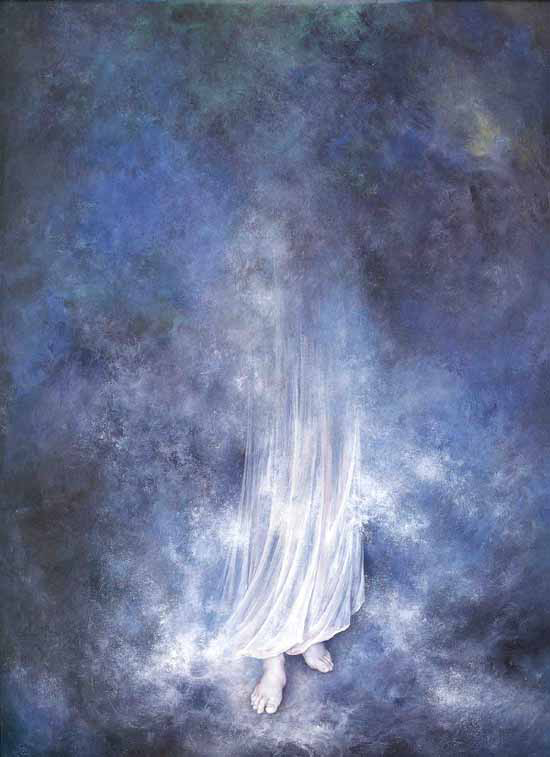
That image, with its headless figure, put me in mind of another image that greatly interests me — a portrayal of the Imam Mahdi by Mahmud Farshchian — so I rescued it from my files to see if it was a good enough match with the ad for me to suggest a possible second graphic influence to Jarret:

16_imam-zaman2.jpg

Not surprisingly perhaps — considering that Samir Khan’s work is, putting it crudely, an advertising graphic, whereas Farshchian’s is a work of devotional art, and that furthermore Inspire is a Salafi-jihadist journal while Farshchian is a pious Shi’ite — the match isn’t close enough for me to argue influence…

But it did set me thinking.

*

The title of the Harding book to which I referred above is On Having no Head, and although it now carries the subtitle Zen and the Rediscovery of the Obvious it actually draws on Islamic traditions quite a bit, quoting Rumi:

Behead yourself! … Dissolve your whole body into Vision: become seeing, seeing, seeing!

and Attar:

Cover your breast with nothingness, and draw over your head the robe of non-existence.

and proposing — I’m putting this into my own words, now — the notion that the physical form of a human face is in some sense no more than a mask, veil or hijab over that light “which lighteth every man that cometh into the world” (John 1.9) — a light too profound for the conventional gaze.

And it is this profundity, attributed in Islam to the prophets in general and superlatively to Muhammad, which makes their literal portrayal a matter of some controversy…

*

Farshchian’s Imam Mahdi, like Khan’s Islamist Morpheus, is headless, I’m suggesting, because, to speak figuratively, radiance has taken the place of the face.

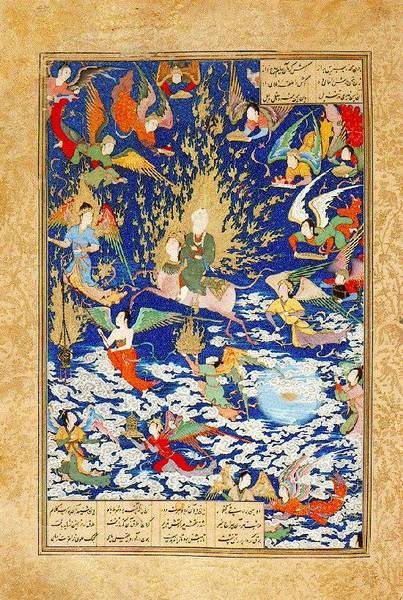
Which is also why, in this image of what must be for Muslims one of the holiest nights in the history of the world, the Night of the Mi’raj, the Prophet is portrayed without a face — or veiled — in this Persian miniature:

miraj_by_sultan_muhammad.jpg

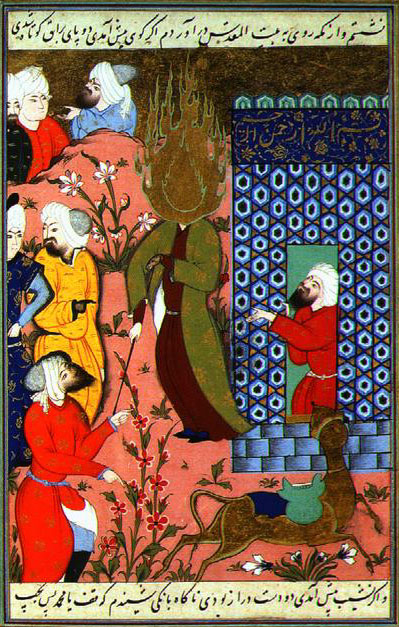
and transfigured by his own fiery “halo” of illumination in this one:

muhammad_miraj1.jpeg

Of the tsunami and Mt. Fuji

April 1st, 2011

[ by Charles Cameron — cross-posted from ChicagoBoyz ]

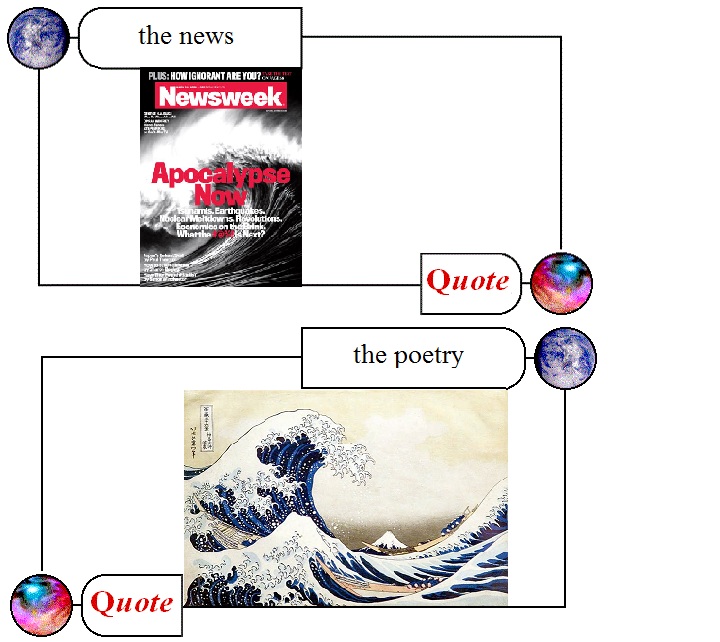
I’ve been thinking quite a bit about William Carlos Williams and his observation in Asphodel, That Greeny Flower:

Our news media blare with (apocalyptic but not revelatory) trumpets…

while Hokusai, painting circa 1831, conveys the vulnerability of the (Japanese and human) situation with his image of boats in a storm.

*

Here’s Dr. Barnett, in my own transcript of his video this week:

The surprise factor here really shouldn’t exist in our minds. I mean the mega-disaster of a tsunami plus and earthquake plus a nuclear meltdown in Japan – well, those three are already highly linked. Japan highly depends on nuclear power, it’s one of the most seismically active island chains in the world, and tsunami is a Japanese word. So if you are going to put a forty year old very aging early technology nuclear power plant right on the coast in Japan, the only mega-disaster you’re going to get there is an earthquake-triggered, tsunami-delivered nuclear meltdown. So these are not surprising connections, we’re just bumping into the connectivity that’s natural and only becoming more expansive as globalization advances.

That’s exactly right – and Hokusai should have been an early warning.

The only thing missing from Barnett’s analysis, and present in Hokusai, is Mt. Fuji – or what TS Eliot (to circle back again to “verbal” poetry) would call “the still point of the turning world”.


Switch to our mobile site