zenpundit.com » computers

Archive for the ‘computers’ Category

Augmented Reality Emerging on Major Platforms

Thursday, July 21st, 2011

This was pretty cool, from Lewis Shepherd’s blog, Shepherd’s Pi:

Virtual recipe stirs in Apple iPad, Microsoft Kinect

Who says Apple and Microsoft can’t work together?  They certainly do, at least when it involves the ingenuity of their users, the more inventive of whom use technologies from both companies (and others).

Here’s a neat example, “a just-for-fun experiment from the guys at Laan Labs” where they whip up a neat Augmented Reality recipe: take one iPad, one Kinect, and stir.


Some technical detail from the Brothers Laan, the engineers who did the work:

We used the String Augmented Reality SDK to display real-time 3d video+audio recorded from the Kinect. Libfreenect from http://openkinect.org/ project was used for recording the data coming from the Kinect. A textured mesh was created from the calibrated depth+rgb data for each frame and played back in real-time. A simple depth cutoff allowed us isolate the person in the video from the walls and other objects. Using the String SDK, we projected it back onto a printed image marker in the real world.” – source, Laan Labs blog.

Shepherd has more on the technology here.

If AR is doable on an iPad fast and dirty by wizardly geeks then Apps for the casual technoprimitives cannot be long off.

Plus ça change II

Wednesday, July 20th, 2011

[ by Charles Cameron — jihadist computing, reminiscence ]

.

portablecompanionv1n1.jpg

!!

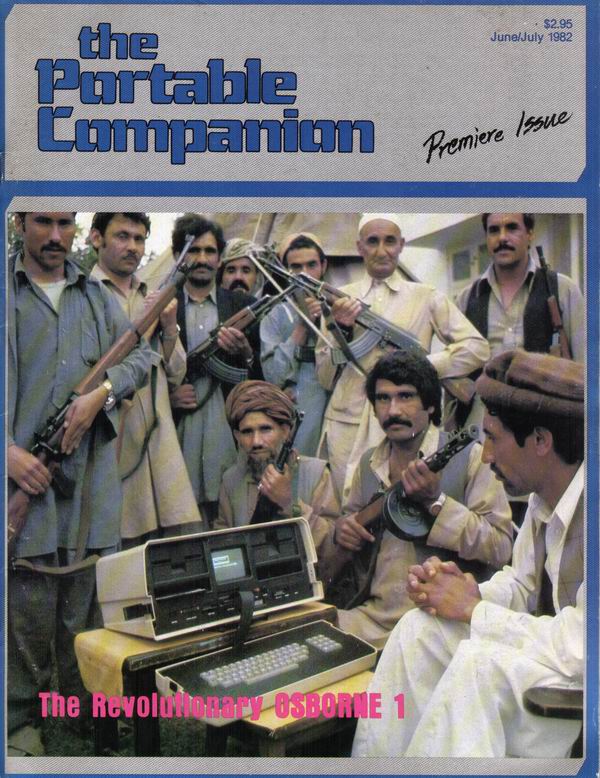
My first computer, back in 1982, was an Osborne like the one depicted here — I have fond memories… it had no hard drive, just a 512k floppy, the CP/M operating system, WordStar word processing, green letters on a tiny black screen, no internet hookup — and I managed to co-write a book on the thing!

The Future of Clandestinity in a Panopticon World

Monday, May 16th, 2011

Israeli intelligence officers caught on camera moments before carrying out an assassination of a HAMAS terrorist.

“Information wants to be free” – Stewart Brand

You do not need to be Alvin Toffler or Marshall McLuhan to have noticed that as a result of the information revolution that in the past decade, much like individual privacy, secrecy has taken one hell of a beating. While Wikileaks document dumping demonstrated that much of what governments overclassify as “top secret” are often simply diplomatically sensitive or politically embarrassing material, the covert ops raid that killed Osama Bin Laden was a reminder that some actions, operations and lives are critically dependent on secrecy.

Secrecy in the sense of intelligence agencies and other actors being able to carry out clandestine and covert activities is rapidly eroding in the face of ominpresent monitoring, tracking, hacking, scanning, recognition software and the ability to access such data in real time, online, anywhere in the world. A few examples: 

Col. TX Hammes at Best DefenseThe Internet and social networks are making it harder to work undercover

It is virtually impossible for an agency to provide sufficient cover for a false name. If you provide information like where you went to school, what posts you have served before, etc., the information can be quickly checked. (Most yearbooks are online; graduates are listed in newspapers; property records, etc.) If you don’t provide that information, then your bio sticks out.

Giving an intern the list of names of personnel at an embassy and telling them to build the person’s bio from online sources — with cross-checking — will quickly cut through a light cover. It will also challenge even a well-constructed cover. I think this is going to be one of the challenges for human intelligence in the 21st century.

Viewdle is a Two-Edged App and Panappticon

Viewdle – Photo and Video Face Tagging from Viewdle on Vimeo.

Haaretz Hamas man’s Dubai death was a Mossad-style execution

What makes the security camera shots released last night by the Dubai police interesting is the professionalism exhibited by the suspected assassins of senior Hamas figure Mahmoud al-Mabhouh.

They arrived on separate flights from different destinations; one of them flew in via Munich and Qatar. They stayed in different hotels and were careful to make phone calls using international routers. They wore clothing that makes them difficult to identify. One is seen with a mustache and a hat, others wearing hats and glasses. They try, throughout, to appear to be innocent tourists or business people, there to enjoy themselves and even play some tennis…

Pity the poor intelligence officer operating without diplomatic cover. A false beard and glassses will no longer suffice.

What kind of adaptions are possible or likely to take place by intelligence, law enforcement, military and corporate security agencies in the face of an emerging surveillance society? First, consider what clandestinity is often used for:

  • To avoid detection
  • To avoid identification even when detected ( providing “plausible deniability” )
  • To facilitate the commission of illicit acts or establish relationships under false pretenses
  • To conduct covert surveillance
  • To collect secret information of strategic significance (i.e. – espionage)
  • To facilitate long term influence operations over years or decades

Taking the long term view will be required. Some thoughts:

One effect will be that marginal subpopulations that live “off the grid” will be at a premium someday for recruitment as intelligence operatives. These “radical offliners” who have never had a retinal scan, been fingerprinted, had their DNA taken, attended public school, uploaded pictures or created an online trail, been arrested or worked in the legal economy will be fit to any false identity constructed and, if caught, are unidentifiable.

Another will be the creation of very long term, institutional, “false front” entities staffed by employees who will never know that the real purpose of the enterprise is to provide airtight legitimate covers and that the economic or other activities are merely ancillary. They won’t be standing jokes like Air America or the various business activities of Armand Hammer, but real organizations with only a few key insiders to facilitate periodic use for intelligence purposes. A similar tactic will be intel agencies “colonizing” legitimate entities like universities, law firms, consultancies, media, financial institutions, logistical and transhipping corporations and NGO’s with deep cover officers who are intended to make ostensible careers there. This of course, is part of basic intelligence history but the scale, subtlety and complexity will have to significantly increase if authentic “legends” are to stick.

Then there’s the creepier and less ethical path of intelligence agencies stealing and using the identities of real citizens, which hopefully a democratic state would eschew doing but which bad actors do now as a matter of course in the criminal world.

Speed will also be an option. As with the Bin Laden raid, fast will increasingly go hand in hand with secret, the latter being a transient quality. If you cannot avoid detection, like the Mossad agents out playing tennis on survellance video, beat the reaction time. Clandestine may also come to mean “Cyber” and “Robotic” moreso than “HUMINT”

Being invisible in plain sight is an art that will grow increasingly rare.

The Abbottabad raid: tellings and retellings

Thursday, May 5th, 2011

[ by Charles Cameron ]
*

.
bryanalex.jpg

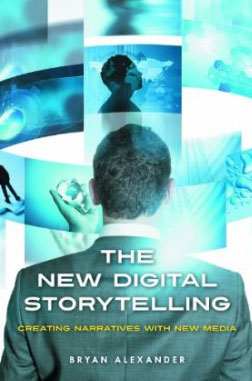
My friend Bryan Alexander‘s book, The New Digital Storytelling: Creating Narratives with New Media, hit the shelves a short while ago (recommended) — and this month Bryan is exploring the various forms of digital story-telling on his new digital storytelling blog.

I’m interested in narrative, too – even when it isn’t digital – because it’s the prime way in which we humans figure out what’s going on around us…

Here, then, are two “tellings and retellings” of the Abbottabad raid and the death of Osama bin Laden.

.
1. The fog of war

In his first briefing on bin Laden’s death from the White House, John Brennan, Assistant to the President for Homeland Security and Counter-Terrorism, dismissed bin Laden with the words, “I think it really just speaks to just how false his narrative has been over the years.”

Narrative is important, and the narrative John Brennan was proposing as a corrective to bin Laden’s version went as follows:

here is bin Laden, who has been calling for these attacks, living in this million dollar-plus compound, living in an area that is far removed from the front, hiding behind women who were put in front of him as a shield. I think it really just speaks to just how false his narrative has been over the years. And so, again, looking at what bin Laden was doing hiding there while he’s putting other people out there to carry out attacks again just speaks to I think the nature of the individual he was.

A writer in the Atlantic commented today:

And that’s the message our counterterrorism officials would, I expect, like the world — and especially any potential followers of al-Qaeda’s anti-American ideology — to get about our newly vanquished enemy, responsible to the single deadliest attack on American soil. The leader of the terrorist group was soft, a coward in the end who hid behind a woman’s skirts like a little girl, having grown accustomed to living in luxury in a mansion. Almost everything about this narrative seemed calculated to diminish any possible perception of strength or masculinity in bin Laden’s reaction to the raid by an elite team of U.S. Navy Seals — men who are in contrast among the most mythic and valorized in our armed forces, known for slogans like “pain is just weakness leaving the body.”

But just a day after Brennan’s briefing, the President’s Press Secretary, Jay Carney, gave a second briefing, in which he revised the official narrative, saying:

Well, what is true is that we provided a great deal of information with great haste in order to inform you and, through you, the American public about the operation and how it transpired and the events that took place there in Pakistan. And obviously some of the information was — came in piece by piece and is being reviewed and updated and elaborated on.
.
So what I can tell you, I have a narrative that I can provide to you on the raid itself, on the bin Laden compound in Pakistan.

I have a narrative…

The revised narrative featured an unarmed bin Laden in a far from palatial house with no visible air-conditioning, who didn’t in fact use a woman as a human shield… all of which “really just speaks to just how false” Brennan’s own original narrative was.

But then – you don’t believe everything you read in the press, do you? And besides, the first news reports of almost any big story are almost invariably inaccurate, it takes time for clarity to emerge… which adds up to the idea that it’s not so easy to distinguish between how the world actually spins — and how the world is spun.

So that’s a telling and retelling of the Abbottabad raid in “real life” as transmitted to us by various media and recorded on the web…
.

2: The twitter-stream and the analyst

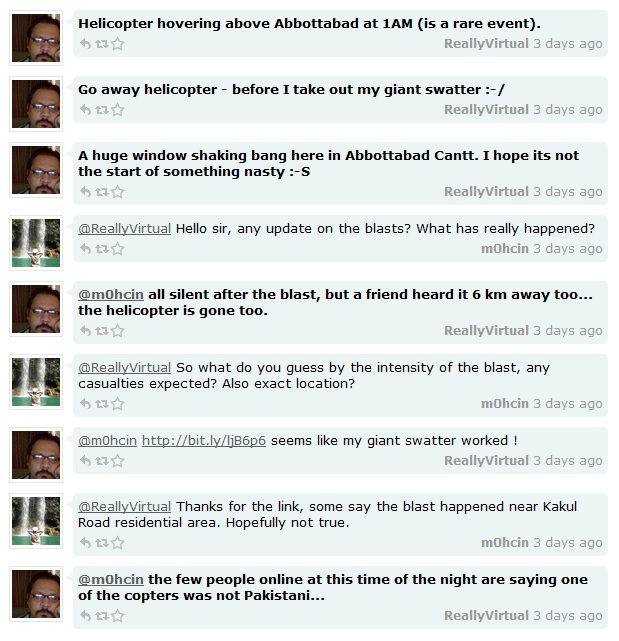
A little earlier a more “purely” digital version of the story – no less confused by the “fog” that inevitably surrounds the reporting of highly volatile situations – had emerged quite spontaneously via Twitter, when the delightfully-named ReallyVirtual (an IT specialist who had moved to Abbottabad for some peace and quiet) was kept awake by the noise of helicopters overhead and sounds of explosions, and tweeted a couple of late-night friends… and a stream of tweets began which quickly led to an almost thousandfold spike in Yahoo searches on bin Laden, and bin Laden related searches occupying all top twenty spots on Google trends

You might call that spontaneous, distributed story-telling – but it’s also the raw material for a collated and curated twitter narrative, using Chirpstory, a tool for curating and presenting stories from the twitter-stream:
chirpstory.jpg

We’re not done yet…

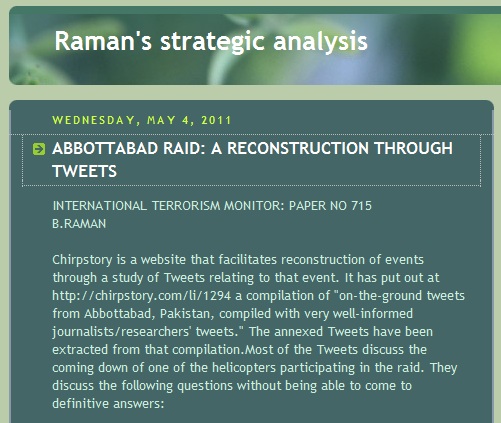
That in turn provides grist for the analytic mill of B Raman, a highly-regarded Indian analyst, blogger, and former chief of counter-terrorism with India’s R&AW intelligence agency – who winnowed out the chaff and added in his own commentary to create a denser, tighter analytic narrative of his own:
raman.jpg

To my way of thinking, the spontaneous twitter-stream version, the Chirpstory adaptation and B. Raman’s midrash on it are at least as interesting as the successive White House narratives…

.

3. Further reading:

Also relevant to our narrative here, and your own readings on the topic of our tale:

How the Bin Laden Announcement Leaked Out
Bin Laden Reading Guide: How to Cut Through the Coverage
The tightly woven web of Jarret Brachman

Wednesday, May 4th, 2011

[ by Charles Cameron — cross-posted with minor alteration from SmartMobs ]
*

Jarret Brachman is one of our brightest analysts of jihadist behavior on the internet. He was the first Director of Research with the Combating Terrorism Center at West Point, and is the author of Global Jihadism: Theory and Practice.

His blog today featured an extraordinary post titled My One Fan in Abottabad.

First he writes:

Out of sheer curiosity, I ran a google analytics search to see if I’ve ever had any hits from Abbottabad, Pakistan to the blog.

Then he shows us the map his research produced :

abbot

and then he comments:

Sure enough, I’ve got one fan there who has been checking the blog randomly over the past couple years.

*

As my Watchmen-hip son might say, … Quis custodiet ipsos custodes?


Switch to our mobile site

