zenpundit.com » parallel

Archive for the ‘parallel’ Category

Metaphors v, We use sports terms all the time

Sunday, August 12th, 2018

[ by Charles Cameron — I’m not the only one thinking sports metaphors are important, though I’ve been collecting a whole lot more examples ]
.

**

There’s a NYT article — We Use Sports Terms All the Time. But Where Do They Come From? — as you see, tucked away in the Sports section, which I’d really like to transport over here whole, because it’s a sports metaphor article, not a sports article, and sports metaphors are a specialty du maison here at ZP.

Let’s see if I can ferret out the gist:

We’re talking about sports idioms, those everyday phrases ingrained in our lexicon, handed down from generation to generation. We use these terms all the time, without really knowing where they came from. Some of their origins are pretty clear: front-runner, on the ropes, the ball is in your court. But there are many others whose provenances are not so apparent.

The world of sports is a particularly fertile ground for such terms, said Katherine Connor Martin, head of U.S. dictionaries at Oxford University Press. “Sports are written about and discussed a lot, and so have generated a great deal of colorful, specialized vocabulary. And competition exists in many other spheres of life, so sports terms are well suited to be borrowed into other domains, such as business or politics.”

**

**

As I’ve suggested, the whole piece is a rich trove of materials for the sort of exploration I’ve been working on. Just a few minutes ago, as it happens, I heard someone on TV say in regard to the 2020 presidential election:

If Michael Avenatti wants to throw his hat into the ring, great.

As it happens, throwing one’s hat into the ring is one of the examples the NYT piece explores a little deeper. Their example:

In The New York Times: Mr. Mahathir threw his hat in the ring in the recent national elections. Opinion, May 12.

Their comment:

Back in the days when boxing was a quasi-legal, rough-and-tumble affair, fighters and even spectators who had an interest in getting into a bout would signal it by tossing in a hat. It’s mostly used now in the rough-and-tumble field of politics to announce that one is running for office.

Its first use, according to the Oxford English Dictionary, came in The London Times in 1804, in its literal sense: “Belcher first threw his hat into the ring, over the heads of the spectators.”

Throwing in the towel would be, I suppose, the equal and opposite phrase..

**

Other examples they went into in similar detail:

Wild-Goose Chase

We need to get a little lost, pursue “productive and instructive disorientation, distraction, wild-goose chases, dead ends.” Book Review, June 4.

Throw in the Towel

Anthony Barile, the owner of this wood-oven veteran where other pizza-makers honed their skills, said he was tired and throwing in the towel after nearly 26 years. Food, March 27.

Out of Left Field

It was so out of left field and something so different than anything I’ve done. Movies, July 6.

Hands Down

Sue is, hands-down, the best at this. I would marry her in a minute. Television, June 21.

Wheelhouse, Strong Suit, Forte

One of the many subspecialities within Wright’s wheelhouse is Italian glass. Arts, April 17.

and so forth, Back to Square One, Across the Board, and my favorite as a Brit:

Sticky Wicket

But ad-driven nostalgia is a sticky wicket. Australia, Feb. 7.

**

**

That last quote, under the Sticky Wicket header, was from Australia, a little far from New York. The writer Victor Mather writes, almost as an apology for straying so far afield:

“Cricket is the U.K.’s baseball,” when it comes to the lexicon, Ms. Martin said. It’s beyond our purview to get into British English too deeply here; there are British alternatives for many terms in American sports.

I don’t know, however, that any American can suggest a baseball term or phrase as beautiful as the British cricketer’s triple pun:

bowling a maiden over

Over and out.

Greed can do it as easily as Religion — or Time Itself

Sunday, July 22nd, 2018

[ by Charles Cameron — the passing of time is theft is the passing of all things ]
.

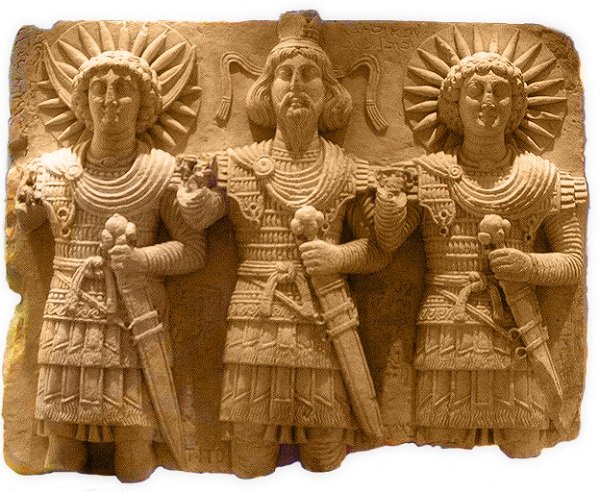
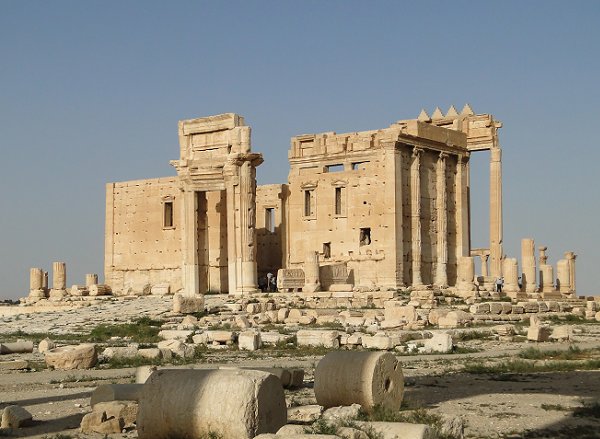
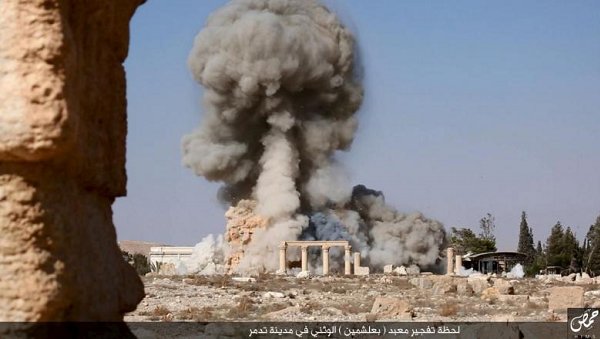
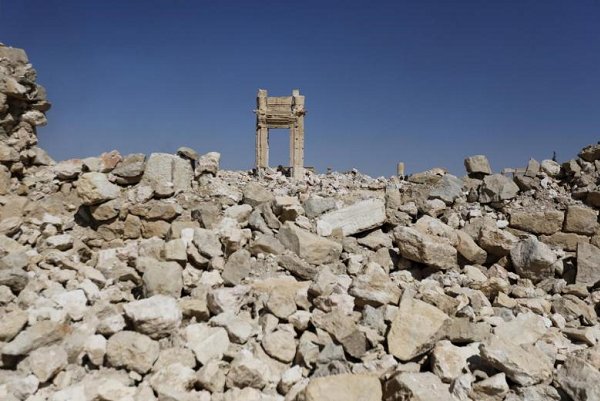
Here’s a quick stop-motion movie of the Temple of Bel, Palmyra, in four powerful frames.

The Temple was originally gloriously decorated..

null

That’s Palmyra’s divine triad: Baalshamin, with the Moon god Aglibol on his right and the Sun-god Yarhibol at left, discovered at Bir Wereb, near Palmyra, 60 cm high (Louvre, Paris) (photo: Emmanuel PIERRE, CC BY-SA 3.0)

The Temple was, in fact, until recently, an impressive ruin..

null

That’s the Temple of Bel, Palmyra, Syria, in a photo by Bernard Gagnon, GNU license.

But then ISIS used explosives for a sacred demolition..

null

Credit for this and the final image goes to Reuters

…and now there’s not much remaining of the glory..

null

End of film, end of story — setup for the point I want to make.

**

Stuff gets made or born, stuff lives or exists.. stuff dies, fades, crumbles, evaporates.. sometimes stuff is reboorn, salvaged, gets a second life..

Consider the great temple of Angkor Wat, buit by Khmer artists, partly destroyed by centuries of weather and overgrowth, pock-marked by the bullets of insurgents & army.. now given a second life as a tourist destination.. Consider Tibetan mandalas, chalked out in detail, painstakingly painted in sand, then swept away, proof of impermancence..

Well?

**

The establishment of monotheism in Egypt was accompanied by royal command with the destruction of what we might now call religious and cultural works —

In rebellion against the old religion and the powerful priests of Amun, Akhenaten ordered the eradication of all of Egypt’s traditional gods. He sent royal officials to chisel out and destroy every reference to Amun and the names of other deities on tombs, temple walls, and cartouches to instill in the people that the Aten was the one true god.

— in a manner that calls to mind some of ISIS excesses, their destruction of the Temple of Bel, for a recent and striking instance.

**

Indeed, places of worship have not infrequently been torn down:

Lord what work was here! What clattering of glasses! What beating down of walls! What tearing up of monuments! What pulling down of seats! What wresting out of irons and brass from the windows! What defacing of arms! What demolishing of curious stonework! What tooting and piping upon organ pipes! And what a hideous triumph in the market-place before all the country, when all the mangled organ pipes, vestments, both copes and surplices, together with the leaden cross which had newly been sawn down from the Green-yard pulpit and the service-books and singing books that could be carried to the fire in the public market-place were heaped together.

That’s from England — which suffered under Cranmer (Reformation) and Cromwell (Civil War), both of them politically influential Puritans.. who between them made ruins of many British abbeys — think Glastonbury, Fountains, Walsingham..

Well, all that’s background, simply to establish that time’s river allows for the buildup by a wide variety of means and sweeping away of all manner of things animate and ootherwise, in a continual flux, a continual emergence, a continual impermanence..

**

But my point, remember?


Photo credit: via Trib Live

My point is that the thief of Pittsburg’s unique and valuable book antiquities deprives us of treasures of the mind in much the same way that ISIS does with its explosives in Palmyra. In the latter case: impassioned religion; in the former: simple greed.

Appraisers discovered missing items and books that had been “cannibalized,” with entire portions removed, according to the affidavit.

and the alleged thief:

is charged with theft, receiving stolen property, dealing in proceeds of illegal activity, conspiracy, retail theft, theft by deception, forgery and deceptive business practices.

Items of high value and greed, idolatry and iconoclasm — the cutting up of books from the Carnegie Library of Pittsburgh including a copy of Newton’s Principia is nend ot in the too different from what ISIS’ Kata’ib Taswiyya batallion did to Palmyra.

Not too different, either, from the activities of Tibetan monks.. or, I suppose, wind, rain, and a thousand years..

**

Percy Bysshe Shelley:

I met a traveller from an antique land,
Who said—“Two vast and trunkless legs of stone
Stand in the desert. . . . Near them, on the sand,
Half sunk a shattered visage lies, whose frown,
And wrinkled lip, and sneer of cold command,
Tell that its sculptor well those passions read
Which yet survive, stamped on these lifeless things,
The hand that mocked them, and the heart that fed;
And on the pedestal, these words appear:
My name is Ozymandias, King of Kings;
Look on my Works, ye Mighty, and despair!
Nothing beside remains. Round the decay
Of that colossal Wreck, boundless and bare
The lone and level sands stretch far away.”

A DoubleQuote-ish Strzok and Kavanaugh parallelism?

Thursday, July 12th, 2018

[ By Charles Cameron — if the parallelism I see isn’t a mirage, it would seem highly relevant to both men and related issues ]
.

Peter Strzok and Brett Kavanaugh:

**

I’ll try to keep this brief, and won’t use my usual DoubleQuotes graphical formalism, which would be costly in both time and space.

Here we go:

It strikes me that there’s a parallelism between the issues swirling around the nomination of Brett Kavanaugh, Judge of the Court of Appeals for the District of Columbia Circuit to the Supreme Court, and those concerning FBI agent Peter Strzok, formerly Chief of the FBI’s Counterespionage Section in the House Judiciary and Oversight Committees joint hearing today..

The parallelism can best be expressed in ternms of a question: can a professional in the field of justice holding strong political opinions credibaly claim to remain unbiased when in professional pursuit of justice?

In the case of Agent Strzok, Democrats would very much prefer the answer to be Yes, while Republicans would like the answer to be an incredulous No — while presumably in the case of Judge Kavanaugh, Democrats would tend to the incredulous No side, while Republicans would prefer a resounding Yes. No doubt there are more subtleties here, but I’m no lawyer and this is the best I can manage.

That quibble aside, the two situations apparently fall into different silos, and I haven’t seen anyone bringing the two situations together in the hope that one would illuminate the other.

Have I simply missed the relevant materials, or does no one else wish to admit the parallelism? It seems to me that most of what I see is partisanship without much principle.

**

Your comments, refinements and refutations are warmly encouraged.

The soccer cup, the wrestling belt

Wednesday, July 11th, 2018

[ by Charles Cameron — London Bridge terror attack and Tham Luang Cave complex rescue, Chiang Rai, Thailand ]
.

Here’s a DoubleTweet. I’m presenting you with two previously unconnected tweets, because I feel their juxtaposition highlights somethung of interest — in this case, trinutes paid by sporting entities to people who’ve gone through exceptionally difficult circimstance in a manner that testifies to their fortitude and courage:

The heroic cop is presented with a WWE championship belt — his t-shirt on the day of the London Bridge attack had featured WWE wrestler Sami Zayn, so there’s a ouroboros there for bonus points, eh?

Guenigault was released from hospital last Friday and received a surprise visit from the 14-time WWE World Champion who praised his immense bravery.

“To run in the direction of a scary situation that can’t even be described in words, to help others, for that to be your instinct to help others – that is a hero,” said Triple H as he presented Guenigault with the belt.

“People say a lot of times that they watch WWE because these guys are like real-life superheroes. Well, Charlie is a real hero.”

**

Okay, and:

The team in the cave had expressed interest in the World Cup, and the head of FIFA — which needs some good PR at this point anyway — invited them, health permitting, to come to Moscow for the finals, but it wasn’t to be, health didn’t permit.

The suggestion that they should receive the Cup was a nice one..

**

Parallelism, with a side of ourob. Enough said?

Black Swan (bookstore) vs Red Hen (restaurant)

Monday, July 9th, 2018

[ by Charles Cameron — a parallelism post, more than one about free speech and civility ]
.

Lexington, VA, and Richmond, VA, the logos:

**

A neatly observed opposition, more or less a natural DoubleQUote, between the Black Swan incident where a fellow customer assaulted Steve Bannon verbally in a bookstore and the restaurant incident where the owner of the Red Hen restaurant ejected Sarah Huckabee Sanders, saying her views did not conform to the ethic — or should that be ethos — of the restaurant:

Now from a purely amateur natural history perspective, in a match between a black swan and a red hen, muy money is on the swan every time, as I trust Nassim Nicholas Taleb would agree. And Nabokov too, for that matter.

From a popular consumer interest perspective, if the match is bookstore vs restaurant, restaurant wins hands down — but I’d go with bookstore, especially if it’s a used bookstore..

**

As to civility vs freedom of expression, thank God I’m not a cop or a judge — I require both. And that’s certainly a paradox, and probably a koan our society will have to face one of these days.

Steve Bannon as a person I find intriguing to the point of sympathy, because he’s read many of the oddball authors I have, though my resulting observations come out of left field, and his out of right..

**

But none of that is what ultimately draws me to this post, it’s the delicious double parallelism of red vs black, swan vs hen.

**

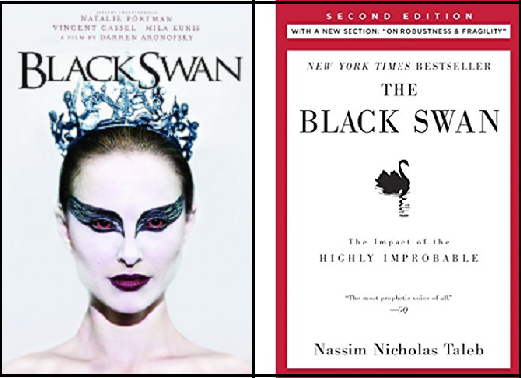
I’ve been wondering, putting together this post, whether the bookstore is named for NN Taleb’s celebrated book, or for the wildly popular ballet film of thet name:

Btw, Vogelgesang is birdsong: hen cluck, swan song.


Switch to our mobile site